You Touch I’ll Tell

Possible TW:

Watching the news this morning they announced a new book.

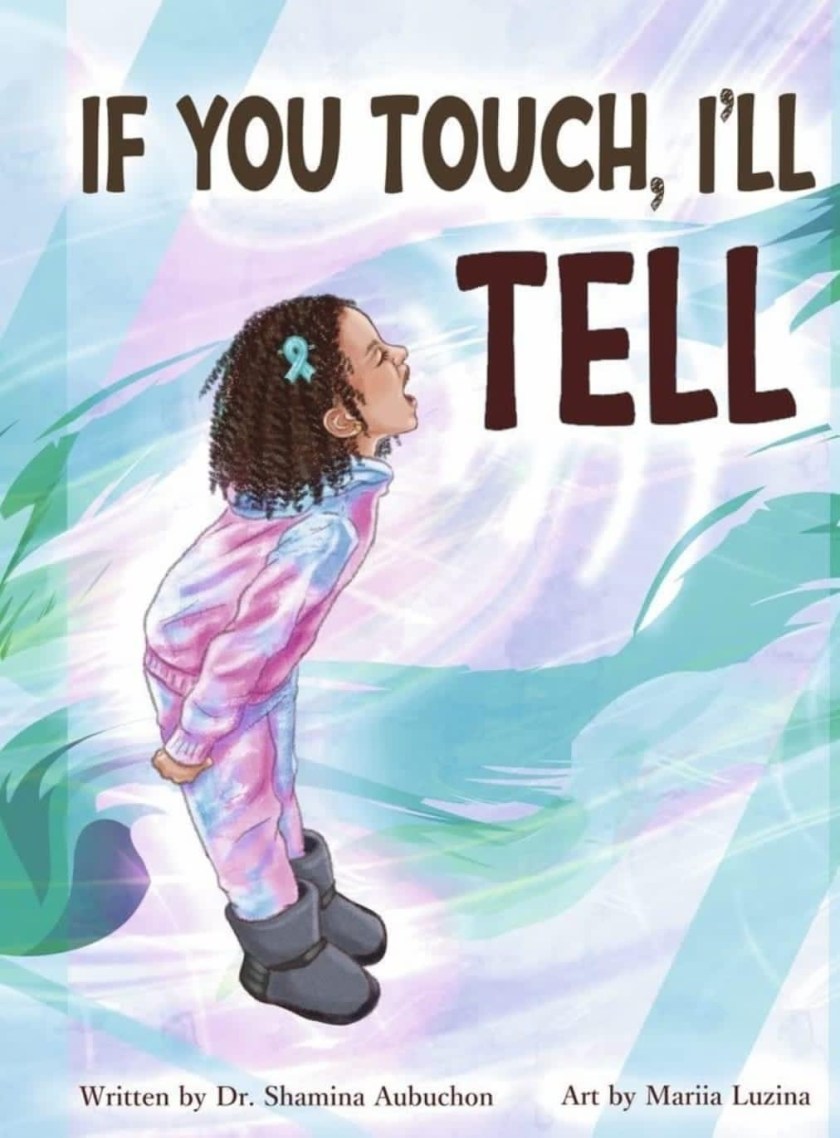
It’s a kid’s book called:

“If you touch, I’ll tell”.

Upon raising awareness about abuse and speaking on her book, the Doctor/Author also said something that really stood out to me.

First she stated “there are 3 words parents can say to help their children speaking up, and that’s: ‘I Believe You’.”

The next sentence was what I heard the loudest…

“There is love in belief.”

“You love your children, so believe them.”

Just a simple, yet powerful sentence I wanted to share. “There is love in belief.”

I do plan to get this book when I’m able to.

Not every parent likes this book.

I’ve seen comments such as, “It’s not appropriate to put these serious subjects into little minds.”

These “subjects” (sexual abuse) they’re real life. Ignoring the bad that does exist, doesn’t make anyone immune to it.

Kids need and deserve to learn how to speak up, and more importantly, know that they CAN speak up!

“If you touch, I’ll tell”

By: Dr. Shamina Aubuchon

We are not there yet : Your Child Really Loves You

I know what you are thinking…

My alienated child hates me.
No true, your child is being brainwashed to reject you.
Your child really loves you.

Maybe I wasn’t a good parent.
Not true, you were and are an awesome parent- no doubts.

My child is going to forget all the good times we had.
Not true. Your child remembers everything and wants to have you back in their life. They can’t right now; they are trying to survive.

My child talks badly about me to their friends.
Believe it or not- they don’t. They praise you and sometimes brag about you.

My child will never come back to me.
A bond between a biological child and a parent is almost impossible to break. There is a very good chance that once they gain clarity on what happened to them, they will reach out to you.

My child is probably going to be screwed up for the rest of their life.
Not true. Alienated kids are survivors with incredible resilience. They know how to adapt, show allegiance and fight for what they believe.

I am never going to be happy unless my child is back in my life.
Oh, not true. While your child is gone, this is a wonderful opportunity for you to work on you and develop positive self esteem. This is your time to be happy despite your pain. Make friends, meditate, pray, take long walks… Get ready…So when they return, they can say- “ Wow, my Mom/Dad is sooo awesome!”

You are beautiful, unique and special❤️

Childhood Lessons

“My parents beat me when I was a kid and I’m not traumatized,” says a male alcoholic whose partner reported him for physical abuse.

“As a child I was punished a lot and I’m fine,” says the man who complains every time he makes a mistake.

“When I disobeyed as a child, my father locked me in a room and for that I am grateful to him today,” says the woman who suffers panic attacks and fear of tight spaces.

“My parents forced me to attend an apprenticeship in this profession, where I make a lot of money, and for that I’m very grateful,” says the man who can’t wait for Friday because he hates his job.

“When I was little, my parents made me sit at the table until I ate everything,” says a woman who doesn’t understand why she struggles with eating disorders.

It’s time to break through the generational trauma and become aware of our past patterns. It is time to be compassionate to ourselves and our children.

A child learns to solve problems through conversation, if we solve conflicts in the family this way. If problems with threats and penalties are solved, one day it will act the same way.

A child learns compassion when we are compassionate towards them.

A child learns to listen to others when we listen to the child, when we are interested in how they feel and what their world looks like.

A child learns to believe in himself if we believe in him.

We don’t have to raise our children, we have to lovingly cultivate them. ❤

Birthing

“They told you about the contractions but did they tell you about the expansion?

Did they tell you how your body would open to make way for the whole universe to pass through?

Did they tell you how your heart would explode with a love bigger than anything you’ve ever known as you pulled your baby to your chest

They told you about the ring of fire but did they tell you about the crown of stars?

Did they mention that there is a moment when your baby enters the world and you leave your body and touch the heavens and become the light of a million galaxies?

Did they tell you how the pain of stretching to receive your child would be more exquisite than any sensation you’ve felt?

They told you you would scream but did they tell you about how you would roar?

Did they tell you about the power that would rise up from your belly as you called your baby forth with your mighty voice?

Did they tell you how you would embody the wild woman within you and breathe fire with your song?

They told you you would bleed but did they tell you how that sacred blood wouldn’t scare you?

How you would feel grateful for that magical liquid of life as it trickled down your leg?

How you would honor its flow and how it would help you heal a lifetime of hating your body’s bleeding cycles?

They told you these stories and taught you to fear birth, to fear your power, to fear yourself.

But you’re stronger and wiser than that mama.

You know that birth is your divine dance, your soul’s song, your moment with God, and you walk fearlessly into her open arms.”

~ Catie Atkinson

https://m.facebook.com/spiritysol/

@spiritysoul on Instagram

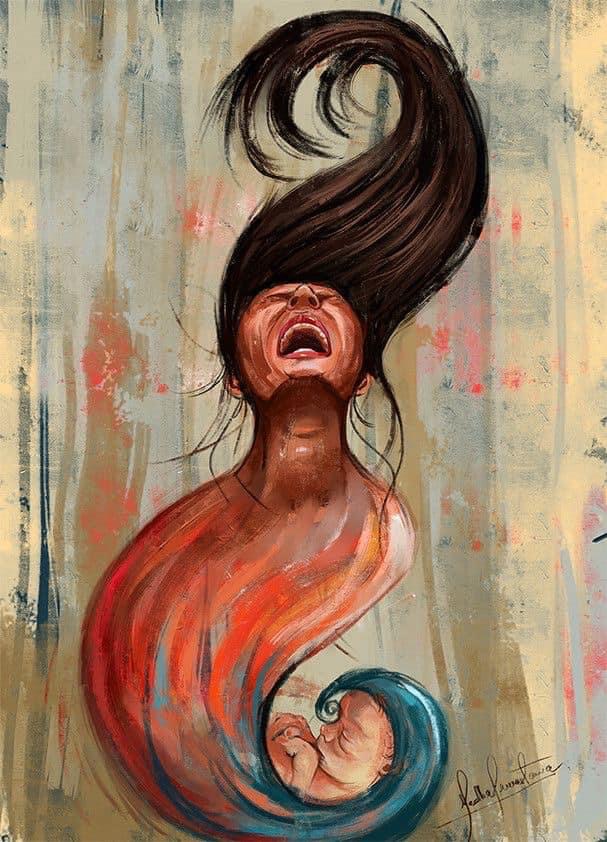
Art: Medha Srivastava, “Motherlove”

https://www.facebook.com/medhasrivastavaa/

#SacredSistersFullMoonCircle #Spirituality. #WomensWisdom #WomensEmpowerment #RedTent #SacredFeminine #Goddess #GoddessCircle #WheeloftheYear #Mythology #Magick #FolkTradition #GivingBirth #Birth #Childbirth #SeasonoftheMother #GodtheMother

Partentification

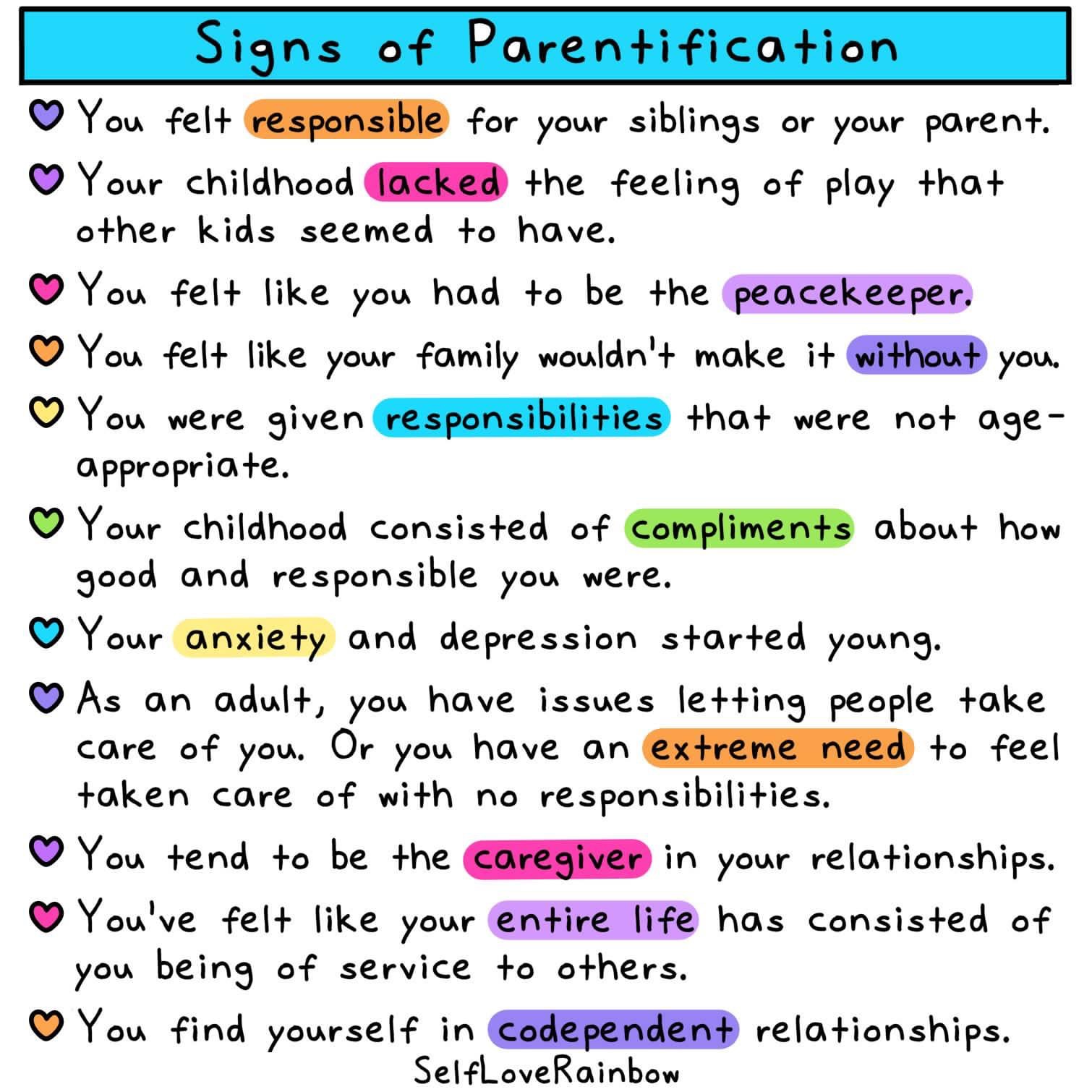
Parentification is where a child is forced or expected, to act as a parental stand-in from a young age.

Parentification is generally classified as parent-focused or sibling-focused and then either as instrumental or emotional. Parent-focused means you were primarily taking care of your parent. Sibling-focused means you were taking care of a sibling or siblings.

Instrumental revolves around practical responsibilities.

– Physically meeting the needs of your siblings or parent by feeding them, helping them get dressed, or bathing them.

– Being in charge of cleaning, cooking, or grocery shopping.

– Paying bills, budgeting, or being in charge of the family finances.

Emotional revolves around being forced to be an emotional support system.

– Listening to your parent talk to you about adult problems.

– Giving advice or comforting your parent over age-inappropriate problems.

– Mediating between your parents or family members.

– Being the one to make your siblings feel loved, safe, and protected.

#parentification

Education

“Schools train people to be ignorant, with style. They give you the equipment that you need to be a functional ignoramus. American schools do not equip you to deal with things like logic; they don’t give you the criteria by which to judge between good and bad in any medium or format, and they prepare you to be a usable victim for the military-industrial complex that needs manpower.”

~Frank Zappa

Childress : Not an Attorney

I am a psychologist, not an attorney. But from where I sit, attorneys are failing.

To me, as a psychologist, parents in the family courts represent a category, a class of people. They are a particularly vulnerable class of people because their rights to self-determination and autonomy in decision-making is compromised by the court’s involvement.

This vulnerable population has been expelled from clinical psychology (treatment) and has been given their own “special” psychologists for this group alone. No other pathology has their own “special” psychologists – not ADHD, or autism, or eating disorders. All of those pathologies (problems) are treated by clincal psychologists.

Only court-involved families are restricted to their own “special” psychologists created just for them, just for this special class of parents for no other reason than their court involvement… with compromised autonomy in decision-making and restricted rights of self-determination.

Because “forensic” psychology is a “sub-specialty” practice, all licensing board complaints are given to other forensic psychologists on the licensing boards for review… and they all do the same thing. They are allowed to self-review – there is no oversight of the forensic psychologists by anyone other than other forensic psychologists.

The field of “forensic” psychology needs outside and independent review. It is a cesspool of professional practice. Where are the licensing boards enforcing ethical standards of practice? Nowhere to be seen… which is why it’s a cesspool.

The licensing boards are corrupt with the influence of exactly the “forensic” psychologists they are tasked with reviewing. The practices of forensic psychology in the family courts need outside and independent review.

Do not get a forensic custody evaluation. Parents want a proper risk assessment for possible child abuse, i.e., a possible shared persecutory delusion with the allied parent as the primary case – which would be a DSM-5 diagnosis of V995.51 Child Psychological Abuse.

Forensic psychologists are ignorant, incompetent, and unethical. I am willing to debate this anytime with anyone, send me the date, time, and platform log-in: The Role of Forensic vs. Clinical Psychology in the Family Courts – Dr. Childress representing clinical psychology and Anyone representing forensic psychology.

I’d like to see a debate sponsored by a law school.

But maybe if the attorney world isn’t able to generate a class-action lawsuit with the AFCC and APA as deep-pockets on something like what’s happening in the family courts (I think it warrants a RICO racketeering look), maybe the legal profession isn’t up the the task of self-examination.

I guess I’ll just have to solve this entirely as a lone clinical psychologist using the power of diagnosis. Because I’m not a lawyer, I never went to law school, I went to psychology school instead so I don’t know legal stuff.

But from where I sit as a clinical psychologist, the attorneys are failing. Or maybe you just haven’t found the right attorneys. I wonder if the ACLU might have an opinion on your situation?

Craig Childress, Psy.D.
Clinical Psychologist, CA PSY 18857

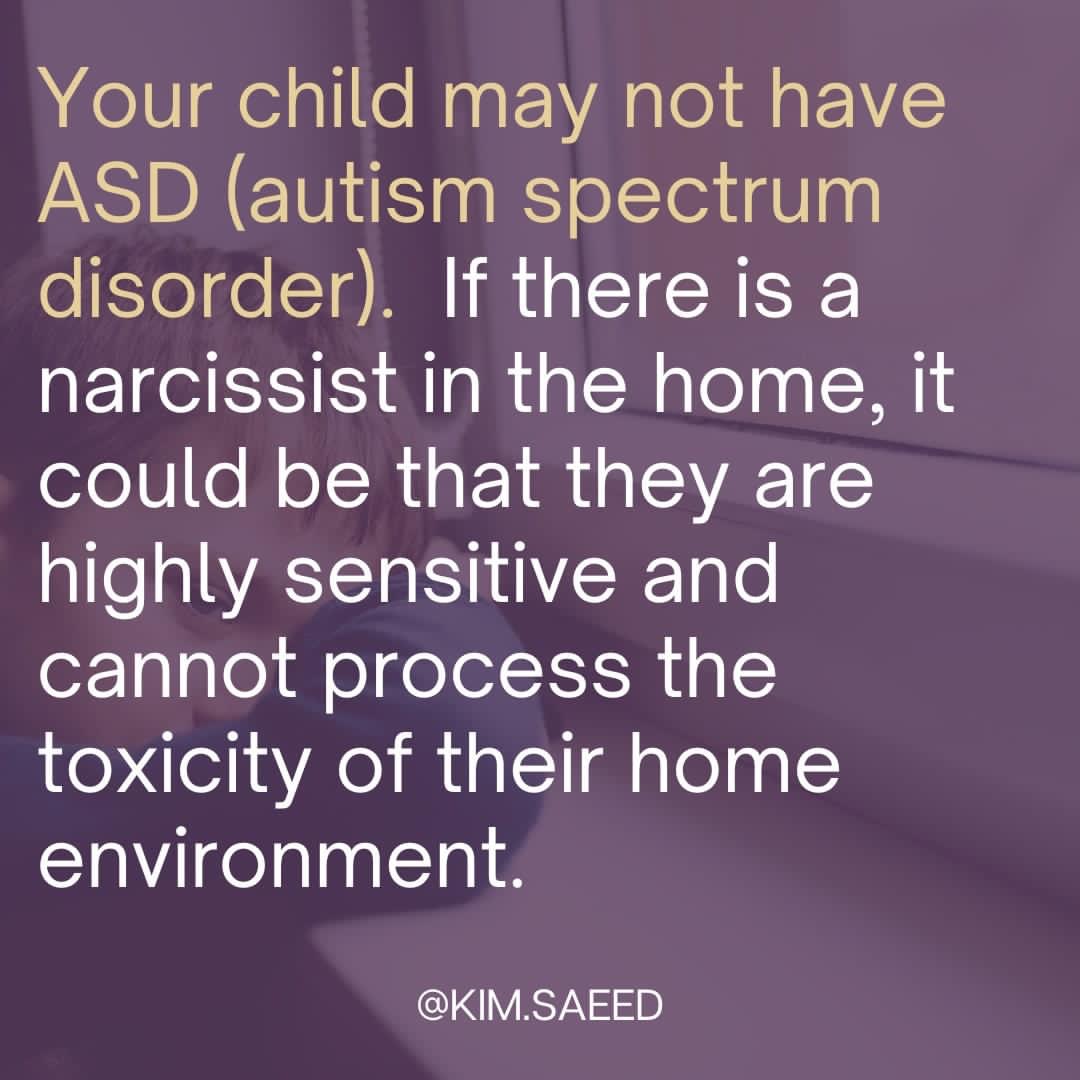
Child may present as Autistic in Narcissist home

A few years into becoming a consultant for narcissistic abuse recovery, I began to notice a high correlation between parents who had an autistic (ASD) child, and who also had a narcissistic partner in the home.

In some cases, emotional abuse and neglect can present as ASD, but recent research also points to some children being highly sensitive who cannot process their emotions in a toxic household.

In the movie, Sensitive – The Untold Story, featuring Alanis Morissette and HSP expert, Dr. Elaine Aron, cover this topic in detail. It’s definitely worth getting a second opinion if your child has been diagnosed with ASD…as well as exploring options for getting your child(ren) out of toxic environments.

#highlysensitiveperson #hsp #empath #highlysensitive #highlysensitivepeople #infj #sensitive #introvert #introvertproblems #mentalhealth

Cycle Breaking

Cycle-Breaking

We come into our lives with things we want to learn and things we still need to heal from past lifetimes. We also come into families where sometimes unhealthy patterns run rampant. It has been proven in studies that trauma responses as well as inclinations towards addictions can and are passed down through DNA. They have also shown how healing ourselves helps to heal and change our own dna as well as that of those closest to us. This is called epigenetics.
Although we each come with our own life paths and missions, we can choose to heal or discontinue unhealthy patterns at any time.
Some are born cycle-breakers who have never fit in with their families. Others come to this as we age and realize that we do not truly feel happy and we begin to examine why.

  1. Once we identify a pattern that we’d like to discontinue, we must acknowledge how we have been affected by it already. There are many different issues and thought-patterns that we may have brought forward from past lives that our families have solidified for us. Even things such as over-concern with material wealth, physical beauty in the extreme, narcissism, an innate distrust of women, men, authority, certain places or the holding of family secrets can come down the line. How have we been affected by those things? How does it color our thoughts? What stories have we created around it? Are we ready to break the cycle?
  2. When we feel fully committed to ending the cycle, we can engage help. Therapists, energy practitioners, doctors, support groups are all available to help us unearth as much information as we can and help us build our confidence in ourselves and moving towards Truth. Combing through our beliefs, day-to-day thoughts, and the WHY behind our distrust and our fear will help us understand our parts as well as what behaviors were learned or given to us through dna. Maybe some behaviors or beliefs were coping mechanisms. It’s time to examine our decisions and maybe make some new choices.
  3. This is where we take serious action. We could tell the truth to end the secret keeping. Maybe we need to break ties with unhealthy or abusive people. We could stop using alcohol, drugs, gambling, sex, and/or food as a way of coping. We could probably benefit from better boundaries and acknowledging the ego games we are engaged in and WHY. This is meaningful, profound work. Expect tears. And a feeling of intense freedom.
  4. Our behaviors will change as our thoughts and beliefs change.
    Others will notice. They may choose to grow with us, or they may hold tighter to the things we are letting go of. It is up to us if we choose to stay in relationships with anyone, ever. Growing and ending cycles can feel lonely. As we let others go, we make room for healthier relationships in our lives.
  5. Animosity does not need to be a part of any of this. We are working on ourselves to end the cycles that we have been in. Boundaries can feel hard at first, until we see how much better we feel when we make better choices for ourselves.
  6. The thing about cycle-breaking is that it in itself is a cycle. We are on a spiral upwards and we can, if we choose, continue to notice what is unhealthy and move towards healing at all times.

Here’s to FEELING, DEALING AND HEALING in every possible way. The crap can stop with us, and our well-being and work towards it can change the color of our skies, not only for us, but for those whose lives we affect as well. ❤
-Nicki