Reminds Me of You , Van Morrison

Years have passed since I felt the loss of a marriage that did not serve higher ground .

Coming to I knew that pills , drink , sex etc we’re not the antidote for the pain of what this marriage did to our sons .

Secrets are still unraveling but long ago when I mourned and ruminated , I can more objectively experience life ; many remedies and healing modalities await the ardent seeker .

So memories dim as does pain that I know will never fully abate , but will never be manipulated to abuse me or our children .

Circle has closed never to be unbroken again .

youtube.com/watch

Teach & Release

You will teach them to fly , but they will not fly your flight .

You will teach them to dream , but they will not dream your dream .

You will teach them to live , but they will not live your life .

Nevertheless , in every flight , in every life , in every dream , the print of the way you taught them will remain …

~ Mother Teresa ~

Artist Credit : JinWoo Kim

https://art.co/artists/jinwoo-kim

Side Effects of Having a Distorted Parent

Child Psychological Abuse

Lifelong Effects on Children Who Grow Up With Narcissistic Personality Disordered Parents–
by Dr. Laurel a Sills, Licensed Clinical Psychologist, Michigan.  9/2/2022
~~
The deeply damaging effects to a personality when growing up with especially subtle narcissism (which is not recognized by outsiders) is extremely long-lasting and often unseen by others. Kids may act strong and unaffected and become leaders or bossy and controlling and seem super confident, or, people- please in such a way that
most people like them and don’t notice that they are appeasing to everybody and not standing up for what they want.

Anxiety is high for the child who grows up confused by hearing they are loved by their parent who doesn’t guide them, dismisses them, is insensitive towards them, is hypercritical, micromanaging, doesn’t seem to see them or respect them. The child feels one way, but is told another or that they are overreacting, being dramatic, making mountains out of molehills, or dismissed, etc.; thus undermining the child’s self-trust and reliance upon their own feelings and perceptions to make accurate conclusions.

As a result, the child is apt to constantly need reassurance and seek outside validation rather than feel self-reliant and trust themself to be able to discern things accurately and appropriately.

Since narcissists unconsciously project their own self hatred and dislike of self onto others, the names they call their children typically are descriptors of themselves or some form of their own self-shame or doubt. If a parent says a child is selfish look and see if the parent is acting that way. If the parent says the child is stupid look and see if the parent is acting unaware of important dynamics.

When narcissistic parents use their children as an extension of themselves, they often push their kids to do the things they never did to finish unresolved dynamics from their own backgrounds. i.e. forcing a child to play football because the parent want to live through them and have their child reflect strength and athleticism and popularity. Forcing K
kids to act in their own mirror images rather than see their child as separate and unique individuals is another common pitfall.

Validating a child’s feelings is vital to help them grow to trust their own perceptions. It’s also important to help distinguish somebody else’s problems from a child’s behaviors.
As children, we must be seen for our own uniqueness and our own strengths and limitations; not be ridiculed for our limitations and molded into a mini version of our parent.

In therapy, the adult children has to express their confusion about how they felt in their families versus what they were told by the unhealthy family members. It takes outside validation, much love and compassion, an explanation for adult children to eventually recognize they were the victims of parents who were also suffering from their upbringing, and suffering that makes them project all kinds of things onto them. I’m not talking about physical abuse and more violent narcissism and sociopathic narcissism. I’m talking about even subtle abuse emotional, constant negative commentary, ignoring, eye/rolling, dismissive body language, disrespect, disregard mixed in with warm fuzzies, a
Conditional love, threats to withdraw love if a child doesn’t do what is asked or commanded… all part of the felt verbal and emotional abuse even when the parent is unaware.

Because the parent is unaware, when they later are confronted by adult children or teenagers about how they were feeling hurt by that parent, that parent often acts as if they were the one mortally wounded. Often the parent acts angry, surprised, betrayed, retaliates, or deeply hurt.

Sometimes parents give their children the silent treatment when a child tells their parent how they’ve been hurt by them. This just compounds the child’s ( teen or adult child’s) guilt and confusion.

Good therapy, in my opinion, combines validation, education, explanation, empathy, and teaching how to cope and separate what that parent did and said to the child from the real truth of who the child ( who became adult or teen pending on what age they are entering therapy) really is and who they were born to be.

The growth to health for the children of Narcissitic parents is to find honest, real, compassionate and loving people who can support, guide, teach and demonstrate unconditional love with guidelines for appropriate behavior in the world. Empathy is vital. Depth of emotions and discussion about feelings is vital. Healing comes in the relational and attachment realms. 

Because the narcissistic parent is so confident and sure of themselves, they’re very intimidating to confront even by the spouse. When children see their other parent staying with the narcissistic parent and not challenging them, it certainly makes challenging that parent even more difficult. The ones that are brave enough to challenge, should not be punished, but instead revered for sharing their feelings and being brave. They have to learn to say things in a healthy way and be given a safe place to share with a professional who can validate them away from the Narcissitic parent(s) and protect them from further ridicule, minimization or dismissal.


The Walrus, the Carpenter- Dr Craig Childress

Many years ago, I fell down the rabbit hole to here and discovered all you parents and your children trapped.

I also found a large menagerie of curious creatures surrounding you in the Wonderland of the family courts, parenting coordinators, “reunification therapists” (there’s no such thing), custody evaluators, GALs, and experts-experts-experts everywhere you look.

You can’t turn around in the Wonderland of here without bumping into an “expert.”

You were trapped in Wonderland of crazy. I had to get you back out to the real world. The creatures of Wonderland, including your “experts”, don’t want you to leave… with your money, they covet your money.

They’ll seek to hold you trapped.

We’re leaving… we’ve left.

Not one more child. We are not losing one more child. We are not losing your child… specifically. We are OUT of Wonderland.

The Red Queen of forensic psychology and the hookah smoking caterpillars of your “experts” will try to keep you from leaving.

Leave.

There is another path – a choice. Established knowledge and clinical psychology, assessment, diagnosis, and treatment.

You want a written treatment plan – google mental health treatment plans and read the top two returns – you want one of those please.

Don’t follow the Walrus and Carpenter little parental clams, or they’ll eat you for their supper and throw your empty shells away.

Walrus & the Carpenter (Childress, 2019)

https://drcraigchildressblog.com/2019/11/17/the-walrus-the-carpenter/

Craig Childress, Psy.D.

Clinical Psychologist, CA PSY 18857

drcraigchildressblog.com/2019/11/17/the-walrus-the-carpenter/

Lonesome

This began before I was 35 , I was lonely for adult support and friendship in a trusting marriage .

It was very sad to acknowledge and live with , but healing lessons taught me , on my owness and a more equable relationship has not shown itself . I’m ok with that , I won’t know the detached , distorted abuse of past .

I haven’t been allowed to participate in anyway with 6 grandchildren as the trauma bond and emotional extortion prohibit growth, healing ❤️‍🩹 based on facts without drama .

Writing found from a nursing home resident.

“I am 82 years old, I have 4 children, 11 grandchildren, 2 great-grandchildren and a room of 12 square meters.

I no longer have a home or expensive things, but I have someone who will clean my room, prepare food and change my bedding, measure my blood pressure and weigh me.

I no longer have the laughter of my grandchildren around me, I don’t see them growing, hugging and arguing. Some come to me every 15 days, some every three or four months, and some never.

I don’t bake cakes anymore, I don’t dig up the garden. I still have hobbies and I like to read, but my eyes quickly hurt.

I don’t know how much longer, but I have to get used to this loneliness. Here at this home, I lead group work and help those who are worse than me as much as I can.

Until recently, I read aloud to an immobile woman in the room next to me, we used to sing together, but she died the other day.

They say life is getting longer. Why? When I’m alone, I can look at photos of my family and memories I brought from home. And that’s all. I miss them.

I hope that the next generations will understand that families are born to have a future (with children) and that they do not forget about the family even in old age.”

PLEASE DON’T FORGET YOUR LOVED ONES.

Successful Kids DO chores

Our sons had to be in charge after psychiatric RX , while Dad took care of himself .

He wasn’t home enough and had no desire to parent as he searched for his new supply . I would like to think he covered their finances but each son worked .

There is a lot of rage at not having parental guidance , family and I have been the target for over 20 years .

selfsufficientkids.com/how-chores-set-kids-up-success-life/

Adult Children ; Survivors of Alienation by parent

As target parents we sometimes lose sight of how hard it is for our alienated kids to reunify with us, especially when our alienated kids are adults as it seems they should be able to easily resume treating us normally. It’s important to remember that it can take super-natural bravery for our kids to reunify with us as they face so many hard and scary scenarios to reunify with us. One of the hard and scary scenarios they must face is…What to tell people about how they’re letting you back into their life when people have been thoroughly convinced that you’re too “crazy, unsafe, unstable, etc etc etc” to have a relationship with? Maybe you’ve been alienated for years to the point that you were excluded from the child’s biggest life moments such as their wedding or the birth of a child so people really are fully immersed in the lies that you’re deserving of total rejection. After all, you MUST be a monster to have not even been included in your own child’s wedding or the birth of their child. After many years of an alienation so deep with convincing lies, it can be overwhelming for the alienated adult child to think about how to explain to people why they would let you back into their life. After all, an alienated child is not going to say “Well, to be honest, my parent was never actually a bad person or did anything wrong. I was put in the position to reject them by my other parent.”

So what can or should you say if you want to reunify with your target parent but don’t know how to explain it to people. The answer is simple. As in almost everything related to reunification, saying less is more. All the adult child needs to say to people is “We’re working things out.” That’s it. “We’re working things out.” Repeat as needed. If you’re an adult child who is reunifying with your target parent and are struggling with this specific challenge, keep a few things in mind. 1) It only takes 2 seconds to say “We’re working things out.” 2 seconds. 2) When you give such a direct and firm answer, people rarely ask more questions. It’s highly unlikely that they will ask you for specifics. If they do ask you, you can say “We can talk about it later” or you can say “”We just wanted to work things out.” You’re under no obligation to anyone to explain further unless it’s someone you want to explain it to further. 3) 99.9% of people will be HAPPY for you! Their response will mostly likely be “That’s great!” because the truth is most people know that we all naturally want good relationships with both of our parents.

While it’s “simple” to make the 2 second statement of “We’re working things out,” we need to recognize that it’s still hard to do. And this is just ONE OF the reasons it’s hard for alienated adult kids to reunify with their target parent. We need to recognize the incredible courage an alienated adult child must use to reunify with their target parent. This is a bigger brave than many people can ever imagine.

4 Agreements

The Four Agreements

1. Be Impeccable With Your Word

Speak with integrity. Say only what you mean. Avoid using the word to speak against yourself or to gossip about others. Use the power of your word in the direction of truth and love.

2. Don’t Take Anything Personally

Nothing others do is because of you. What others say and do is a projection of their own reality, their own dream. When you are immune to the opinions and actions of others, you won’t be the victim of needless suffering.

3. Don’t Make Assumptions

Find the courage to ask questions and to express what you really want. Communicate with others as clearly as you can to avoid misunderstandings, sadness and drama. With just this one agreement, you can completely transform your life.

4. Always Do Your Best

Your best is going to change from moment to moment; it will be different when you are healthy as opposed to sick. Under any circumstance, simply do your best, and you will avoid self-judgment, self-abuse and regret.”

~Don Miguel Ruiz

Art | Catrin Welz-Stein

Waiting for an Opening , and much needed change ( abused parent-child)

Unfortunately, too often alienated parents are told to ‘wait for their kid to come around someday.’ Even more unfortunate, too many parents listen to that.
I was an alienated child. Then an alienated ADULT child. Still a child nonetheless. I know what your minor and adult child actually wants–a relationship with you. Despite all the negative things they say and do, they actually want their parent. They want to love and be loved by you. But guess what? When parents decide to wait around & then stop showing up for their alienated child, this sends a counterproductive message to the child, which adds to their confusion. In short, if you want to reunite with your child, it is going to take a lot more than simply waiting around. Not sure where to go from here? Luckily, I have a webinar and in-depth program for parents who want to learn what it takes to reunite with an adult child. I reunited with my dad as an adult, and he and I (and his grandchildren) got to experience the relationship we always deserved.
All you have to do is click the link below to get started- it starts with you. Let’s go get your [adult] kids back.🧡💪🏼https://www.consciouscoparentinginstitute.com/reunited-replay/

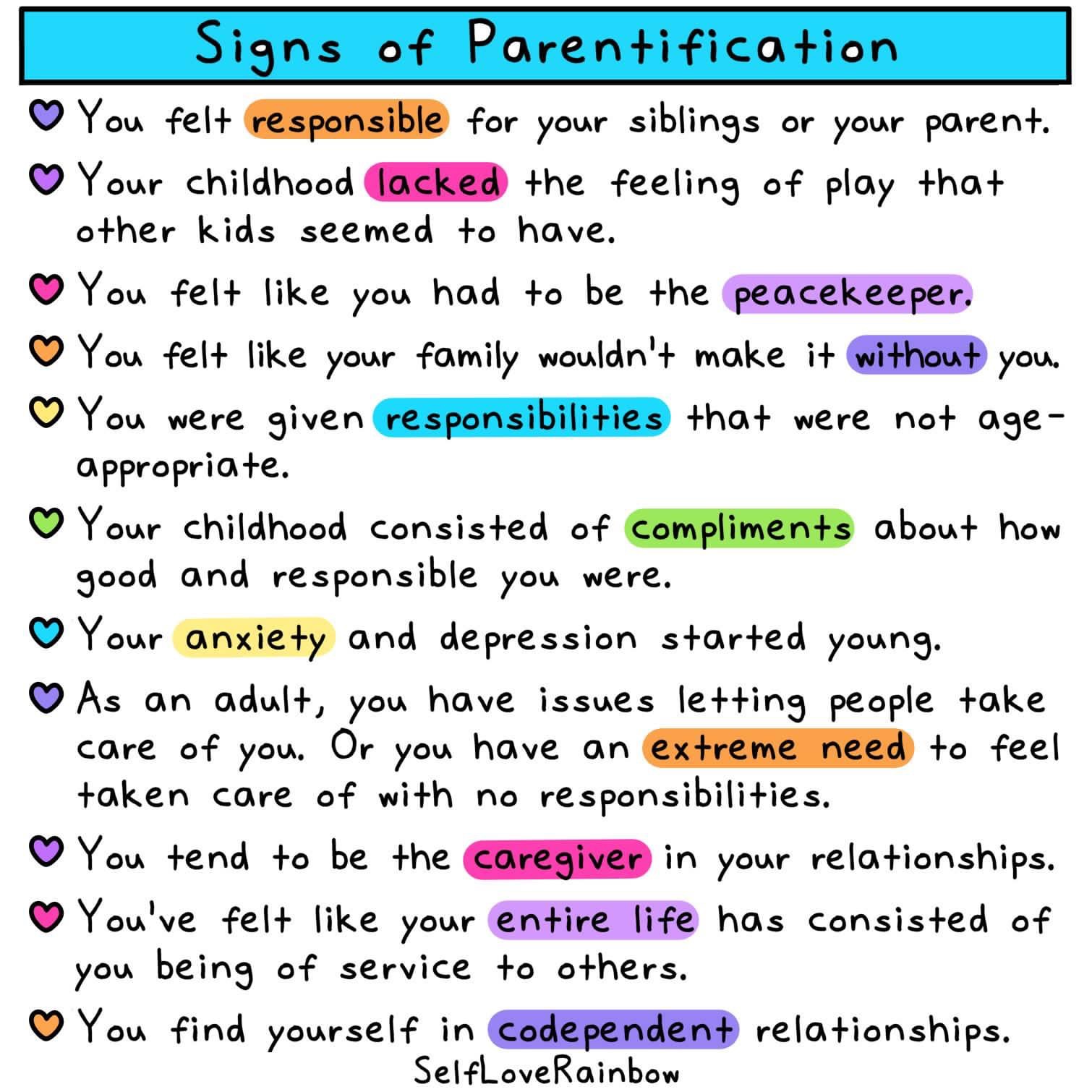
Partentification

Parentification is where a child is forced or expected, to act as a parental stand-in from a young age.

Parentification is generally classified as parent-focused or sibling-focused and then either as instrumental or emotional. Parent-focused means you were primarily taking care of your parent. Sibling-focused means you were taking care of a sibling or siblings.

Instrumental revolves around practical responsibilities.

– Physically meeting the needs of your siblings or parent by feeding them, helping them get dressed, or bathing them.

– Being in charge of cleaning, cooking, or grocery shopping.

– Paying bills, budgeting, or being in charge of the family finances.

Emotional revolves around being forced to be an emotional support system.

– Listening to your parent talk to you about adult problems.

– Giving advice or comforting your parent over age-inappropriate problems.

– Mediating between your parents or family members.

– Being the one to make your siblings feel loved, safe, and protected.

#parentification