Adolp Hitler -Monika Aksumit

In 1923 Adolf Hitler incited an insurrection against the German government. He was tried, given a slap on the wrist, and became a convicted felon. Despite being treated charitably by the judge, Hitler claimed the trial was political persecution and successfully portrayed himself as a victim of the “corrupt” Social Democrats.
Hitler cleverly positioned himself as the voice of the “common man,” railing against the “elites,” cultural “degeneracy,” and the establishment, who he all labeled as “Marxists.” He claimed the education system was indoctrinating children to hate Germany, and promised to return Germany to greatness.

To solidify his base, Hitler masterfully scapegoated minorities for the nation’s problems, exploiting societal divisions with an “us vs. them” narrative. Many Germans took the bait. Hitler’s Nazi Party continued to gain traction, until he became Chancellor in 1933.
Hitler appointed German oligarchs as his economic advisors. He proceeded to privatize government run utilities, solidifying support of the economic elite.

With the working class divided along cultural and ethnic lines, the Nazis shut down workers unions and abolished strikes.
Progressives and trade unionists were imprisoned and sent to concentration camps. Corporate profits skyrocketed while working class Germans lived paycheck to paycheck.

Hitler, who became a billionaire while in office, knew he and his clan of oligarchs could get away with the scam if they constantly had an “enemy within” to blame while the corporatocracy robbed the country blind.

An easy target was one of the smallest minorities. Hitler removed birthright citizenship rights of Jews and started rounding them up for mass deportations for being “illegally” in the country.
The German press under Nazi rule highlighted instances of violence by Jews to convince the public that Jewish immigrants were a danger to the “real Germans.”

Hitler wasted no time dismantling democratic institutions. Loyalty wasn’t just encouraged; it was demanded. Opponents were silenced. Media that dared to questioned[sic] him were vilified as “the enemy” and “Marxists.”

Hitler’s Propaganda Minister, Joseph Goebbels, bragged about how the Nazis were able to intimidate the media into giving them favorable coverage, and didn’t need to give direct orders.
The Nazi regime and its followers collected all books they saw as promoting “degeneracy” or what would be considered “woke” today, and burned them in large bonfires. They also burned books that promoted class consciousness.

Berlin had a thriving LGBTQ community in the 1920s, and even had the first transgender clinic. The Nazis burned it to the ground. LGBTQ people were sent to concentration camps and forced to wear triangle badges. Many were killed in the Holocaust.
The Nazis also saw manhood as under threat by independent women who didn’t rely on men. In 1934, Hitler proclaimed, “A women’s world is her her husband, her family, her children, her house.” Laws that had protected women’s rights were repealed and new laws were introduced to restrict women to the home and in their roles as wives and mothers.

Reproductive rights were severely rolled back, and doctors who performed abortions could face the death penalty.
Despite all of this, the German people didn’t have a similar historical parallel to look upon as a warning.
Most Germans never acted like the sky was falling.

Most just went along with their lives as usual, until many of their lives were snuffed out. By the time Hitler’s reign was forced to an end by the Allied Powers, 11 million people were murdered in the Holocaust, and 70-85 million were killed in WW2 .

Monica Aksamit
Bluesky

Just thought everyone needed a refresher course on this tragic part of world history.

Robert Reich on Trump

Friends,

It can be overwhelming. Trump is trying to “flood the zone” so we focus on a few outrages that we find most offensive and lose sight of the big picture — the larger strategy he and Elon Musk and their cronies are pursuing.

Their major goal is not only or even mainly to impose white Christian nationalism on America, nor to downsize the federal government, nor to wreak vengeance on Trump’s enemies.

It is to concentrate ever more power in Trump’s hands, so he can concentrate ever more wealth in the oligarchy’s hands.

The overall strategy boils down to five tactics.

  1. Replace federal civil servants with Trump loyalists.

It’s like the communist witch hunts of the late 1940s and early 1950s, only not with loyalty oaths to the United States but loyalty oaths to Trump.

Under one of Trump’s first executive orders, known as “Schedule F,” job protections shielding tens of thousands of senior career federal workers will be eliminated, making it easier to replace them with loyalists.

This week, Trump (via Musk) issued to all 2.3 million federal workers an offer to quit and get eight months pay or face the possibility of being furloughed without pay or fired. This, too, is aimed at getting rid of the professional civil service and installing people more loyal to Trump than to the United States.

Dozens of career officials at the National Security Council have been sent home while their loyalty is being reviewed. Dozens of other career officials, at the U.S. Agency for International Development, have been put on leave for suspicion of resisting an order by Trump.

Trump has conducted a mass purge of more than a dozen inspectors general (in direct violation of a law requiring written notice to Congress with a “substantive rationale, including detailed and case-specific reasons” at least 30 days in advance). The only inspector general who remains is a Trump loyalist.

  1. Take over independent decision-making across government.

This past Monday night, Trump froze up to $3 trillion in federal grants and loans to determine whether they “meet his priorities,” even though they had been passed by Congress. This was a direct violation of the Impoundment Act of 1974. (Later in the week, the freeze was rescinded, but it is expected to be reimposed in a form less vulnerable to legal challenges.)

He fired Democratic members of independent agencies — the National Labor Relations Board and the Equal Employment Opportunity Commission — leaving each without enough members to legally act.

This action is also unlawful. The law creating the labor board makes it independent of the White House in part by limiting a president’s ability to fire its members at will, stating: “Any member of the board may be removed by the president, upon notice and hearing, for neglect of duty or malfeasance in office, but for no other cause.”

  1. Put current officials on notice that defiance will be punished.

The media calls this Trump’s retribution for past perceived wrongs, but as a practical matter, it’s Trump’s warning to current officials that he will punish any disloyalty or defiance.

Trump has fired more than a dozen prosecutors from the Justice Department who worked for the special counsel Jack Smith on investigations into Trump.

A memo to the fired prosecutors from the acting attorney general, James McHenry, says a major factor in firing them was disloyalty to Trump: “Given your significant role in prosecuting the president, I do not believe that the leadership of the department can trust you to assist in implementing the president’s agenda faithfully,” he wrote.

Trump’s Justice Department has also opened an investigation into the actions of career prosecutors who criminally charged the Trump supporters who attacked the U.S. Capitol on January 6, 2021.

Trump has withdrawn security details from former public officials who have criticized him, although the threats on their lives continue — Anthony Fauci, John Bolton, and General Mark Milley. Trump has also rescinded additional protections for certain senior civil servants whose lives have been threatened.

  1. Eliminate or intimidate sources of news and facts that have criticized Trump.

Trump has threatened to throw journalists in jail and revoke the broadcast licenses of television networks he perceives as unduly critical of him. He is also threatening universities, scientists, and government research agencies whose findings he dislikes. Trump’s Department of Education plans to control classroom curricula.

The threats are escalating. Days ago, Musk lashed out at the nonprofit Wikipedia after his page there was updated with a description of his controversial Nazi-like salute during Trump’s Inauguration Day celebrations.

  1. Divide and conquer.

Trump wants Americans to get so riled up against one another that we don’t look upward and see where all the wealth and power have gone. This, too, is a tactic for consolidating power.

Yesterday, for example, Trump blamed the tragic air crash on Biden and Obama initiatives to make the federal workforce more diverse, claiming they “came out with a directive — ‘too white,’” but that “we want the people that are competent.”


It’s important to see Trump’s strategy as a whole. It is designed to consolidate his power. If we see it as a whole, the rest of us are better able to counter it — by demanding action from and fortifying our members of Congress, organizing for the midterm elections in 2026 to take back both chambers, conducting boycotts, and supporting and defending those who are vulnerable to Trump.

Americans don’t want a dictator. We don’t want an oligarchy. We were founded in rebellion against a king and his aristocracy.

Trump’s consolidation of power comes at a time when huge wealth has been amassed in the hands of 640 billionaires, including many who are in Trump’s White House — including the richest person in the world, who is now giving out orders as if he were Trump.

This concentration of power increases opportunities for oligarchic transactions — more power for more wealth, and more wealth for more power — that siphon off wealth and power from everyone else and undermine democracy.

This is the central reality of what has happened during the first 10 days of the Trump regime.

What do you think?

Distributive Bargaining – Prez Trump’s Art of the Deal

The best, most cogent and elegantly simple explanation into the inexplicably destructive negotiating processes of the president,by Prof. David Honig of Indiana University.

Everybody I know should read this accurate and enlightening piece…

“I’m going to get a little wonky and write about Donald Trump and negotiations. For those who don’t know, I’m an adjunct professor at Indiana University – Robert H. McKinney School of Law and I teach negotiations. Okay, here goes.

Trump, as most of us know, is the credited author of “The Art of the Deal,” a book that was actually ghost written by a man named Tony Schwartz, who was given access to Trump and wrote based upon his observations. If you’ve read The Art of the Deal, or if you’ve followed Trump lately, you’ll know, even if you didn’t know the label, that he sees all dealmaking as what we call “distributive bargaining.”

Distributive bargaining always has a winner and a loser. It happens when there is a fixed quantity of something and two sides are fighting over how it gets distributed. Think of it as a pie and you’re fighting over who gets how many pieces. In Trump’s world, the bargaining was for a building, or for construction work, or subcontractors. He perceives a successful bargain as one in which there is a winner and a loser, so if he pays less than the seller wants, he wins. The more he saves the more he wins.

The other type of bargaining is called integrative bargaining. In integrative bargaining the two sides don’t have a complete conflict of interest, and it is possible to reach mutually beneficial agreements. Think of it, not a single pie to be divided by two hungry people, but as a baker and a caterer negotiating over how many pies will be baked at what prices, and the nature of their ongoing relationship after this one gig is over.

The problem with Trump is that he sees only distributive bargaining in an international world that requires integrative bargaining. He can raise tariffs, but so can other countries. He can’t demand they not respond. There is no defined end to the negotiation and there is no simple winner and loser. There are always more pies to be baked. Further, negotiations aren’t binary. China’s choices aren’t (a) buy soybeans from US farmers, or (b) don’t buy soybeans. They can also (c) buy soybeans from Russia, or Argentina, or Brazil, or Canada, etc. That completely strips the distributive bargainer of his power to win or lose, to control the negotiation.

One of the risks of distributive bargaining is bad will. In a one-time distributive bargain, e.g. negotiating with the cabinet maker in your casino about whether you’re going to pay his whole bill or demand a discount, you don’t have to worry about your ongoing credibility or the next deal. If you do that to the cabinet maker, you can bet he won’t agree to do the cabinets in your next casino, and you’re going to have to find another cabinet maker.

There isn’t another Canada.

So when you approach international negotiation, in a world as complex as ours, with integrated economies and multiple buyers and sellers, you simply must approach them through integrative bargaining. If you attempt distributive bargaining, success is impossible. And we see that already.

Trump has raised tariffs on China. China responded, in addition to raising tariffs on US goods, by dropping all its soybean orders from the US and buying them from Russia. The effect is not only to cause tremendous harm to US farmers, but also to increase Russian revenue, making Russia less susceptible to sanctions and boycotts, increasing its economic and political power in the world, and reducing ours. Trump saw steel and aluminum and thought it would be an easy win, BECAUSE HE SAW ONLY STEEL AND ALUMINUM – HE SEES EVERY NEGOTIATION AS DISTRIBUTIVE. China saw it as integrative, and integrated Russia and its soybean purchase orders into a far more complex negotiation ecosystem.

Trump has the same weakness politically. For every winner there must be a loser. And that’s just not how politics works, not over the long run.

For people who study negotiations, this is incredibly basic stuff, negotiations 101, definitions you learn before you even start talking about styles and tactics. And here’s another huge problem for us.

Trump is utterly convinced that his experience in a closely held real estate company has prepared him to run a nation, and therefore he rejects the advice of people who spent entire careers studying the nuances of international negotiations and diplomacy. But the leaders on the other side of the table have not eschewed expertise, they have embraced it. And that means they look at Trump and, given his very limited tool chest and his blindly distributive understanding of negotiation, they know exactly what he is going to do and exactly how to respond to it.

From a professional negotiation point of view, Trump isn’t even bringing checkers to a chess match. He’s bringing a quarter that he insists of flipping for heads or tails, while everybody else is studying the chess board to decide whether its better to open with Najdorf or Grünfeld.”

— David Honig

“All men are created equal” reality

This is amazing 🤩

www.facebook.com/share/v/19yPq34itw/

Merit Based Government

I am providing a link that discusses how the merit based system that Prez T wants to implement.

Isn’t that difficult to understand and accept as the solution when he does not merit his position, nor do most of his nominees ?

And he wants Federal employees to Nark on each other ‘ big brother style ‘

Lots of shit stirred in a week 😳

Apparently there’s pot at the end of this rainbow 🌈 as it were ….

all is as it should be 🙏💯

Merit based system

https://library.fiveable.me/key-terms/intro-to-poli-sci/merit-based-system

I have found it necessary to end my association with friends on Facebook and finally with a Christian who likes to spew his hatred on me which allows him to keep his cool with his wife etc… end game .

Nope he crossed a line and I don’t play that game and just stopped . And it’s ok 👍

Judicial Bias – Craig Childress PsyD

Enter Player 2.

I spend over an hour talking with Melanie this morning. We’re on different over-lines and exactly the same under-lines.

The over-lines are glacial. The under-lines are in ludicrous speed. Wheee, hold on.

Melanie is Public Police – and she’s going Political Science. That is an entirely different line from a clinical psychologist.., yet we are fully entangled. When one spins-up, magically so does the other. When one spins-down, magically so does the other.

Spooky action at a distance.

Melanie saw the patterns a long time ago – once you see the patterns, you see the “tells” on the pathology – the signs that the pathogen is in that person’s brain.

I watched as she played with the pathogen when it signaled its presence on my Facebook page. She’s gotten better. Now… she’s doing a Mental Status Exam of thought and perception on it.

She’s collapsing the delusion into its dissociative core. Oh my. It’s relatively easy once you see the patterns. You set it up. It doesn’t think – it lacks linear-logical reasoning… it’s a thought disorder.

If you remain immensely linear and logical… you’ll pop it out – *pop* – oh… high there delusion, nice to meet you.

We don’t diagnose delusions based on History… we pop the delusion right out in front of us during the session – and we cal turn it this way and that. We can even rate it on a 7-point scale called the Brief Psychiatric Rating Scale item 11 Unusual Thought Content.

Social Constructions… uh-oh pathogen-people… in clinical psychology Social Construction is an entire School of psychotherapy like psychoanalytic, CBT, or family systems.

The Social Construction therapies include Solution-Focused (Berg) and Narrative (White). They are immensely powerful. I use them all the time… without your knowledge that I’m using them. Hee-hee-hee, I do things you don’t see.

Melanie’s in the world of Social Construction. Uh-oh for you pathogen-people. Judicial Bias? That is an entirely different line than the one I’m on… on the over-line. It is spot-on the same under-line, and it’s the under-line that is moving.

Soon… the under-line will explode into the over-line and the world changes immediately as if from nowhere. It’s called a paradigm shift. I may be dead… but its coming.

I should “Interview” Melanie. I could be like Joe Rogan interviewing topical people of the day. I should learn how to do that on my video platform.

Hey Melanie… I want to Interview you on Judicial Bias in the Child Custody Decisions. We can present three to five slides and talk about them.

She’s a rock star. She’s tough. She’s been battling the pathogen a long time as it attacks in a variety of ways… and she’s turned it. She caught it and she’s turned it.

Excellently done. She’s going one way. I’m going another. it is exactly the same under-line. One spins up, the other spins up. One spins down, the other spins down. The lines are entirely entangled.

Craig Childress, Psy.D.

Clinical P;sychologist,

WA 61538481

OR 4392 – CA 18857

Mental Health in Parental Alienation- Charlie Mc Cready

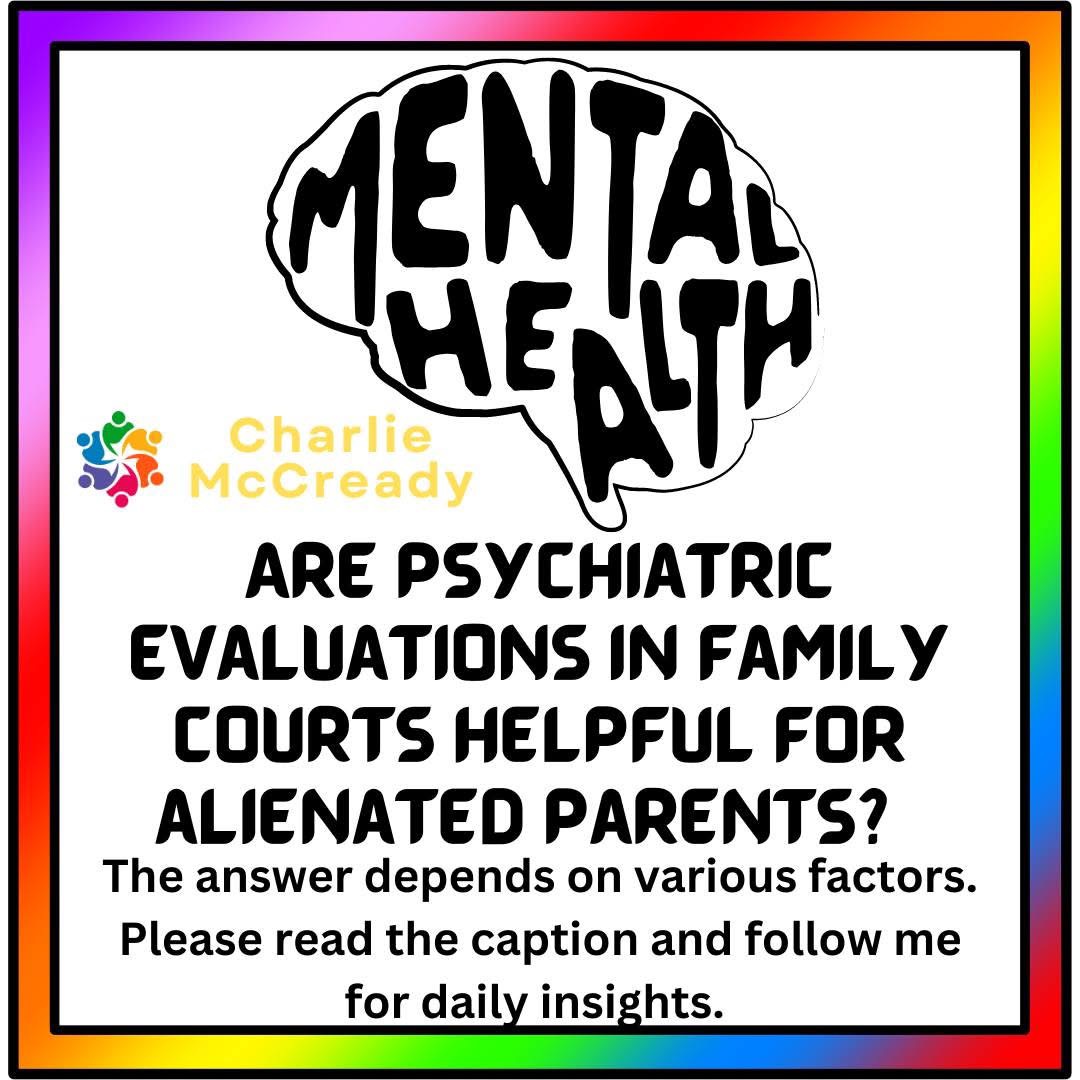
Psychiatric evaluations can offer benefits by providing an objective and professional assessment of a person’s mental health, including any disorders or conditions that may affect their behaviour or functioning within a family setting. This information can inform court decisions regarding child custody, visitation, and other family arrangements.

However, there are potential drawbacks to consider. Evaluations may be subjective, leading to different conclusions from different evaluators. They can also be costly, time-consuming, and may not always yield clear or actionable recommendations.

One concern is the potential emotional stress and charged atmosphere that evaluations can create, particularly in custody disputes or contentious family matters. Mental health professionals must approach evaluations sensitively and ethically, prioritising the well-being of all parties involved.

It’s also important to note that evaluations rely on the information provided and the cooperation of all parties, which can be challenging if an alienating parent manipulates or deceives the assessment process. Additionally, evaluations are most effective when conducted by professionals experienced in parental alienation.

#charliemccready

#parentalalienationcoach

#parentalalienation

#FamilyCourt

#fathersrights

#mothersrights

#custody

#childabuseawareness

#childcustody