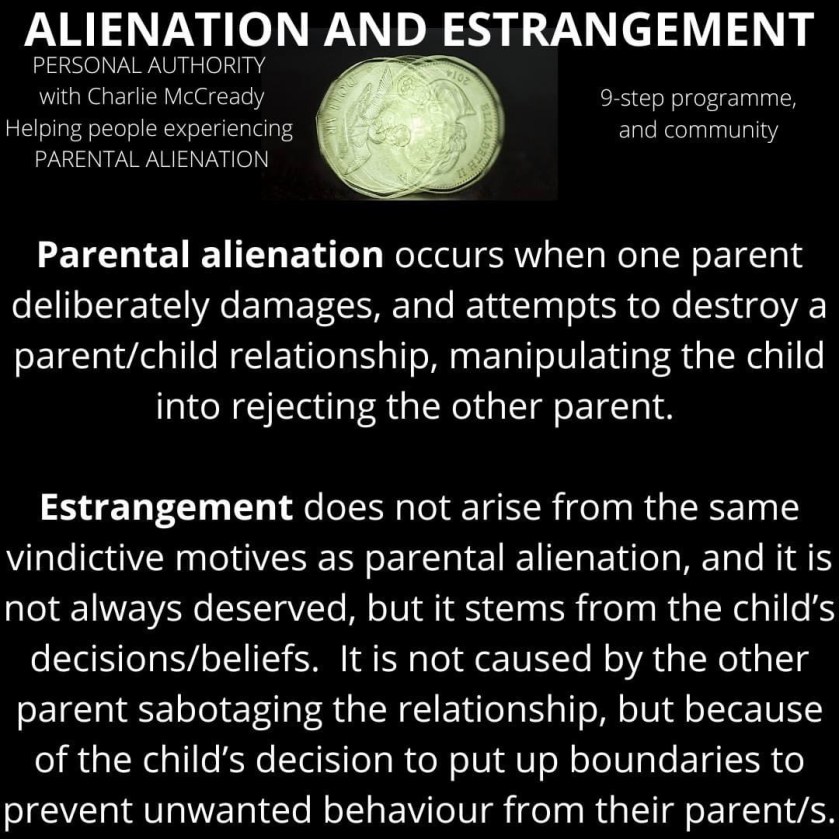
The parent-child relationship is one of the strongest human bonds and it is totally heartbreaking when a parent and a child are no longer in contact. Two reasons for this can be parental alienation or estrangement. Two sides of the same coin. Both involve grief, regret, torment, and heartbreaking separation, but are also different as I shall try to explain below.
In the Journal of Forensic Science, the difference between parental alienation and realistic estrangement was defined this way: Parental alienation is the rejection of a parent without legitimate justification and realistic estrangement is the rejection of a parent for a good reason.
Parental alienation: When the relationship was previously loving, and in the absence of emotional or physical abuse, parental alienation is seldom initiated by the child. This pathological behaviour is born of a false or illogical belief fostered by the alienating parent, out of hatred, fear, envy, or disrespect, usually during and after a high conflict divorce, though alienation behaviours might have started while the parents were living together under the same roof. The alienating parent will use the child as a weapon by undermining their previously happy, loving relationship with the mentally healthy parent. With parental alienation, the child treats the parents as good and bad, right and wrong. They take on the alienating parent’s beliefs, justifications, fears, anger, language … they become loyal defenders of the ‘good’ parent because that parent has worked on them. Some liken it to a cult leader and their followers, or to brainwashing. The child aligns with the aggressor (please see my post on this).
Estrangement: Although this is also traumatic and heartbreaking, it is different to parental alienation. It doesn’t stem from the other parent doing all they can to destroy the parent/child loving relationship, but instead from the child’s independent-minded decision. The child puts up a boundary to prevent unwanted behaviour from his/her parent. This can include a great many things, including family conflict, disparaging behaviour, disagreements over life choices, violence, and abusive language .. … It is sadly fairly common for a parent who is estranged from his/her children to blame the other parent of parental alienation. It is easier to blame others than to take on any blame and responsibility themselves. The parent’s behaviour could be driving a child away, but their lawyer blames it on alienation. This is a travesty of justice, and courts must be more aware of these false accusations. It is important to evidence everything.
Whether you are going through estrangement or parental alienation, it is essential to get the emotional support you need. If you are reunited with your child, you can also try family counselling to help repair the relationship. I advocate Conscious Parenting. Whatever you choose, never hesitate to reach out for help. If the reconnection isn’t yet happening, or it’s been a long time since you’ve experienced separation, make sure you are looking after yourself, to get beyond grief and rage, and try to accept the situation, best you can. You deserve to be happy.
Narcissists discard their children when they’ve been exposed for who they really are. In my experience outward appearances count for everything in the life of a narcissist. Narcissistic parents expect (in fact insist on) absolute loyalty from their children. A child may be well aware of his/her parents’ lying, cheating, and manipulative ways, but he/she is expected to remain “on side,” always. If the children dare to cross to the “other side,” and take a principled stand, they should be prepared for the inevitable outcome; alienation. A child will be treated with the same (or greater) contempt as anyone else outside the family who has dared to cross them. They will be made to suffer the consequences of exposure. After the perceived “injury,” narcissistic parents will set a deliberate course to rally as many “flying monkeys” as possible to their side, adeptly portraying themselves as victims of their children’s ungrateful, self-serving treatment of them. Their attempts to discredit their children to preserve their image will know no bounds. Accept that those who really know you will not be convinced, and those that don’t, simply don’t matter in the grand scheme of things. Supporting one another in our decision to go “no contact” with our parents has not only strengthened our relationship, but has also allowed us to heal together.
Joanne Hill, Hon B.A., B.Ed Psychology & Sociology (1984)
“Dr Carol Golly, a child and family psychotherapist, believes children can be damaged if contact with grandparents is stopped. “Children who become cut off from grandparents with whom they enjoyed prior close relationships may have lifelong difficulties with trust, relationships, and emotional health,” she says, citing evidence that self-devaluation and relationship cut offs “may become an intergenerational pattern”.”
I’ve finished the first draft of my first article to submit for journal publication. It’s directed toward an Ethics journal. That’s where I’ll start.
I plan to write articles for submission to an Ethics journal, a Clinical Journal, and a Cultural psychology journal. Then I’ll come back to the Forensic journals after that, maybe.
Notice I haven’t written any journal articles yet. There’s a reason. Now it’s time. There will be about an 18-month lag time from my writing to their appearance in a peer-reviewed journal. I work ahead. In about a year or two, the arrival of these articles will be useful.
It’s not my job to educate them, they should already know – Standards 2.01 and 2.03 of the APA ethics code. They weren’t motivated to solve anything. We’ll see what we can do about that.
I’m coming for the licenses, I want their licenses revoked for being child abusers.
As a clinical psychologist, I am acting pursuant to my ethical obligations under Standard 1.05. The Standards of the APA ethics code are mandatory for all psychologists – ethical practice is not optional, it’s required.
Standard 1.05: “If an apparent ethical violation has substantially harmed or is likely to substantially harm a person or organization and is not appropriate for informal resolution under Standard 1.04, Informal Resolution of Ethical Violations , or is not resolved properly in that fashion, psychologists take further action appropriate to the situation.”
The conditional clauses of Standard 1.05 are met. What “further action” is appropriate to this situation? I will be providing parents with the information they need for their malpractice lawsuits against forensic psychologists for violations to Standards 2.04 and 9.01 of the APA ethics code, and for failure in their duty to protect obligations.
I am required by Standard 1.05 of the mandatory APA ethics code to “take further action appropriate to the situation.” There is a reason for ethical Standards. This is it. Unethical practice is the problem, the ethical Standards of the APA are the solution.
The forensic psychologists currently control the licensing boards, they review themselves and they all do the same thing. We will need to take this into the courts as malpractice litigation.
I want their license to practice revoked for participating in the psychological abuse of the child.
The lion is a stalking hunter. I’ve always known we would get here. I hoped we wouldn’t. I had to give them every opportunity to correct their actions and protect the child. They’ve had their time.
The savanna belongs to the parents, to the lions protecting their cubs, not to the jackals and hyenas. We’ll see what we can do about that.
I have fulfilled my due-diligence obligations each step of the way. I told the AFCC directly in 2017. I told the APA directly in 2018. I told the Trust malpractice insurance carrier in 2020 that this would be going into the courts by necessity.
I am now actively working as the expert witness on possible malpractice cases involving forensic psychologists. I will be the expert for the prosecution at their malpractice trial. I’m not here to make friends. I’m here to protect the child.
Why are they here?
I don’t like moving dark energies. Sometimes it’s necessary.
I have developed lines of questions for the cross-examination of testimony from forensic psychologists. I provide these lines of questions to attornesy when appropriate to the situation. The lines of questions have the goal of leading the forensic psychologists into openly acknowledging their unethical malpractice in their testimony, under oath, with a court reporter present.
The subsequent malpractice lawsuits become so much easier when the forensic psychologist admits to the malpractice under oath with a court reporter present. That’s my goal. We’ll see how successful I can be, I’m just getting started, I’m just coming out of the gates.
Give me about a year or so… we’ll see where we are at that point.
I’m also involved in other ways on these court cases seeking a more directly current resolution of the family conflict, but I also have an obligation to my clients to provide them with the documentation support they need for accountability with the forensic psychology people once the matter of direct concern is settled.
Attacking the license of another psychologist is a serious-serious undertaking. I don’t like moving dark energies, but sometimes it’s necessary. I have performed my due-diligence obligations every step of the way.
It’s necessary.
I’m anticipating this is going to be a professional bloodbath, at least that’s my goal. I’m hoping that sometime next year there will be a peer-reviewed article in an Ethics journal parents can use to support their malpractice lawsuits.
In the meantime, while the malpractice lawsuits formulate and emerge, licensing board complaints should fall like rain when they are warranted for ethical violations to Standards 2.04 and 9.01, and for failure in their duty to protect.
The weather’s changing, looks like rain.
Licensing Board Complaints
Make the forensic psychologists on the licensing boards cover-up their negligent and unethical practice over-and-over again on exactly the same grounds every time – violations to Standards 2.04 Bases of Scientific and Professional Judgments and 9.01 Bases for Assessment, and for failure in their duty to protect.
Then follow-up with your state legilative representative, asking them to look into the corruption and cover-up of the licensing boards for the unethical malpractice in forensic psychology.
Come together and fight for each other and each other’s children. If they did it to you, then they did the same thing to the parent and child before you, and they will do the same thing to the parent and child who follows – unless you stop them.
Movement made by one is movement by all. You are not alone. It’s time to let them hear your roar. The savanna belongs to the parents, these are your children, not theirs.
In the absence of child abuse, parents have the right to parent according to their cultural values, their personal values, and their religious values.
The only question to answer is… is there child abuse? – V995.51 Child Psychological Abuse, the creation of a shared persecutory delusion that then destroys the child’s attachment bond to the other parent.
Negligent Malpractice
I’m not from here. I’m not from this court-involved pathology world. Look at my vitae. I’m a trauma psychologist out of child abuse and foster care, I’m here to protect chidlren from child abusers.
Not from the other parent, they’re just pathological. It’s the child abusing forensic psychologists I’m after. The betrayers – the ones who should protect… and don’t. The ones who particpate in psychologically abusing the child because of their ignorance, incompetence, and unethical practice.
I want their license to practice revoked for participating in the psychological abuse of the child. That’s my goal. We’ll see how successful I can be in a couple of years. I’m just starting, Covid and chaos are ending and we are reemerging into the world in 2022, and I’m not going anywhere. By 2024, this should be interesting.
I’m on the savanna now, I’m in the courts as a testifying expert witness. I will meet them in the courts. I read their reports. I write my reports about their reports. I don’t think they’ll like being peer-reviewed by Dr. Childress. It’s likely to be a surprising event in their world, to have their report peer-reviewed by Dr. Childress.
I read my reports about their reports. I don’t think they’ll like my reports. I’m not here to make friends. I’m here to protect the child from the child abusers.
Do you hear that rustling in the grasses? They don’t. When you see the lion, the hunt is already over.
So that’s what I’ll be doing to round out my professional career.
I’m peer-review from clinical psychology of their professional practices. The standards of practice in forensic psychology are substantially beneath those of clinical psychology. I suspect they’re in for a surprise.
In a year or so I’m anticipating I’ll be standing on hill made from their bones, at least that’s my goal. We’ll see how successful I can be.
Child Abuse
In clinical psychology, we abide by the Standards of the APA ethics code… but forensic psychologists do something different. They don’t abide by the ethical Standards of practice mandated by the APA.
They’ll even testify that forensic psychology is different. That’s their downfall but they don’t comprehend that yet. They will.
Clinical psychologists comply with the ethical Standards of the APA ethics code. Forensic psychologists do something different, they don’t comply with the ethical Standards of the APA.
Clinical psychologists diagnose child abuse and fulfill their duty to protect obligations. Clinical psychologists protect children from child abuse.
Forensic psychologists do something different. They don’t diagnose child abuse and they don’t protect the child. Instead, forensic psychologists particpate in the psychological abuse of the child. That represents a prominent failure in their duty to protect obligations.
Google negligence: failure to take proper care in doing something.
Did they conduct a proper risk assessment for possible Child Psychological Abuse (DSM-5 V995.51)? Did they conduct a proper assesment for a possible delusional thought disorder in the parent imposed on the child, a shared persecutory delusion?
I am stone-cold serious, look at me. I’m not a happy psychologist. I am going after their license to practice for being a child abuser – the betrayer, the one who should protect… and doesn’t.
Dr. Childress becomes very unhappy when people abuse my children, and all children are my children. Dr. Childress becomes especially unhappy when the child abusers are other psychologists. That is not okay.
I’ve hired an assistant to help me get my articles into APA format and submitted to various journals, and then to track the submissions through journal rejections until we find its location.
That way I can remain focused on my task at-hand.
If they change, then they admit that I am right – about everything – including their current and prior unethical practice and their collusion with child abuse.
If they don’t change, then they await the malpractice lawsuits that are coming for violations to Standards 2.04 and 9,01 of the APA ethics code, and for their negligent failure in their duty to protect obligations.
It’s called a double-bind, either way they are in trouble. You parents are familar with double-binds, the no-win situations that surround you no matter which way you turn.
Double-binds are abundant surrounding you, it’s a feature of trauma pathology. I know. I’m a trauma psycyhologist. This is my pathology. I’m reorganizing things, shifting around a lot of things to their proper locations.
It’s what I do. I’m a clinical psycholgist. We do something different. We create change, and we know exactly how to do that.
YouTube
I’ll be turning to my YouTube channel next. It’s time to unload that Internet medium of communication. Everyone is currently using it to upload information. I’m not going to use it that way. I’m a clinical psychologist, I do something different.
It’s a communication medium. Can psychotherapeutic change agents be delivered using the Internet communcation medium of YouTube? I suspect they can. Not your typical change agents we use in our day-to-day face-to-face therapy work, but I think there’s change agents appropriate to this new medium of communication.
Let’s find out.
I’m planning to organize the information into various lines because I will be doing various things directed to various audiences. I’m anticipating that the structure of the information sets will gradually unfold as the lines take shape.
I’m an Internet psychologist. I’m the first. Wheee. No one’s ever done this before. How many other psychologists have solved everything about child custody conflict in the courts? No one. How may other psychologists have killed an entire field of psychology? No one.
I think I’m the goat of clinical psychologists. Now I’m going where no one has gone before – I’ll be exploring if the Internet commucation medium of YouTube can be used to deliver psychotherapeutic change-agents.
I need an outcome measure. How about we use the fall of forensic psychology? That sounds like a good outcome.
I’m going to start my YouTube channel by answering your questions. If you have a question for Dr. Childress, send it to question.for.drchildress@gmail.com. I don’t need your story, I know your story, what’s your question? I’ll know your story by your question.
A question ends with a ? thing. Your stories don’t.
If you have that question, so do a lot of other people, and once things are posted to YouTube they remain for everyone. The information sets build. Let’s get busy.
It’s time to take this Internet thing out for a spin and see what it can do. You just have to know your medium, don’t think flat-lander, the Intenet is way different – know the limitations and use the advantages.
The world is changing – because we are changing it – because it needs to change.
Craig Childress, Psy.D. Clinical Psychologist, CA PSY 18857



 GreatCosmicMothersUnite