
Tag: Narcissist
Side Effects of Having a Distorted Parent
Child Psychological Abuse
Lifelong Effects on Children Who Grow Up With Narcissistic Personality Disordered Parents–
by Dr. Laurel a Sills, Licensed Clinical Psychologist, Michigan.  9/2/2022~~
The deeply damaging effects to a personality when growing up with especially subtle narcissism (which is not recognized by outsiders) is extremely long-lasting and often unseen by others. Kids may act strong and unaffected and become leaders or bossy and controlling and seem super confident, or, people- please in such a way that
most people like them and don’t notice that they are appeasing to everybody and not standing up for what they want.
Anxiety is high for the child who grows up confused by hearing they are loved by their parent who doesn’t guide them, dismisses them, is insensitive towards them, is hypercritical, micromanaging, doesn’t seem to see them or respect them. The child feels one way, but is told another or that they are overreacting, being dramatic, making mountains out of molehills, or dismissed, etc.; thus undermining the child’s self-trust and reliance upon their own feelings and perceptions to make accurate conclusions.
As a result, the child is apt to constantly need reassurance and seek outside validation rather than feel self-reliant and trust themself to be able to discern things accurately and appropriately.
Since narcissists unconsciously project their own self hatred and dislike of self onto others, the names they call their children typically are descriptors of themselves or some form of their own self-shame or doubt. If a parent says a child is selfish look and see if the parent is acting that way. If the parent says the child is stupid look and see if the parent is acting unaware of important dynamics.
When narcissistic parents use their children as an extension of themselves, they often push their kids to do the things they never did to finish unresolved dynamics from their own backgrounds. i.e. forcing a child to play football because the parent want to live through them and have their child reflect strength and athleticism and popularity. Forcing K
kids to act in their own mirror images rather than see their child as separate and unique individuals is another common pitfall.
Validating a child’s feelings is vital to help them grow to trust their own perceptions. It’s also important to help distinguish somebody else’s problems from a child’s behaviors.
As children, we must be seen for our own uniqueness and our own strengths and limitations; not be ridiculed for our limitations and molded into a mini version of our parent.
In therapy, the adult children has to express their confusion about how they felt in their families versus what they were told by the unhealthy family members. It takes outside validation, much love and compassion, an explanation for adult children to eventually recognize they were the victims of parents who were also suffering from their upbringing, and suffering that makes them project all kinds of things onto them. I’m not talking about physical abuse and more violent narcissism and sociopathic narcissism. I’m talking about even subtle abuse emotional, constant negative commentary, ignoring, eye/rolling, dismissive body language, disrespect, disregard mixed in with warm fuzzies, a
Conditional love, threats to withdraw love if a child doesn’t do what is asked or commanded… all part of the felt verbal and emotional abuse even when the parent is unaware.
Because the parent is unaware, when they later are confronted by adult children or teenagers about how they were feeling hurt by that parent, that parent often acts as if they were the one mortally wounded. Often the parent acts angry, surprised, betrayed, retaliates, or deeply hurt.
Sometimes parents give their children the silent treatment when a child tells their parent how they’ve been hurt by them. This just compounds the child’s ( teen or adult child’s) guilt and confusion.
Good therapy, in my opinion, combines validation, education, explanation, empathy, and teaching how to cope and separate what that parent did and said to the child from the real truth of who the child ( who became adult or teen pending on what age they are entering therapy) really is and who they were born to be.
The growth to health for the children of Narcissitic parents is to find honest, real, compassionate and loving people who can support, guide, teach and demonstrate unconditional love with guidelines for appropriate behavior in the world. Empathy is vital. Depth of emotions and discussion about feelings is vital. Healing comes in the relational and attachment realms. 
Because the narcissistic parent is so confident and sure of themselves, they’re very intimidating to confront even by the spouse. When children see their other parent staying with the narcissistic parent and not challenging them, it certainly makes challenging that parent even more difficult. The ones that are brave enough to challenge, should not be punished, but instead revered for sharing their feelings and being brave. They have to learn to say things in a healthy way and be given a safe place to share with a professional who can validate them away from the Narcissitic parent(s) and protect them from further ridicule, minimization or dismissal.
Adult Children ; Survivors of Alienation by parent
As target parents we sometimes lose sight of how hard it is for our alienated kids to reunify with us, especially when our alienated kids are adults as it seems they should be able to easily resume treating us normally. It’s important to remember that it can take super-natural bravery for our kids to reunify with us as they face so many hard and scary scenarios to reunify with us. One of the hard and scary scenarios they must face is…What to tell people about how they’re letting you back into their life when people have been thoroughly convinced that you’re too “crazy, unsafe, unstable, etc etc etc” to have a relationship with? Maybe you’ve been alienated for years to the point that you were excluded from the child’s biggest life moments such as their wedding or the birth of a child so people really are fully immersed in the lies that you’re deserving of total rejection. After all, you MUST be a monster to have not even been included in your own child’s wedding or the birth of their child. After many years of an alienation so deep with convincing lies, it can be overwhelming for the alienated adult child to think about how to explain to people why they would let you back into their life. After all, an alienated child is not going to say “Well, to be honest, my parent was never actually a bad person or did anything wrong. I was put in the position to reject them by my other parent.”
So what can or should you say if you want to reunify with your target parent but don’t know how to explain it to people. The answer is simple. As in almost everything related to reunification, saying less is more. All the adult child needs to say to people is “We’re working things out.” That’s it. “We’re working things out.” Repeat as needed. If you’re an adult child who is reunifying with your target parent and are struggling with this specific challenge, keep a few things in mind. 1) It only takes 2 seconds to say “We’re working things out.” 2 seconds. 2) When you give such a direct and firm answer, people rarely ask more questions. It’s highly unlikely that they will ask you for specifics. If they do ask you, you can say “We can talk about it later” or you can say “”We just wanted to work things out.” You’re under no obligation to anyone to explain further unless it’s someone you want to explain it to further. 3) 99.9% of people will be HAPPY for you! Their response will mostly likely be “That’s great!” because the truth is most people know that we all naturally want good relationships with both of our parents.
While it’s “simple” to make the 2 second statement of “We’re working things out,” we need to recognize that it’s still hard to do. And this is just ONE OF the reasons it’s hard for alienated adult kids to reunify with their target parent. We need to recognize the incredible courage an alienated adult child must use to reunify with their target parent. This is a bigger brave than many people can ever imagine.
$ Narcissistic Right to Abuse $
Narcissist have No Close Friends – Lots of trauma bonds
Why Narcissist turn people against you
Know this too well
Line Em Up – James Taylor
Of course I’m a huge fan , my Dad and 2nd son are named James , which translates to supple-mentor.
A deceased soul mate was also named James and died of extreme complications from years of IV drug use .
The detached upbringing and loss of both parents ; created this grieving soul who captured my heart in a bond that I could not escape . Addiction to this addict did not resonate and I married for several weeks to break the tie that bound me . I had experimented to better understand and it did not please me and it was easy to abstain except for “pot”.
In marriage it was the same , an occasional Valium , or smoke.
Sleep was threatened from the get go , with intense snoring and I don’t do well with lack of sleep . My nature then was high strung and active but I became weak and moody but did not understand why .
The reasons have lined themselves up , as it were . Our family was destroyed for reasons of addiction , control and ego .
The eyes have become more beady . And darker . As have some of our leaders , exposing a consciousness lack that is staggering .
After hearing Romney state that morality had nothing to do with politics , yesterday I heard the GOP rep talk about morality in the GOP.
That’s a good thing because I know Republicans that are moral and the greedy eyes are lining up . I don’t need to name names but look at the eyes ! Note who peers over their glasses in a passive aggressive profession / authority , manner ?
We each are part of a whole and as the harvest comes in we do harvest the truths that are clearing the way to new earth and less greedy little eyes !
Childress : Not an Attorney
I am a psychologist, not an attorney. But from where I sit, attorneys are failing.
To me, as a psychologist, parents in the family courts represent a category, a class of people. They are a particularly vulnerable class of people because their rights to self-determination and autonomy in decision-making is compromised by the court’s involvement.
This vulnerable population has been expelled from clinical psychology (treatment) and has been given their own “special” psychologists for this group alone. No other pathology has their own “special” psychologists – not ADHD, or autism, or eating disorders. All of those pathologies (problems) are treated by clincal psychologists.
Only court-involved families are restricted to their own “special” psychologists created just for them, just for this special class of parents for no other reason than their court involvement… with compromised autonomy in decision-making and restricted rights of self-determination.
Because “forensic” psychology is a “sub-specialty” practice, all licensing board complaints are given to other forensic psychologists on the licensing boards for review… and they all do the same thing. They are allowed to self-review – there is no oversight of the forensic psychologists by anyone other than other forensic psychologists.
The field of “forensic” psychology needs outside and independent review. It is a cesspool of professional practice. Where are the licensing boards enforcing ethical standards of practice? Nowhere to be seen… which is why it’s a cesspool.
The licensing boards are corrupt with the influence of exactly the “forensic” psychologists they are tasked with reviewing. The practices of forensic psychology in the family courts need outside and independent review.
Do not get a forensic custody evaluation. Parents want a proper risk assessment for possible child abuse, i.e., a possible shared persecutory delusion with the allied parent as the primary case – which would be a DSM-5 diagnosis of V995.51 Child Psychological Abuse.
Forensic psychologists are ignorant, incompetent, and unethical. I am willing to debate this anytime with anyone, send me the date, time, and platform log-in: The Role of Forensic vs. Clinical Psychology in the Family Courts – Dr. Childress representing clinical psychology and Anyone representing forensic psychology.
I’d like to see a debate sponsored by a law school.
But maybe if the attorney world isn’t able to generate a class-action lawsuit with the AFCC and APA as deep-pockets on something like what’s happening in the family courts (I think it warrants a RICO racketeering look), maybe the legal profession isn’t up the the task of self-examination.
I guess I’ll just have to solve this entirely as a lone clinical psychologist using the power of diagnosis. Because I’m not a lawyer, I never went to law school, I went to psychology school instead so I don’t know legal stuff.
But from where I sit as a clinical psychologist, the attorneys are failing. Or maybe you just haven’t found the right attorneys. I wonder if the ACLU might have an opinion on your situation?
Craig Childress, Psy.D.
Clinical Psychologist, CA PSY 18857
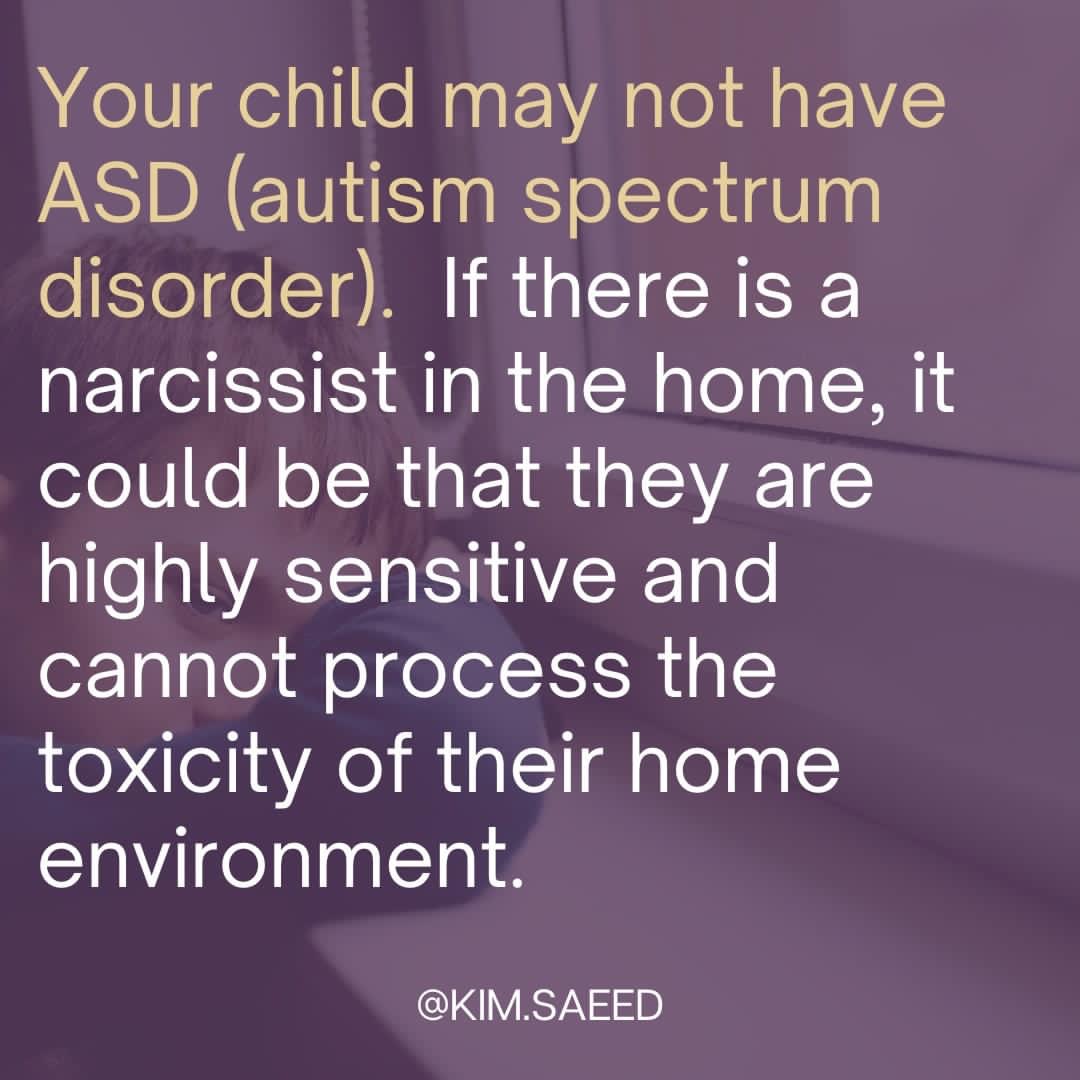
Child may present as Autistic in Narcissist home
A few years into becoming a consultant for narcissistic abuse recovery, I began to notice a high correlation between parents who had an autistic (ASD) child, and who also had a narcissistic partner in the home.
In some cases, emotional abuse and neglect can present as ASD, but recent research also points to some children being highly sensitive who cannot process their emotions in a toxic household.
In the movie, Sensitive – The Untold Story, featuring Alanis Morissette and HSP expert, Dr. Elaine Aron, cover this topic in detail. It’s definitely worth getting a second opinion if your child has been diagnosed with ASD…as well as exploring options for getting your child(ren) out of toxic environments.
#highlysensitiveperson #hsp #empath #highlysensitive #highlysensitivepeople #infj #sensitive #introvert #introvertproblems #mentalhealth
Cycle Breaking
Cycle-Breaking
We come into our lives with things we want to learn and things we still need to heal from past lifetimes. We also come into families where sometimes unhealthy patterns run rampant. It has been proven in studies that trauma responses as well as inclinations towards addictions can and are passed down through DNA. They have also shown how healing ourselves helps to heal and change our own dna as well as that of those closest to us. This is called epigenetics.
Although we each come with our own life paths and missions, we can choose to heal or discontinue unhealthy patterns at any time.
Some are born cycle-breakers who have never fit in with their families. Others come to this as we age and realize that we do not truly feel happy and we begin to examine why.
- Once we identify a pattern that we’d like to discontinue, we must acknowledge how we have been affected by it already. There are many different issues and thought-patterns that we may have brought forward from past lives that our families have solidified for us. Even things such as over-concern with material wealth, physical beauty in the extreme, narcissism, an innate distrust of women, men, authority, certain places or the holding of family secrets can come down the line. How have we been affected by those things? How does it color our thoughts? What stories have we created around it? Are we ready to break the cycle?
- When we feel fully committed to ending the cycle, we can engage help. Therapists, energy practitioners, doctors, support groups are all available to help us unearth as much information as we can and help us build our confidence in ourselves and moving towards Truth. Combing through our beliefs, day-to-day thoughts, and the WHY behind our distrust and our fear will help us understand our parts as well as what behaviors were learned or given to us through dna. Maybe some behaviors or beliefs were coping mechanisms. It’s time to examine our decisions and maybe make some new choices.
- This is where we take serious action. We could tell the truth to end the secret keeping. Maybe we need to break ties with unhealthy or abusive people. We could stop using alcohol, drugs, gambling, sex, and/or food as a way of coping. We could probably benefit from better boundaries and acknowledging the ego games we are engaged in and WHY. This is meaningful, profound work. Expect tears. And a feeling of intense freedom.
- Our behaviors will change as our thoughts and beliefs change.
Others will notice. They may choose to grow with us, or they may hold tighter to the things we are letting go of. It is up to us if we choose to stay in relationships with anyone, ever. Growing and ending cycles can feel lonely. As we let others go, we make room for healthier relationships in our lives. - Animosity does not need to be a part of any of this. We are working on ourselves to end the cycles that we have been in. Boundaries can feel hard at first, until we see how much better we feel when we make better choices for ourselves.
- The thing about cycle-breaking is that it in itself is a cycle. We are on a spiral upwards and we can, if we choose, continue to notice what is unhealthy and move towards healing at all times.
Here’s to FEELING, DEALING AND HEALING in every possible way. The crap can stop with us, and our well-being and work towards it can change the color of our skies, not only for us, but for those whose lives we affect as well. ❤
-Nicki
 GreatCosmicMothersUnite