
Romantic relationships are more central to men’s well-being than women’s, according to recent research.
Popular culture suggests women prioritize romantic relationships more than men, though recent evidence paints a different picture. Studies often depict women as emotionally dependent on their partners, while men are stereotypically viewed as independent and emotionally reserved. These assumptions have influenced not only cultural narratives but also academic research.
Iris V. Wahring and colleagues challenge this narrative by providing a comprehensive analysis of how romantic relationships impact men and women differently, drawing on interdisciplinary research across psychology, sociology, and evolutionary biology.
The researchers argue that men, on average, rely more on their romantic partners for emotional support and intimacy than women do. They suggest that this discrepancy stems from gendered socialization patterns: men are less likely to cultivate strong, emotionally supportive friendships or family ties outside of romantic relationships, while women are encouraged to develop broader networks of intimacy and care. These differences make romantic relationships disproportionately significant for men in fulfilling emotional and psychological needs.
The authors outline four key findings to support their argument. First, men expect greater benefits from relationships and are more motivated to form romantic partnerships. Compared to women, men perceive romantic relationships as offering a more substantial improvement in their well-being, partly because they tend to have fewer alternatives for fulfilling emotional and intimacy needs.
For example, research indicates that single men are more likely than single women to actively search for a partner, and men are more likely to idealize romantic connections, believing in concepts such as “love at first sight” and confessing love earlier in a relationship. Men also report falling in love more often and more quickly than women, reinforcing their stronger drive to initiate romantic involvement.
Second, men derive more mental and physical health benefits from romantic involvement compared to women. Romantic relationships provide men with a source of emotional support, which translates to higher life satisfaction, improved mental health, and better physical health outcomes. The paper cites evidence showing that single men experience higher rates of depression, stress, and loneliness compared to single women, and men who lack a partner are at greater risk of adverse health outcomes, including reduced life expectancy.
Conversely, married or partnered men tend to experience lower rates of hypertension, inflammation, and other health issues compared to single men. Women’s broader social networks and alternative sources of support mean that they are less dependent on their romantic partners for these health benefits, resulting in a weaker overall association between relationship status and health for women.
Third, men are less likely to initiate breakups than women, partly due to their stronger dependence on the emotional support provided by romantic partners. The authors highlight that approximately 70% of divorces are initiated by women, and women are more likely to end non-marital relationships as well. Men’s greater reluctance to end relationships is explained by their perception that the costs of leaving, primarily the loss of emotional and intimacy support, outweigh the potential benefits. Additionally, men are less likely to view breakups as opportunities for growth or self-discovery, further decreasing their likelihood of initiating separation.
Fourth, men experience greater emotional and psychological distress following the dissolution of a romantic relationship. After a breakup, men are more likely to report feelings of loneliness, sadness, and reduced life satisfaction compared to women. They also experience more severe physical health consequences, including an increased risk of suicide and mortality after losing a partner through separation or death. The authors argue that these negative outcomes are tied to men’s dependency on romantic partners as their primary source of emotional support. Women, by contrast, are more likely to turn to friends and family for support during and after a breakup, which helps them cope more effectively and recover more quickly.
These findings are grounded in broader societal and cultural norms that discourage men from seeking or expressing emotional vulnerability outside of romantic relationships. From an early age, men are socialized to prioritize independence and emotional restraint, which limits their ability to form deep, supportive connections with friends and family. As a result, romantic partners often become the sole providers of emotional intimacy and care in men’s lives. This dynamic explains why men tend to strive harder for relationships, benefit more from being in them, and struggle more deeply when they end.
Wahring and colleagues highlight the importance of rethinking cultural narratives around gender and relationships, particularly in recognizing men’s emotional vulnerabilities and their reliance on romantic relationships for well-being.
Mane Kara-Yakoubian
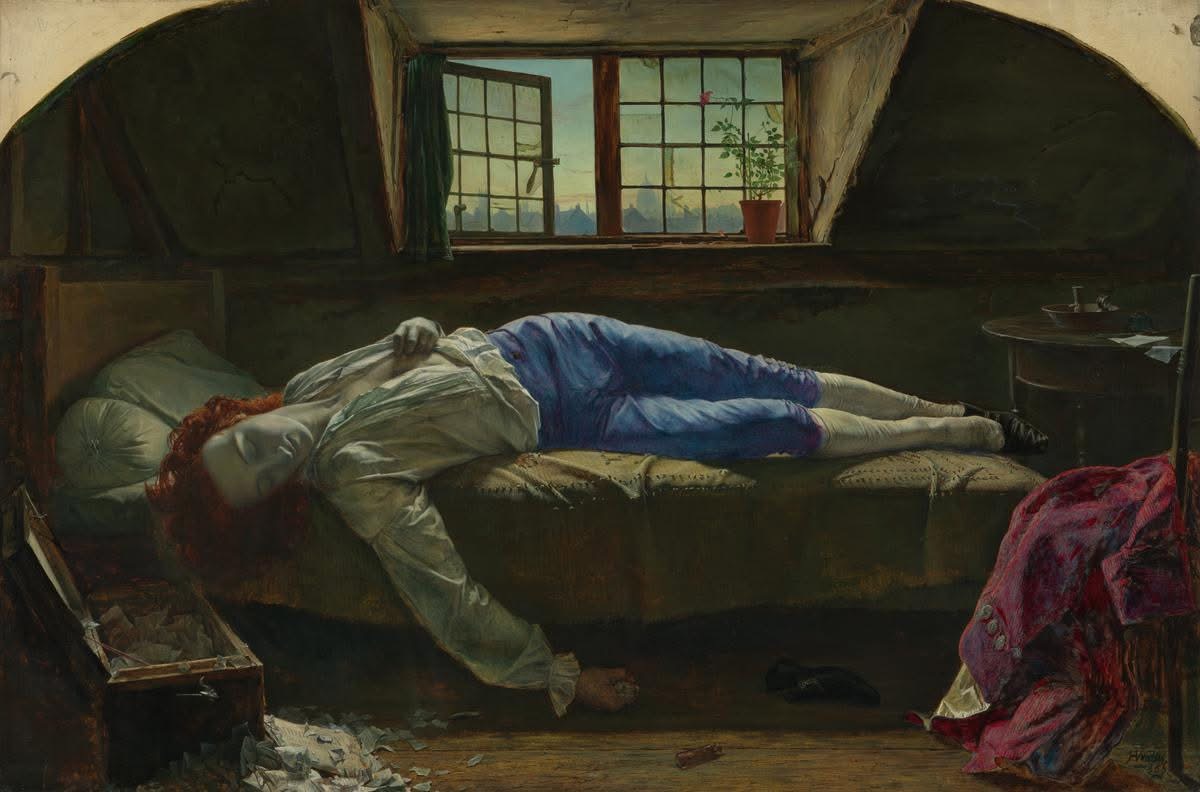
Art- Chatterton, 1856, Henry Wallis. Visual description-The painting depicts the impoverished late 18th-century poet Thomas Chatterton, who poisoned himself in despair at the age of seventeen, and was considered a Romantic hero for many young and struggling artists at the time. The poet is lying on a bed, his eyes closed and his long red hair falling away underneath an open window.

 GreatCosmicMothersUnite