

Tag: communication
Family Court Nightmare for Mom
19 Year-Old Sues Family Court Officials for $250 Million for Taking Her Away from Mom; Giving Custody to Father
Defendants Include Lawyers, Social Workers, Evaluators, GAL’s
“The defendants conspired to deny Annelise access to the courts and intentionally inflicted emotional distress on Annelise while she was still a minor. Defendants knowingly interfered with Annelise’s constitutional right to a relationship with her mother and four siblings, causing inordinate stress and difficulty.”
– Dede Evavold, blogger at Red Herring Alert
Annelise Rice, a hockey player at UND [University of North Dakota] and graduate of Minnetonka High School, filed a lawsuit on March 17, 2017, in Minnesota federal court seeking damages for deprivation of civil rights by tortuous [sic] intervention [interference] in a mother-child relationship and deprivation of rights under color of the law (Civil Action No. 17-cv-796 ADM/HB).
…The defendants include court-appointed Guardians at litem, Social Workers, and lawyers who were involved in the custody evaluation and CHIPS (Child in Need of Protection or Services) proceedings for Annelise Rice.
…Judges, lawyers, and social workers no longer have absolute immunity and can be held responsible for their actions that deprive Constitutional rights, even if they are acting in an official role.
This case is highly unusual due to the large amount of defendants involved.
…Annelise asks the court for relief in an amount great enough to deter defendants and others in similar positions from engaging in this egregious misconduct in the future. There have been many cases of negligence by social services that have put young lives at risk.
Social workers, Guardians at litem, lawyers, and judges need to be held accountable to prevent further neglect, abuse, and deaths of children in protective care. This lawsuit could potentially turn into a class action suit, because of the amount of families that have been mistreated in this way. Contact: Annelise Rice at More.moxie@me.com
EXCERPTS from:
19 YEAR-OLD SUES FOR DEPRIVATION OF CIVIL RIGHTS
SUMMARY:
Annelise’s mom, Caroline, went from being a stay-at-home mom to losing custody of her five children. When the father decided he wanted to take the kids away from his ex, family court officials, led by Judge Richard Perkins, kicked into gear and made that happen. Full custody was awarded to the father, even though the children testified to horrible physical abuse by him.
At one point, Annelise ran away from her father and fled to Canada with her mom, however they were caught and Caroline was jailed. Caroline was jailed three times in her many attempts to protect her children, and she was tormented there in an effort to break and silence her.
Judge Perkins presided over the prosecution of Caroline for “abduction”, which was a clear conflict of interest, and at which she, not surprisingly, was convicted. But the appellate court actually overturned her conviction citing Judge Perkins’ biased handling of the case, including exclusion of evidence of the father’s abuse from the jury. So there was some due process for Caroline at the appellate level, which is unusual.
The children have spoken about the pain of losing their mother for many years.
COALITION NOTE: The sheer number of court-affiliated officials whom Annelise is suing spotlights the systemic coordination to empower fathers to take custody of their children—and that is not an exhaustive list. There are likely many more professionals who participated. Most cases in which a mother is trying to keep or protect her children involves many court-affiliated professionals who go along with the agenda and help the father win custody—whether he is abusive or just wants to avoid child support.
It is unclear why Judge Richard Perkins is not included in the lawsuit, since the article asserts that judges can now be held accountable through these civil rights lawsuits, and especially since an appellate court found Judge Perkins to have been biased.
It is also unclear who the judge is on Annelise’s federal civil rights case. The docket states that it is Judge Ann Montgomery, but that it is referred to Judge Hildy Bowbeer. Hopefully, whoever it is will not dismiss the case and will make fair rulings.
Answers to Annelise’s complaint are due in June. Watch this space for updates.
Previous Safe Kids post:
Judge Richard Perkins Held Accountable for Covering Up Abuse!
Some of the story as told by Annelise’s older sister, Lauren
[Pictured: Annelise and Caroline (top left); Judge Ann Montgomery (left middle); Judge Hildy Bowbeer (left bottom); Annelise (right)]

Detachment of adult child
The detachment a mother experiences when letting go of an adult child is a multifaceted and often profound emotional process.
Its not a sudden severing of ties, but rather a gradual shift in the mother-child relationship as the child transitions into independence.
Heres a breakdown of what this detachment can entail:
Emotional Shifts:
* A Sense of Loss and Grief:
Even though its a natural progression, mothers can experience a sense of loss akin to grief.
This can stem from the changing daily interactions, the feeling of no longer being the primary caregiver and the realization that their childs life is now largely separate from their own.
The “empty nest syndrome” is a well-known manifestation of this.
* Letting Go of Control and Worry: Mothers have often spent years ensuring their childs safety and well-being.
Letting go involves relinquishing a degree of control and learning to trust their adult child’s decisions, even if they differ from their own.
This can be a source of anxiety and worry for some mothers.
* Redefining Identity:
For many mothers, a significant part of their identity is tied to being a parent.
As their children become independent, they may need to redefine their role and sense of purpose beyond active mothering.
This can be a time of self-discovery but also potential uncertainty.
* Mixed Emotions:
The detachment process often involves a complex mix of emotions.
There can be sadness and nostalgia for the past but also pride and joy in seeing their child thrive.
There might be relief at having more personal time, coupled with a pang of missing the daily connection.
* Emotional Distance (Healthy vs. Unhealthy):
A healthy detachment involves creating appropriate emotional boundaries, allowing the adult child to navigate their own life while still offering support when needed.
Unhealthy detachment can manifest as emotional unavailability, disinterest, or a premature pushing away, which can harm the parent-child relationship.
Behavioral and Relational Changes:
* Shifting from Caregiver to Supporter:
The mothers role evolves from direct caregiving to offering emotional support, guidance (when asked), and a safety net.
The dynamic becomes more adult-to-adult.
* Respecting Boundaries:
A crucial aspect of healthy detachment is respecting the adult child’s boundaries regarding their personal life, decisions and space. This can be challenging after years of being deeply involved.
* Less Frequent Direct Involvement:
Daily interactions and involvement in the childs life naturally decrease as the adult child establishes their own routines, relationships and responsibilities.
* New Forms of Connection:
The relationship doesnt necessarily diminish but transforms.
Connection might shift to less frequent but more meaningful interactions, focusing on shared interests and mutual respect.
Psychological Aspects:
* Attachment Theory:
This theory suggests that the bond between parent and child evolves over time.
Healthy detachment in adulthood signifies a secure attachment where the child feels confident to explore independently, knowing the parent is still a secure base to return to if needed.
* Developmental Stages:
Both the parent and the adult child are navigating new developmental stages.
The mother might be entering a phase of re-focusing on personal goals, while the child is establishing their independence.
* Individual Differences:
The experience of detachment varies greatly among mothers.
Factors such as personality, the closeness of the previous relationship, the mothers support system and her own interests and activities play a significant role.
Challenges:
* Enabling vs. Supporting: Mothers may struggle with the balance between offering support and enabling dependence, hindering their childs growth.
* Difficulty Letting Go of the “Baby”:
It can be emotionally challenging to see a grown adult instead of the child they nurtured for so long.
* Societal Expectations: Sometimes, societal norms or personal expectations can make it difficult for mothers to embrace their changing role.
The detachment a mother goes through is a complex emotional and relational adjustment.
Its a necessary process that allows the adult child to fully step into their own life while ideally maintaining a loving and supportive, albeit different, relationship with their mother.
A healthy detachment fosters independence, mutual respect, and an evolving bond that reflects the changing needs of both individuals.
“Life is a balance between holding on and letting go.”
Rumi
On a personal note:
I Am going through this process right now and to be honest this has been one of the absolute most difficult things I have ever had to do.
I have practiced detachment for many years.
To some degree, I have had to let go of every single person I have ever loved.
But there is nothing, NOTHING, that can prepare a mother to learn how to detach from their child in a healthy, loving way.
I was talking with my husband and said to him:
“I feel lost.
The mother role is an identity I have lived with for 25+ years.
I dont know who I Am. And its confusing.”
He said to me:
“Maybe it’s not about who you are but about who you want to become.”
To the Mamas out there:
If you have gone through this or have yet to, just know that you are not alone, that every single feeling you experience upon the entire spectrum of emotion is VALID.
The only way to heal is to feel.
Bless your beautiful Mama hearts.
I bow deeply and with respect for the challenge we all share as being the Mothers.
One of the hardest things a mother will ever do is watch her heart walking around outside her chest and hope the world is gentle with it.
~Monique Satonin
Art: FreePik
Sacred Divine Feminine

Children’s Resilience
Stable Men
Moms Breaking Cycles 🙌
To the moms breaking cycles they never asked to be part of.
To the ones learning how to feel, how to cry, how to forgive, all while raising babies who won’t have to carry the same weight.
I see you.
It’s not easy healing from what hurt you while showing up with love, patience, and softness for your kids.
It’s not easy being the first to say “this ends with me.”
But it is brave. It is powerful. It is world-changing.
Keep going, mama.
Every time you choose connection over control, every time you apologize, every time you pause to breathe…
You are doing the work that will ripple through generations.
And that matters more than you know.
Narcissist: unable to love- Charlie McCready
Narcissistic alienating parents are characterised by a self-centred, manipulative, and exploitative nature. They prioritise their own needs, desires, and self-image above the well-being of others, including their children. Here are some key points:
Lack of empathy: Narcissistic individuals often struggle with empathy, which is the ability to understand and share the feelings of others. They have difficulty recognising and validating the emotional experiences of their children or anyone else in their lives. Their focus is primarily on themselves and their own needs.
Manipulative and controlling behaviour: Narcissistic parents tend to manipulate and control those around them to maintain a sense of power and superiority. They may use tactics such as gaslighting, guilt-tripping, emotional manipulation, and coercive control to assert dominance and maintain control over their children.
Exploitation of relationships: They view relationships as opportunities for personal gain rather than genuine connections based on mutual care and support. They may exploit their partner’s and their children’s love and loyalty to serve their own agenda, using them as extensions of themselves rather than recognising their autonomy and individual needs. This also goes for other family members and work associates, in fact, anyone in their lives.
Lack of genuine love and care: Narcissistic individuals struggle to experience and express genuine love and care for others. Their primary focus is obtaining admiration, attention, and validation. As a result, their relationships, including those with their children, lack the depth, emotional connection, and authentic care that healthy relationships require.
Superficial charm and manipulation: They often appear charming, charismatic, and even loving in the early stages of a relationship. However, their behaviour tends to be manipulative, self-serving, and inconsistent over time. Their actions are primarily driven by a need for control, admiration, and validation rather than genuine care and concern.
They lose interest when someone no longer ‘serves’ them. When someone calls out their behaviour, they’ll go on the attack to protect their interests/lies. It’s important to recognise that not all alienating parents are narcissistic, and not all narcissistic parents engage in parental alienation. But when these two dynamics intersect, the results can harm and damage the child’s well-being and the parent-child relationship.
#charliemccready
#parentalalienationcoach
#narcissisticabuseawareness
#narcissisticparent
#traumabonding

Emotionally Homeless
Man, make sure your woman is not emotionally homeless. She needs to feel safe, cherished, and deeply understood.
A woman who is emotionally homeless carries a silent pain. She may have a roof over her head, but if she doesn’t have a space where she feels truly seen, heard, and valued, she is wandering through life unanchored. Love is not just about physical presence; it is about emotional security. A man who loves her must ensure that his presence is a sanctuary, not a storm.
When a woman feels emotionally secure, she flourishes. She speaks her truth without fear, she loves without hesitation, and she trusts without doubt. But when she lacks that security, she withdraws. Her laughter becomes forced, her eyes lose their spark, and her heart begins to protect itself from the very love she once desired.
A man’s touch, words, and actions determine whether she feels at home or like a stranger in her own relationship. If she constantly questions her place in his life, if she feels like she must beg for attention, if her emotions are dismissed as “too much,” she will slowly start to detach. Not because she wants to, but because she has no choice.
A woman who is emotionally homeless may not leave immediately, but she will start to build walls. She will become quieter, less expressive, and more independent—not because she wants to be strong, but because she is forced to protect herself. And once she fully detaches, there is no love strong enough to bring her back.
The truth is, most women do not ask for grand gestures. They do not need a man to move mountains for them. What they need is consistency, reassurance, and a love that feels like home. They need to know that their emotions are not a burden, that their love is not one-sided, and that their vulnerability is safe in his hands.
Emotional homelessness in women is not just about neglect; it is about being in a relationship where she feels alone. She might have a man beside her, yet feel like she is fighting battles by herself. She might have a partner who loves her, yet feel completely misunderstood. And over time, this loneliness breaks her more than any physical distance ever could.
If a man truly loves his woman, he will make sure she never feels like a guest in his life. He will create space for her heart, her fears, her dreams, and her emotions. He will listen—not just to respond, but to understand. He will reassure her—not just with words, but with actions. He will stand beside her—not just when it is easy, but when she needs him the most.
A woman who feels emotionally at home is radiant. She gives love freely, she supports without resentment, and she trusts with an open heart. She doesn’t hold back, because she knows she is safe. But a woman who feels emotionally homeless starts to fade. And once she fades, no amount of love will bring her back to who she once was.
So, man, make sure your woman is not emotionally homeless. Be her safe place. Be the warmth she returns to, not the cold world she tries to escape.

Powerless Triggers – Charlie McCready
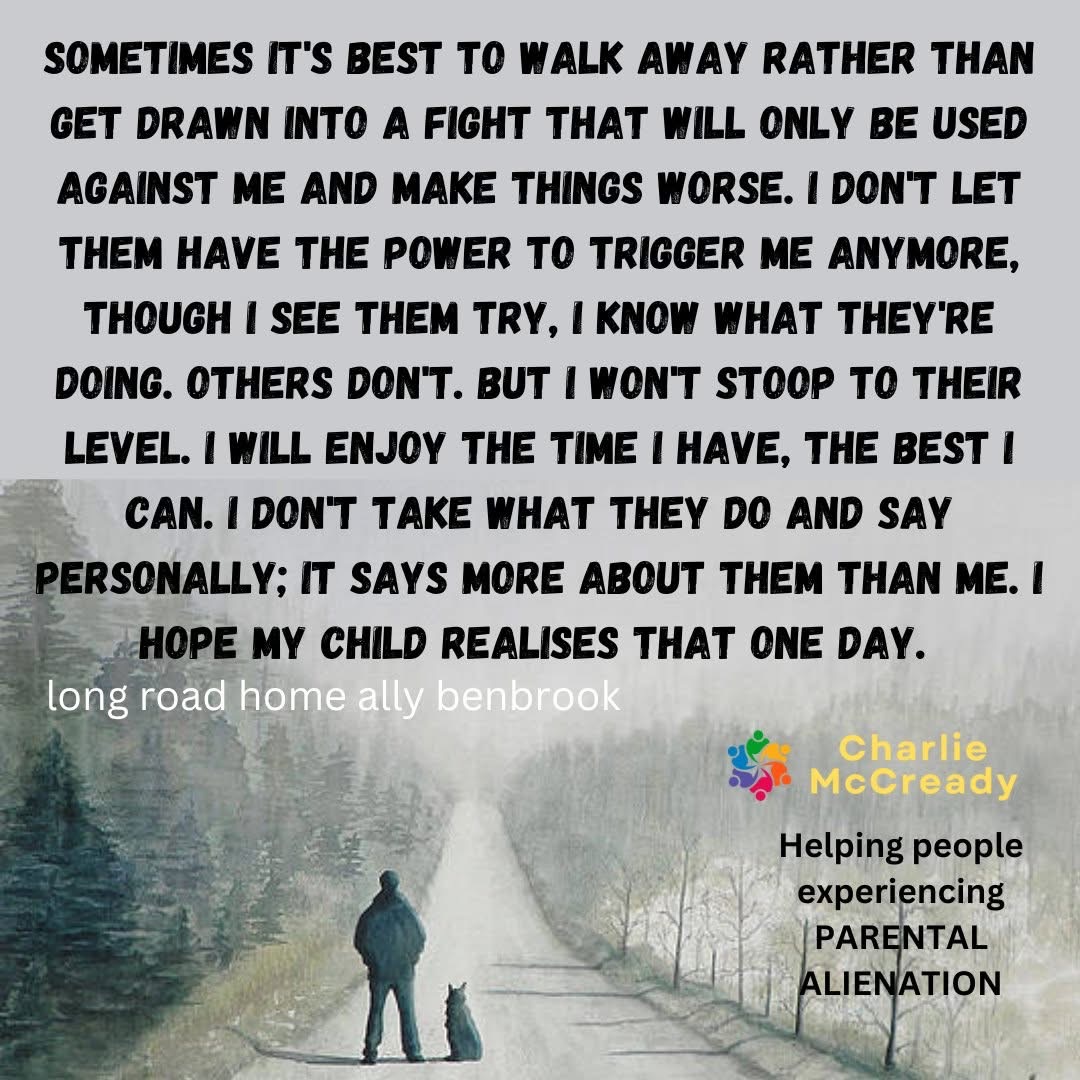
I’ve come to understand that this isn’t about me personally; it’s a deeply rooted attachment pathology, and complex family dynamic involving disordered parenting. It’s spiralled into a situation where my child’s thoughts, beliefs and behaviours have been significantly influenced – trauma-bonded, coercively controlled, emotionally manipulated. Learning about this has helped me see the bigger picture, though I am working on my sense of isolation, frustration, injustice, and of course the grief. There’s nothing like it. People say it’s like a ‘living bereavement’ and that’s so true. It seems people don’t truly understand this unless they’ve been through it, and alienated parents are united in feeling let down by the mental health and family court system.
Still, I’ve learned a lot. I’ve learned not to react to the hurtful behaviour anymore. Sometimes, I catch myself just shaking my head, thinking, ‘Oh, this again.’ It’s like recognising a pattern. I remind myself that ‘this too will pass.’ My focus now is on maintaining my love for my child, even if they can’t see it right now. Detaching with love has become my way of preserving our bond through this difficult time. Nobody can take the love I have for my child away from me. Nothing and no one.
Conscious parenting plays a significant role here. It’s about recognising the importance of my child’s emotional well-being even when they may not fully comprehend it themselves. So, I make an effort to create a safe and loving space for them whenever/should they ever walk through my door. My door, and my heart, are open. I don’t let their negative behaviour dictate my response. Instead, I model the behaviour I want them to see—unconditional love, patience, and understanding. It’s challenging, but it’s also empowering because I believe this will help me and it will help my child heal and come back into my life when they’re ready.
Meanwhile I’m getting on with my life and not feeling sad or guilty about it. I have my moments, but I’m focussing on the present not the past, the love not the loss. If I can do it, and I’ve been in the pits of despair believe me, I know you can too.
#charliemccready
#parentalalienationcoach
 GreatCosmicMothersUnite