Relationship with Narcissistic be like ….

In every toxic relationship, there comes a point where you look at your life and think, “Not This”. It could be a fleeting moment of awareness during your morning shower or when you’re being subjected to yet another silent treatment or triangulation event. ⁠

We all have “Not This” moments during the course of toxic relationships.⁠

It’s during our “Not This” moments that we can choose to start planning something different for ourselves. We may not know what that will look like, but in the moment, it doesn’t matter. All we know is “Not This”. There is no turning back.⁠

Or, after the dust settles, we may choose to “work on” the relationship because staying means less upheaval than leaving. At least with a toxic partner, we know what to expect. ⁠

Getting out on one’s own is often a scary proposition, so we choose to stay in “Not This”, thereby setting ourselves up for a life of emotional ruin. You’ll look back on all the years you wasted and realize things haven’t changed at all.⁠

But, every passing minute is a chance to turn it all around. I have several resources for you if you’re ready, or even if you’re just thinking about it…⁠

👉 https://linktr.ee/kim.saeed

Xo (◍•ᴗ•◍)♡ ✧*。⁠

#healing #breakinghabits #emotions #emotionalhealth #hope #selflove #emotionalwellness #narcissisticabuserecovery

Childress : Not an Attorney

I am a psychologist, not an attorney. But from where I sit, attorneys are failing.

To me, as a psychologist, parents in the family courts represent a category, a class of people. They are a particularly vulnerable class of people because their rights to self-determination and autonomy in decision-making is compromised by the court’s involvement.

This vulnerable population has been expelled from clinical psychology (treatment) and has been given their own “special” psychologists for this group alone. No other pathology has their own “special” psychologists – not ADHD, or autism, or eating disorders. All of those pathologies (problems) are treated by clincal psychologists.

Only court-involved families are restricted to their own “special” psychologists created just for them, just for this special class of parents for no other reason than their court involvement… with compromised autonomy in decision-making and restricted rights of self-determination.

Because “forensic” psychology is a “sub-specialty” practice, all licensing board complaints are given to other forensic psychologists on the licensing boards for review… and they all do the same thing. They are allowed to self-review – there is no oversight of the forensic psychologists by anyone other than other forensic psychologists.

The field of “forensic” psychology needs outside and independent review. It is a cesspool of professional practice. Where are the licensing boards enforcing ethical standards of practice? Nowhere to be seen… which is why it’s a cesspool.

The licensing boards are corrupt with the influence of exactly the “forensic” psychologists they are tasked with reviewing. The practices of forensic psychology in the family courts need outside and independent review.

Do not get a forensic custody evaluation. Parents want a proper risk assessment for possible child abuse, i.e., a possible shared persecutory delusion with the allied parent as the primary case – which would be a DSM-5 diagnosis of V995.51 Child Psychological Abuse.

Forensic psychologists are ignorant, incompetent, and unethical. I am willing to debate this anytime with anyone, send me the date, time, and platform log-in: The Role of Forensic vs. Clinical Psychology in the Family Courts – Dr. Childress representing clinical psychology and Anyone representing forensic psychology.

I’d like to see a debate sponsored by a law school.

But maybe if the attorney world isn’t able to generate a class-action lawsuit with the AFCC and APA as deep-pockets on something like what’s happening in the family courts (I think it warrants a RICO racketeering look), maybe the legal profession isn’t up the the task of self-examination.

I guess I’ll just have to solve this entirely as a lone clinical psychologist using the power of diagnosis. Because I’m not a lawyer, I never went to law school, I went to psychology school instead so I don’t know legal stuff.

But from where I sit as a clinical psychologist, the attorneys are failing. Or maybe you just haven’t found the right attorneys. I wonder if the ACLU might have an opinion on your situation?

Craig Childress, Psy.D.
Clinical Psychologist, CA PSY 18857

The thing about her

“That’s the thing about her.

She was sensitive, loving, kindhearted, and soft.

She felt what you felt.

She felt your happiness, worry, stress, and pain.

Yet she was strong willed and she took no crap.

She voiced her opinion and thoughts, and she stood up for those she cared about.

She wasn’t always that way.

She was made into that at a young age.

Trauma shaped her.

Maybe that was a good thing.

Maybe she had to go through all that to become the person she is today.

A mix of both heaven and hell. Softness and strength.

Chaos and wild.

Fragility, and steadiness.

Follows the rules, yet goes against the crowd.

She could break glass ceilings with eloquent precision.”~

~Michele, Simple Elegance

Cycle Breaking

Cycle-Breaking

We come into our lives with things we want to learn and things we still need to heal from past lifetimes. We also come into families where sometimes unhealthy patterns run rampant. It has been proven in studies that trauma responses as well as inclinations towards addictions can and are passed down through DNA. They have also shown how healing ourselves helps to heal and change our own dna as well as that of those closest to us. This is called epigenetics.
Although we each come with our own life paths and missions, we can choose to heal or discontinue unhealthy patterns at any time.
Some are born cycle-breakers who have never fit in with their families. Others come to this as we age and realize that we do not truly feel happy and we begin to examine why.

  1. Once we identify a pattern that we’d like to discontinue, we must acknowledge how we have been affected by it already. There are many different issues and thought-patterns that we may have brought forward from past lives that our families have solidified for us. Even things such as over-concern with material wealth, physical beauty in the extreme, narcissism, an innate distrust of women, men, authority, certain places or the holding of family secrets can come down the line. How have we been affected by those things? How does it color our thoughts? What stories have we created around it? Are we ready to break the cycle?
  2. When we feel fully committed to ending the cycle, we can engage help. Therapists, energy practitioners, doctors, support groups are all available to help us unearth as much information as we can and help us build our confidence in ourselves and moving towards Truth. Combing through our beliefs, day-to-day thoughts, and the WHY behind our distrust and our fear will help us understand our parts as well as what behaviors were learned or given to us through dna. Maybe some behaviors or beliefs were coping mechanisms. It’s time to examine our decisions and maybe make some new choices.
  3. This is where we take serious action. We could tell the truth to end the secret keeping. Maybe we need to break ties with unhealthy or abusive people. We could stop using alcohol, drugs, gambling, sex, and/or food as a way of coping. We could probably benefit from better boundaries and acknowledging the ego games we are engaged in and WHY. This is meaningful, profound work. Expect tears. And a feeling of intense freedom.
  4. Our behaviors will change as our thoughts and beliefs change.
    Others will notice. They may choose to grow with us, or they may hold tighter to the things we are letting go of. It is up to us if we choose to stay in relationships with anyone, ever. Growing and ending cycles can feel lonely. As we let others go, we make room for healthier relationships in our lives.
  5. Animosity does not need to be a part of any of this. We are working on ourselves to end the cycles that we have been in. Boundaries can feel hard at first, until we see how much better we feel when we make better choices for ourselves.
  6. The thing about cycle-breaking is that it in itself is a cycle. We are on a spiral upwards and we can, if we choose, continue to notice what is unhealthy and move towards healing at all times.

Here’s to FEELING, DEALING AND HEALING in every possible way. The crap can stop with us, and our well-being and work towards it can change the color of our skies, not only for us, but for those whose lives we affect as well. ❤
-Nicki

Love is not a cage

True, deep longing love desires the very best for the person who receives our affections,

even if in achieving their highest form and happiness they are taken away.

The highest form of love is not a cage,

but the open sky.

The highest test of this love is letting go and trusting everything will happen for the best.

The highest and most divine love is a form of non-striving and trust.

Letting go instead of trying to control.

Even if letting go rends your heart in two,

let it bleed and continue to love till you can smile.

Art ≈ NICOLAS NADJA

Child Psychological Abuse NOT Parental Alienation- Childress

Stop using “parental alienation” in a professional capacity, it will only lead you to your destruction. Use Child Psychological Abuse instead.

“I am concerned the other parent is psychologically abusing our child. I am concerned that the other parent has formed a shared persecutory delusion with my child targeting me, that is destroying my child’s attachment bond to me… as described in these quotes from Walters & Friedlander.

From Walters & Friedlander: “In some RRD families [resist-refuse dynamic], a parent’s underlying encapsulated delusion about the other parent is at the root of the intractability (cf. Johnston & Campbell, 1988, p. 53ff; Childress, 2013). An encapsulated delusion is a fixed, circumscribed belief that persists over time and is not altered by evidence of the inaccuracy of the belief.” (Walters & Friedlander, 2016, p. 426)

From Walters & Friedlander: “When alienation is the predominant factor in the RRD [resist-refuse dynamic}, the theme of the favored parent’s fixed delusion often is that the rejected parent is sexually, physically, and/or emotionally abusing the child. The child may come to share the parent’s encapsulated delusion and to regard the beliefs as his/her own (cf. Childress, 2013).” (Walters & Friedlander, 2016, p. 426)

Walters, M. G., & Friedlander, S. (2016). When a child rejects a parent: Working with the intractable resist/refuse dynamic. Family Court Review, 54(3), 424–445. 

“I’d like a risk assessment for possible Child Psychological Abuse surrounding a possible shared persecutory delusion of the other parent with the child.”

Craig Childress, Psy.D.

Clinical Psychologist, CA PSY 18857

No Value : Childress

You are of no value.

Mothers are of no value. Fathers are of no value. This is a pathology of lies.

The central theme is a select person is of no value. Which person is selected, whether it is the mother or father in the family, depends on the circumstances of the pathology. It is always the other person in a partnership who is of no value

I am your everything. They are of no value. This is a pathology of lies. This is a pathology of projection.

Mothers are of value. Fathers are of value. Human beings are of value. No one is of “no value” – that is a perverse belief. Who holds that belief that another human being is of no value?

Anyone who holds the belief that another person is of no value is pathological and pathogenic. Everyone is of value just for being. Mothers are valuable to their children, they are irreplaceable and unique. Fathers are of value to their children, they are irreplaceable and unique.

Who taught this child that people are of no value? Who taught this child that their mother is of no value? Who taught this child that their father is of no value? Who taught this child that people are of no value? That is perverse instruction in values.

This is a pathology of lies. Where is the origin for this lie? Who is of “no value” – no one who is here. Who then?

Them. The one who holds the pathology and is expressing it, the pathological parent is the holder of the “no value” theme – they believe they are of no value – to the core of their being. That is the pathogen in their attachment networks… the damage from the failure of parental empathy… they are of no value.

Zero. None.

They collapse into an abyss at their core, they must avoid their core at all costs. They need constant emotional supply to their fragile narcissism to avoid the gravitational pull of the black hole at their core, they are on the edge of collapse into the dark abyss of the truth, that they are of no value.

They are the source of the lie. They spread the lie about others, that they are of no value, to give themselves value.. they are more than nothing, almost… as long as no one uncovers their secret. Their secret that they are of no value. They are fundamentally unlovable just because of who they are.

This is a pathology of lies. No human is of no value. All mothers are valuable. All fathers are valuable. Because of love.

They are empty and malevolent people. There is no love in them. They are damaged and broken inside. They are Dark personalities of cruelty. They need love.

The child loves them. The child’s love gives them value. They are of value because the child loves them, they are of value to us because we love the child. They are of value because of the child.

That’s mom. That’s dad. All mothers have value. All fathers have value. This is a pathology of lies. Everyone has value simply by the nature of their humanity. No one is without value.

No one is without value.

Who holds that belief? Where is the perversion among us? Who believes people are of no value, anyone? Who spreads that lie into us? Who teaches that lie to the child?

There are mental health people who believe that perversion of humanity, that someone is of no value. They believe that mothers and fathers are of no value because of this-and-that reason for justification.

They are wrong… immensely wrong… they are perverse in their beliefs. Everyone is of value, no one is of no value. These mental health people are the pathology, and they are pathogenic. Everyone – everyone – is of value.

Even the allied parent. We never reject family… not even them. Because they are of value simply because… and more… because they are loved… by the child… and by us because we love the child and the child loves that parent.

The child will not abandon that parent to the abyss. To rescue the child we must understand the child’s love. We must rescue everyone, because everyone is of value.

The child is of value… immense value. The child loves two humans, one is mom, a unique human being, one is dad, a unique human being. Both mom and dad are of immense value to the child.

To understand the child’s value is to understand the child’s love. The child only has one unique mother, who is of immense value to the child. The child only has one unique father, who is immense value to the child. Simply because they are mom and dad. Simply because the child’s love gives them immense value to the child.

Who says mothers are of no value to the child? Who says fathers are of no value to the child? This is a perverse belief of cruelty and a lie. This is a pathology of lies.

The premise, the ground of truth we stand on, is that everyone has value. Especially mothers. Especially fathers.

Who says mothers are of no value? Who says fathers are of no value? Who spreads that perversion? Who spreads that lie? Who teaches the child that people are of no value?

That is a perverse teaching, That is a perverse value. That is a lie.

This is a trauma pathology, a rippling of unresolved trauma across generations. It ripples in the patterns that formed it, the rock of the abuse that created the splash of the trauma, that now ripples out across time.

The patterned theme is that someone is of “no value” – who is of no value in the trauma-across-time? The child – the abused child is of no value. The failure of parental empathy is the abuse, and the abuse is the failure of parental empathy… the child is of no value.

Zero. Nothing.

This is a pathology of lies. It is born in lies, it continues in lies. The child – now turned in a fragile mind to be the “bad parent” – is of no value.

You can go away now. The child loves me and not you. You are of no value, I am the everything of love for the child. The child loves me and not you. Because I need the child’s love to be of value. If the child loves you, they won’t love me… because I am of no value.

This is a pathology of lies.

Craig Childress, Psy.D.
Clinical Psychologist, CA PSY 18857

Triangles : Childress

There are no two-person arguments in a family. In a family, conflict always breaks down into a three-person triangle.

Bowen Center: “A triangle is a three-person relationship system. It is considered the building block or “molecule” of larger emotional systems because a triangle is the smallest stable relationship system. A two-person system is unstable because it tolerates little tension before involving a third person. A triangle can contain much more tension without involving another person because the tension can shift around three relationships. If the tension is too high for one triangle to contain, it spreads to a series of “interlocking” triangles. Spreading the tension can stabilize a system, but nothing is resolved.”

Bowen Center: Triangles

https://www.thebowencenter.org/triangles

There are no two-person arguments in a family. Either they break down into a coalition of the parents against the child (called the “identified patient”), or into a coalition of a parent with the child against the other parent (called a “cross-generational coalition”).

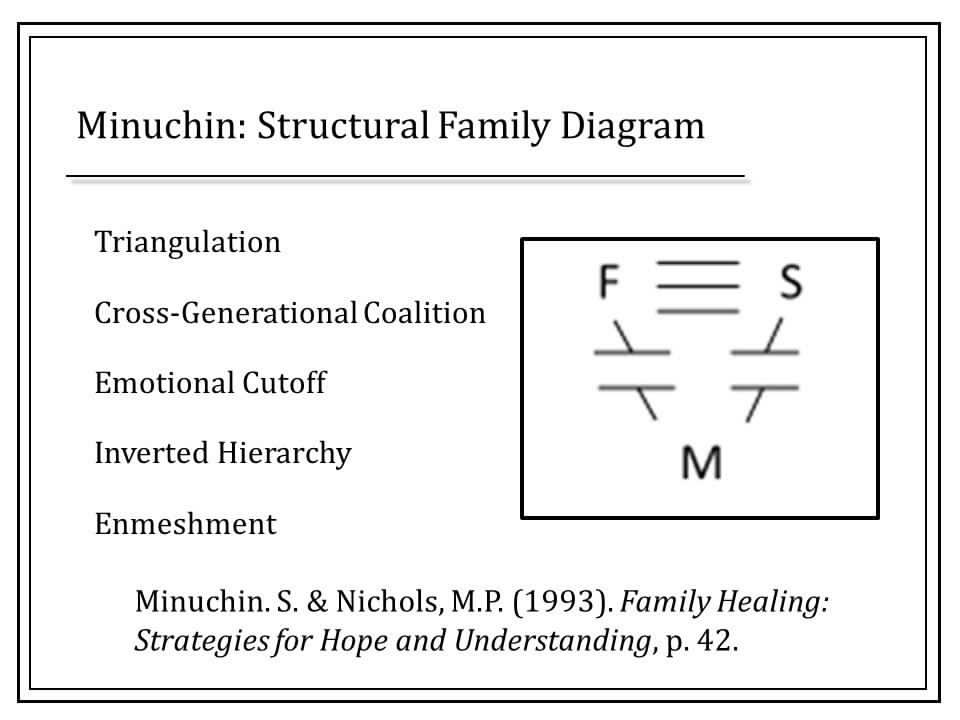
Salvador Minuchin, the founder of the Structural school of family systems therapy has a Structural family diagram depicting a cross-generational coalition of a father and son against the mother, resulting in an “emotional cutoff” (Bowen) in the child’s relationship with the mother.

Cloe Madanes, the co-founder of the Strategic school of family systems therapy, describes the cross-generational coalition in her 2018 book, Changing Relationships.

From Madanes: “In most organizations, families, and relationships, there is hierarchy: one person has more power and responsibility than another. Whenever there is hierarchy, there is the possibility of cross-generational coalitions. The husband and wife may argue over how the wife spends money. At a certain point, the wife might enlist the older son into a coalition against the husband. Mother and son may talk disparagingly about the father and to the father, and secretly plot about how to influence or deceive him. The wife’s coalition with the son gives her power in relation to the husband and limits the husband’s power over how she spends money. The wife now has an ally in her battle with her husband, and the husband now runs the risk of alienating his son.”

From Madanes: “Such a cross-generational coalition can stabilize a marriage, but it creates a triangle that weakens the position of both husband and wife. Now the son has the source of power over both of them. Cross-generational coalitions take different forms in different families (Madanes, 2009). The grandparent may side the grandchild against a parent. An aunt might side with the niece against her father. A husband might join his father against the wife.

From Madanes: “These alliances are most often covert and are rarely expressed verbally. They involve painful conflicts that can continue for years. Sometimes cross-generational coalitions are overt. A wife might confide her marital problems to her child and in this way antagonize the child against the father. Parents may criticize a grandparent and create a conflict in the child who loves both the grandparent and the parents. This child may feel conflicted as a result, suffering because his or her loyalties are divided.”

Jay-Haley, the other co-founder of Strategic family systems therapy provides the professional definition of a cross-generational coalition.

From Haley: “The people responding to each other in the triangle are not peers, but one of them is of a different generation from the other two… In the process of their interaction together, the person of one generation forms a coalition with the person of the other generation against his peer. By ‘coalition’ is meant a process of joint action which is against the third person… The coalition between the two persons is denied. That is, there is certain behavior which indicates a coalition which, when it is queried, will be denied as a coalition… In essence, the perverse triangle is one in which the separation of generations is breached in a covert way. When this occurs as a repetitive pattern, the system will be pathological.” (Haley, 1977, p. 37)

Notice Haley calls the cross-generational coalition a “perverse triangle.”

These are the top people in family systems therapy – Bowen – Minuchin – Madanes – Haley.

Do you think family systems therapy would be relevant to apply to family conflict in the courts?

Yes.

Do they apply family systems constructs and principles to their work with family conflict in the courts?

No.

Is that unethical practice in violation of Standard 2.04 Bases for Scientific and Professional Judgments that requires – mandatory – that psychologists apply the “established scientific and professional knowledge of the disciple” as the bases for their professional judgments?

Yes.

Do they even know family systems constructs and principles when assessing and treating family conflicts?

No.

Are they in violation of Standard 2.01 of the APA ethics code for practicing beyond the boundaries of their competence?

Yes.

Do the licensing boards care that they are in violation of Standards 2.04 and 2.01 of the APA ethics code?

No.

Why not?

I don’t know. Someone should ask them and find out why they don’t enforce ethical standards of practice in the family courts.

Don’t you deserve to have ethical and competent psychologists treating you and your children?

Apparently not.

Craig Childress, Psy.D.

Clinical Psychologist, CA PSY 18857
Karma is gonna tag the Distorted Energy that is Narcissistic

Awareness of the laws of cause and effect has been the base of my authentic self upon reflection .

I took responsibly for 14 months younger brother and was highly empathetic to him which was too much responsibility as a toddler .

Aware of his misdirected, anger , need to avenge lasting decades and this showing up in stage 5 kidney disease .

Brother is part of a solid marriage , and many intense men talk to me for hours pre COVID as we bond in some common core truths and I hear how awesome I am and of course the same is true of them and I always shine a light towards my communication (so I’m told )

But very harsh lessons have tempered my concern in other but surrender to free will and the journey that’s very necessary and individual .

My priority is my earth home and a safe reliable new SUV , foodstuffs and peace ☮️

Blessings & Peace

Dona Luna

youtube.com/watch