
Meeting of Two Persons by Dan L. Edmunds, Ed.D

From.MEETING OF TWO PERSONS

| Dan L. Edmunds, Ed.D.

What is termed “madness” or “mental illness” is for some the only means for expression of their being lost and confused in a world which has caused them deep hurt and pain. Such is not disease but behavior with metaphorical meaning. There has been received through life mixed messages and placement into situations where regardless of the option they chose they felt damned. They seek to break out from the reality which has only caused them distress. The development of hallucinations and delusions are all metaphors for the very real demons they have encountered in a disordered society. tweet

The inner mind, the voice within us, becomes amplified and becomes “possessed” with the demons coming forward from the trauma and distress which has been encountered. Rebellion against the system of things becomes self-destructive as the person seeks to send a message to the world of their distress, but it remains unheard. Each coping mechanism that has been employed has often led to failure and not brought them out of the unlivable situation that is their life. However, the catharsis of this pain and grief can go in two directions – it can be misery and existential death, or it can be transformative.
Through the pain and struggle, through the breaking out of the “typical reality” one can journey through various modes of altered consciousness. Many deemed “mad” speak of the supernatural. They have sought every attempt to reach out and create meaning. If they can be helped by a loving, supportive network to navigate through this state of confusion and the various realms of altered consciousness towards rebuilding and reconstructing a life of meaning, then they can come forward to a recovery that gives them valuable insight about human nature, who they really are, and the reality of the impermanence of this life and the world around us. They will find that suffering is inevitable, and in that suffering is the state of the world that is mired in greed and attachment. The ones deemed “mad” have accomplished a rare task – they have completely detached. But this detachment is only from the typical standards of the world. They remain haunted by the visions of their previous life.
They cannot escape it, and thus they become anxious and paranoid that something or someone will pull them back to that painful existence. At times, rage comes forward as the reaction to challenges, but who would not be outraged if their voice was suppressed and they became the scapegoat for the problems of their families or those around them? Those deemed “mad”, feeling always alone, depart to a world where they remain alone from people, yet may create for themselves beings who give them comfort and solace. This is really the end of their search, to simply be accepted and loved. But here too lies a problem, for when their lives have been devoid of love and they receive unconditional love, it becomes like an overwhelming fire that consumes them. They have never been loved, so how can they respond to an outpouring of love?
When all they knew was that oppression and coercion was said to be because “we love you”, when “love” really was only about control, how can the person then understand genuine love? Once again, the confusion sets in. To reach the person who has been deemed “mad”, we cannot overwhelm. Our sincerity will not be enough, for their trust has been shattered time and time again. It is only through entering their world for what it is, by joining in, and learning to speak the language of madness, that we ourselves can begin to understand the experience of these individuals. It is only by this joining in that the person may have the chance for the journey known as “madness” to reach a transformative movement towards recovery.
Haint Blue Ceilings

Few People Know The Real Reason Porch Ceilings In The South Are Painted Haint Blue In Color:

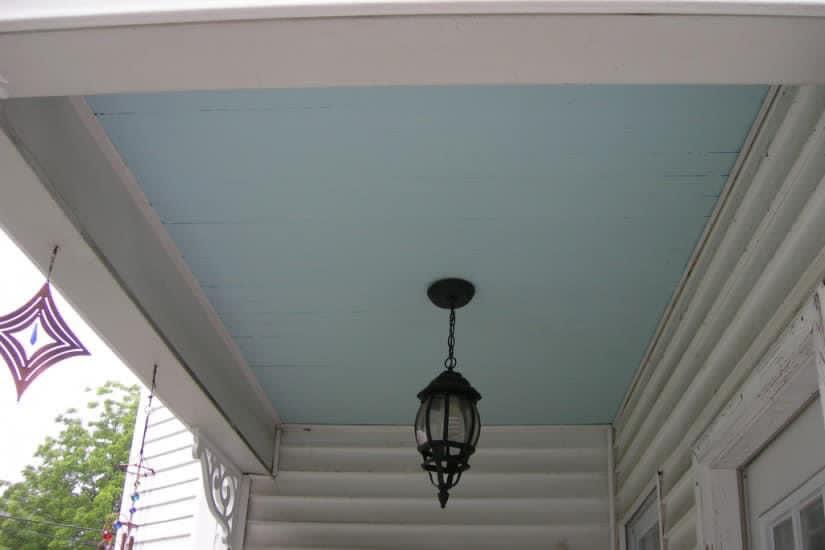
Raise your hand if your porch ceiling is painted light blue. Welcome to the South, where a light blue front porch ceiling is a common feature of many homes, especially older ones.

It originated in the Gullah culture of South Carolina, where porch ceilings were painted “Haint Blue” to ward off evil spirits from the home. Because rumor had it that spirits wouldn’t cross water, porch ceilings were painted light blue or greenish-blue to mimic a water surface. The Gullah tradition spread throughout the southern states, and warding off ghosts is one big reason people give for the haint-blue ceilings found on porches of homes.

But there’s another, perhaps even more common reason cited for such a practice. Light blue ceilings are said to discourage wasps from building their nests on the ceiling of your porch, because the light blue color tricks the unwelcome insects into thinking the ceiling is part of the sky. Apparently, spiders (and perhaps even other bug pests) are discouraged from hanging out on the porch for the same reason.

There’s some question whether it’s the color that actually repels these insects or the fact that lye, a natural insect repellent, was mixed in with the paint when this tradition started.

Plus, light blue is a cool, refreshing, calming color that reflects plenty of light into the shade of a front porch, making it the perfect canopy for a pleasant interlude spent swaying gently in a rocker or a porch swing while you watch the world go by.

🔹Read more at https://en.m.wikipedia.org/wiki/Haint_blue

Childress on Child Abuse

In the absence of child abuse, parents have the right to parent according to their cultural values, their personal values, and their religious values.

In the absence of child abuse, each parent should have as much time and involvement with their child as possible.

In the absence of child abuse, to restrict either parent’s time and involvement with their child would damage the child’s attachment bond to that parent, thereby harming the child and harming the parent.

Is there child abuse? Let’s get a proper risk assessment for possible child abuse.

Either,

1) child abuse by the targeted parent accounting for the child’s attachment pathology toward that parent,

Or.

2) child psychological abuse by the allied parent, i.e., a shared persecutory delusion created by the collapse of a narcissistic-borderline personality parent surrounding divorce.

One way or the other, we’re looking at a likely child abuse diagnosis. We need a proper risk assessment for possible child abuse.

From Walters & Friedlander: “In some RRD families [resist-refuse dynamic], a parent’s underlying encapsulated delusion about the other parent is at the root of the intractability (cf. Johnston & Campbell, 1988, p. 53ff; Childress, 2013). An encapsulated delusion is a fixed, circumscribed belief that persists over time and is not altered by evidence of the inaccuracy of the belief.” (Walters & Friedlander, 2016, p. 426)

From Walters & Friedlander: “When alienation is the predominant factor in the RRD [resist-refuse dynamic}, the theme of the favored parent’s fixed delusion often is that the rejected parent is sexually, physically, and/or emotionally abusing the child. The child may come to share the parent’s encapsulated delusion and to regard the beliefs as his/her own (cf. Childress, 2013).” (Walters & Friedlander, 2016, p. 426)

Walters, M. G., & Friedlander, S. (2016). When a child rejects a parent: Working with the intractable resist/refuse dynamic. Family Court Review, 54(3), 424–445.

What is the diagnosis? Is there a shared persecutory delusion? We need an answer to that question.

If the mental health person cannot answer that question – is there a shared persecutory delusion? – then they are pointless to the situation because we need an answer to that question.

IT… IS… SIMPLE. Is there a shared persecutory delusion? Yes? No?

How do they know if they don’t even look to see? Do the child’s symptoms meet diagnostic criteria for a persecutory delusion? How about we use Item 11 on the Brief Psychiatric Rating Scale for Unusual Thought Content (delusions), “one of the oldest, most widely used scales to measure psychotic symptoms,” to rate the delusional quality of the belief.

Or you can write the answer on a napkin. Tell us by smoke signals for all I care… we just need an answer, is there a shared persecutory delusion – a fixed and false belief in supposed “victimization”?

The treatment for cancer is different than the treatment for diabetes. Diagnosis guides treatment. If we treat cancer with insulin then the patient dies from the misdiagnosed cancer.

What is the diagnosis?

“I don’t diagnose, I don’t like to pathologize” Then you’re a pretty worthless person to the situation because we need a diagnosis.

Is there child abuse? V995.51 Child Psychological Abuse? Why are we not routinely getting an answer to that question for court-involved family conflict?

They deserve to lose their license. Look at all they’re putting you through because they won’t diagnose Child Psychological Abuse (V995.51) when it’s warranted. They have duty to protect obligations, and they are not protecting your child.

Knowledge is power. Planning is power. The pathogen is now-reactive. Plan ahead, move step-by-step on a linear path to the goal. You want a written treatment plan to fix things please.

Google mental health treatment plans and read the first two returns – one of those please.

Craig Childress, Psy.D.
Clinical Psychologist, CA PSY 18857

Alienated Parent Wins

What about the kids?

A win for a parent that has been alienated from his children!
My friend went to court on his divorce/custody case this morning. He has been alienated from his children since he made the choice to divorce a few months ago. Told the children did not want to see him and all of the usual tactics used against him. He was just asking for joint custody. She (the mother) only came to court to fight over the child support. She also brought the kids with her saying they would tell the judge they did not want to see him. Long story short- he saved all the messages and documentation, the judge spoke to the kids alone. The result was him getting full custody and her with zero visitation and she has to pay for counseling for the kids in addition to child support. The judge said it was one of the worst cases of parental alienation AND manipulation he had ever seen. So to all those going through something similar- hang in there, document everything- the truth will eventually come out.

Our Daughters

Our daughters need us not to be perfect.

They need us to be messy, raw, and real,

admitting our mistakes and apologizing for them,

pink in the cheeks with embarrassment, and feeling our feelings with tears in the corners of our eyes.

They need to hear us discussing our struggles with them. They weren’t there to witness them all, so they may think we never had any.

But let’s tell them what we overcame, so no shame exists between us, and they’ll feel comfortable revealing their authentic selves, too.

We want our daughters to view mistakes as an opportunity to learn and grow, not a failure.

Because gosh, we should be tired of hearing about girls uncomfortable in their skin, poking, prodding, and tugging at their stomachs when they don’t live up to their own expectations, looking in the mirror and feeling not enough.

So no, we shouldn’t want girls who smile pretty, don’t take risks, and keep themselves small stuck in a perfectionist mind.

We should want our girls strong, resilient, and BRAVE.

Girls who go after challenges just like our boys who are always encouraged to play rough, climb high, and reach for the stars.

So our daughters need us not to be perfect,

so, they, too, can reach for the stars for themselves, and each and every woman after them to become the brave and imperfect humans, they were meant to become.

– Danielle Sherman-Lazar

Childress : Second Opinion/ Parental Alienation

Just so we’re clear… for all you parents who are going to get a forensic custody evaluation for $20,000 – $40,000, you can add a surcharge of an additional $10,000 for a second-opinion review by Dr. Childress to correct the misguided errors in the forensic custody evaluation.

AND… I’m going to recommend that your family get a written treatment plan, and for that you’ll need a diagnosis… which the forensic custody evaluation did not provide. Therefore, you will need to get a clinical diagnostic assessment of the attachment-related pathology in your family for about $2,500 – $5,000 with tele-health second opinion.

Hmm, I have an idea… why don’t we skip the forensic custody evaluation and the second-opinion analysis of it from Dr. Childress and save all that money… and START with a clinical diagnostic assessment of the attachment pathology in your family.

You need a treatment plan. A treatment plan requires a diagnosis, the treatment for cancer is different than the treatment for diabetes. You need a clinical diagnostic assessment to return a diagnosis to guide the development of a written treatment plan.

So let’s do that. Let’s get a diagnostic assessment to see what the problem is, then get a written treatment plan to fix whatever the problem is.

We must first diagnose what the pathology is before we know how to treat it. We must first identify what the problem is before we know how to fix it.

Diagnosis = identify
Pathology = problem
Treatment = fix it

Forensic psychology is a failed experiment in service delivery to a vulnerable population. Clinical psychology needs to return. They will refuse, it’s too dangerous. We need to make it safe for them to return.

That’s my role. We start by establishing baseline standard of practice to which ALL mental health professionals can be held accountable.

All psychologists should be applying EXACTLY the same information (the best), to reach EXACTLY the same conclusions (accurate), and provide EXACTLY the same recommendations (effective).

Is there a shared persecutory delusion? What’s the answer? If not, why not? Is the belief system true?

Is there psychological abuse of the child (DSM-5 V995.51)? If not, why not? What more would need to happen for it to become Child Psychological Abuse (V995.51)?

Is there psychological and emotional abuse of the parent using the child as the weapon (DSM-5 V995.82)? If not, why not? What more would need to happen for it to become Spouse or Partner Abuse, Psychological?

Family law attorneys will need to establish the path through the court system – treatment not custody – we want a written treatment plan… for that we need a diagnostic risk assessment for possible child abuse.

Clinical psychologists need to return – treatment not custody. You will want DBT therapy (Linehan) for it’s structure and containment of personality disorder pathology, and you will want the attachment therapy of EFT (Johnson) to inform the court-adapted DBT family therapy.

Market demand. Supply follows money. You’re the solution. You just needed to be given a choice – forensic or clinical – custody or treatment.

Choose treatment to fix things. Forensic psychology fixes nothing – ever. Ask them. Do you diagnose things? No. Do you treat things? No. What do you do? They do forensic custody evaluations for $20,000 to $40,000 put an added Dr. Childress second-opinion corrective surcharge.

I suggest you don’t want one of those. I suggest you want a clinical diagnostic risk assessment – is there a shared persecutory delusion (Walters & Friedlander, 2016; Family Court Review)?

The assessment for a delusional thought disorder is a Mental Status Exam of thought and perception. Do they now how to conduct one? Dr. Childress does. Perhaps they should consult with Dr. Childress.

From Improving Diagnosis: “Clinicians may refer to or consult with other clinicians (formally or informally) to seek additional expertise about a patient’s health problem. The consult may help to confirm or reject the working diagnosis or may provide information on potential treatment options.” (Improving Diagnosis in Healthcare, 2015)

From Improving Diagnosis: “Clinicians can also recommend that the patient seek a second opinion from another clinician to verify their impressions of an uncertain diagnosis or if they believe that this would be helpful to the patient.” (Improving Diagnosis in Healthcare, 2015)

See. Get a second opinion.

Craig Childress, Psy.D.
Clinical Psychologist, PSY 18857