Being cheated on

Here’s the truth about being cheated on…

If you’ve been cheated on by the person you love, it doesn’t matter how much you love them, you need to understand that you deserve better and that it’s better to let them go.

When someone cheats on you, it changes who you are, and it changes how you think.

Because betrayal trauma is different; it’s one of the worst kinds.

Cheating is one of the most disrespectful and disgusting types of behaviour that someone can ever display in a relationship.

Most cheaters are some form of narcissists or at the very least have narcissistic personalities, and as such they’d rather blame the person they cheated on or the person they cheated with instead of properly taking accountability for their actions.

Trust that is broken as a result of betrayal is one of the worst forms of broken trust in a relationship.

You can still love this person but once that trust is broken, things will never be the same again.

It’s like a china vase being dropped on the ground; you can glue it back together but it’s never quite the same.

Every time you look at them, you’re going to remember what they did and how much it hurt.

You’re going to feel the anger, the pain, and their betrayal all over again.

You’re going to remember how to them you weren’t enough for them in the relationship.

It’s going to keep playing over and over again in your head no matter how much you love them.

And chances are, if they feel they’ve gotten away with it, they’re going to do it again!

You deserve better than this, and you need to make the decision to move on and find someone decent, who actually has morals, values, and integrity, because your relationship won’t ever be able to be quite the same again.

The reality is that people who cheat have the weakest mentalities, and they are some of the weakest people you’ll ever come across because of what they allowed to take place.

You deserve better than that, and you deserve better than feeling the pain of their betrayal every single day when you look at them.

You deserve someone who can be mature enough to appreciate what they have, and not act like a child who doesn’t know right from wrong.

Know you worth, walk away, and know that they’re just not worth it…

🎨 Pinterest

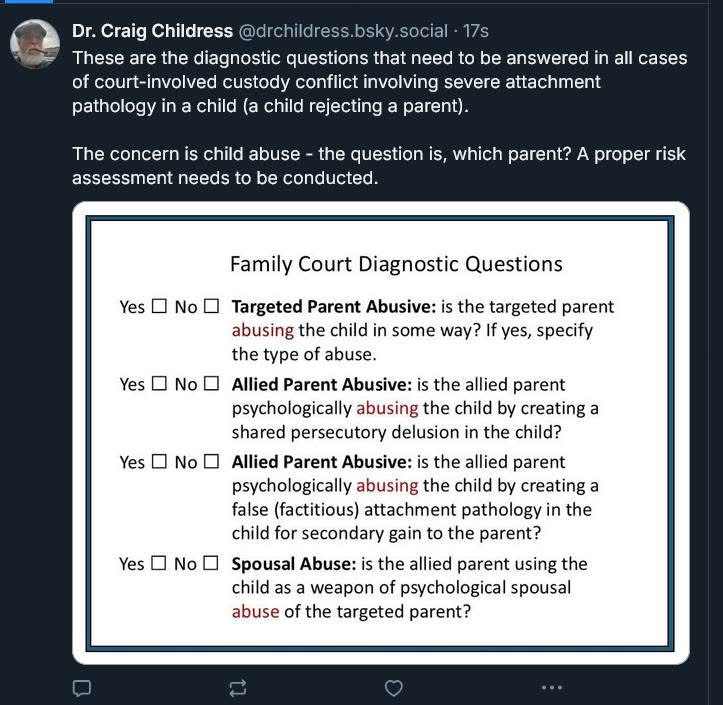
Dr Craig Childress PsyD : Diagnoses Breakthrough 🎊 Child Phycological Abuse

I’ve been thinking…

Now that I have the three DSM-5 Diagnoses seminars up on my YouTube channel, 1) the DSM-5 Diagnosis, 2) Diagnosing a Persecutory Delusion, and 3) Diagnosing a Factitious Disorder Imposed on the Child, I know what my next Diagnosis Chapter is…

4) Diagnosing Child Abuse

Because the forensic custody evaluators never diagnosed the child abuse – they never diagnosed anything, they do something different of their own devising – they put all the legal professionals to sleep… like things weren’t that important.

This is child abuse. We need an accurate diagnosis in six to eight weeks.

Which means the legal system must respond much-much more quickly… however we also need the psychologists to conduct the clinical diagnostic assessments.

Parents and the courts can ask for a diagnostic assessment of the family conflict as much as you want, if the psychologists don’t do that then it’s not available.

A diagnostic assessment is being withheld from parents and the courts for the personal financial gain of the forensic custody evaluators.

I’m in the AFCC now. I’ll be encountering the forensic custody evaluators there, and they’ll be encountering me.

Paradigms are changing. It’s not incremental change, it’s transformational change. Forensic custody evaluations are entirely leaving – bye-bye – a failed experiment on parents and children.

Clinical psychology is returning, diagnosis and treatment.

All mental health professionals have duty to protect obligations. This is child abuse – and spousal abuse of the targeted parent by the allied using the child, and the child’s induced pathology, as the spousal abuse weapon.

Duty to protect obligations are active – we need to get a proper risk assessment with an accurate diagnosis within six to eight weeks.

Since it will be a disputed diagnosis, each litigant-parent should be allowed to appoint a consultant to participate in the diagnostic assessment sessions through telehealth.

The ONLY cause of the child’s symptoms – a child seeking to flee a parent; a directional change in a primary motivational system – is child abuse by one parent or the other.

We need a clinical diagnostic assessment for child abuse to the appropriate differential diagnoses for each parent. How do we assess for child abuse?

That’s what I’ll explain in the next seminar: Diagnosing Child Abuse.

I served as the Clinical Director for a three-university assessment and treatment center for children ages 0-to-5 in foster care, CPS was our primary referral source.

I’ve personally treated all four forms of child abuse, and I have lead the treatment teams for all forms of child abuse that have included CPS social worker involvement.

I should describe how to assess for child abuse.

Craig Childress, Psy.D.

Clinical Psychologist

WA 71538481

OR 3942 – CA 18857

Tears – Charlie McCready

I cried very easily , often in frustration for not being heard or valued . Dad called them Crocodile 🐊 tears or water works and often teased me for my sensitivity .

X was immune to my sensitivity and tears . He’d make like he was crying ( no tears ) on a few occasions.

I’m not ashamed of my tears or emotions as a SSHP . I tear up in laughter , in compassion, at beauty and in pain or frustration .

” Laughter and Crying are the same release”-Joni Mitchell

I rarely cry and could use a good cry on a mountain top where I could scream as well! Releasing years of abusive overlords and watching folks succumb to fuckery in our world …

Blame as an escape

Thinking that my years of abuse , the varied betrays aided in my personal growth while I was drugged via psychiatric ineptitude! If continues .. so the tables are turned and balance will be restored, as I graduate 🧑‍🎓

*

“Your suffering is never caused by the person you’re blaming.”

Blame is an easy escape, but it never leads to freedom and encases you in a prison of false perception. It’s tempting to believe that suffering is caused by someone else—that their words, their actions, or their choices are the reason for the pain. But what if the real source of suffering isn’t what they did, but the way it is perceived, processed, and held onto?

The mind has a way of creating narratives. It builds stories around pain, assigning fault and attaching emotions to past wounds. But the moment blame is given away, power is also given away. Blame keeps the focus outward, waiting for someone else to change, apologize, or make things right. But what if peace doesn’t depend on their actions? What if it has always been an internal choice?

No one can control how others act. People will make mistakes, they will be unfair, they will disappoint. But what happens next—the response, the emotions carried forward, the way the situation is interpreted—is entirely within personal control. And this is where true strength lies: in realizing that suffering isn’t created by the external, but by the attachment to what cannot be changed.

Personal accountability is not about excusing others—it’s about reclaiming power. It’s the understanding that while pain is real, suffering is optional. It’s the choice to see difficult situations as lessons instead of burdens, to shift perspective from victimhood to growth. The world will not always be kind, but inner peace is not determined by external forces.

Letting go of blame is not about denying hurt; it’s about refusing to let it define the future. When responsibility is taken for thoughts, reactions, and emotions, life no longer feels like something that happens *to* you, but something shaped *by* you.

Freedom begins the moment responsibility is claimed. The choice is always there: to remain bound by blame or to step forward in strength. In the end, the only true control is over oneself, and that is where real peace is found.

Adolp Hitler -Monika Aksumit

In 1923 Adolf Hitler incited an insurrection against the German government. He was tried, given a slap on the wrist, and became a convicted felon. Despite being treated charitably by the judge, Hitler claimed the trial was political persecution and successfully portrayed himself as a victim of the “corrupt” Social Democrats.
Hitler cleverly positioned himself as the voice of the “common man,” railing against the “elites,” cultural “degeneracy,” and the establishment, who he all labeled as “Marxists.” He claimed the education system was indoctrinating children to hate Germany, and promised to return Germany to greatness.

To solidify his base, Hitler masterfully scapegoated minorities for the nation’s problems, exploiting societal divisions with an “us vs. them” narrative. Many Germans took the bait. Hitler’s Nazi Party continued to gain traction, until he became Chancellor in 1933.
Hitler appointed German oligarchs as his economic advisors. He proceeded to privatize government run utilities, solidifying support of the economic elite.

With the working class divided along cultural and ethnic lines, the Nazis shut down workers unions and abolished strikes.
Progressives and trade unionists were imprisoned and sent to concentration camps. Corporate profits skyrocketed while working class Germans lived paycheck to paycheck.

Hitler, who became a billionaire while in office, knew he and his clan of oligarchs could get away with the scam if they constantly had an “enemy within” to blame while the corporatocracy robbed the country blind.

An easy target was one of the smallest minorities. Hitler removed birthright citizenship rights of Jews and started rounding them up for mass deportations for being “illegally” in the country.
The German press under Nazi rule highlighted instances of violence by Jews to convince the public that Jewish immigrants were a danger to the “real Germans.”

Hitler wasted no time dismantling democratic institutions. Loyalty wasn’t just encouraged; it was demanded. Opponents were silenced. Media that dared to questioned[sic] him were vilified as “the enemy” and “Marxists.”

Hitler’s Propaganda Minister, Joseph Goebbels, bragged about how the Nazis were able to intimidate the media into giving them favorable coverage, and didn’t need to give direct orders.
The Nazi regime and its followers collected all books they saw as promoting “degeneracy” or what would be considered “woke” today, and burned them in large bonfires. They also burned books that promoted class consciousness.

Berlin had a thriving LGBTQ community in the 1920s, and even had the first transgender clinic. The Nazis burned it to the ground. LGBTQ people were sent to concentration camps and forced to wear triangle badges. Many were killed in the Holocaust.
The Nazis also saw manhood as under threat by independent women who didn’t rely on men. In 1934, Hitler proclaimed, “A women’s world is her her husband, her family, her children, her house.” Laws that had protected women’s rights were repealed and new laws were introduced to restrict women to the home and in their roles as wives and mothers.

Reproductive rights were severely rolled back, and doctors who performed abortions could face the death penalty.
Despite all of this, the German people didn’t have a similar historical parallel to look upon as a warning.
Most Germans never acted like the sky was falling.

Most just went along with their lives as usual, until many of their lives were snuffed out. By the time Hitler’s reign was forced to an end by the Allied Powers, 11 million people were murdered in the Holocaust, and 70-85 million were killed in WW2 .

Monica Aksamit
Bluesky

Just thought everyone needed a refresher course on this tragic part of world history.