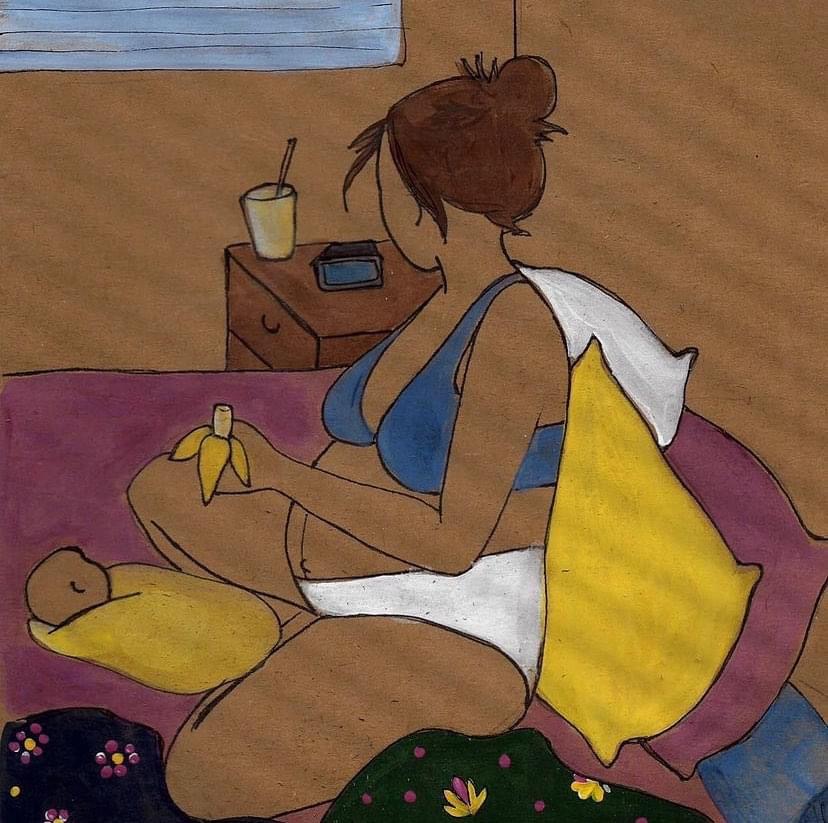
Motherhood Reality

“They tell us how to grow a baby. What to eat.

What not to eat. What vitamins to take and what bras to buy. Allll the prenatal yoga moves to do.

But they forget to tell us how to put ourselves back together once that baby is born.

They forget to tell us how we might feel like we’re drifting.

Afloat. Alone. On a life raft with leaky breasts and sore stitches and a tiny little being dependent upon us for survival.

They forget to tell us how weird and wild it feels to have loose organs shifting about inside of us. How there will be so much softness still.

I get it. You don’t want to startle us. You don’t want us to be scared about what’s ahead.

But….a little heads up would be helpful

We’re brave enough for the truth.

And those things you find so scary- loose skin and leaky breasts and big feelings- we might just be bold enough to welcome them.

To see the beauty there.

So here’s the truth mama-

Your pelvic floor will probably need work and attention. You’ll have to put in some effort to regain that muscle strength, no matter how gentle your birth. Your breasts and belly will probably never be the same. Love them anyway. Love than more than before!! Celebrate them! Buy bras that make you feel sexy. Then move on.

Your identity and sense of self will change radically. Buckle up for the ride. You’ve got this. Your partnership and friendships and general relationship with the outside world might feel foreign for awhile. Or forever. Those relationships might crack and break under the weight of new parenthood. Live your truth. Leave the rest behind. In love.

The whole world might feel shaken up.

You’ll probably feel shaky and raw

That’s normal (they just forgot to tell you.)

You’re new here. In this skin. In this role. In this love. You’ll find your way. You’ll find your rhythm. It will all fall into place- with time.

Until then- breathe.

As deeply as you can.

Drink your tea before it gets cold.

If you can.

Rest –

whenever you can.

And love on your new self.

As deeply as you can.”

#repost @spiritysol ❤️

They did not warn about being single mothers within a marriage ; single wives …..

What therapy should be ; Dan Edmonds Ed.D

When a distressed person enters the realm of modern psychiatric practice they are first confronted with what Laing terms as the ‘psychiatric ceremonial’. In this process, the experience of the person is not considered. Rather, the psychiatrist sits in a place of judgment, he being considered sane and stable, and determines by his subjective observation of behavior how the person is a deviant from what should be expected of him or her and then categorizes it and assigns it a label. There is no concern for the person’s experience, rather the person is seen as an ‘it’, as an object whose behavior is to be analyzed. Science is only able to examine what is, not what will be. It is based on duplication of results, but can we duplicate experience. When we merely look at behavior without understanding the context of it, we draw false conclusions. Understanding the context may lead us to see that the behavior is not truly meaningless after all. Frankl states, “An incurably psychotic individual may lose his usefulness but yet retain the dignity of a human being…a doctor, who would still interpret his role mainly as that of a technician would confess that he sees in his patient nothing more than a machine…but man is ultimately self-determining.”
Laing states, “behavior therapy is the most extreme example of such schizoid theory and practice and proposes to think and act purely in terms of the other without reference to the self of the therapist or the patient, in terms of behavior without experience, in terms of objects rather than persons. It is inevitably therefore a technique of nonmeeting, of manipulation, and social control.’ Experience is the soul of psychotherapy and we should note that the term psychotherapy literally means the ‘healing of the soul’. The therapeutic process should be a meeting of two human beings, it should be the sharing and understanding of experience. Laing states that “I see you and you see me. I experience you, and you experience me. I see your behavior and you see my behavior. But I do not and never will see your experience of me.” It is popular today to look at individuals’ behaviors merely as the result of chemical processes or the effects of so called chemical imbalances. But then we must ask the question as Laing did- do chemicals come together because they love each other? Do atoms explode because they hate one another?
So often we seek to ignore experience. Laing notes the invalidation of experience by such comments as ‘that never happened’, or the trivialization of
experience, or to invalidate its content by such words as “it wasn’t really that way’ or ‘how can you think such a thing?” We must realize that we exist in an existential vacuum, and it is these things that lead to the development of aggression, addiction, depression. Our behaviors are how we communicate distress; they are for some the only form of communication they know. Their behaviors communicate to us a glimpse of their experience. “If our experience is destroyed, our behavior will be destructive. If our experience is destroyed, we will have lost our selves (pg.28).” The therapeutic process is a shamanic voyage, a journeying with another person. But can two human beings truly come together? Are there too many barriers? Can we put aside our affiliations, our ethnicities, our religions, and all the other things that set us apart? Can we come together completely bare and share in the human condition? Nietzsche stated, “Nihilism represents the ultimate logical conclusion of our great values and ideas- because we must experience nihilism before we can find out what value these ‘values’ really had.” So, we must come together in nothingness and from this to ex nihilo, from nothing, become. We must as Frankl (pg. 112) stated be able to transform tragedy into triumph.
But without often realizing it, therapists and others become agents of oppression. Is our work solely leading people to become proper conformists, to do what others are doing? Is our work solely to make people adapt to totalitarianism, to do what they are told to do? It has always been these two processes that have led to the most dangerous of
outcomes. When freedom and autonomy are taken, and individuals can no longer be individuals, when critical thinking has ceased, we have entered a dreadful place. Maybe we are already there. Freedom is to have choice and have regard for others. License is to do which one wishes without regards to the other. Often today we see the violence evoked on people in the name of a common good or a common cause, or as Durkheim would say the collective consciousness. We can even justify our brutality as progress if what we are doing somehow subdues a person, makes them more amenable to society, or brings us satisfaction. If we can turn a person into a ‘them’ by ascribing a label, then ‘we’ can feel justified to treat them as we wish. This violence which calls itself love can be found within the very structure of the family. Within the structure of the family are certain rules that are established that the members are to adhere to. These rules may not always be sensible, but nonetheless become a part of how the family operates. They are generally known whether or not they always are followed. It is dependent on who is in control and what the consequences are for violation whether the family members adhere to the established rules of conducting themselves.

-Dan L. Edmunds, Ed.D.
MEETING OF TWO PERSONS: WHAT THERAPY SHOULD BE

Relational Disconnection as a Mental Illness

Indigenous psychology views things differently. Within indigenous communities, being bad for the community—harming another in any significant manner—is a sign of illness. Whether robbery, assault, or murder, harming another is believed to be rooted in relational and emotional disconnection (Ross, 2006). Consequently, justice has to do with repairing relationships—restoring respectful and caring connection—toward self, others, community, landscape, and the unseen spiritual world. Healing circles are formed to determine the best course for repairing a particular situation.

Relational Disconnection As Mental Illness

www.kindredmedia.org/2018/10/relational-disconnection-as-mental-illness/

Left Side ; for Lymph Drainage

According to Eastern philosophies, whether it is Indian, Chinese, Tibetan or Thai, the left side of the body is totally different from the right side. Even some Buddhist monastic traditions include within their precepts for monks to sleep on their left side.

Although it sounds weird resting and sleeping on your left side has many health benefits.

Lymph drains to the left.

The left side of the body is the dominant side in the lymphatic system. Most of the lymph drains into the chest duct located on the left side. In its path the lymph transports proteins, glucose metabolites and waste products that are purified by the lymph nodes to be drained left side.

Derived from the above, it is common to infer in Eastern medicine that conditions on the left side of the body may be due to chronic congestion of the lymphatic system.

The priorities of the body.

According to ayurveda congestion happens in the body by following certain priorities. If the lymphatic system is co-managed, subsequently the liver and blood saturate with toxic substances. Primary symptoms of congestion appear on the left side of the body before moving to the right side where they appear later.

Tired after a meal?

Indian suggestion is that if you take a break after eating do it by lying on your left side. Break time should not exceed 10 minutes and is different from the afternoon nap which is usually 20 minutes or more.

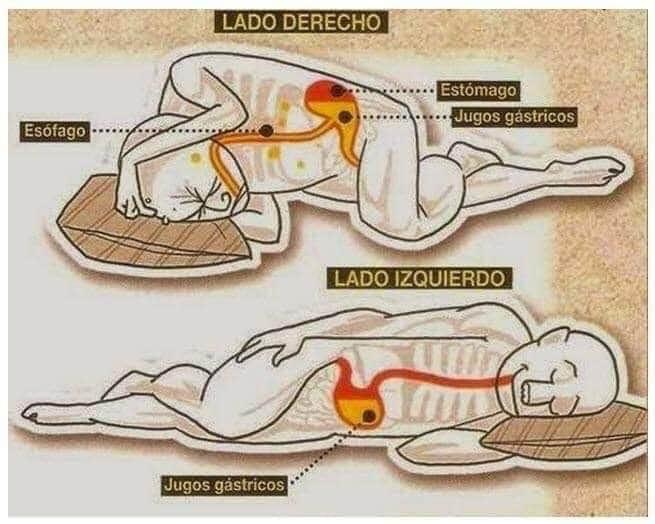
Stomach and pancreas hang on to the left side. When you lie down on your left side both hang naturally allowing for optimal and efficient digestion.

Food is driven to move naturally through the stomach and pancreatic enzymes are secreted gradually and not in a single stroke, which happens if you lie down on the right side.

When you lie on your left side your liver and gallbladder hang from your right side. Resting on the left side allows them to hang and secret their precious enzymes into the digestive tract, emulsifying fats and neutralizing stomach acids.

When the digestive system is stimulated this way your digestive cycle is shorter and doesn’t leave you sluggish for the rest of the afternoon. Try resting 10 minutes on your left side after eating.

Feel energized and not tired after eating.

Try to eat in a relaxed way at midday and don’t forget to rest on your left side and check that you will feel more energetic and with better digestion.

The magic of sleeping on the left.

Best elimination.

The small intestine flushes toxins through the ileocecal valve (VIC) on the right side of the body at the onset of the large intestine. The large intestine travels down the right side of your body, crosses your abdomen and descends down the left side.

Through VIC, sleeping on the left side allows gravity to stimulate bodily waste into the large intestine from the small intestine more easily.

By going through the night and continuing to sleep on your left side the debris moves more easily toward the descending colon and morning removal will be easier.

Best heart function.

More than 80% of the heart is located on the left side of the body. If you sleep on the left side the lymph drained toward the heart will be driven by gravity by removing work from your heart while you sleep.

The aorta, which is the body’s largest artery, exits from the upper part of the heart and arches left before going down to the abdomen. When sleeping on the left side, the heart more easily pumps blood into the descending aorta.

Sleeping on the left side allows the intestines to move away from the cava vein that carries blood back to the heart. Remarkably the cava vein rests on the right side of the spine, so when you lie on the left side the viscera move away from the cava veen.

Again gravity makes heart work easier.

The splinter is on the left.

The spleen is part of the lymphatic system and is also on the left side of the body. Its function is that of a large lymph node that filters the lymph and additionally filters the blood. When you lie down on the left side the fluid return to the spleen is easier and occurs more easily by gravity.

The lymphatic system drains all cells in the body through contractions and muscle movement and not through the heart pumping. Helping the lymph drain into the spleen and heart with gravity is a simple way to purify your body

Give it a shot!

And while there are no scientific protocols to it, sleeping on the left side makes sense. Understanding ancestral wisdom based on knowledge of modern anatomy clears up many doubts about the reasons one has in the east to sleep a certain way.

BUT ABOVE ALL… “BREATHE THROUGH YOUR NOSE”… Breathe Life and Healthy
Homelessness & Trauma

The case discussed had alcohol addiction and ” behavioral ” health treatment included a lot of prescribed drugs . These are supposed to be short term use only.

A survivor of childhood sex abuse , her lover became abusive and this sadly points to changes being required.

Homelessness alters everything and in my opinion she should not have been evicted while in treatment .

I don’t feel the obstacles to heal addictions are necessary in the name of service and help , including a list of RX which ongoing in treatment bring a whole new problem when seeking balance in life … seems never ending

www.psychiatrictimes.com/view/i-have-no-one-understanding-homelessness-and-trauma

Childress : Child becomes “regulator object for NPD/Borderline Personality

drcraigchildressblog.com/

Teach & Release

You will teach them to fly , but they will not fly your flight .

You will teach them to dream , but they will not dream your dream .

You will teach them to live , but they will not live your life .

Nevertheless , in every flight , in every life , in every dream , the print of the way you taught them will remain …

~ Mother Teresa ~

Artist Credit : JinWoo Kim

https://art.co/artists/jinwoo-kim