
And they are being exposed and retired
It’s way past time 💯🙏
Here is proof that pedophiles are running this planet, pages and pages of proof
https://docslib.org/doc/1401572/beyond-the-dutroux-affair-the-reality-of-protected-child-abuse-and-snuff

And they are being exposed and retired
It’s way past time 💯🙏
Here is proof that pedophiles are running this planet, pages and pages of proof
https://docslib.org/doc/1401572/beyond-the-dutroux-affair-the-reality-of-protected-child-abuse-and-snuff
Mom took kids and left , but they found each other again !
Labeled a ” mental disorder ”
or trauma response ?
Being subjected to a
perfectionist as a child can and
does create ” Patty Perfect ”
ends up in overwhelming
life situations, burdened with
responsibilities and many
negatives can result .
Alcoholism is just one response
but expecting all around you
to be perfect is a heavy burden
especially when one does not
strive for perfection perhaps
having laid that burden down !
Qualifying behaviors, as just
” my OCD” kicking in doesn’t
resonate when it’s a place for
blame , or projected blame
always pointing out the lack
in another . It’s a stressful
situation and personally I
don’t do well under such
pressure .
I had ” family ” members via
marriage that were always
exclusive in their bond , found
me less than desirable and a
partner who did not ever have
my back , but rather joined in
the ladies constant criticism
and judgment which was
highly toxic and really affected
me as a newly wed , mother
the 1st year and for several
decades . I did not want to be
in their company as it became
more intense and flagrantly
obvious!
I was not fully aware that our
sons had adapted to this , and
with those last 5 years in toxic
treatment for ” bipolar ” it
was a mantra of ex and his
family that I chose to be
Bipolar and gravely ill to get
out of my duties as Mom .
I’m sure ex felt the loss of my
inability to do my ” jobs”
and further neglected the
horrific situation and it’s effect
on our sons .
He was busy making plans to
exit with as much as possible
and covertly blame all
failures on me .
Of course it’s always been and
always will be his job to heal
that childhood desire or
pressure for perfection but I’m
keenly aware of what a toll
that takes on everyone in his
world as he always is in that
mode and never really
enjoying the moment and that
radiates to others negatively .
It’s the ” bar” expected of those
around him ; Great
Expectations that I could not
meet which made me less
than in his opinion!
I realize how it drained him
and noted how scheduled he
was concerning his personal
habits .
He had no idea , nor did he
care how anything affected
me .
I should talk about treatment.
You should know stuff about treatment. I thought about telling you about delusional disorders, you should know what they are too. But you need to know about treatment more.
Not the treatment of your children and this pathology – yet – just treatment of treatment stuff. Like behavior therapy and an Applied Behavioral Analysis. You should know about that (it will lead into DBT therapy because DBT is based on behavioral therapy principles of Applied Behavioral Analysis).
Behavior therapy is the “B” in DBT. You should know what the A-B-C’s of ABA are. What? Exactly.
It’s easy once you understand it. The Contingent Visitation Schedule is a behavior therapy structure (over a Strategic family systems intervention).
You should know about Solution-Focused therapy most definitely. That’s what’s going to unlock the trauma piece of the puzzle and get things moving forward. Do things seem stuck in one place? Solution-Focused therapy will unstick it.
You should also know about Narrative therapy – it is excellent. It’s a tricky little post-modern social constructionsist therapy, it’s in the same school of psychotherapy as Solution-Focused therapy. I use Narrative therapy all the time and no one sees it because no one knows what it is. I should introduce you to Narrative therapy.
Don’t try this at home kids, Dr. Childress is a trained professional. If untrained people start using knowledge willy-nilly, you might create a better world, and you wouldn’t want that.
So be careful with the knowledge I give you. The application of knowledge by untrained people could create a wonderful world, and you’re not ready for that yet – so use it in small doses so you don’t create wonderful too fast. Slowly.
I should tell you about therapy. Not therapy for your kids, not exactly, not yet. Just therapy for therapy things. What is it and how does it work.
There’s schools of therapy – four – actually five – actually six. Five and six are amazingly effective, but you need to know schools one-through-four as the basics for understanding therapy, then add five, then add six.
The four primary schools are
1. Psychoanalytic – Freud and the couch – this is the grand-daddy school of them all, called “depth-psychology” – it’s evolved to Self Psychology with a primary guy Kohut who is immensely relevant to the family conflict pathology in the courts. Bowlby, attachment, and Tronick, intersubjectivity, are in the psychoanalytic school.
2. Cognitive-Behavioral (CBT) – Skinner and lab animals – this is the reward-and-punishment behavioral therapy approach. Actually it’s about cues and triggers – what cues (elicits) the behavior. Sometimes it’s what we think – that’s the cognitive part of CBT. It’s the primary school in use most everywhere, and CBT is the foundation for DBT (Linehan).
3. Humanisitic-Existential – self-actualization and growth – this is the soft and accepting school of therapy – Rogers Client Centered therapy. This school of therapy is about transformations, it’s not appropriate for the pathology here in the family courts.
Family Systems – it’s about families and how they work – this is the school of psychotherapy that should be applied when diagnosing and treating family conflict – there’s three schools within family systems – Minuchin Structural – Haley & Madanes Strategic – Bowen Bowenian (he kinda describes it all, with the others expanding on Bowen-themes).
The fifth school is Post-Modern Social Constructionism – I think of them as boutique therapies – Cultural therapy – Feminist therapy – Solution-Focused therapy – Narrative therapy. They are all amazingly powerful, tricky to learn but powerful when used.
I strongly suggest the addition of Solution-Focused therapy to DBT family therapy for this pathology in the courts, it will release the process from its focus on the past. I add Solution-Focused therapy to pretty much everything I do from the other schools of psychotherapy.
I like Narrative therapy a lot. I use it a lot. I embed Narrative therapy into my work in the other schools as well. The Post-Modern Social Construction schools of psychotherapy are like principles – you can use the principles within the other schools as well.
They all blend. But do you know what happens when you blend a bunch of paints together? It turns to mud-color. Mixing colors to create a painting is a professional craft.
I should tell you about therapy. You’re going to want DBT (court-adapted), that’s from the Cognitive-Behavioral school, so you should know about an Applied Behavioral Analysis, you’ll find that helpful.
You should know about attachment-therapy, that’s from the Psychoanalytic school – that’s going to be Tronick and his breach-and-repair sequence. You’ll find that helpful too – watch Tronick’s Still Face YouTube description of his research on the breach-and-repair sequence.
You should know about Solution-Focused therapy too so you can get un-stuck from your stuck. You’d probably like to be unstuck from your stuck.
Dr. Childress and the School of Rock… er… Psychotherapy, this Sunday 8 Pacific on Facebook Live. Let’s change the world – slowly – go slow – you don’t want to create wonderful too fast, you’re not ready for a wonderful world just yet, so just use a little of the knowledge I give you to solve little things until you’re ready to solve everything.
Don’t create the solution too fast because then you won’t have a problem to fix, and you need your problem. Why do you need your problem? I don’t know. It makes no sense to me, but you hold onto it so I guess you need it.
So fix it slowly. Otherwise you’ll wind up with everything fixed and you won’t have your problems anymore.
Dr. Childress – Schools of Psychotherapy – Sunday over morning coffee and crumpets. Let’s rock this Internet thing and take her out for a spin to see what she can do – tomorrow at 8 Pacific.
Schools of Psychotherapy and coffee with Dr. Childress.
Craig Childress, Psy.D.
Clinical Psychologist, CA PSY 18857

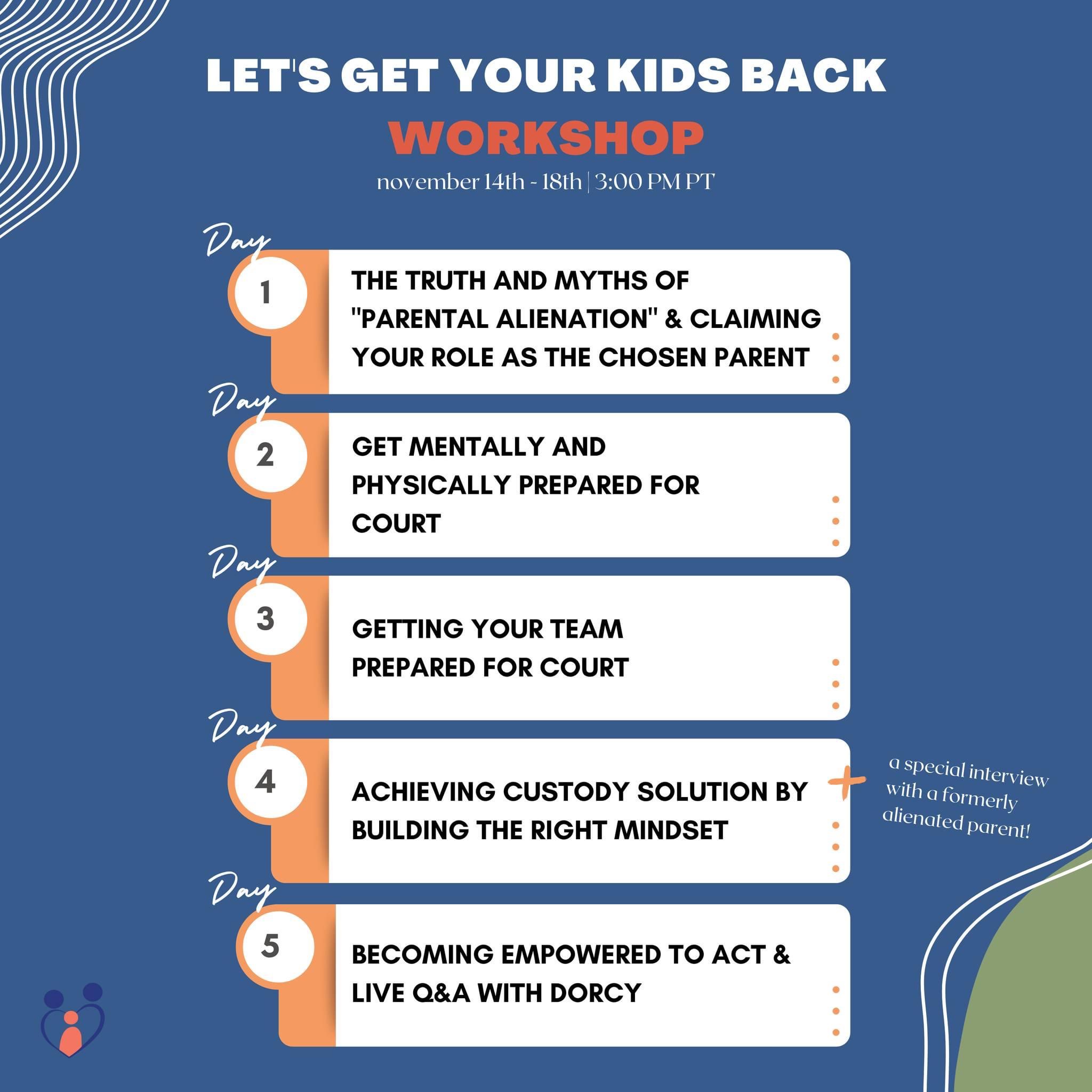
Join me on November 14th through the 18th for my free, live workshop, Let’s Get Your Kids Back. I will be live each day at 3:00 PM PT in the Alliance to Solve Parental Alienation Facebook group. Register today and receive your workbook. The countdown begins!
 GreatCosmicMothersUnite