
www.spiritualunite.com/articles/ascension-symptoms-headaches/
Category: Parential Alienation-Child Abuse
Brain & Narcissist Abuse
Baby Facts
Against my heart and soul , I left our 4 month old with in laws for a week at the beach .
Ex MIL stayed quite clearly that he ( baby) would not even miss me .
* wasn’t the only thing she got wrong
Chem trails – Russ Tanner
Post Lockdown Suicide Tsunami that never came
As we near the third anniversary of COVID-19, international suicide statistics reveal that the suicide epidemic that was widely predicted to ensue after the lockdown never happened.
Understanding how these predictions failed reveals the limitations of mental health modeling, challenges our assumptions about suicidality, and begs the question, “why wasn’t there a suicide epidemic?” A viewpoint article recently published in the Australian & New Zealand Journal of Psychiatry offers some answers.
The Australian authors, Nick Glozier, Richard Morris, and Stefanie Schurer, quote Nobel prize-winning economist Daniel Kahneman:
“People cannot be faulted for failing to predict the unpredictable, but they can be blamed for lack of predictive humility.”
www.madinamerica.com/2022/11/post-lockdown-suicide-tsunami-never-came/
On the run🙈
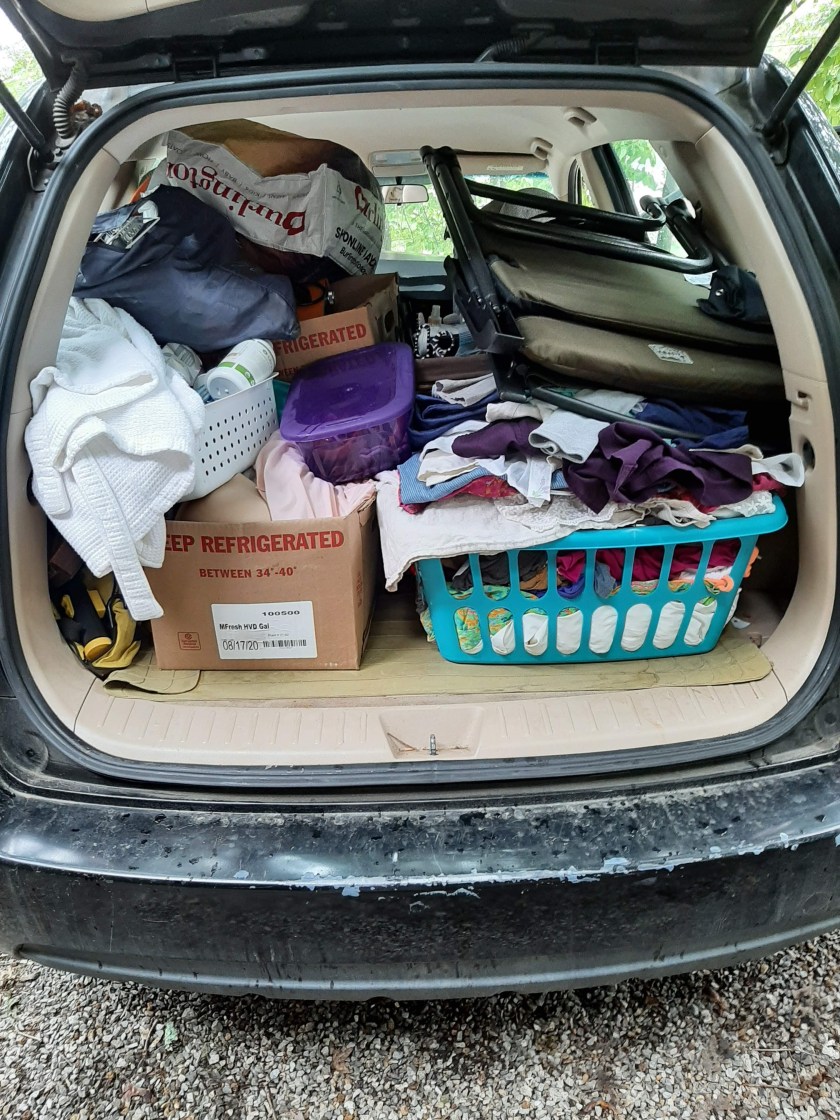
This is the trunk of my 08 Kia
loaded with as much as
possible .
There have been several of
these chronic retaliatory land
lord abuse .
There will be no more 🐸👍
The Kia has seen better days
at this stage of evolution ☑️❤️🩹
I am ready to let her go , after
careful examination 🙌
That won’t be a problem , but
1st she’ll be examined through-
ly.
That’s how I rock !
Dad helped me buy her , and
signed over the title a year
before he exited !!!
Witch Wound
THE WITCH WOUND
They call it the witch wound.
We were punished you see, broken, slain, for shining too brightly.
So we learned to hide that spark.
We learned to play it down, play dumb, play dead.
And we were taught to fear the light within us, lest it herald our downfall.
But not anymore.
You are not a wicked witch my friend, you are quite simply, or complicatedly, a woman.
And your magic is not something you can choose, or lose.
It always is, and always has lived within you.
And you need no longer hide it.
I call it the witch wound, but the time to heal is here.
Now.
Let that magic out.
Donna Ashworth
Art by Art by Waya Raventalker.
#witchwound #halloweenpoetry #witches #womennotwitches

14 Generations of Ancestors DNA within you
Facebook’s negative mental health impact on students from the get go
Depression stats are still high , despite all the “ advanced treatments “
Between 1987 and 2007, the number of people receiving treatment for depression in the United States increased fourfold (and has continued to rise more gradually since). However, the prevalence of depression either stayed the same—or may have even increased—during that time. Researchers call this the “treatment-prevalence paradox” (TPP).
* Browse through a DSM for all the codes that allow billing to insurance and you’ll find every human emotion , every sickness , every disease and you can bet the pharmacy has an antidepressant for that particular issue .
No science. Read the facts of how efficiently testing is done or not.
Ready of the kin ship between FDA who usually rewards the best show , not the best product.
The horrific loss of life and families erased as mine was began in 1987 with the huge push to diagnosis bipolar which presented in varied ways .
Their eyes are wide shut about these side effects and society accepted , the law embraced the all knowing wizards of Pharma and suicide was normalized by many especially 80’s
Ignoring thus supporting abuse Knowing thus supporting the trauma .
For these reasons and more , having personally exited that matrix , I’m aware there are many like I was ; induced into a state of Ill health and toxic mind and endured 5 years of neglect , abandonment , having no interest in my life , before leaving for another 20 year period aligned with his twin .
Learning nothing , his shadow is depressive , and I’m eager to complete business and no contact ever .
Coming to and regaining , renewing my essence was hellish in many respects but invaluable to my healing process .
Blessings& Peace ❤️☮️
Dona Luna 🐸
Now, in a new study, researchers review the seven possible explanations for this—and the evidence for and against each one. The study was led by Johan Ormel at the University of Groningen, The Netherlands, and published in Clinical Psychology Review.
Ormel and his co-authors explain:
“The increased availability of effective treatments should shorten depressive episodes, reduce relapses, and curtail recurrences. Combined, these treatment advances unequivocally should result in lower point-prevalence estimates of depression. Have these reductions occurred? The empirical answer clearly is NO.”
Despite More Treatments for Depression, Prevalence Doesn’t Decrease—Why?
www.madinamerica.com/2022/10/treatment-depression-increased/
 GreatCosmicMothersUnite