

Tag: Child Abuse
What therapy should be ; Dan Edmonds Ed.D
When a distressed person enters the realm of modern psychiatric practice they are first confronted with what Laing terms as the ‘psychiatric ceremonial’. In this process, the experience of the person is not considered. Rather, the psychiatrist sits in a place of judgment, he being considered sane and stable, and determines by his subjective observation of behavior how the person is a deviant from what should be expected of him or her and then categorizes it and assigns it a label. There is no concern for the person’s experience, rather the person is seen as an ‘it’, as an object whose behavior is to be analyzed. Science is only able to examine what is, not what will be. It is based on duplication of results, but can we duplicate experience. When we merely look at behavior without understanding the context of it, we draw false conclusions. Understanding the context may lead us to see that the behavior is not truly meaningless after all. Frankl states, “An incurably psychotic individual may lose his usefulness but yet retain the dignity of a human being…a doctor, who would still interpret his role mainly as that of a technician would confess that he sees in his patient nothing more than a machine…but man is ultimately self-determining.”
Laing states, “behavior therapy is the most extreme example of such schizoid theory and practice and proposes to think and act purely in terms of the other without reference to the self of the therapist or the patient, in terms of behavior without experience, in terms of objects rather than persons. It is inevitably therefore a technique of nonmeeting, of manipulation, and social control.’ Experience is the soul of psychotherapy and we should note that the term psychotherapy literally means the ‘healing of the soul’. The therapeutic process should be a meeting of two human beings, it should be the sharing and understanding of experience. Laing states that “I see you and you see me. I experience you, and you experience me. I see your behavior and you see my behavior. But I do not and never will see your experience of me.” It is popular today to look at individuals’ behaviors merely as the result of chemical processes or the effects of so called chemical imbalances. But then we must ask the question as Laing did- do chemicals come together because they love each other? Do atoms explode because they hate one another?
So often we seek to ignore experience. Laing notes the invalidation of experience by such comments as ‘that never happened’, or the trivialization of
experience, or to invalidate its content by such words as “it wasn’t really that way’ or ‘how can you think such a thing?” We must realize that we exist in an existential vacuum, and it is these things that lead to the development of aggression, addiction, depression. Our behaviors are how we communicate distress; they are for some the only form of communication they know. Their behaviors communicate to us a glimpse of their experience. “If our experience is destroyed, our behavior will be destructive. If our experience is destroyed, we will have lost our selves (pg.28).” The therapeutic process is a shamanic voyage, a journeying with another person. But can two human beings truly come together? Are there too many barriers? Can we put aside our affiliations, our ethnicities, our religions, and all the other things that set us apart? Can we come together completely bare and share in the human condition? Nietzsche stated, “Nihilism represents the ultimate logical conclusion of our great values and ideas- because we must experience nihilism before we can find out what value these ‘values’ really had.” So, we must come together in nothingness and from this to ex nihilo, from nothing, become. We must as Frankl (pg. 112) stated be able to transform tragedy into triumph.
But without often realizing it, therapists and others become agents of oppression. Is our work solely leading people to become proper conformists, to do what others are doing? Is our work solely to make people adapt to totalitarianism, to do what they are told to do? It has always been these two processes that have led to the most dangerous of
outcomes. When freedom and autonomy are taken, and individuals can no longer be individuals, when critical thinking has ceased, we have entered a dreadful place. Maybe we are already there. Freedom is to have choice and have regard for others. License is to do which one wishes without regards to the other. Often today we see the violence evoked on people in the name of a common good or a common cause, or as Durkheim would say the collective consciousness. We can even justify our brutality as progress if what we are doing somehow subdues a person, makes them more amenable to society, or brings us satisfaction. If we can turn a person into a ‘them’ by ascribing a label, then ‘we’ can feel justified to treat them as we wish. This violence which calls itself love can be found within the very structure of the family. Within the structure of the family are certain rules that are established that the members are to adhere to. These rules may not always be sensible, but nonetheless become a part of how the family operates. They are generally known whether or not they always are followed. It is dependent on who is in control and what the consequences are for violation whether the family members adhere to the established rules of conducting themselves.
-Dan L. Edmunds, Ed.D.
MEETING OF TWO PERSONS: WHAT THERAPY SHOULD BE
Child Psychological Abuse /PA
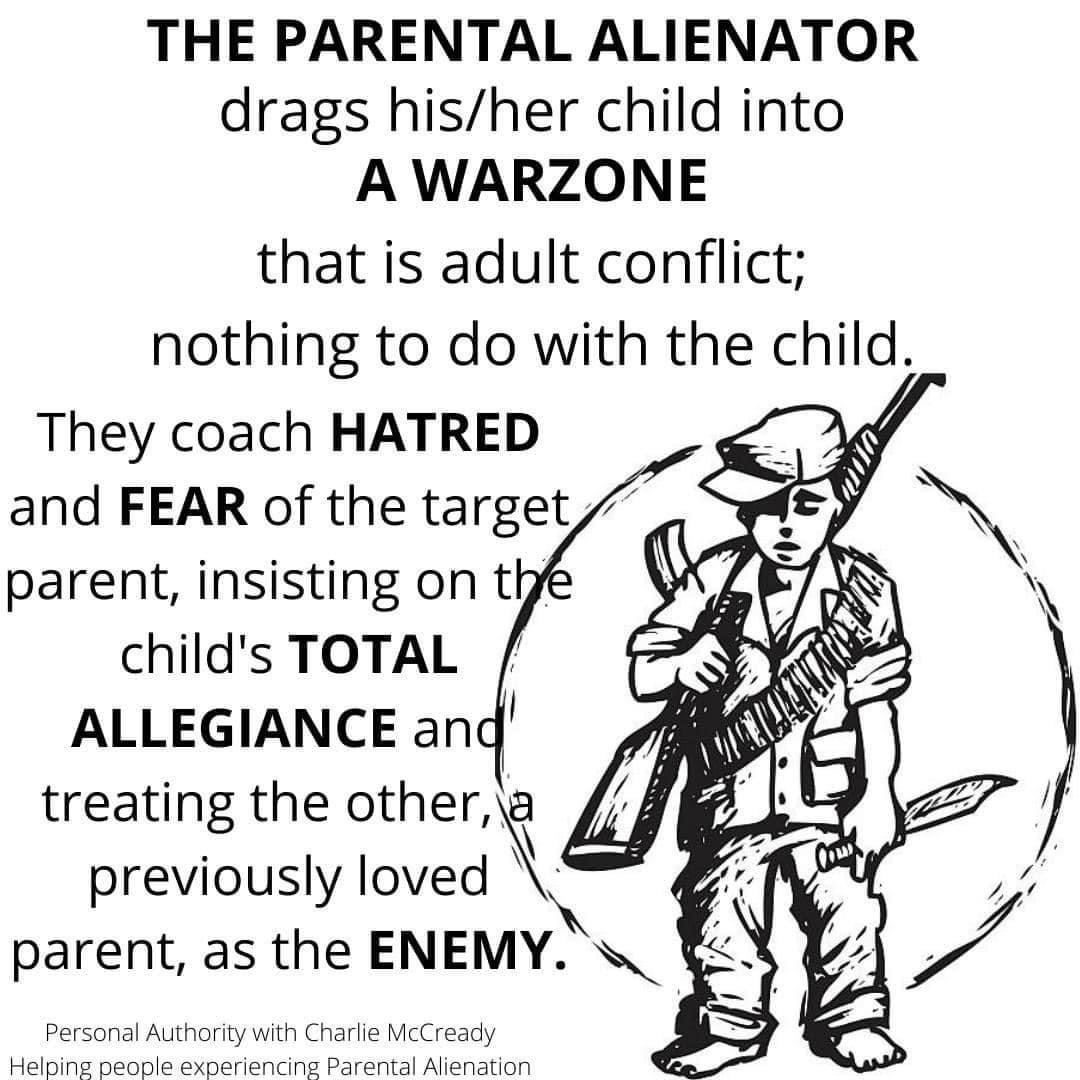
The heartbreaking and frustrating thing for alienated parents is that we can’t force our child/children to see things from our point of view or, at the very least, to see things in a more balanced way. We crave justice. It is hard to resist trying to tell them right from wrong, to teach them that this (parental alienation) isn’t the way a loving parent behaves, that we love them, we want them in our lives, we’re not who they’ve been led to believe we are … If we push all this on them, we risk pushing them away. They don’t (want to) see their alienation or that they’ve been in any way complicit. They were acting in the only way they knew how to survive the nightmare situation their alienating parent put them in. It is a test of patience and love, waiting for them to wake up from this nightmare and see the light.
Homelessness & Trauma
The case discussed had alcohol addiction and ” behavioral ” health treatment included a lot of prescribed drugs . These are supposed to be short term use only.
A survivor of childhood sex abuse , her lover became abusive and this sadly points to changes being required.
Homelessness alters everything and in my opinion she should not have been evicted while in treatment .
I don’t feel the obstacles to heal addictions are necessary in the name of service and help , including a list of RX which ongoing in treatment bring a whole new problem when seeking balance in life … seems never ending
www.psychiatrictimes.com/view/i-have-no-one-understanding-homelessness-and-trauma
Childress : Child becomes “regulator object for NPD/Borderline Personality
Child Sex Abuse , Is not exempt in any religion and always covered up
Side Effects of Having a Distorted Parent
Child Psychological Abuse
Lifelong Effects on Children Who Grow Up With Narcissistic Personality Disordered Parents–
by Dr. Laurel a Sills, Licensed Clinical Psychologist, Michigan.  9/2/2022~~
The deeply damaging effects to a personality when growing up with especially subtle narcissism (which is not recognized by outsiders) is extremely long-lasting and often unseen by others. Kids may act strong and unaffected and become leaders or bossy and controlling and seem super confident, or, people- please in such a way that
most people like them and don’t notice that they are appeasing to everybody and not standing up for what they want.
Anxiety is high for the child who grows up confused by hearing they are loved by their parent who doesn’t guide them, dismisses them, is insensitive towards them, is hypercritical, micromanaging, doesn’t seem to see them or respect them. The child feels one way, but is told another or that they are overreacting, being dramatic, making mountains out of molehills, or dismissed, etc.; thus undermining the child’s self-trust and reliance upon their own feelings and perceptions to make accurate conclusions.
As a result, the child is apt to constantly need reassurance and seek outside validation rather than feel self-reliant and trust themself to be able to discern things accurately and appropriately.
Since narcissists unconsciously project their own self hatred and dislike of self onto others, the names they call their children typically are descriptors of themselves or some form of their own self-shame or doubt. If a parent says a child is selfish look and see if the parent is acting that way. If the parent says the child is stupid look and see if the parent is acting unaware of important dynamics.
When narcissistic parents use their children as an extension of themselves, they often push their kids to do the things they never did to finish unresolved dynamics from their own backgrounds. i.e. forcing a child to play football because the parent want to live through them and have their child reflect strength and athleticism and popularity. Forcing K
kids to act in their own mirror images rather than see their child as separate and unique individuals is another common pitfall.
Validating a child’s feelings is vital to help them grow to trust their own perceptions. It’s also important to help distinguish somebody else’s problems from a child’s behaviors.
As children, we must be seen for our own uniqueness and our own strengths and limitations; not be ridiculed for our limitations and molded into a mini version of our parent.
In therapy, the adult children has to express their confusion about how they felt in their families versus what they were told by the unhealthy family members. It takes outside validation, much love and compassion, an explanation for adult children to eventually recognize they were the victims of parents who were also suffering from their upbringing, and suffering that makes them project all kinds of things onto them. I’m not talking about physical abuse and more violent narcissism and sociopathic narcissism. I’m talking about even subtle abuse emotional, constant negative commentary, ignoring, eye/rolling, dismissive body language, disrespect, disregard mixed in with warm fuzzies, a
Conditional love, threats to withdraw love if a child doesn’t do what is asked or commanded… all part of the felt verbal and emotional abuse even when the parent is unaware.
Because the parent is unaware, when they later are confronted by adult children or teenagers about how they were feeling hurt by that parent, that parent often acts as if they were the one mortally wounded. Often the parent acts angry, surprised, betrayed, retaliates, or deeply hurt.
Sometimes parents give their children the silent treatment when a child tells their parent how they’ve been hurt by them. This just compounds the child’s ( teen or adult child’s) guilt and confusion.
Good therapy, in my opinion, combines validation, education, explanation, empathy, and teaching how to cope and separate what that parent did and said to the child from the real truth of who the child ( who became adult or teen pending on what age they are entering therapy) really is and who they were born to be.
The growth to health for the children of Narcissitic parents is to find honest, real, compassionate and loving people who can support, guide, teach and demonstrate unconditional love with guidelines for appropriate behavior in the world. Empathy is vital. Depth of emotions and discussion about feelings is vital. Healing comes in the relational and attachment realms. 
Because the narcissistic parent is so confident and sure of themselves, they’re very intimidating to confront even by the spouse. When children see their other parent staying with the narcissistic parent and not challenging them, it certainly makes challenging that parent even more difficult. The ones that are brave enough to challenge, should not be punished, but instead revered for sharing their feelings and being brave. They have to learn to say things in a healthy way and be given a safe place to share with a professional who can validate them away from the Narcissitic parent(s) and protect them from further ridicule, minimization or dismissal.
The Walrus, the Carpenter- Dr Craig Childress
Many years ago, I fell down the rabbit hole to here and discovered all you parents and your children trapped.
I also found a large menagerie of curious creatures surrounding you in the Wonderland of the family courts, parenting coordinators, “reunification therapists” (there’s no such thing), custody evaluators, GALs, and experts-experts-experts everywhere you look.
You can’t turn around in the Wonderland of here without bumping into an “expert.”
You were trapped in Wonderland of crazy. I had to get you back out to the real world. The creatures of Wonderland, including your “experts”, don’t want you to leave… with your money, they covet your money.
They’ll seek to hold you trapped.
We’re leaving… we’ve left.
Not one more child. We are not losing one more child. We are not losing your child… specifically. We are OUT of Wonderland.
The Red Queen of forensic psychology and the hookah smoking caterpillars of your “experts” will try to keep you from leaving.
Leave.
There is another path – a choice. Established knowledge and clinical psychology, assessment, diagnosis, and treatment.
You want a written treatment plan – google mental health treatment plans and read the top two returns – you want one of those please.
Don’t follow the Walrus and Carpenter little parental clams, or they’ll eat you for their supper and throw your empty shells away.
Walrus & the Carpenter (Childress, 2019)
https://drcraigchildressblog.com/2019/11/17/the-walrus-the-carpenter/
Craig Childress, Psy.D.
Clinical Psychologist, CA PSY 18857
drcraigchildressblog.com/2019/11/17/the-walrus-the-carpenter/
Anne H was taken out or took time out #ChildTrafficingExposers
Childress : Let’s Roll
What happens when Bill Bernet dies, what happens to the Gardnerian PAS movement? Who takes over?
Not to be morbid, but Bill’s old, I’m old, what happens when we depart? With AB-PA, I’m not involved so everyone just goes on applying the knowledge of Bowlby, Minuchin, and Beck, the established scientific knowledge of the disciple.
But when Bill departs for the hinterlands, who follows him as the leader of the PAS-squad? Linda Gottlieb? No. Amy Baker? She’s a researcher. Jennifer Harman? She’s likely going down with Linda. Karen Woodall is in England… Demosthenes Lorandos? I don’t think he’ll have the clout to carry a movement… and with Dr. Childress attacking on Standard 2.04 and 2.01, I don’t think Demosthenes is going to be the next leader.
I don’t see one. Who’s the rising young star of Gardner’s PAS model? All the early career psychologists will go toward AB-PA because it gives them more expanse to grow into their profession.
I think we’ve reached the time death for Gardner’s PAS model. We’re watching the final death throes of PAS.
Everything shifts to the forensic psychologists. The DV-monkeys are active and howling, with Kayden’s Law they smell victory. They want Dorcy… the no “reunification workshops” of Kayden’s Law could be called the Dorcy Clause, and it could equally read – “No Dorcy.”
The pathogen hates Dorcy, frothing hatred. The pathogen hates her because it knows she has the cure of its pain, the cure for the pathology – the pathogen knows she sees it… and solves it.
For over a decade the pathogen has tried to destroy Dorcy with every manner of slander and attack. She’s still here. Stupid pathogen.
There is no way Dorcy, an unlicensed professional, survives a decade in the immensely hostile world of the family courts… unless she’s the real-deal.
She’s the real-deal. That’s why she has the full support of Dr. Childress – she’s had my full support since 2014 and I haven’t wavered.
We’re going into Kayden’s Law world now, here come the DV-monkeys. They want to stop Dorcy – by legislation. Stay close, Dorcy. I’m at your side on the battlefield and I’m not going anywhere.
Bring it. It’s time. Let’s do this and finish this.
We need to end the fight-and-fight surrounding the child. So let’s do that. If that means more fighting for a while… okay. Let’s do it and get it done… so we can move forward.
I formed a Facebook group with Dorcy, the Alliance to Solve Parental Alienation. I got it up to 16,000 members… then I left. I gave the group to Dorcy. I had a platform of 16,000 members and I gave it away.
Why?
Because I am entering a period of conflict. I carry the voice of destruction. Dorcy is all about reunion and bonding. We are carrying different energies to the same purpose.
I wanted to maintain the separation to keep her clean from the fight-and-fight to come… my job. My people, my job.
She can remain focused on her role. Each to our role, you have the most special role of all. Dorcy will explain it.
Battle’s coming. I hear the horns, do you hear them? I do. They’re calling us, it’s time. Break out the drums and pipes, don your armor, prepare.
The paradigm is shifting.
The outcome I recommend is an AB-PA/High Road pilot program for the family courts with university involvement for evaluation research. I’d recommend Stanford Forensic Psychiatry as the PI. If you want a solution, that is the solution.
They don’t want a solution… yet. We just need to get their attention first. That will be happening soon.
The change agents I’m using do not create incremental change – they create transformational change. They’re different change agents than most people use, sort of a craftsman’s art of change.
There’s big change and little change, and then there’s transformations, an entirely different change agent set. The transformational change agents come from humanistic-existential psychology. They’re hard to use.
Most people don’t know how to create transformational change.
Dorcy used contextual change agents, no one else uses the change agents she uses. I wouldn’t call them complicated or hard, I’d call them elegant and immensely effective for trauma pathology.
Psychotherapy uses change agents based on the treatment school, cognitive behavioral use their change agents, family system therapy uses its agents of change, psychoanalysis uses it’s change agent approaches.
None of them use a context-based change agent like Dorcy in her High Road workshop. That’s why when we co-presented her High Road ABA single-case data to the national convention of the American Psychological Association I submitted to Division 24 Society for Theoretical and Philosophical Psychology.
By analogy, if psychotherapy were all the different types of carbon-based lifeforms, Dorcy’s change agent approach is like a silicon-based life form – entirely unique.
Everything is headed for the Tower of Destruction, watch as it all collapses – the Gardnerians – the forensic psychologists – the approach in the family courts – everything is changing.
Because it needs to change.
Dr. Childress & Dorcy Pruter will hold the center of the battlefield. Not a chance we’re budging. We know exactly where we are, and we’re exactly where we are supposed to be, doing exactly what we are supposed to do.
Your turn. You’re the chosen parent. You’re the protective parent. You’re the authentic parent. It’s time to live into your role. You just need support. You have support. Let’s go get you more.
Ignore the chaos, ignore the destruction. That’s my job. Remain focused on your task… you want a written treatment plan to fix things… for that you’ll need a diagnosis… for that you’ll need a proper assessment to reach an accurate diagnosis to guide the development of an effective treatment plan to fix things.
Because it’s always in the child’s best interest to fix family conflict. So let’s do that.
I want Valkyries.
Craig Childress, Psy..D.
Clinical Psychologist, CA PSY 18857
 GreatCosmicMothersUnite