

Tag: abuse
Parental Alienators hide their abuse in shadows/Charlie McCready
Alienating parents and their cohorts work in the shadows. Their abuse is often hidden from sight to all but the target parent. This makes it 100 times worse as the target parent feels nobody hears them or sees what’s happening, not even the therapists and family courts. It makes it incredibly challenging for the target parent to seek help or gain support. It can also be covert and confusing to its victims because there are days when the alienating parent can be affectionate, kind, and caring. This is often why the abused child (and target parent) sticks around, hoping for more good days. But the moments of no-drama can give false hope.
A few Quentin Tarantino characters come to mind. He writes his villains so well because he shows us the side they show to people they’re not abusing. In Django Unchained, Calvin Candie, played by Leonardo DiCaprio, is a charismatic and charming plantation owner. In one scene, Calvin talks about the French delicacy, “Croque Monsieur.,” amusing and entertaining his guests over a sumptuous dinner. But Calvin is also a cruel and sadistic slave owner who subjects his slaves to brutal treatment. The contrast between his charming demeanour and abusive behaviour highlights his character’s complexity and how he manipulates those around him.
Just as characters in Tarantino’s films can appear charming while perpetrating cruelty, the alienating parent employs a similar tactic of alternating between kindness and manipulation. This intricate interplay between light and darkness serves to ensnare the child in an emotionally fraught situation. Unfortunately, many Family Court Judges don’t see through the charm, lies, trauma bonds, and indoctrination. They consistently ignore the abusive parent’s coercive control, psychological abuse and dishonesty, often giving that parent placement of the children. The system is broken and failing target parents and alienated children all over the world. We need to do all we can to bring this abuse to light.
#charliemccready
#parentalalienationcoach
#narcissisticabuseawareness
#CoerciveControl

Family Court Reality
Humanity : This is a test 💯💰
Grandma’s Truth
I am aware of much but not all of past family transgressions
I did marry a masked man who used the dirtiest tricks to win 🥇 not caring who experienced trauma.
CIA – Weeping Angel / Spywear
Dr Craig Childress PsyD : Diagnoses Breakthrough 🎊 Child Phycological Abuse
I’ve been thinking…
Now that I have the three DSM-5 Diagnoses seminars up on my YouTube channel, 1) the DSM-5 Diagnosis, 2) Diagnosing a Persecutory Delusion, and 3) Diagnosing a Factitious Disorder Imposed on the Child, I know what my next Diagnosis Chapter is…
4) Diagnosing Child Abuse
Because the forensic custody evaluators never diagnosed the child abuse – they never diagnosed anything, they do something different of their own devising – they put all the legal professionals to sleep… like things weren’t that important.
This is child abuse. We need an accurate diagnosis in six to eight weeks.
Which means the legal system must respond much-much more quickly… however we also need the psychologists to conduct the clinical diagnostic assessments.
Parents and the courts can ask for a diagnostic assessment of the family conflict as much as you want, if the psychologists don’t do that then it’s not available.
A diagnostic assessment is being withheld from parents and the courts for the personal financial gain of the forensic custody evaluators.
I’m in the AFCC now. I’ll be encountering the forensic custody evaluators there, and they’ll be encountering me.
Paradigms are changing. It’s not incremental change, it’s transformational change. Forensic custody evaluations are entirely leaving – bye-bye – a failed experiment on parents and children.
Clinical psychology is returning, diagnosis and treatment.
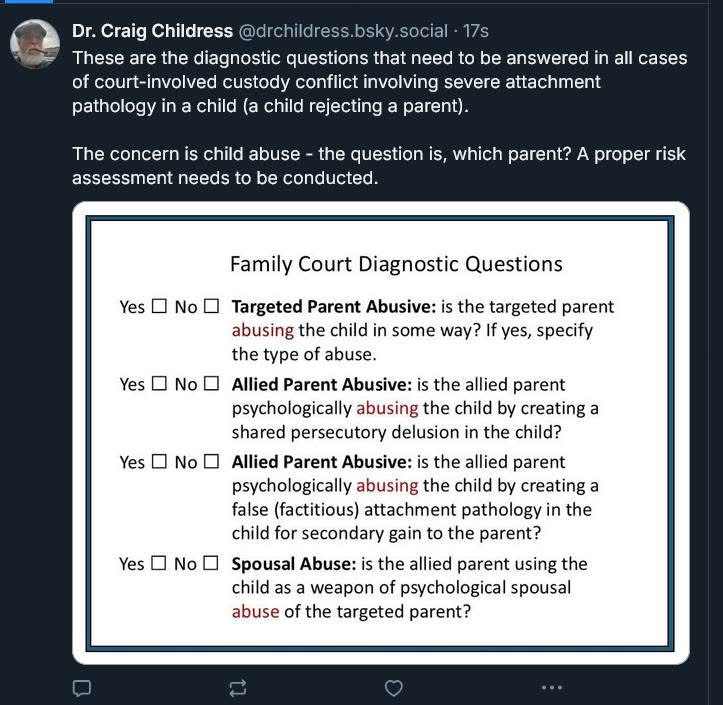
All mental health professionals have duty to protect obligations. This is child abuse – and spousal abuse of the targeted parent by the allied using the child, and the child’s induced pathology, as the spousal abuse weapon.
Duty to protect obligations are active – we need to get a proper risk assessment with an accurate diagnosis within six to eight weeks.
Since it will be a disputed diagnosis, each litigant-parent should be allowed to appoint a consultant to participate in the diagnostic assessment sessions through telehealth.
The ONLY cause of the child’s symptoms – a child seeking to flee a parent; a directional change in a primary motivational system – is child abuse by one parent or the other.
We need a clinical diagnostic assessment for child abuse to the appropriate differential diagnoses for each parent. How do we assess for child abuse?
That’s what I’ll explain in the next seminar: Diagnosing Child Abuse.
I served as the Clinical Director for a three-university assessment and treatment center for children ages 0-to-5 in foster care, CPS was our primary referral source.
I’ve personally treated all four forms of child abuse, and I have lead the treatment teams for all forms of child abuse that have included CPS social worker involvement.
I should describe how to assess for child abuse.
Craig Childress, Psy.D.
Clinical Psychologist
WA 71538481
OR 3942 – CA 18857
 GreatCosmicMothersUnite