
Friendship/ Brotherhood instead of Dad .
So I was the heavy , bad parent in lieu of
his casual offering .
Friendship/ Brotherhood instead of Dad .
So I was the heavy , bad parent in lieu of
his casual offering .
9 ways Gen Z ‘protects their peace’ that older generations recognize as running away
Avery White / Jul 22, 2025
Lifestyle
The line between self-preservation and self-sabotage is blurrier than either generation wants to admit.
The coffee shop was playing that lo-fi playlist every workspace has now—the one designed to promote focus without actually being noticeable. My nephew Jake was explaining why he’d stopped responding to his girlfriend’s texts mid-conversation.
“She was getting upset about me canceling dinner plans again,” he said, scrolling through his silenced notifications. “I just don’t need that energy right now. She can wait until I’m in a better headspace.”
His phone lit up with another message. He flipped it face down without reading it.
“Good for you,” I thought initially. “Setting boundaries.” But as our coffee stretched on, I watched him do the same thing with his roommate (texting about rent), his mom (asking about Thanksgiving), and his group project partner (panicking about a deadline). Each time: glance, dismiss, “I’ll deal with it later.”
This wasn’t boundary-setting. This was a full-scale retreat from anything uncomfortable, dressed up in the language of self-care.
Gen Z has mastered the vocabulary of emotional wellness. They’re fluent in boundaries, triggers, and toxic relationships. They’ve turned “protecting their peace” into both an art form and a rallying cry. But somewhere between learning to say no and learning to engage with difficulty, something got lost in translation.
What older generations see as running away, many in Gen Z call self-preservation. What Gen Z sees as healthy boundaries, older folks recognize as familiar patterns with unfamiliar names. The truth lives somewhere in the middle—in that uncomfortable space that neither generation seems eager to occupy.
It happens with remarkable speed. Someone senses conflict might be coming—maybe a difficult conversation, maybe disagreement about weekend plans—and suddenly you’re staring at “User not found” where their profile used to be.
“I don’t need that energy in my life,” (sound familiar?) a young colleague explained after blocking a friend who’d questioned their decision to skip another group gathering. Apparently it’s the Swiss Army knife of avoidance. The friend hadn’t been cruel or unreasonable. They’d simply asked why. Previous generations did this too, of course. We just took months of passive-aggressive behavior to accomplish what Gen Z does with one click. The efficiency is almost admirable. But relationships aren’t social media feeds—you can’t just unfollow the parts that challenge you without losing something essential.
“That’s really triggering for me.” “I need to protect my energy right now.” “This feels like you’re violating my boundaries.”
Valid concepts, essential for mental health—when used accurately. But watch how quickly they become shields against any feedback, criticism, or request someone doesn’t like. Therapists have started calling this “weaponized self-care talk”—using the language of healing to avoid rather than engage.
I watched a manager try to give performance feedback to a new graduate. Normal stuff—deadlines, communication, basic workplace expectations. The response? “This conversation is affecting my mental health. I need to step away.”
The feedback wasn’t harsh or personal. It was the basic friction of working with others. When the language of healing becomes a weapon against growth, we’ve missed something important about what these words actually mean.
We’ve normalized disappearing. A friend who manages a downtown retail location tells me she’s lost three employees this year to what she calls “ghost quitting”—they simply stopped showing up. When she finally reached one through Instagram, they said they “needed to prioritize their wellbeing.”
She’s not alone. Workplace ghosting—employees vanishing without notice—has become widespread enough that HR departments have a name for it.
Yes, many of these jobs are genuinely terrible—unpredictable schedules, no benefits, wages that don’t cover basic expenses. There’s something to be said for refusing to be exploited. But the pattern extends far beyond bad workplaces. Friends ghosted after minor disagreements. Family gatherings skipped without explanation. Commitments abandoned the moment they become inconvenient.
When protecting your peace means never having a difficult conversation, never delivering bad news, never facing the discomfort of ending things properly—that’s not wellness. That’s avoidance with a wellness filter.
“I only follow accounts that make me feel good,” Jake told me during another coffee meetup, as if this were revolutionary. The irony? It’s precisely what everyone’s parents do on Facebook. But Gen Z has perfected the art. The algorithm serves up exactly what they want to see. Anyone who disrupts this carefully curated reality gets muted, blocked, unfollowed. They’ve created perfect digital worlds where everyone agrees with them, validates their choices, speaks their language.
The result? Young adults genuinely shocked when real life doesn’t work like their feed. When disagreement isn’t violence. When challenge isn’t trauma. They’ve protected their equilibrium so thoroughly they’ve forgotten that disruption is often where growth happens.
When did emotional boundaries become emotional walls? I’ve watched as acknowledgment of struggle gets labeled as “negativity” that must be expelled.
Friend going through a divorce? “Sorry, I can’t handle negative energy right now.” Family member loses their job? “I need to protect my mental space.” Someone needs support? “That sounds really heavy. Have you tried journaling?”
They’re not wrong that emotional boundaries matter. But there’s a difference between protecting yourself from genuine toxicity and abandoning anyone who isn’t currently thriving. When your peace requires everyone around you to be perpetually okay, you’re not practicing self-care—you’re practicing a sophisticated form of selfishness.
The moment work becomes challenging, stressful, or simply boring, they’re gone. “It was toxic,” they’ll say about a workplace where they were asked to meet deadlines. “I had to protect my peace,” about a job that required them to work on projects they didn’t personally choose.
Workplace standards absolutely needed updating, and previous generations tolerated far too much. But there’s crucial ground between “accept any treatment” and “leave the moment you’re uncomfortable.” That’s where skills develop. Where resilience builds. Where you learn the difference between genuinely toxic environments and the normal friction of working with other humans.
Instead, many job-hop at the first sign of difficulty, collecting two-week stints like passport stamps, always protecting their peace, rarely building anything that requires sustained effort.
I’ve watched this pattern repeatedly: relationships ending not because of abuse or fundamental incompatibility, but because they require effort. First disagreement? Done. Different opinions? Blocked. Asked to compromise? “This relationship is draining my energy.” The math is revealing. What they call “too much work” often means the normal maintenance of human connection—checking in during hard times, showing up for important events, occasionally prioritizing someone else’s needs. The basic reciprocity that makes relationships meaningful.
Always “working on themselves” but never quite ready to engage with the world as it is.
“I can’t date until I’ve healed my attachment style.” “I can’t take that job until I’ve finished my self-discovery.” “I can’t visit family until I’ve processed my childhood.”
Jake mentioned he’s been “preparing” to have a serious conversation with his girlfriend for three months. The preparation has outlasted most relationships.
Self-improvement matters. But when the journey becomes an excuse to never arrive anywhere, when “working on yourself” becomes a way to avoid working on anything real, growth becomes its own form of stagnation.
Perhaps most tellingly, they’ve reframed accountability as attack. Being held responsible for their actions becomes violence against their peace.
Didn’t follow through on something? “You’re being really aggressive right now.” Hurt someone’s feelings? “I was just being authentic to myself.” Failed to meet a commitment? “Your expectations are toxic.” Every consequence becomes someone else’s problem. Every failure is the world’s fault for not accommodating their needs. They’ve learned to use the language of boundaries to avoid the discomfort of responsibility—which might be the most sophisticated avoidance technique of all.
FINAL THOUGHTS
Here’s what makes this particularly complex: Gen Z isn’t wrong about the importance of mental health, boundaries, or self-care. They’re the first generation to really understand that you can’t pour from an empty cup, that “no” is a complete sentence, that your peace matters.
They watched their parents burn out, stay in toxic relationships, endure abusive workplaces. They decided—correctly—that they deserved better. The problem isn’t the principles. It’s what happens when every tool becomes a hammer and every situation looks like a nail.
Basically Gen Z have become an extension of technology, unfortunately machines don’t have emotions or empathy.
Have you ever noticed how the moment a woman refuses to tolerate lies, disrespect, or deceit, she’s suddenly labeled as “difficult”? How the second she stands up for herself, draws a line, or refuses to accept less than she deserves, she becomes “unstable,” “crazy,” or “bitter”? It’s almost like the world has a problem with women who have standards… especially when those standards challenge the comfort of a man who’s used to getting away with doing the bare minimum.
Let’s be real…. a woman who speaks her truth, calls out toxic behavior, and walks away from anything that disrespects her is not broken. She’s not hard to love. She’s not angry for no reason. She’s just tired of pretending she doesn’t see the red flags, tired of shrinking herself to keep the peace, tired of swallowing her emotions to protect someone else’s ego.
It’s not that she’s bitter… it’s that she’s done being betrayed and expected to stay sweet about it. It’s not that she’s unstable… it’s that she’s exhausted from carrying the weight of her own loyalty while constantly being tested. And it’s definitely not that she’s crazy… it’s that she finally stopped ignoring what her intuition was screaming all along.
The truth is, many men call women “crazy” when they can’t manipulate them. They call them “bitter” when they refuse to accept disrespect. They call them “difficult” when they realize she’s not going to play small just to be loved.
But here’s what they don’t understand: a woman who knows her worth is powerful. A woman who says, “I’m not accepting less than I give,” is unstoppable. And if protecting her peace makes her “too much”…. then let her be too much. Because the right man will never be intimidated by her strength, her boundaries, or her voice. He will honor it.
So let them talk. Let them misunderstand her. Because being labeled for standing firm is a small price to pay for keeping her dignity intact.
______🔥

Look around. You can feel it , can’t you?
Something is breaking. People are unraveling. Reality feels unstable… and not just because of what’s happening on the surface. This runs deeper. You can see it in people’s eyes… the disconnect, the confusion, the hollow expressions like something inside has shut down. And it’s not just burnout. It’s spiritual disconnection.
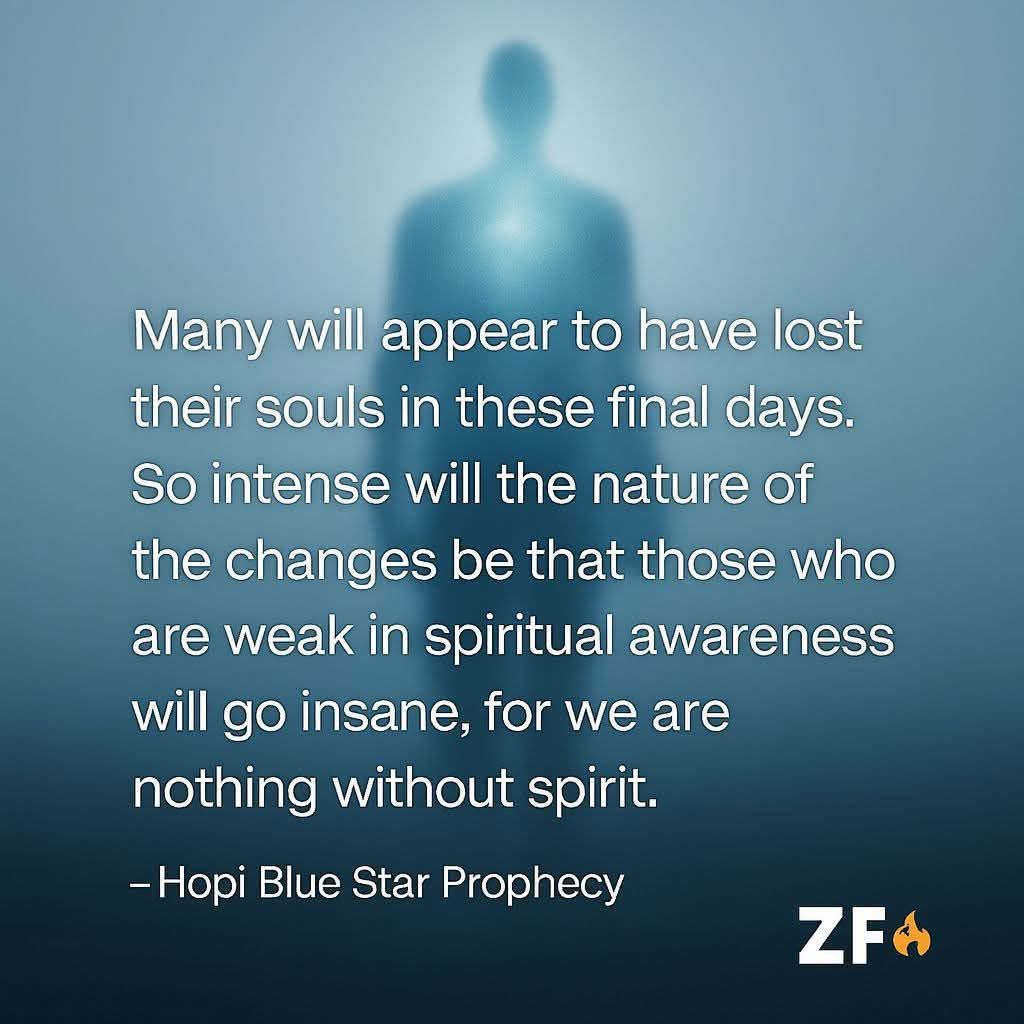
We were warned about this… that in these times, many would appear to have lost their souls. That the pressure would get so intense that those without a strong spiritual foundation would collapse under it. And that’s exactly what we’re seeing now.
Because when the old world falls apart and all the masks are stripped away… all you’re left with is what’s real. And if you’ve never built that connection to your own soul, your own truth, your own Source… these days will feel like hell.
But here’s the thing… you don’t have to have all the answers. You just have to remember who you are. Anchor into spirit. Return to the breath. Come back to your center.
We were never meant to make it through this shift with logic alone.
The ones who endure are the ones who remember… We are nothing without spirit.
ZF 🔥
~ Zachary Fisher
Psychology shows that when a woman endures prolonged stress and instability, her body adapts to survival mode—often without her even realizing it until she’s completely exhausted. Mentally, emotionally, physically. She remains on high alert, tense and guarded, always bracing for the next disruption. Even in calm moments, relaxation feels foreign… unsafe. Not because she’s ‘dramatic’ or ‘too sensitive,’ but because her nervous system has forgotten what true safety feels like.
Years of disappointment. Years of bearing burdens alone. Years of smiling while shattered inside. It changes you. You stop trusting quiet days. You question consistency. Kindness makes you wary because you’ve learned that love often comes with strings, silence means punishment, and peace can shatter without warning.
So no—she isn’t ‘moody’ or ‘too much.’ She isn’t overreacting. Her body is stuck in fight-or-flight. Her heart is weary. Her spirit is exhausted from years of self-protection, to the point where being held—truly held, without fear—feels like a distant memory.
If you want to love a woman like this? Be safe. Be steady. Be soft. Don’t give her more reasons to question her worth. Don’t punish her for needing comfort. Don’t make her believe her pain makes her unlovable. She doesn’t need perfection—she needs patience.
Healing doesn’t begin when life gets quiet. It begins when life stays safe.
And too many women are still waiting for that safety to arrive.
 GreatCosmicMothersUnite