Difficult Past – Charlie McCready

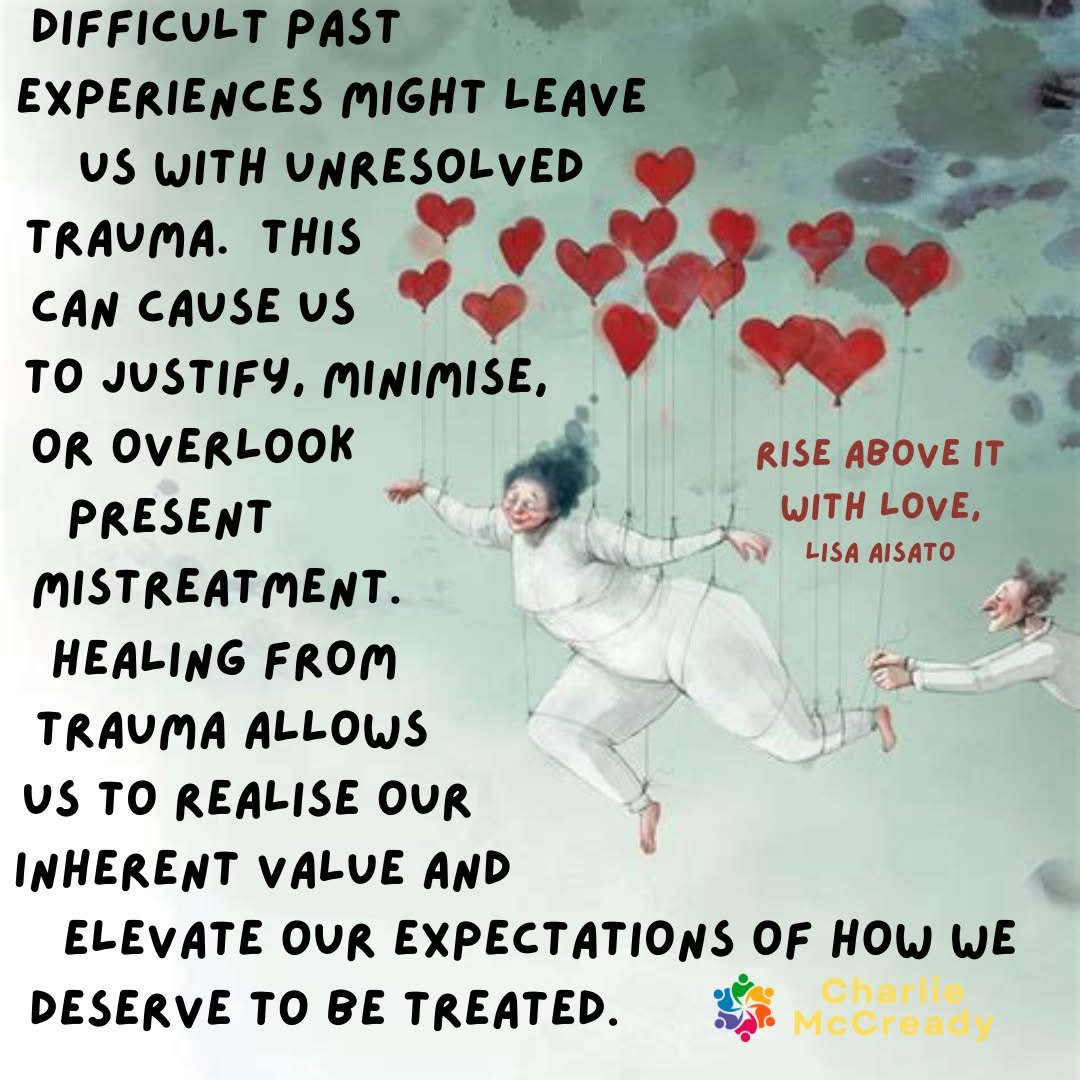
Self-worth and self-love are integral to our happiness. If we don’t get a sense of our own value when we’re children, during school years, or with our spouse/partners, we can potentially open ourselves up to experiences in our lives that reflect our low self-esteem/lack of self-love back at us, reinforcing the proverbial vicious cycle.

“You don’t attract what you want, you attract what you are.” Wayne Dyer

“Emancipate yourself from mental slavery, none but ourselves can free our minds” Bob Marley

I speak from experience. I have been through many dark nights of the soul over the years. Many. And always, it comes back to the need for more self-love and worth. It starts with that.

I’m sure you’ve heard it before, but we must love ourselves first and be our own best friends. We must love and care for ourselves as we love and care for others. Those people and experiences we’ve attracted into our lives, like those parental alienators, take advantage of kindness, generosity, love, and compassion. Healthy relationships come from mental and emotional maturity and balance. Boundaries. Self-respect. Love is not conditional – attachment, promises, control, manipulation. We don’t need validation from others. We are enough We can let go of fear, anger, and grief … I know it’s hard, but it can be done with time, kindness, and some conscious effort, of course. We can start afresh every day—a clean slate. We are not victims. We can transform pain into power. The past is over. Our memories can’t hold us back forever.

“There is no coming to consciousness without pain. People will do anything, no matter how absurd, in order to avoid facing their own souls. One does not become enlightened by imagining figures of light, but by making the darkness conscious.” Carl Jung

Nobody else has the permission to tell us we are less, not good enough, unlovable … that stems from their own issues and fears. We should know better if only our minds would just give us a break and be our friends, not our prison guards. Today offers the gift of the present. We can be the saviour, the hero and the creator of our lives.

#charliemccready

#parentalalienationcoach

#selfworthmatters

#healing

#selfcare

#selflovejourney

#parentalalienation

#parentalalienationawareness

#FamilyCourt

#custody
Parental Alienation: How to trust your child who has lied about you

Building or maintaining a relationship with an alienated child who has made false accusations against you is one of the most challenging aspects of parental alienation. It is deeply painful to hear your child say things that you know are untrue, especially when those accusations damage the trust and bond you once shared. The path forward requires incredible strength, patience, and resilience.

It’s important to remember that these accusations are not coming from your child’s authentic self. Children in situations of parental alienation are often under immense pressure to conform to the alienating parent’s narrative. They may feel coerced, fearful, and/or confused, and as challenging as it is for us/the alienated parent to understand, repeating these falsehoods can be their way of surviving within that dynamic. It is compared to Stockholm syndrome for good reason. Recognising this can help you separate your child from the behaviour, understanding that their words are a reflection of the manipulation they are experiencing rather than an expression of their true thoughts or feelings.

Rebuilding trust starts with showing unconditional love, even when it feels undeserved. It can be helpful to avoid reacting with anger or defensiveness when faced with false accusations. Again, I know this is not easy! (Even as a life coach, I’m guilty of reacting in anger when very provoked/accused of falsehoods and threatened with violence.) Do all you can to respond calmly and kindly, emphasising your love for them and your willingness to listen without judgment. For example, you might say, “I understand that this is how you see things right now, and I’m sorry you feel that way. I love you no matter what.” Such responses demonstrate that you are a safe, steady presence in their life, even when the relationship feels unjustly, painfully fractured.

Trust can feel like a two-way street, but in cases of parental alienation, it’s often one-sided for a time. While you extend trust and love to your child, it’s also essential to protect yourself emotionally. It’s sometimes a good idea to keep a record of interactions and communication, not to use against your child, but to safeguard your own well-being and ensure clarity about what has been said or done. Target parents get gaslighted and manipulated, especially when we’re so emotionally drained. Maintaining realistic expectations is also key; rebuilding the relationship may take months – even years.

Some parents, including myself for a time, face the unbearable reality of no contact or communication with their alienated child. When your child refuses to see you, doesn’t respond to messages, or seems unreachable, it can feel as though they’ve slipped through your fingers. I know how isolating and heart-wrenching it can be. The questions of “How did it come to this?” and “What more could I have done?” can consume you.

In those moments, it’s easy to feel hopeless. They may not show it, they may not acknowledge it, but somewhere deep down, they know you’re there, and you love them. This is what many previously alienated children have said was something like a lifeline.

Social media, for instance, might be one of the few ways they can see you—so present yourself as a person who is calm, loving, and thriving. Avoid posts that reflect your grief or anger, even though those feelings are valid. Over time, your steady presence and resilience may plant seeds of doubt about the alienating narrative and leave the door open for reconnection.

For 1:1 coaching, please DM me for more info, and we can have a chat about how it might help you as I have helped hundreds of others.

#charliemccready

#parentalalienationcoach

#alienatedchild

#narcissisticabuseawareness

#narcissisticparent

#emotionalabuse

Craig Childress PsyD- BPRS

Heads up – incoming.

You will want to familiarize yourself with a rating scale: the Brief Psychiatric Rating Scale (BPRS), “one of the oldest most widely used scales to measure psychotic symptoms.”

Wikipedia BPRS
https://en.wikipedia.org/wiki/Brief_Psychiatric_Rating_Scale

The professional article is online and provides the BPRS manual of anchor points for 24 symptoms.

BPRS Article & Manual
https://www.researchgate.net/publication/284654397_Brief_Psychiatric_Rating_Scale_Expanded_version_40_Scales_anchor_points_and_administration_manual

The items of primary relevance are 9) Suspiciousness and 11) Unusual Thought Content (delusions). The clinical concern is for a possible persecutory thought disorder (in the allied parent transferred to the child; i.e., a shared/induced persecutory delusion).

I will be recommending that the BPRS rating scale be applied in all child custody conflicts involving severe attachment pathology displayed by the child (i.e., a child rejecting a parent).

I recommend BPRS ratings for items 9) Suspiciousness and 11) Unusual Thought Content (delusions).

I also recommend BPRS ratings for 3) Depression (grief response), 2) Anxiety (phobic response), 6) Hostility (anger response), and 20) Uncooperativeness.

We need to get clarity on the child’s symptoms. We accomplish that by using a reliable symptom documentation instrument, i.e., the BPRS.

You’ll begin to hear me reference the BPRS. You should familiarize yourself with the anchor points for the relevant sub-scales of 9) Suspicousness and 11) Unusual Thought Content (delusions).

As a lay person, you can apply the anchor points to the child’s symptom presentation to indicate your perspective and reporting on the child’s symptoms.

However, ultimately we will want a formal mental health assessment of the child’s symptoms using the BPRS to anchor our understanding for the nature, scope, and severity of the child’s symptom presentation.

Craig Childress, Psy.D.
Clinical Psychologist
WA 61538481
OR 3942 – CA 18857

Abuse in the Family – Charlie McCready

In Abuse in the Family, Alan Kemp defines domestic violence as “a form of maltreatment perpetrated by a person with whom the victim has or had a close personal relationship” (Kemp, p. 36). I believe that using terminology that accurately describes parental alienation as a form of abuse is crucial. Those of us who have experienced it understand that it transcends the label of ‘parental alienation’—a term that is often misunderstood and misused. It encompasses child psychological abuse, spousal psychological abuse, and constitutes a form of violence within the domestic environment.⁠

Kemp’s book serves as an excellent resource for anyone seeking to understand psychological maltreatment, which, in essence, includes parental alienation. The same categories apply: rejecting (spurning), terrorising, corrupting, denying essential stimulation, emotional unavailability, unreliable parenting, neglect in mental health, medical, or educational contexts, degrading or devaluing, isolating, and exploiting.⁠

The alienating parent manipulates and exploits the children, isolating them from a nurturing parent and their family, including grandparents, step-parents, step-children. They deny the children their fundamental needs for love and belonging from the targeted parent, thereby neglecting their mental welfare. This parent dismisses the children’s and the targeted parent’s expressions of love and need for one another. The alienating parent not only terrorises and corrupts the children but also prioritises their own desires above the needs of everyone else, including their own children.⁠

Kemp employs an ecological approach to explore the pervasive issue of family maltreatment, analysing the complex relationships at macro, meso, and micro levels. By addressing questions such as “Why does family maltreatment occur?” “What do its victims experience?” “How do they recover?” “What can we do to help them?” “How can we understand the perpetrators?” and “How might we reduce or prevent family abuse?”, we can better equip ourselves to combat this significant social problem.

The definition of domestic violence presented in Kemp’s work applies aptly to parental alienation, wherein one parent manipulates a child to turn against the other parent, constituting emotional and psychological abuse. My posts are here not to alarm or upset but to spread awareness about what’s known as ‘parental alienation’ and to provide guidance to those who are going through it, as I did myself. Apart from these daily posts, which I hope help you know you’re not alone, and to better understand it’s an attachment disorder, a pathology, it’s not you; please reach out if I can help with the coaching I offer.

#charliemccready

#parentalalienationcoach

#pathogenicparent

#coercivecontrol

Fear your children believe they stayed attached Narcissist

When You’re Afraid Your Child Will Believe the Narcissist’s Version of You

There’s a fear that keeps you up at night.

Not the fear of doing this alone.

Not even the fear of starting over.

But the fear that one day… your child will believe the version of you that the other parent has created.

The exaggerated stories.

The twisted narratives.

The subtle digs disguised as jokes.

The lies wrapped in just enough truth to sound believable.

You hear your child repeat things you never said.

You see the hesitation in their eyes, wondering who to trust.

And it breaks something in you.

Because you’ve spent years becoming the parent you needed. You’ve poured your whole heart into showing up with honesty, grace, and consistency. And still—there’s this ache… that all of that could be undone by someone who’s more interested in control than connection.

But here’s what’s true:

Time tells the truth.

Your child may not see it now.

They may be swayed by charm or confusion or fear of upsetting the wrong person.

But one day, they’ll notice.

They’ll notice who picked them up on the hard days.

Who listened instead of lectured.

Who stayed soft when it would’ve been easier to shut down.

They’ll see the difference between love that performs and love that protects.

So keep going.

Keep showing up with steady love and quiet truth.

You don’t have to fight for your child’s loyalty—just be the safe place they’ll always come back to when the masks fall.

And when they ask the hard questions later?

You’ll have something the other parent never will:

A clear heart and a life that proves your love.