
A woman becomes pregnant.
She is pressured and often forced to get the flu shot and TDap.
If she is rh- blood type, she is pressured to get rhoGAM injections.
She receives multiple ultrasounds.
She may receive antibiotics for group B strep.
If the doctor has a vacation scheduled during the week of her presumed delivery date, she is pressured to induce.
If she doesn’t dilate as expected after being induced, she is pressured and sometimes forced to deliver via C-section.
She is drugged and exhausted and handed a clipboard with papers to “initial here and sign here.”
Her baby is injected with synthetic vitamin k at 20,000 times the rate normal for a newborn, and with either 9 mg benzyl alcohol or 10.5 mg Polysorbate 80, both of which are toxic, within minutes of delivery.
Baby is then injected with hepatitis B vaccine, with 250 mcg aluminum.
Baby won’t nurse.
Baby is lethargic.
Baby is not interested in his environment.
Baby is colicky.
Baby is irritable and doesn’t sleep.
Mom is worried and asks the doctor for guidance.
Doctor tells mom: “Don’t worry so much. This is normal. You’re just a new, nervous mother.”
Doctor goes back to his/her vacation.
Mother has just begun the lifelong and relentless reality of dealing with the outcome of “the advances modern medicine.”
Tag: toxic
Operation Spectrum ( 5 G )
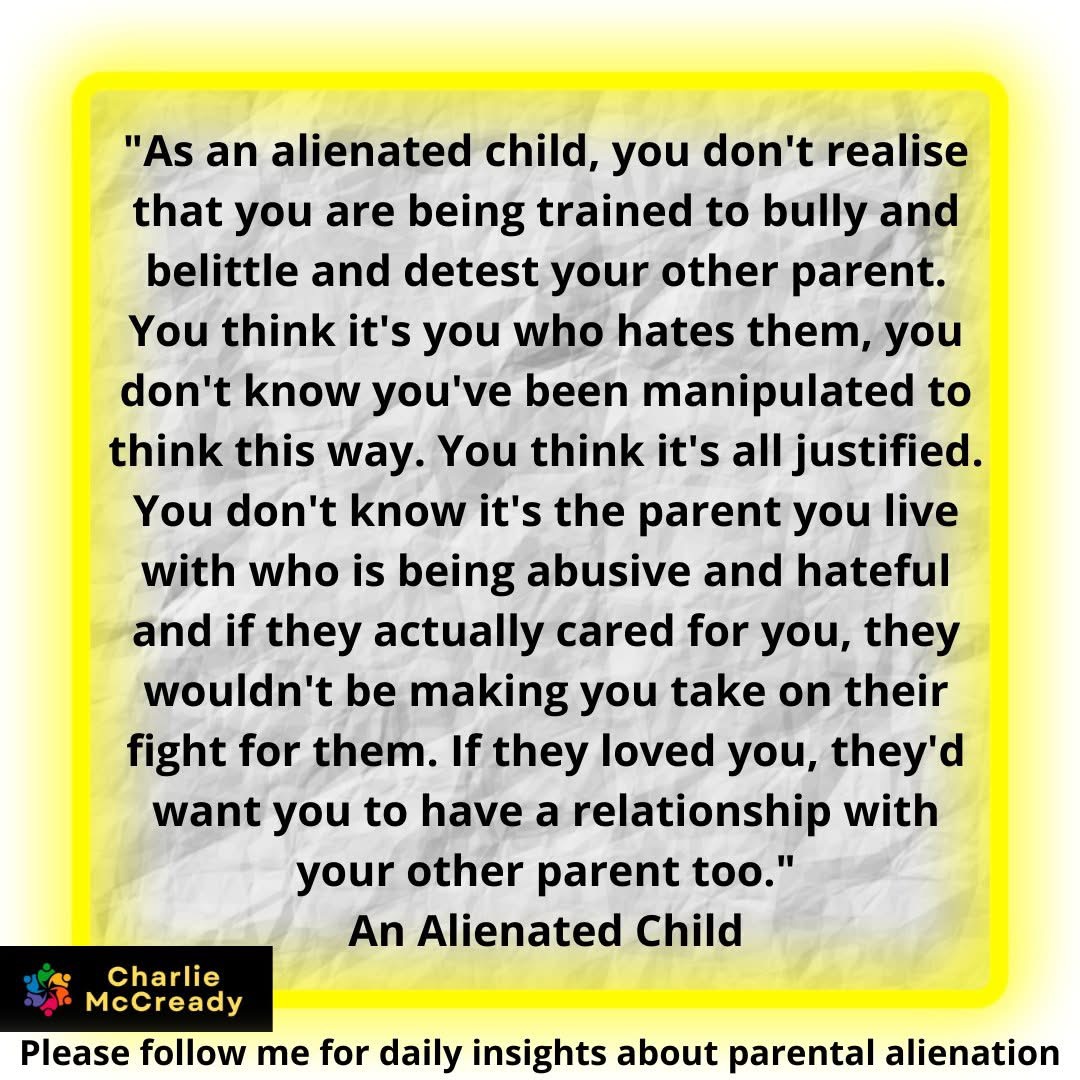
The manipulated alienated child – Charlie Mc Cready
It’s painful for the alienated child when they realise they’d put their trust in a parent who didn’t entirely have their best interests in mind, they were mostly thinking of themselves. They were being childish, vengeful and selfish when as a parent they’d have been expected, and trusted to be emotionally mature, mentally balanced, nurturing, and unconditionally loving.
Coming to terms with being manipulated, lied to, and deprived of a relationship with a loving parent can be a challenging process for an alienated child. It often involves recognising and acknowledging what really happened, which can evoke feelings of anger, sadness, and betrayal. Healing and reconciliation requires support from people who understand parental alienation. They can gradually gain insight into the dynamics at play and develop a healthier perspective on the situation. It is essential for the child to separate their own identity and emotions from the alienating parent’s influence, allowing them to reclaim their autonomy and make informed decisions about their relationships. Ultimately, the healing process involves finding ways to rebuild trust, establish boundaries, and create a fulfilling life that includes a sense of love and connection with both parents, regardless of the alienating parent’s actions.
A significant amount of programming of false beliefs and fictions need to be untangled so they can move on with their life as a sovereign, happy, healthy-minded individual who is free to love who they choose, not only who their alienating parent allows them to love.
Alienated children need to be immensely brave and strong to break free, but they can and do. Some cut ties with the alienating parent; some find a way to have both parents in their lives, which was always the best situation for them.
#charliemccready
#parentalalienationcoach
#alienatedparent
#coercivecontrol
#narcissisticabuseawareness
#parentalalienationawareness
#parentalalienation
#childpsychologicalabuse
#mothersmatter
#FathersMatter
#FamilyCourt
#custody
Weaponized Self Importance/ Narcissist Behavior
The Narcissist victim
Narcissistic strategy in divorce
Estrangement example
There are many professionals who have addressed the alienation and trauma of family estrangement and many are dangerous concepts . Inner healing is individual and should be as long and hard process .
I have statistics that state 1 of 5 kids are affected and that demands better therapies , better treatment, more educated and legal professionals and procedures that are based on truths , on facts and ultimately in the best interest of each family member , Justice , and the child that does not require treatments , prescription medications and life experiences that are more than challenging.
My daughter posted this on her FB page. I’ve never read or heard of this book and I didn’t send it to her. I’ve had no contact with her for over 6 years. They all ghosted me. She is a covert narcissist. When she no longer needed me she discarded me and convinced everyone I abused her. I was in shock. I told her I did everything for her and my now-grown grandchildren. She said every parent does that. No big deal.
I’m mostly healed from the estrangement, but this post angered me due to her total lack of gratitude. I raised my kids alone after finding their father dead from suicide. I was only 22 years old. I had no help and it was not easy. I showered my kids with love constantly. I guess hardship is considered abuse now. There is no abuse worse than an adult child discarding their elderly mother. There is no greater pain.
This is her post.
It Didn’t Start with You: How Inherited Family Trauma Shapes Who We Are and How to End the Cycle by Mark Wolynn
It Didn’t Start with You is about how trauma is passed down generationally, and how to heal it.
In my (unpopular, according to reviews) opinion, the reason this book has sold so well is because we, as a society, don’t know why we’re traumatized. It’s easier for us to paint over a dirty fence, attempting to bandage our family problems through “feel good” efforts.
Wolynn suggests that we all have inherited familial trauma that’s passed down through our DNA, and once we become aware of what our parents and grandparents experienced, we can heal all wounds and have happy relationships.
Easy peasy.
Maybe when you’ve had the ideal upbringing. But did you?
He doesn’t address dysfunction or abuse within the family. Instead he suggests being compassionate towards them, as if knowing about their traumas will absolve them from anything they may have done to you when you were growing up, or even as an adult.
Learned behaviors, beliefs, and feelings that have formed as a result of one’s experiences within the family—Wolynn attributes these to genetic generational trauma, subconscious memories from our ancestors. To him, these drive our behavior. He uses this framework for his system of “healing.” He does not address poverty, hardship, or emotional, verbal, physical, or sexual abuse.
He shares stories about his patients’ sense of relief and healing, but their underlying challenges have not been addressed, their relationships not truly changed. If none of the reader’s personal circumstances are looked at, all of this “generational trauma” is conjecture. The fence is still dirty and the paint peels sooner or later.
“We must first repair our broken relationships with our parents.”
How does he suggest that we do this? He suggests we take responsibility for our parents. He doesn’t suggest how to seek a relationship with them where they do the same. If they took responsibility for their past grievances, they would change their behavior, not in the short term, but for the long haul.
The onus falls on the adult child.
If your parents experienced past traumas, it doesn’t mean they win a “get out of jail free card.”
Wolynn states, “You can’t change what was, but you can change what is, as long as you don’t expect your parents to change or be different from who they are. It is you who must hold the relationship differently. That’s your work. Not your parent’s work. The question is are you willing?”
You can be compassionate and understand your parents’ pain, but that doesn’t mean you must acquiesce to dysfunction or abuse.
Here are a couple of my favorite “healing sentences” he suggests using if you’ve “rejected” a parent:
“I’m sorry for how difficult I’ve been.”
“I’ll take your love as you give it, not as I expect it.”
“I’m sorry that I pulled away. I promise, for the remaining time we have together, I’ll be closer.”
People think this is helping them, but it’s putting them through the same pain their parents did.
It Didn’t Start with You is dysfunctional therapy. I’m concerned for any vulnerable person who seeks out this type of “therapy”, or for any therapist who employs its ideas. It’s better suited to line a bird cage.
In fact, this book did line my bird’s cage. That’s because my abusive mother sent it to me after I finally cut contact—to absolve herself from her behavior, and to tell me that it’s my fault.
You can heal even if your parents refuse to.
Survival: Trauma Goal
Toxins and Autism
Anger
ᴛʜᴇ ᴍᴏꜱᴛ ᴅᴀɴɢᴇʀᴏᴜꜱ ᴀɴɢᴇʀ ɪꜱ ʙᴜɪʟᴛ ɪɴꜱɪᴅᴇ ꜱᴏᴍᴇᴏɴᴇ ᴡɪᴛʜ ᴀ ɢᴏᴏᴅ ʜᴇᴀʀᴛ.
🌟 It’s the quiet ones. The helpers. The ones who forgive, again and again.
🌟 It’s the ones who swallow their pain to keep the peace.
🌟 It’s the ones who wear a smile even when their soul is screaming.
But here’s the thing about good hearts: they can only take so much.
💔 That anger? It’s like a ticking time bomb.
💔 It’s the years of being overlooked, dismissed, and hurt.
💔 It’s the silent sacrifices that go unnoticed, unappreciated.
When a good heart finally erupts, it’s not just anger. It’s a volcanic explosion of every betrayal, every heartbreak, every moment of silent suffering.
⚡ Beware the anger of a good heart. It’s not born out of hate, but out of a desperate need to protect what remains.
⚡ It’s a cry for justice, for recognition, for a chance to be heard and healed.
⚡ And when that anger speaks, the world should listen.
So to those who carry this silent rage, know this:
❤️ Your anger is valid.
❤️ Your pain is seen.
❤️ Your voice matters.
Use that anger, not to destroy, but to rebuild. To carve out the respect, the love, the understanding you deserve.
And remember, even a good heart has the right to roar. 🗣️🌿
Words and image © Amanda Weston

 GreatCosmicMothersUnite