Indoctrination/Parental Alienation- Charlie McCready

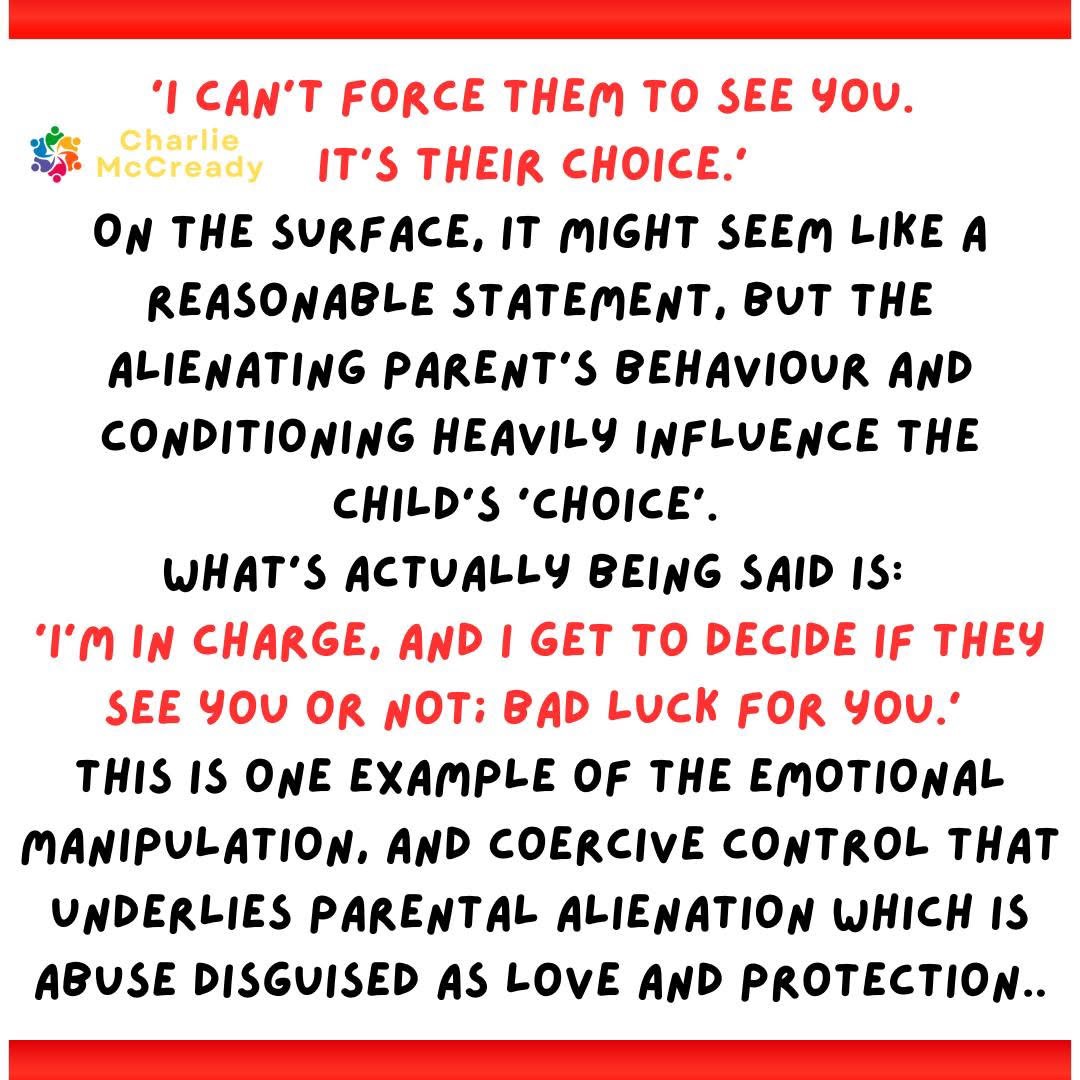
The idea that the alienating parent is not standing in the way of your relationship with your child is pure theatre. It’s an act. Behind the scenes, they’ve already given the child their lines and coached them into believing the character they’re supposed to play. Indoctrination, such as when a child is alienated and without justification for their rejection of you, is what’s happening. The child isn’t being given choices. They’ve already been coercively controlled and enmeshed into an alignment with the alienating parent.⁠

A child’s expression of wishes holds such power and is often a deciding factor in proceedings concerning them, but it should be acknowledged as a voice, not a choice. Placing the child in a position where they must select one parent over the other goes beyond being inappropriate. Children often desire things at age 8 or 9 that they’d go nowhere near ten years later. I’ll give you an example. I thought it would be incredibly cool to be a lion tamer. Thankfully my parents didn’t think to put me in a lion’s den with a whip and a whistle, thinking that my needs must be met because this is what I believed was right for me. I also wanted to be able to fly, and they didn’t send me off to be operated on with wings attached to me surgically. Of course, children need to be heard, but they also have to be guided, nurtured, given boundaries while not being totally indoctrinated. Children might not know better than to wish for something detrimental to them, as in the case of being allowed to choose to reject a loved, loving parent, having been encouraged by the alienating parent to do so.⁠

Research shows that many adults who, in their youth, rejected a parent, having been given a lot of pressure to do so by the other parent, later came to regret it and wished somebody would have had the sense to help them realise this was not a good idea – friends, family, legal or mental health professionals, anybody. ⁠

Taking, ‘it’s their choice’ at face value fails to recognise the extent of coercive control, psychological abuse, and manipulation at play, which can have profound negative effects on the child’s emotional development and well-being.⁠

#charliemccready

#parentalalienationcoach

#adversechildhoodexperiences

#CoerciveControl

#custodybattle

#parentalalienation

#narcissisticparent

#mothersmatter

#FathersMatterToo

#FathersMatter

#FamilyCourt

#coercivecontrolawareness

#parentalalienationawareness

#mothersrights

#FathersRights

#ChildCustody

#traumabonding

#familycourts
Doctors – The Reality

Sadly this is fact .

Many drs do not continue their education

after graduation, many learn from the

pharmaceutical industry in a ” best in

show”.

It’s been normalized which is why I see

holistic !

www.facebook.com/share/r/1AM7AqMwBZ/

Mediators – Craig Childress PsyD

Hmm… for mediators…

Mediators are often the first contact point for the mental health system, they are the interface between the legal system’s dispute resolution and mental health communication and negotiation skills.

They are also the system’s first contact point for the presence of a high-conflict narcissistic-borderline-dark personality parent in the family, which expands into clinical concerns for possible psychological child abuse if there’s significant child pathology present.

Mediators are not qualified to make the diagnosis – it’s a sophisticated pathology of patterns. However, they should be qualified to recognize the initial patterns of concern and recommend additional clinical diagnostic assessment for the family.

What child symptoms should warrant a referral for a clinical diagnostic assessment?

Any attachment symptoms, i.e., problems in love and bonding with either parent should receive a clinical diagnostic assessment of the child’s attachment pathology to the differential diagnoses of concern for each parent.

When we have significant attachment pathology displayed by a child, child abuse concerns become a prominent consideration and need a proper risk assessment to the differential diagnoses of concern for each parent.

Whenever there is post-divorce attachment pathology displayed by a child, Dr. Childress wants to be reassured about possible child abuse.

A child rejecting a parent is a disorganized attachment – i.e., the child has no organized strategy to bond to the parent. Disorganized attachment is caused by abusive or psychotic range parenting.

So… if the child displays no organized strategy to bond to the parent, then there is abusive or psychotic range parenting somewhere in the family. That is the type of parenting that creates disorganized attachment.

Look at the targeted parent first. Is the targeted parent abusing the child in some way? If not, then it’s the allied parent who is causing the child’s disorganized attachment to the targeted parent (for secondary gain to the allied parent).

One or the other. That’s the ONLY thing that causes that set of child symptoms – i.e., a child rejecting a parent, a directional change in a primary motivational system. If a child is rejecting a parent (disorganized attachment), then there is abusive range parenting by one parent or the other.

Diagnosing a persecutory delusion is an affirmative diagnosis. It’s not made based on history, we pop the delusion out right in our session using a Mental Status Exam of thought and perception, a sweep of their frontal lobe linear-logical reasoning system.

See Diagnosis Series 4: Diagnosing a Persecutory Delusion

Diagnosing a factitious disorder imposed on the child is a diagnosis by rule-out. To diagnose a factitious disorder we FIRST have to rule out all possible real causes, then we only have one thing left…. that it’s not a true pathology, it’s a false disorder (for secondary gain).

See Diagnosis Series 5: Diagnosing a Factitious Disorder Imposed on a Child

When the person produces a false disorder in themselves for secondary gain (often for financial gain), it’s a Factitious Disorder. When they produce a false disorder in the child for secondary gain (typically for emotional gain), it’s a Factitious Disorder Imposed on Another.

Wikipedia on FDIA says the diagnosis of FDIA is given to the adult, and the child receives a child abuse diagnosis.

From Wikipedia FDIA: “In DSM-5, the diagnostic manual published by the American Psychiatric Association in 2013, this disorder is listed under 300.19 Factitious disorder. This, in turn, encompasses two types: Factitious Disorder Imposed on Self; Factitious Disorder Imposed on Another (Previously Factitious Disorder by Proxy); the diagnosis is assigned to the perpetrator; the person affected may be assigned an abuse diagnosis (e.g. child abuse).”

Creating a delusional thought disorder in the child (a psychotic level pathology) that then destroys the child’s attachment bond to the other parent (a false/factitious attachment pathology imposed on the child for secondary gain to the allied parent), represents a DSM-5 diagnosis of V995.51 Child Psychological Abuse.

So? Is that what we have in this family? “I don’t know” is not a proper answer to the question. I’m asking if the child is being psychologically abused by a narcissistic-borderline-dark personality parent… that question needs a timely answer please.

In all cases of child abuse, we always protect the child.

All. Every time. We always protect the child from child abuse. Is there child abuse?

Mediators are the first contact point. There are two potential mediation topics – property and child custody. Financial property mediation is not a significant concern, get the accountants.

It’s the child custody concerns that raise possible child abuse issues. Is either parent worried about possible child abuse by the other parent?

If either parent is worried about possible abusive range parenting by the other (e.g., psychological child abuse), then a proper clinical diagnostic risk assessment for the child and family is warranted.

If you have a concern that the allied parent is psychologically abusing the child, tell the mediator. Tell the mediator you have an expert in clinical psychology who’s consulting on your family conflict and ask them to watch my YouTube video: Speaking to Court-Involved Mediators.

What video? The next one.

Craig Childress, Psy.D.

Clinical Psychologist

WA 61538481

OR 3942 – CA 18857

We are all Wounded

We Are All Wounded

We are all wounded,

bearing invisible scars that lie deep within our souls—

where no light dares to reach.

We move through life with hearts stitched together

by trembling hands and whispered hopes,

praying that no one looks too closely.

The world teaches us to wear masks,

to force a smile when it hurts,

to cover our cracks and pretend we are whole.

But the truth is, we are all broken—

each of us carrying untold stories

we’re too scared to share.

The mother who sheds silent tears

long after her children have drifted to sleep.

The man who laughs the loudest,

masking an emptiness that echoes through the night.

The friend who always says, “I’m fine,”

because she knows that no one truly asks twice.

We bleed differently.

Some wounds are fresh—

still raw and aching to the touch.

Others have formed fragile scabs,

but the pain lingers like a ghost,

haunting us when we press too hard.

And some are buried so deep

we’ve convinced ourselves they don’t exist—

until something unexpected tears them open again.

Maybe it was betrayal that shattered you.

Maybe it was the love you poured out

that was never returned.

Maybe it was the dream you chased

only to be left with empty hands.

Or the person you lost too soon—

a void that time has failed to fill.

Maybe it was the harsh words you endured as a child,

or the deafening silence when you needed comfort most.

But listen, love—

your wounds do not make you weak.

They make you human.

They are proof of a life fiercely lived,

of battles fought with a heart brave enough to feel.

Your pain is a testament to your strength,

to the resilience of a soul

that refuses to give up.

And though we are all wounded,

we are also healers—

carrying soft words in our hearts,

offering comfort through unspoken understanding.

We mend each other with kind gestures,

with the warmth of a gentle touch,

with a reminder whispered in the quiet—

“You’re not alone.”

That is how we begin to heal.

So do not hide your wounds.

Do not pretend they are invisible.

Let them breathe—

let them teach you tenderness,

reminding you that every soul you meet

is fighting a battle unseen.

We are all wounded,

but we are also unbreakable.

We may stumble, but we rise again.

We may break, but we rebuild—

stronger, wiser, and braver than before.

Our scars are stories—

not just of pain and loss

but of courage and survival.

So if you feel broken today,

know this, my love—

you are not alone.

You belong to a world of souls

who wear their cracks with grace,

shining light through their brokenness.

And that—

that is what makes us beautifully,

irrevocably human.

Emotional Coercion, Psychological Abuse & Manipulation- Charlie McCready

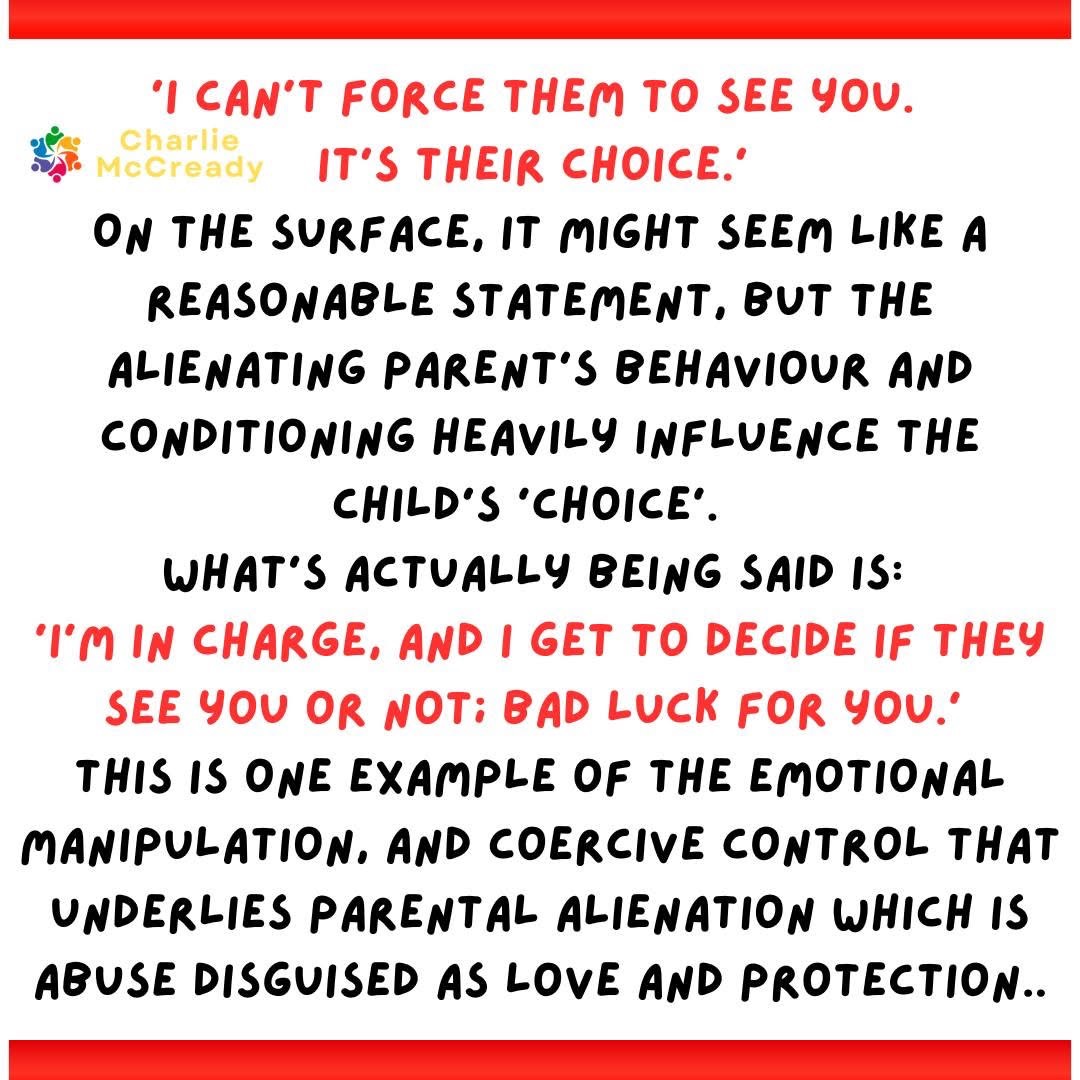
The idea that the alienating parent is not standing in the way of your relationship with your child is pure theatre. It’s an act. Behind the scenes, they’ve already given the child their lines and coached them into believing the character they’re supposed to play. Indoctrination, such as when a child is alienated and without justification for their rejection of you, is what’s happening. The child isn’t being given choices. They’ve already been coercively controlled and enmeshed into an alignment with the alienating parent.⁠

A child’s expression of wishes holds such power and is often a deciding factor in proceedings concerning them, but it should be acknowledged as a voice, not a choice. Placing the child in a position where they must select one parent over the other goes beyond being inappropriate. Children often desire things at age 8 or 9 that they’d go nowhere near ten years later. I’ll give you an example. I thought it would be incredibly cool to be a lion tamer. Thankfully my parents didn’t think to put me in a lion’s den with a whip and a whistle, thinking that my needs must be met because this is what I believed was right for me. I also wanted to be able to fly, and they didn’t send me off to be operated on with wings attached to me surgically. Of course, children need to be heard, but they also have to be guided, nurtured, given boundaries while not being totally indoctrinated. Children might not know better than to wish for something detrimental to them, as in the case of being allowed to choose to reject a loved, loving parent, having been encouraged by the alienating parent to do so.⁠

Research shows that many adults who, in their youth, rejected a parent, having been given a lot of pressure to do so by the other parent, later came to regret it and wished somebody would have had the sense to help them realise this was not a good idea – friends, family, legal or mental health professionals, anybody. ⁠

Taking, ‘it’s their choice’ at face value fails to recognise the extent of coercive control, psychological abuse, and manipulation at play, which can have profound negative effects on the child’s emotional development and well-being.⁠

#charliemccready

#parentalalienationcoach

#adversechildhoodexperiences

#CoerciveControl

#custodybattle

#parentalalienation

#narcissisticparent

#mothersmatter

#FathersMatterToo

#FathersMatter

#FamilyCourt

#coercivecontrolawareness

#parentalalienationawareness

#mothersrights

#FathersRights

#ChildCustody

#traumabonding

#familycourts

Parental Alienation- Charlie McCready

“The only thing necessary for the triumph of evil is for good men to do nothing.” – Edmund Burke⁠

The problem with good people doing nothing, often due to constraints like job remits or instructions not to step in and take action, is that it sometimes allows harmful situations or injustices to persist unchecked. Their inaction enables the continuation of wrongdoing, And so it is with parental alienation. ⁠

There’s a story about a teacher with a fishbowl on his desk. Before leaving the room, he gave strict instructions to his class not to touch the fish. He took a fish from its bowl and placed it on his desk. When the teacher had gone, the school kids stared at each other, shrugging their shoulders, confused and unsure what to do. They sat there. They stared at the fish, flapping desperately. Dying before their very eyes. One girl couldn’t bear it anymore. She rushed to the desk and put the fish back in the bowl. The teacher returned to the class. She expected to be reprimanded, but she didn’t care. Nor did he. Instead, he congratulated her and proceeded to give a lesson on how it’s sometimes best to break the rules, especially in a life-and-death situation. ⁠

The problem with legal and mental health experts is that they tend to go by the book, but as parental alienation is yet to be recognised officially, there is no standardised method of identifying it, taking action, or supporting the true victims of this psychologically abusive family violence – the children and ‘target’ parents. Too often, they do nothing. And this is worse. It’s harmful to do nothing. ⁠

However, I do believe this will change. Just as we now know, cigarettes are not healthy. We have safeguarding measures for domestic abuse (especially women). In time, parental alienation will be recognised as abuse.

#charliemccready

#parentalalienationcoach

#alienatedchild

#childpsychologicalabuse

#familycourts

#parentalalienationawareness

#custody

#FamilyCourt

#parentalalienation

#healing