
Tag: Children
Message to targeted parents / Don’t give up – Charlie McCready
Vaccines – The 1st year
In their first year of life, a baby may receive as many as the following vaccines at each age.
At 2 months: six injections, eight different vaccines – HepB #2, Rotavirus #1, DTaP #1, Hib #1, PCV #1, IPV #1
At 4 months: five injections, seven different vaccines – Rotavirus #2, DTaP #2, Hib #2, PCV #2, IPV #2
At 6 months: eight injections, 10 different vaccines – HepB #3, Rotavirus #3, DTaP #3, Hib #3, PCV #3, IPV #3, COVID-19 #1, Flu #1
At 12 months: nine injections, 11 different vaccines – HepB #3, Hib #4, PCV #4, IPV #3, COVID-19 #1, Flu #1, MMR #1, Varicella #1, HepA #1
DTaP and MMR vaccines are single injections each containing three vaccines.
𝗚𝘂𝗲𝘀𝘀 𝗵𝗼𝘄 𝗺𝗮𝗻𝘆 𝘀𝗮𝗳𝗲𝘁𝘆 𝘀𝘁𝘂𝗱𝗶𝗲𝘀 𝗵𝗮𝘃𝗲 𝗯𝗲𝗲𝗻 𝗰𝗼𝗻𝗱𝘂𝗰𝘁𝗲𝗱 𝗯𝘆 𝗽𝗵𝗮𝗿𝗺𝗮𝗰𝗲𝘂𝘁𝗶𝗰𝗮𝗹 𝗰𝗼𝗺𝗽𝗮𝗻𝗶𝗲𝘀, 𝗴𝗼𝘃𝗲𝗿𝗻𝗺𝗲𝗻𝘁 𝗮𝗴𝗲𝗻𝗰𝗶𝗲𝘀 𝗼𝗿 𝗽𝗵𝘆𝘀𝗶𝗰𝗶𝗮𝗻 𝗴𝗿𝗼𝘂𝗽𝘀 𝗼𝗻 𝘁𝗵𝗲 𝘀𝗶𝗺𝘂𝗹𝘁𝗮𝗻𝗲𝗼𝘂𝘀 𝗮𝗱𝗺𝗶𝗻𝗶𝘀𝘁𝗿𝗮𝘁𝗶𝗼𝗻 𝗼𝗳 𝗮𝗻𝘆 𝗼𝗳 𝘁𝗵𝗲 𝗮𝗯𝗼𝘃𝗲 𝘃𝗮𝗰𝗰𝗶𝗻𝗲 𝗰𝗼𝗺𝗯𝗶𝗻𝗮𝘁𝗶𝗼𝗻𝘀 𝗶𝗻 𝗶𝗻𝗳𝗮𝗻𝘁𝘀?
The answer is: None.
No organization—including the CDC, FDA, NIH, the American Academy of Pediatrics, or any physicians’ group—has ever studied the long-term safety of injecting any of these vaccine combinations simultaneously. Nor have they assessed the safety of repeating this practice, which occurs at least four times during the first 12 months of a baby’s life—at 2, 4, 6, and 12 months.
Despite all this, pediatricians routinely engage in this untested practice every day.
Moreover, administering multiple vaccines at once, and doing so every few months, makes it nearly impossible to pinpoint which vaccine or combination is responsible if an adverse reaction occurs.
So, if seizures occur after receiving six vaccines, how can it be determined which vaccine or combination of vaccines caused the reaction?
Add in the fact that adverse effects and diseases can develop months or even years later after vaccination, and this further obfuscates any ability to establish a clear cause!
This photo is from a pediatricians’ training manual.

Craig Childress PsyD – 2nd opinion Consultant -Child Psychological Abuse
I’m a second opinion consultant. That’s what old folks are best at.
We have experience. The young do, the old consult from our accumulated wisdom.
I have a very niche role. I have a client-parent-attorney. My role is to do what I can to ensure the child and family receives an accurate diagnosis and effective treatment plan, and that the Court receives an accurate diagnosis of the family problem for its decision-making surrounding the child.
If you value my opinion regarding the pathology in the family, then I am of value. If my opinion regarding the pathology present in the family is not valued, then I am of no value.
It all comes down to my credibility. Is what I’m saying true or false?
Look it over. Decide. You’ll find that everything I say about the pathology in the family courts is 100% supported, true, and correct.
I know that. I know that it all comes down to credibility. That’s why I’ve grounded in established knowledge, beginning with the DSM-5 diagnostic system of the American Psychological Association and the ethics code for the American Psychological Association.
Forensic psychologists, take a look at what Dr. Childress is asserting. Is it true of false? Judges and court-involved professionals, take a look at what Dr. Childress is asserting. Is it true or false?
Decide. I’ll wait. Dum-dee-dum… it’s true.
So can we now move forward into protecting children from child abuse, and their parents from spousal abuse?
I wrote an email confirming the information I discussed in a consultation session with a parent for documentation purposes to be shared around professionals.
You may find it’s content helpful as well. I always say the same thing – and I’ll continue to say the same thing until we start protecting children from child abuse by a narcissistic-borderline-dark personality parent.
_______________
Diagnosis: your family will need an accurate diagnosis of the problem so that an effective treatment plan can be developed. Currently, I am not confident that the pathology (problem) in the family has been accurately diagnosed.
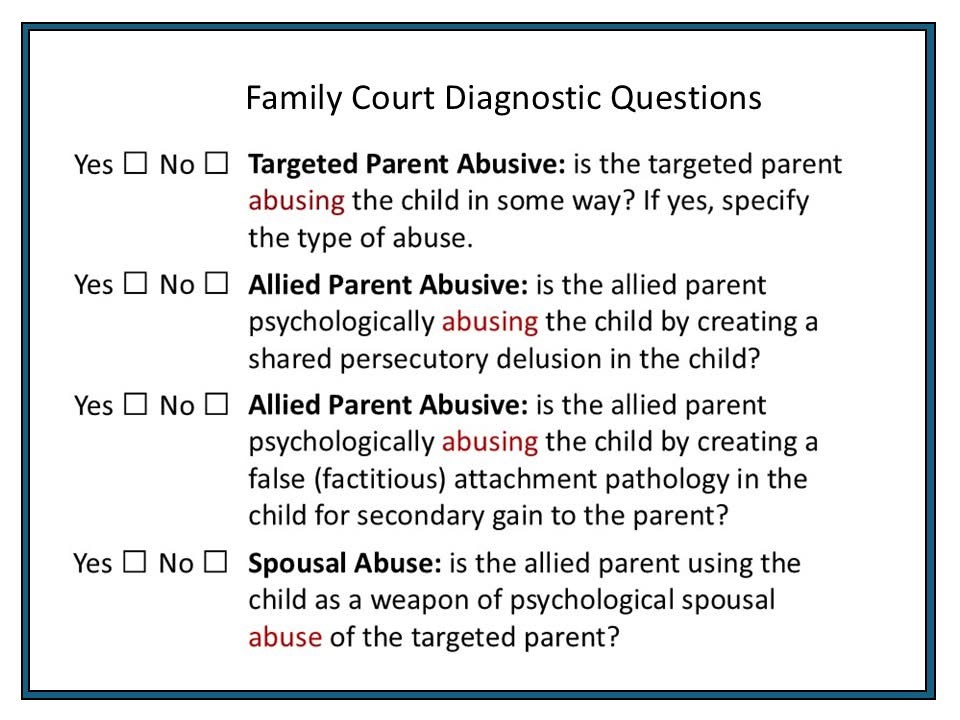
Clinical Concerns (differential diagnosis): the clinical concerns surrounding the family problem include the following differential diagnostic possibilities:
• Child abuse by father (specify the type of abuse)
• A persecutory delusion with the mother induced in the child (DSM-5 297.1 Delusional Disorder; persecutory type)
• A false (factitious) attachment pathology imposed on the child by the mother’s distorted parenting (DSM-5 300.19 Factitious Disorder Imposed on the Child; FDIA)
• Child psychological abuse by the mother who is creating false attachment pathology in the child for secondary gain to the mother (DSM-5 V995.51 Child Psychological Abuse)
• Spousal psychological abuse of the father by the mother using the children as the spousal abuse weapon (DSM-5 V995.82 Spouse or Partner Abuse, Psychological).
I have attached the diagnostic questions that need to be answered. The current family therapist has duty of care and duty to protect obligations relative to the diagnostic concerns involved.
I have the following resources available for the treating therapist and GAL (and Court) regarding the diagnostic assessment of court-involved family conflict surrounding child custody:
• YouTube Diagnosis Series: DSM-5 Diagnoses of Family Court Pathology
• YouTube Diagnosis Series: Diagnosing a Persecutory Delusion
• YouTube Diagnosis Series: Diagnosing a Factitious Disorder Imposed on the Child
• YouTube Diagnosis Series: Diagnosing Child Abuse in the Family Courts
• YouTube Diagnosis Series: Assessing Parenting
I recommend that a proper risk assessment be conducted for the family to the appropriate differential diagnoses for each parent. The current therapist has duty of care and duty to protect obligations, and it would be incumbent upon this therapist to either conduct a proper risk assessment for the dangerous pathologies potentially involved in the family, or to ensure that a proper risk assessment gets conducted.
Dangerous Pathology & Risk Assessments
There are three dangerous pathologies, suicide, homicide and abuse (child, spousal, and elder abuse), Whenever a mental health professional encounters any dangerous pathology (suicide, homicide, abuse) duty to protect obligations are active and the mental health professional must do three things:
1) Risk Assessment: the mental health professional must personally conduct a proper risk assessment for the danger involved, or ensure that a proper risk assessment gets conducted,
2) Protective Action: the mental health professional must take an affirmative protective action to ensure everyone’s safety (this might be increasing the frequency of sessions for a suicidal patient, or a CPS referral for child abuse concerns).
3) Documentation: the mental health professional should then document the findings of the risk assessment (if one was conducted) and the affirmative protective action taken.
I indicated that I am available for professional consultation with all court-involved mental health and legal professionals.
I am attaching the domains of my expertise and vita. Court-involved professionals can also follow me on Bluesky: @drchildress.bsky.social
Craig Childress, Psy.D.
Clinical Psychologist
WA 61538481
OR 3942 – CA 18857
Rebuilding your life after Alienation
Somebodies Child
They do not call us orphans,
Not when we stand tall in the world –
Not when we sign papers and pay bills,
Not when grief slips into our pockets
Like loose change we never meant to carry.
But we are –
Orphans of an age,
Left to navigate without the voices
That once guided us home.
No one warns us that loss reshapes the air,
That their name will sit in our throats,
That love doesn’t vanish – only echoes,
Soft and relentless, in everything they touched.
We catch ourselves searching –
In the tilt of our reflection,
In the way our hands move like theirs did,
In old letters, old recipes, old stories
That suddenly feel too heavy to hold.
People will say, ‘They’d be so proud of you.’
As if pride could fill the silence,
As if knowing that could make it hurt less.
But even in the emptiness,
Even with no parent left to be seen,
We are not untethered.
We are still carried in the love that made us.
We are still,
And will always be –
Somebody’s child.
Heather Lea

Mental health issues in Alienator
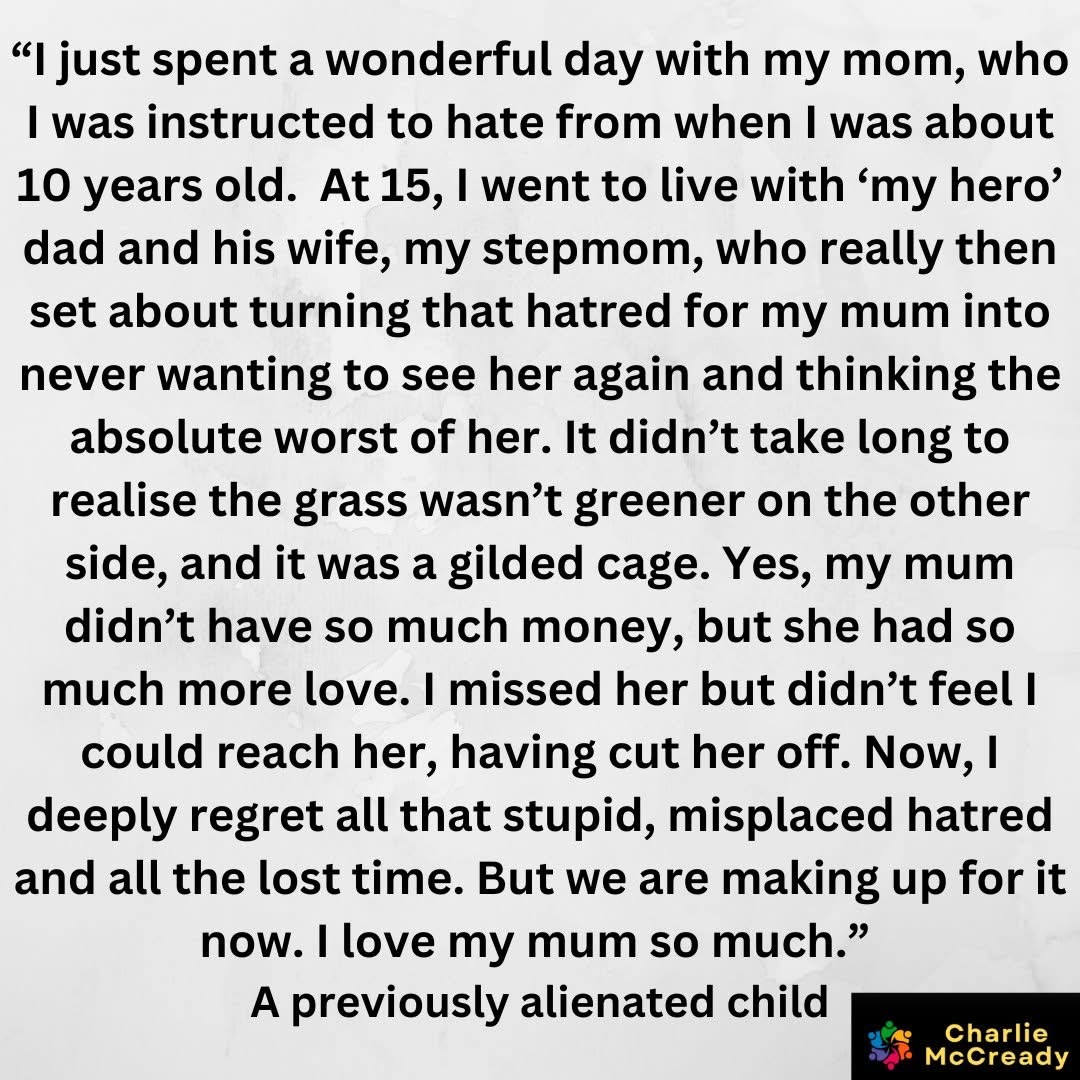
It’s often the case that the alienating parent may exhibit untreated mental health issues. These issues can range from personality disorders like narcissism or borderline personality disorder to unresolved trauma or attachment issues. However, rather than addressing these issues, the pathogenic parent tends to project their own shortcomings onto the targeted parent. This projection serves as a defence mechanism, allowing the pathogenic parent to avoid taking responsibility for their behaviour and deflecting attention away from their own mental health challenges. Instead, they attribute all wrongdoing to the targeted parent, painting them as the sole source of problems within the family dynamic.
Often, the ‘target’ parent has done what they can to encourage the pathogenic parent to seek help but is met with resistance or denial. As a result, the alienated parent is often seeking help to help them cope with an ex who refuses to admit they need help! They may undergo therapy or counselling to help them navigate the complexities of parental alienation and develop coping strategies to protect their well-being and maintain a healthy relationship with their child despite the obstacles posed by the pathogenic parent.
I look forward to the day when there’s a wider public understanding of what we call ‘parental alienation’ (child psychological abuse) and support, interventions, education, and a focus on encouraging the pathogenic parent to seek professional help.
Meanwhle, every day, these posts go out, hoping to help you feel less alone, hoping to help you understand the pathology, so it lightens your load a little. I know I felt so incredibly isolated (over 20 years ago when I first started on this road) myself. Stay strong. Don’t ever lose hope. My children returned. It took a while, but make sure you live your life and don’t get overcome with grief and anger. Do what you can to let that go, and strive to be happy. Reach out if you want to know more about how I can help more with my program and coaching.
#charliemccready
#parentalalienationcoach
#narcissisticabuseawareness
#familycourts
 GreatCosmicMothersUnite