Alienation & extended Famlies

“We often talk about how alienation cuts off one relationship. But in reality the truth is, it severs an entire family line. It has no mercy as it leaves parents without their children. It also leaves grandparents sitting by their windows, flipping through old photo albums, wondering what they did to deserve this treatment.

Remembering all those bedtime hugs, the silly stories, and backyard adventures that came to such a sudden end.If you ask any alienated grandparent, they’ll likely say: “I never thought I’d ever become a stranger to the child I once held in my arms as a baby.”

Now, ask the parents, and most of them will tell you: “I never imagined my own mother or father would lose their grandchild because someone I once trusted decided to destroy everything because of me.”

The saddest part? The alienator isn’t satified with severing just one bond—they tear through entire generations. They conciously choose to rewrite the family story. They turn family closeness into distance, and loving memories into something that hurts too much to remember.

Still, both the parents and grandparents hold on. They keep the birthday cards safely tucked away in drawers. In their mind’s eye, they remember the favorite colors, or the silly sayings, and the way a child’s head once rested under their chin.

Just like the parents who still hear the words, “I love you, Dad,” or, “Don’t let me go, Mom.”

For those living through this, you know that this pain doesn’t just come and go. Instead, it follows you everywhere. Into the grocery store, where another child looks just like yours. Into every holiday season, where an empty chair sits at the table. Even into your nightly dreams, where the reunion plays out perfectly, until you wake up to the same numbing silence you’ve been carrying for months, and sometimes years.

Yet… we still hope. That’s what so many don’t understand. Even after all the unanswered calls, all the doors that were slammed shut on us, all the letters marked “Return to Sender,” we still hope.

We hold onto the possibility of one more chance.

One more knock on the door.

One more opportunity to say, “I never stopped loving you.”

To the alienated grandparents out there, I want to say this: You’re not forgotten. The grief you feel is real. Your love still matters. That special place you held in your grandchild’s life should never have been taken from you.To the parents who are still hanging on: Don’t ever let go.

You’re not weak for caring. You’re certainly not foolish for loving. After all, you’re a parent, and that’s what we do.

To those reading this who’ve never lived through this kind of emotional torture: Please know this kind of silence doesn’t happen by accident. It’s designed.. It’s the product of manipulation, control, and the belief that love should have limits. Maybe one day, the door will open again. Maybe a child, or a grandchild will ask the question that begins to undo all the lies that were told.”

Until then, we wait in the wings… together

✍️ David Shubert
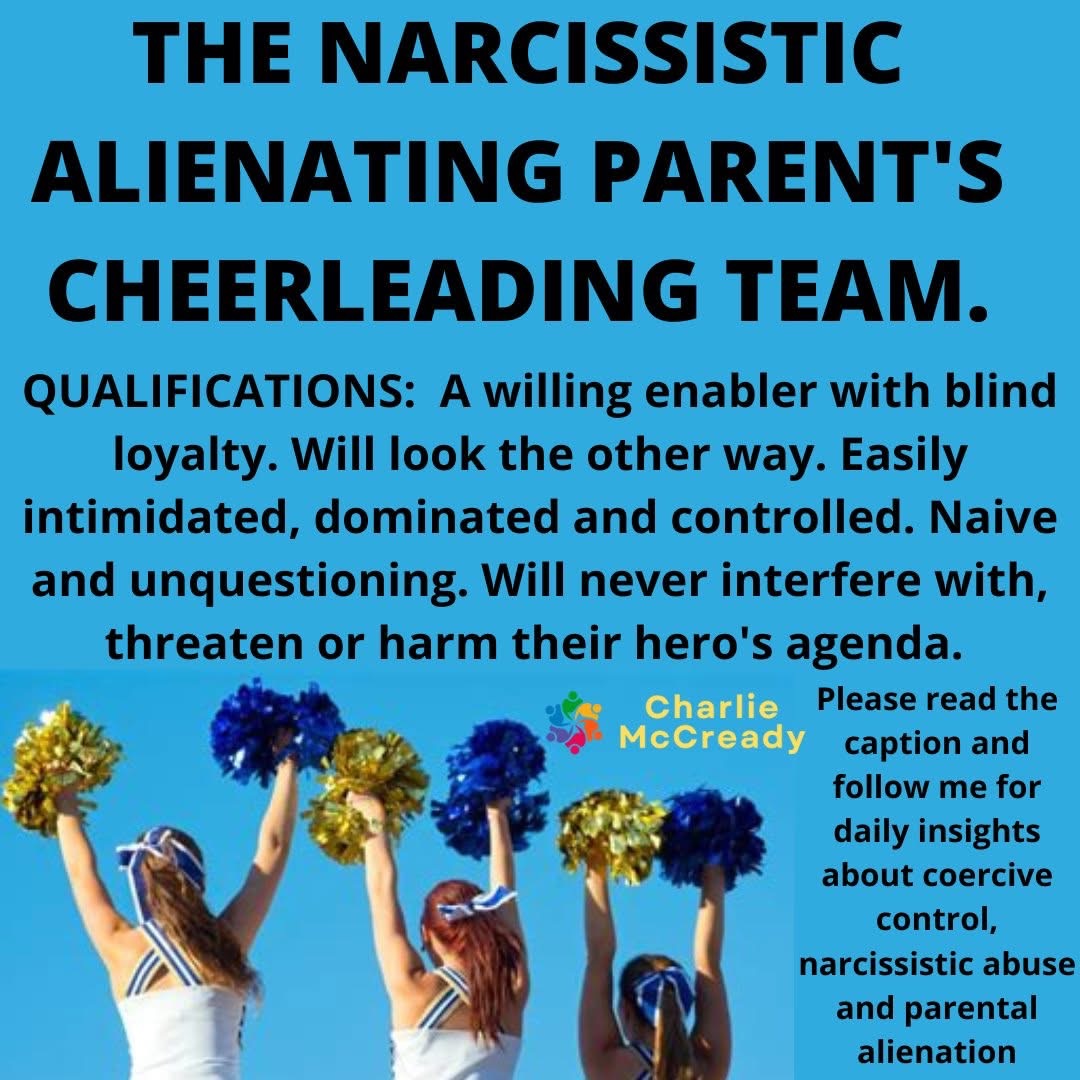
Enablers of Alienation via Narcissist -Charlie McCready

The alienating parent often seeks to create a support system comprised of people who enable, support and reinforce their behaviour. These enablers are like a cheerleading team, and they play a significant role in perpetuating the alienation. Here’s how this dynamic typically works:

The key enablers are willingly blind to the negative actions of the alienating parent. They demonstrate unwavering loyalty, refusing to acknowledge any wrongdoing.

Enablers consciously choose to ignore signs of manipulation or mistreatment. They might witness the alienating parent’s behaviour but deliberately turn a blind eye, allowing the alienation to continue unchecked.

Enablers are often submissive and easily controlled by the alienating parent. They may fear repercussions if they resist or question the alienator’s actions, leading them to comply passively.

Enablers might lack critical thinking skills or be naive, making them susceptible to the alienating parent’s persuasive tactics. They unquestioningly accept the distorted narrative presented by the alienator.

Crucially, enablers do not challenge the alienating parent’s agenda. They refrain from interfering even when they suspect that the alienator’s actions are harmful.

Enablers serve as cheerleaders, and their support reinforces the alienator’s belief that their actions are justified, making it increasingly difficult for the targeted parent and the alienated child to break free from the cycle of manipulation.

These enablers create a toxic echo chamber around the alienating parent, but why do they do it? Enablers support the alienating parent due to loyalty, fear, or manipulation, often gaining a sense of belonging, protection, or approval in return for their unquestioning allegiance.

#charliemccready

#parentalalienationcoach

#narcissisticabuseawareness

#narcissisticparent

#coercivecontrol

#traumabonding

#FathersRights

#mothersrights

#childrensrights

#parentalalienationisreal

#FamilyCourtReform

#FamilyCourt

#mothersmatter

#FathersMatterToo

#fathersrightsmovement

#FathersMatter

#custodybattle

#ChildCustody

#custody

#parentalalienation

#parentalalienationawareness

#gaslighting

#emotionalabuse

#enablers

Totally ignoring child’s needs / Charlie McCready

Parental alienation is, at its core, a profound attachment disorder where a child is psychologically manipulated to reject a parent they once loved. This is a form of psychological abuse rooted in coercive control, triangulation, and projection onto the alienated or ‘target’ parent. The alienating parent often engages in a cycle of deceit and manipulation, projecting unresolved personal issues onto the relationship between the child and the other parent. It’s a dynamic where the child’s genuine needs and emotional security are disregarded, with the alienating parent instead using the child as a tool to meet their own psychological needs.⁠

Many of these behaviours are driven by traits associated with cluster B personality disorders, where characteristics like narcissism, deep-seated fear of abandonment, and hostility towards the other parent can foster an intense drive to “punish” that parent. The alienating parent cannot see beyond their own needs and vendettas, resulting in a delusional mindset where they feel justified in severing the bond between their child and the co-parent. This distorted view places their own emotional fulfilment above the child’s right to a healthy, loving relationship with both parents, disregarding the immense psychological harm it inflicts on the child.⁠

I have been through the injustice, grief and trauma of alienation, and am totally invested in helping others. As well as my daily posts, I offer 1:1 coaching, and a 9-step program. I’m glad to say clients who do my program talk of gaining emotional and mental resilience and peace of mind, often within just a few weeks of starting. I help my clients understand and deal with their alienated child/ren, the alienating parent, plus how to overcome and survive the many challenges. Please send me a message if you are interested to know more, or you can visit my website.⁠

#charliemccready

#parentalalienationcoach

#ParentalAlienation

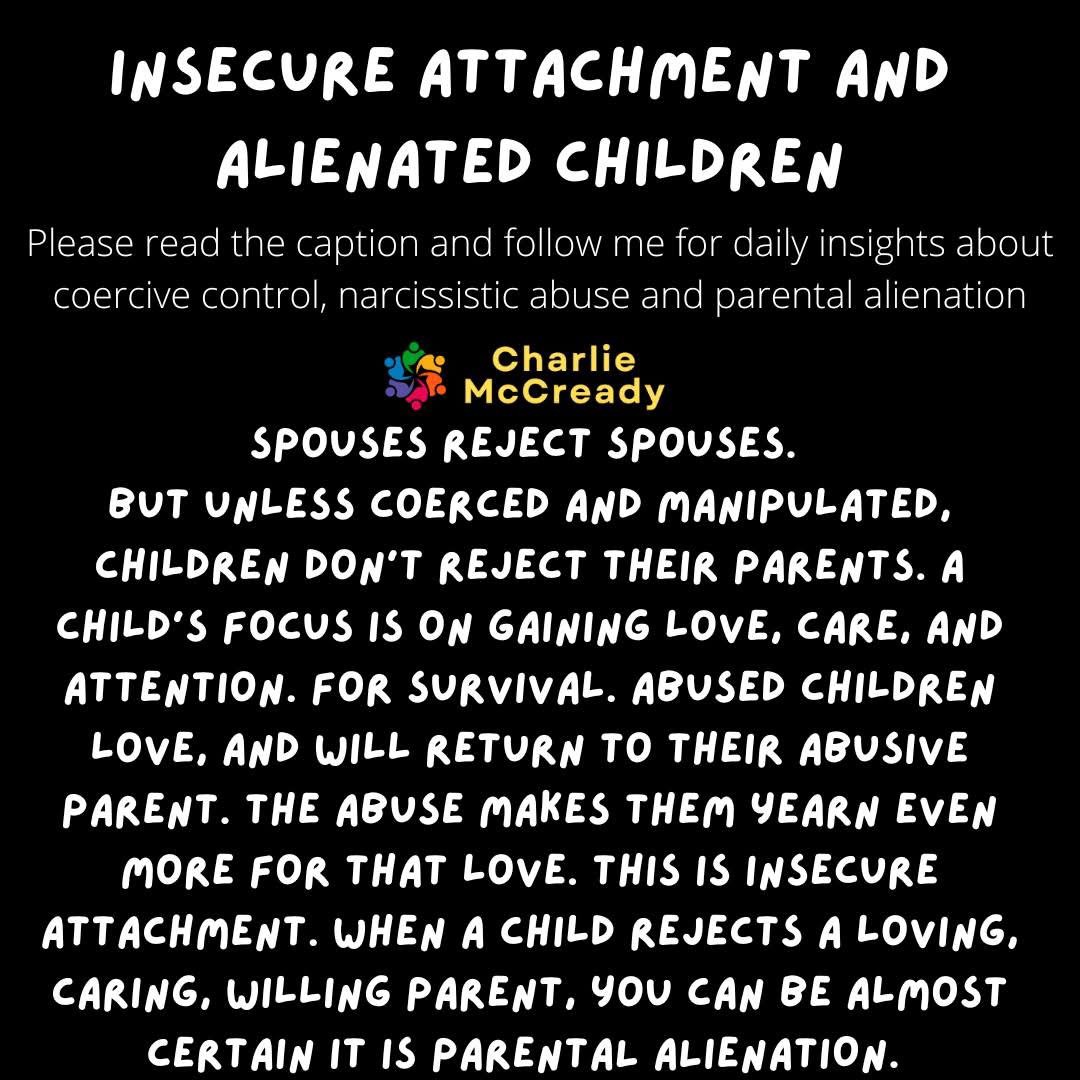
Insecure Attachment & Alienated Children – Charlie McCready

Insecure attachment and parental alienation are deeply intertwined and illuminate the profound impact of emotional manipulation on children. In contrast to estrangement, where rejection may be rooted in valid reasons, parental alienation involves the unjustified, coerced rejection of a parent who was once loved and has never stopped loving their child. In situations of psychological abuse, children, out of fear and the instinctual drive for survival, may gravitate towards the seemingly stronger, albeit abusive, parent, seeking safety in the very source of their distress. This is sometimes referred to as ‘identification with the aggressor’. This is an attachment disorder involving cognitive dissonance and ‘splitting’, and it exploits the child’s fundamental need for love, care, and security, leading to severe emotional consequences.

Insecure attachment refers to a pattern of relational behaviour in which a child, due to inconsistent caregiving or a lack of emotional responsiveness from caregivers, develops difficulties in forming secure, trusting relationships, and this, in cases of ‘parental alienation’ will specifically be the ‘target’ rejected parent. Insecure attachment in a child often results from inconsistent or neglectful parenting, where a child’s basic emotional and physical needs are not consistently met. Again, this will stem from alienating behaviours in their ‘aligned’ parent. Insecurely attached children may exhibit clingy or avoidant behaviour, struggle with self-esteem and self-worth, and have difficulties regulating their emotions.

An alienated/psychologically abused child who has experienced the accompanying insecure attachment will benefit from a great deal of empathy and perhaps also counselling and support groups. The child needs to feel safe in relationships and in the world, rebuilding trust and the ability to develop secure attachments while healing from the effects of parental alienation.

#charliemccready

Alienated Child – Charlie McCready

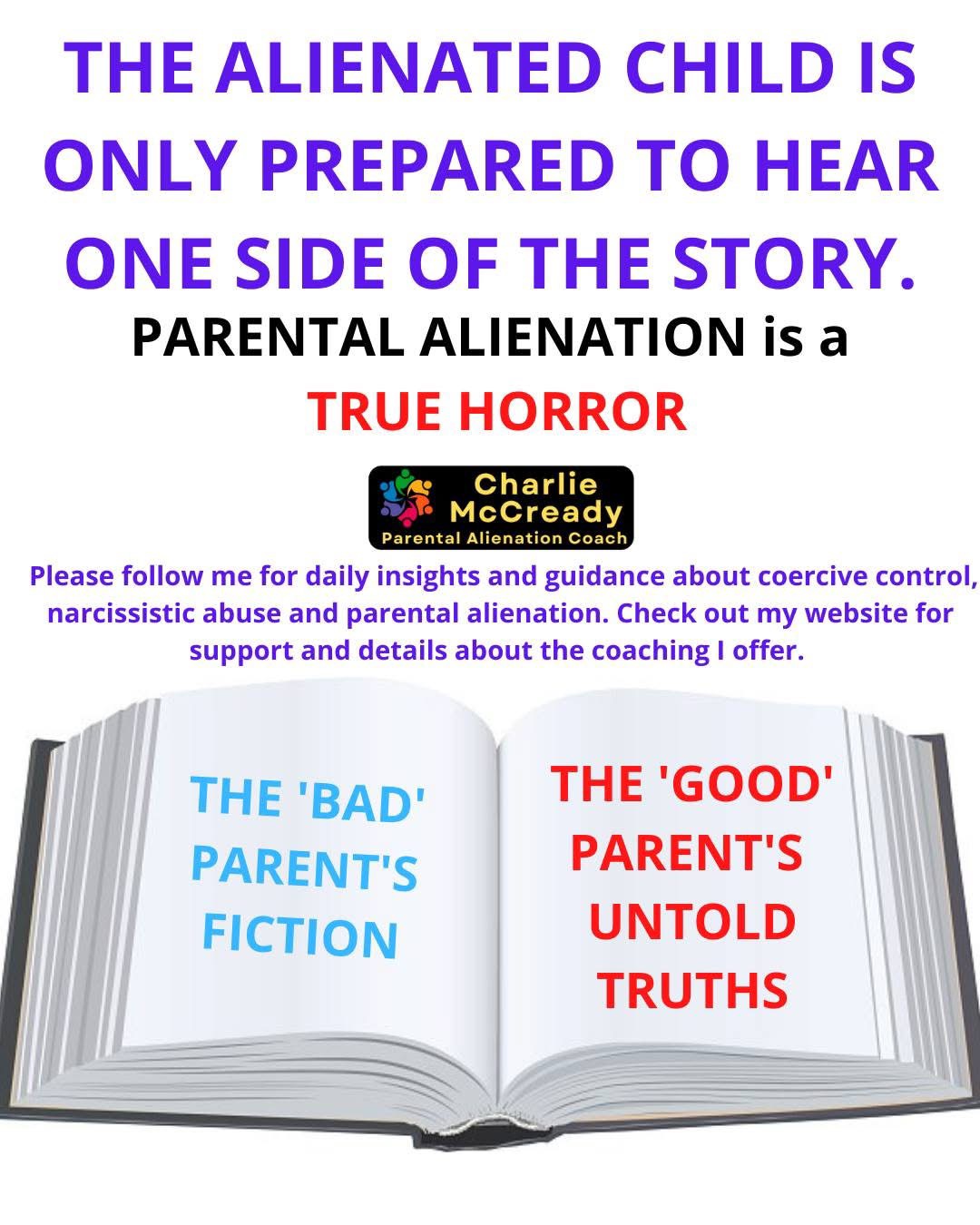
The alienated child unconsciously aligns with the parent who is presenting themselves as being good, loving, protective, ‘the only one’. The child then consciously rejects the apparently ‘bad’ parent. Despite how it might appear, this is agonising, traumatic, confusing, and upsetting to them, and yet all the anger and negativity induced is projected onto the ‘target’ parent. It’s quite easy to manipulate this alienation (denigration, judgement, emotional cut-off and/or actual no contact) when that child only hears only one side of the story, over and over again. It’s a horror story, a fiction they come to believe is real. The triangulation/alienation keeps the truth out of bounds and censored, and the ‘target’ parent becomes the monster in the story, a creation of the alienating parent’s imagination and disordered pathology. , The rejection of a loving parent by the alienating child is a coping mechanism. They ‘split’ – good, bad – and think they hate the ‘bad’ parent, and love the ‘good’ parent. This child is terrified of being abandoned by the parent who has inflicted forced compliance and shared persecutory delusions on their child, telling the child they’re the only parent … it’s trauma bonding, similar to Stockholm syndrome, and it is, of course, emotional and psychological abuse. To re-establish any relationship with the rejected parent, that child basically needs to find the courage (because of induced shame, guilt, fear, confusion, anger … the whole parental alienator’s toxic pathology) to hear the other side of the story. In many cases, it might be a story that the target parent is unable to tell if it causes more pain to that child. Often it is better to close the book on the past. It depends on the child and situation. You have to ‘read’ them to see how much they would benefit from hearing anything from previous chapters. It’s painful for any of us – our alienated children being no exception – to find out we’ve been duped, controlled, manipulated, emotionally abused deprived of the love and nurture of a loving, available parent, and believing them to be something they are not. If and when your alienated child reaches out, keep your words in the present tense, and loving, turning the page on the past, and focussing on creating a better future moving forwards.

#charliemccready

#parentalalienationcoach

#alienatedparent

#traumabonding

#coparentingwithanarcissist

Alienate – Charlie McCready

Parental alienation is a harrowing, vengeful form of psychological abuse, where one parent (sometimes with help from others) systematically erodes the attachment bonds of the child with their other ‘target’ parent. They actively sow seeds of doubt and misinformation, manipulating the thoughts and beliefs of innocent children against their own flesh and blood. It involves projecting the alienating parent’s own insecurities and faults onto the ‘target’ parent, creating a distorted reality for the child. Blame is shifted, and responsibility is deflected, all while the alienating parent gains control by isolating the alienated parent from family life. The result is a toxic environment where the child is emotionally torn, experiencing conflicting feelings due to the cognitive dissonance created by the stark contrast between the alienating parent’s manipulative narratives and the actual truth. This relentless psychological onslaught fractures trust, distorts reality, and inflicts deep emotional wounds, leaving all parties, especially the children, in a state of profound turmoil and confusion. There’s debate over the term ‘parental alienation’ and it could certainly be called pathogenic parenting, hostile aggressive parenting, intractable contact, narcissistic parenting, disordered parenting, malicious parent syndrome, psychological manipulation, emotional abuse, domestic partner abuse, child psychological abuse, spousal abuse, domestic violence, family bond obstruction or child alienation … it is abuse by any other name.

#charliemccready

#parentalalienationcoach

#alienatedparent

#coercivecontrol

#parentalalienationischildabuse

#parentalalienationawareness

#parentalalienation

#narcissisticabuseawareness

#narcissisticparent

#parentalalienationisreal

#custodybattle

#custodybattle

#FamilyCourt

#ChildCustody

Narcissistic traits & Alienation – Charlie McCready

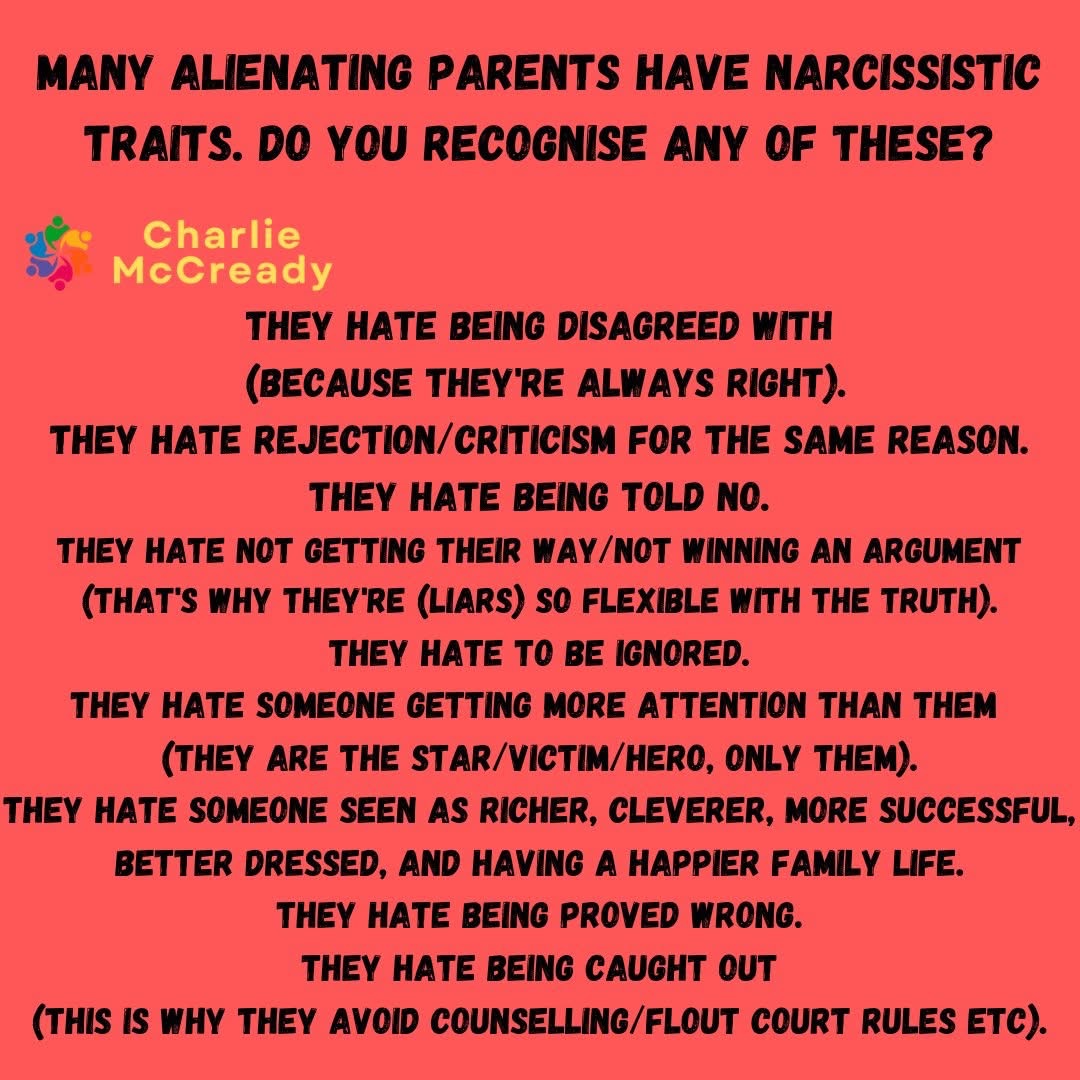
Many alienating parents exhibit narcissistic traits, which include an intense need for admiration and a lack of empathy for others. They are sensitive to rejection and criticism because it challenges their self-perceived superiority. Being told “no” or not getting their way threatens their sense of control and dominance. Their flexibility with the truth (aka outright lies and deceptions) stems from a desire to maintain their self-image as flawless. They consider themselves something of a hero! Being ignored undermines their need for validation from the outside world. Also, they resent others’ success or attention, feeling threatened by anyone who outshines them. In the case of ‘parental alienation’, this extends to fearing or being threatened by the idea that the children love their ex. They avoid counselling and disregard court rules to evade exposure or accountability, reinforcing their manipulative tactics. Believe it or not, many of these behaviours stem from their deep-seated insecurity and the compulsion to maintain a facade of perfection and superiority.

#charliemccready

#parentalalienationcoach

#narcissisticabuseawareness

#narcissisticparent

#gaslighting

#coercivecontrol

#parentalalienationawareness

#parentalalienation

#mothersmatter

#FathersMatterToo

#FathersMatter

#FamilyCourtReform

#FamilyCourt

#ChildCustody

#custodybattle

#custody

#mothersrights

#FathersRights

#fathersrightsmovement

#childrensrights

Alienated Kids are groomed into emotional servitude

Parental alienation doesn’t just separate a child from a parent—it rewires their nervous system.

Alienated children are often conditioned to believe:

• They must manage the alienating parent’s emotional state.

• Any deviation from loyalty is betrayal.

• Their love must be earned through compliance, silence, or performance.

This grooming creates a child who becomes hyper-attuned to the needs, moods, and reactions of others. The message they internalize is clear:

“You are responsible for how I feel.”

And if the child doesn’t manage that emotional state correctly, the cost is often rejection, guilt, withdrawal of affection, or punishment.

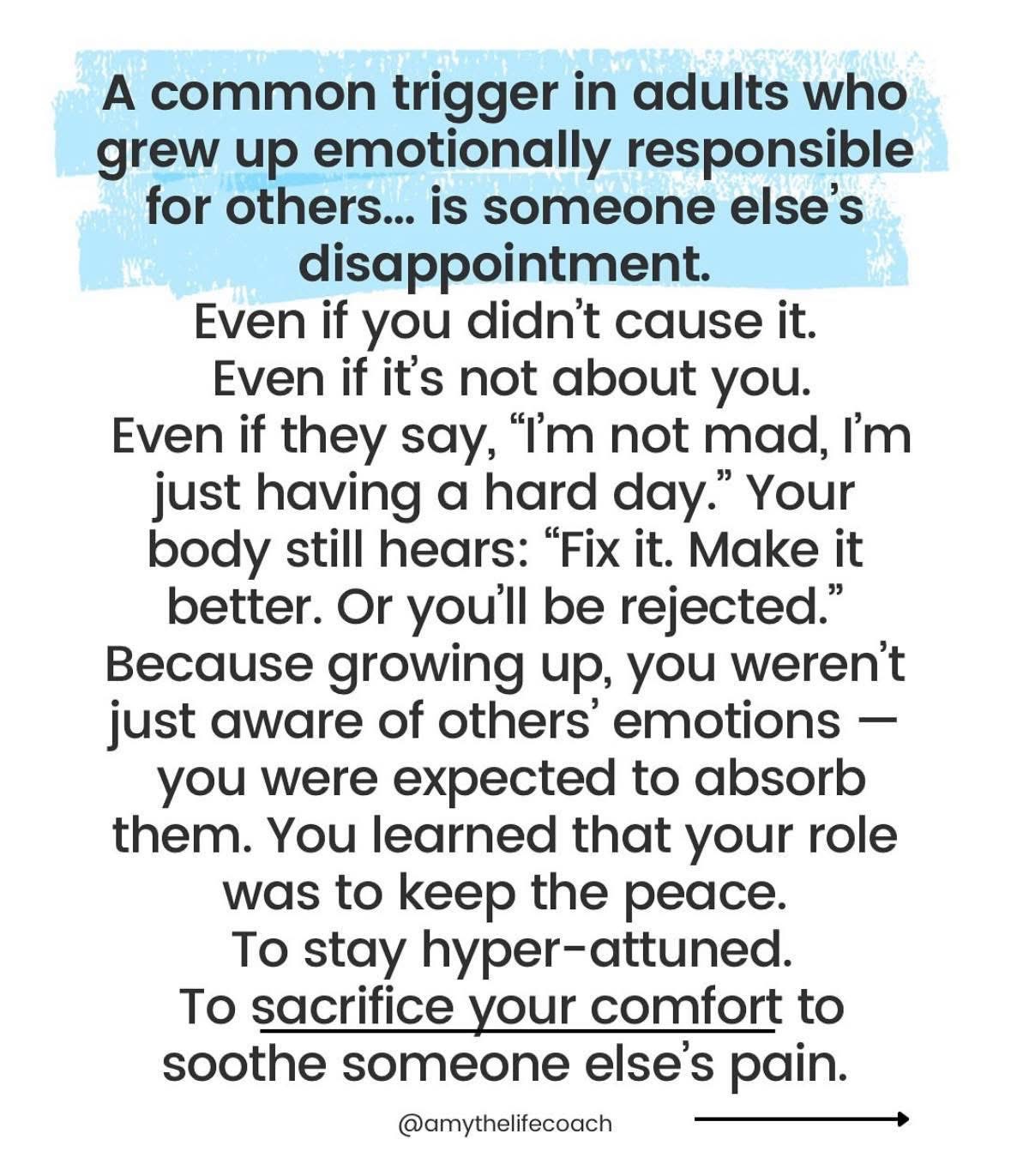
They learn to sacrifice their comfort, truth, and identity to maintain approval.

They become peacekeepers.

Performers.

Caretakers of chaos.

This is emotional enmeshment masked as loyalty—and it leaves long-term scars.

What This Looks Like in Adulthood

These children often grow up to:

• Feel triggered by other people’s disappointment—even when it’s not directed at them

• Feel responsible for fixing everything

• Have difficulty saying “no” or disappointing others

• Lose their sense of self in relationships

• Seek external validation at the expense of their own truth

Their inner narrative becomes:

“If I don’t fix this, I’ll lose love.”

“If I don’t keep the peace, I’ll be punished.”

“If someone’s unhappy, it must be my fault.”

This is not their fault. It’s the result of living in survival mode for years under the weight of manipulation.

How to Help Your Alienated Child Heal When They Come Back

When your child returns—emotionally or physically—you have a rare and sacred opportunity. Not to explain your pain. Not to clear your name. But to give them space to discover who they are without pressure.

Here’s how:

1. Give Them Emotional Sovereignty

Let them know they are not responsible for your healing. Say:

“You’re not here to take care of my feelings. I’m here to hold space for yours.”

2. Model Nervous System Regulation

If you stay calm, grounded, and regulated—even when they test boundaries—they will feel the difference. You become the safe space they never had.

3. Normalize Their Confusion and Mixed Emotions

Let them know it’s okay to feel loyalty to both parents. Don’t force them to choose sides. Instead, affirm:

“You’re allowed to love us both. You’re allowed to have your own experience.”

4. Don’t Trauma-Dump

They don’t need to hear your whole story or pain. They need to know they’re loved and safe. If they ask, share—but only what they can emotionally handle.

5. Help Them Rebuild Identity

Encourage expression through creativity, exploration, and play. Say things like:

“What do you love?”

“What makes you feel alive?”

“You don’t need to perform here. Just be.”

6. Celebrate Autonomy

They were stripped of autonomy in the alienation dynamic. Give it back. Let them choose the pace of reconnection. Let them have opinions. Let them say no.

Healing Begins With You

If you want your child to shed the burdens placed on them, you must never place new ones on their shoulders. Let their nervous system relearn what it feels like to be near someone who doesn’t demand anything of them except presence.

You are not here to pull them back into your world.

You’re here to witness the return to their own.