

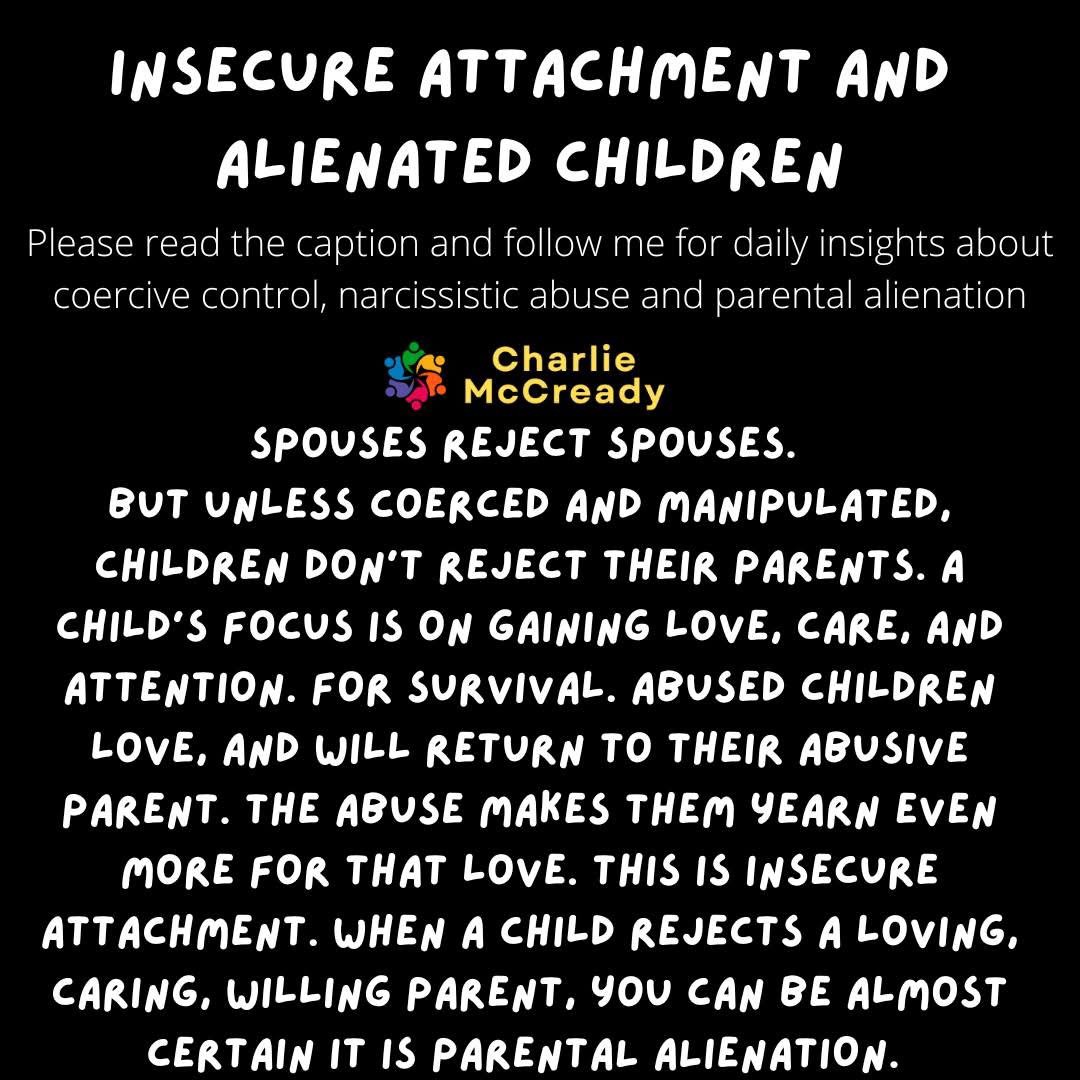
Insecure attachment and parental alienation are deeply intertwined and illuminate the profound impact of emotional manipulation on children. In contrast to estrangement, where rejection may be rooted in valid reasons, parental alienation involves the unjustified, coerced rejection of a parent who was once loved and has never stopped loving their child. In situations of psychological abuse, children, out of fear and the instinctual drive for survival, may gravitate towards the seemingly stronger, albeit abusive, parent, seeking safety in the very source of their distress. This is sometimes referred to as ‘identification with the aggressor’. This is an attachment disorder involving cognitive dissonance and ‘splitting’, and it exploits the child’s fundamental need for love, care, and security, leading to severe emotional consequences.
Insecure attachment refers to a pattern of relational behaviour in which a child, due to inconsistent caregiving or a lack of emotional responsiveness from caregivers, develops difficulties in forming secure, trusting relationships, and this, in cases of ‘parental alienation’ will specifically be the ‘target’ rejected parent. Insecure attachment in a child often results from inconsistent or neglectful parenting, where a child’s basic emotional and physical needs are not consistently met. Again, this will stem from alienating behaviours in their ‘aligned’ parent. Insecurely attached children may exhibit clingy or avoidant behaviour, struggle with self-esteem and self-worth, and have difficulties regulating their emotions.
An alienated/psychologically abused child who has experienced the accompanying insecure attachment will benefit from a great deal of empathy and perhaps also counselling and support groups. The child needs to feel safe in relationships and in the world, rebuilding trust and the ability to develop secure attachments while healing from the effects of parental alienation.
#charliemccready

 GreatCosmicMothersUnite