Family Court-Daniela Cueva Perez

I always assumed that victims of injustice had avenues for complaint or appeal, and ultimately could overcome systematic abuses through collective activism… but the reality is much sadder and more complicated.

The abuse and corruption in family courts is real—by judges, GALs, reunification therapists, parenting coordinators, supervisors, and even attorneys. The experiences of family court victims often sound so outrageous and egregious; it’s hard to believe they are commonplace or that NOTHING is being done by legislators, judicial departments or the media to protect victims of abuse. But the reality is: family courts deal such a destructive blow of psychological and financial abuse, most victims are too traumatized to file appeals or complaints.

Here’s why, backed by what the research shows:

• Over 70% of family court litigants represent themselves, often because they’ve run out of money. Family court disputes can cost between $50,000 and $500,000 or more. Appeals can cost $15,000–$50,000+ and require legal precision most parents can’t manage alone.

• Family court decisions are rarely overturned. In many states, fewer than 10% of family law appeals succeed unless there’s clear legal error or misconduct—something hard to prove without transcripts, which cost thousands. Family court judges have such wide discretion, their decisions are nearly impossible to appeal even if one side has a mountain of compelling evidence. Family court judges have that much power and discretion— not to mention ”weighing factors” for decisions in family court  are often vague and contradicting. 

• Judicial oversight is minimal. In 2022, only 1.5% of formal complaints against state judges nationwide resulted in any public discipline. Most are dismissed or resolved in secrecy. Judicial fitness committees are made up of fellow judges, and colleagues, which creates an obvious conflict of interest. 

• Complaints often go back to the same system that caused the harm— meaning that appeals go back to the same biased judges. Parenting coordinators, GALs, supervisors and reunification therapists are rarely held accountable because they are protected by court appointment and private contracts that require immunity from suit—and there’s no centralized oversight. In Oregon, for example, the AFCC (Association of Family and Conciliation Courts) maintains close professional ties between corrupt attorneys, evaluators, supervisors and therapists in order to protect and perpetuate this lucrative industry. 

• Parents are told not to complain, and to pay the exorbitant bills of all of the court appointed affiliates who have insinuated themselves into a family court case, out of fear of retaliation. Attorneys often advise clients to “stay compliant” or “don’t stir things up,” warning that even valid complaints could be used as proof of “parental alienation” or non-cooperation. 

• The victims of the system are ultimately too traumatized to go back and fight it.  The mental and physical trauma creates a lifetime of collateral damage that leaves victims crawling away or running for their lives. 

The result is system where harm happens behind closed doors, and the people most affected feel powerless to speak out. Children are pawns whose voices are silenced systematically by the very people who are supposed to protect them. 

#onemomsbattle #familycourtcorruption #oregonfamilycourt #stopcourtabuse #custodypeace

The Blessings of Being Rejected by your child

Watching your child(ren) go through so much of life enmeshed with a parent who abuses them , to savage you … is the Hell on Earth no one wants or deserves .

That said , I have been on my own since 1993 . As the toxic RX increased the unpleasant side effects of being the target physically, I had no one who cared .

Realizing the blatant abuse and X’s desire to recreate as much of my trauma of childhood , I could more easily distance myself

youtube.com/watch

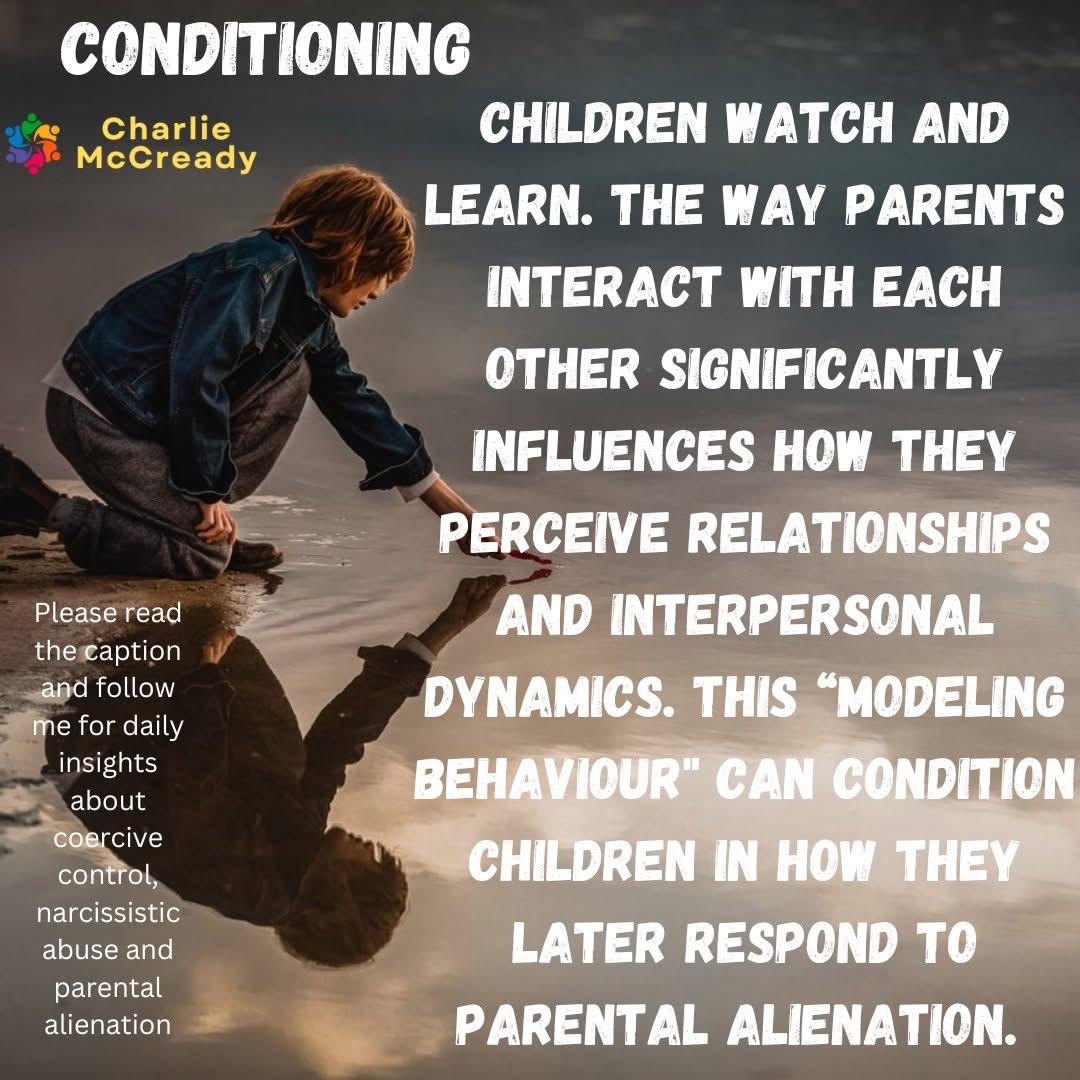
Conditioning – Charlie McCready

Children are like sponges, absorbing not only information but also behaviours exhibited by the adults around them. The way parents interact with each other significantly influences how children perceive relationships and interpersonal dynamics. This subtle process, known as “Modelling Behaviour,” lays the groundwork for how children may later respond to challenges like parental alienation.⁠

Children are incredibly perceptive observers of their parents’ actions and interactions. As they witness how adults communicate, resolve conflicts, and treat one another, they internalise these behaviours as normal or acceptable. Parents are role models, demonstrating how their children should engage in relationships, express emotions, and handle disagreements. When one parent engages in negative behaviours like badmouthing, denigrating, or criticising the other, children unconsciously learn that these behaviours are acceptable and permissible, and in the case of alienating behaviours, the child may be encouraged and rewarded for emulating them. ⁠

When parents consciously exhibit kindness, respect, and empathy toward each other, they create a foundation for their children to build upon. Children growing up in an environment where healthy communication and conflict resolution are the norm are more likely to carry these positive traits into their own relationships as they mature. But as an alienated parent, remember that your disposition and actions, even from afar (children are sponges; they watch and pick up on things), can guide your child’s emotional growth and cultivate positive relationships throughout their life.⁠

#charliemccready

#parentalalienationcoach

#childrensrights

#fathersrights

#mothersrights

Controlling the Child to harm the other parent./Charlie McCready

An alienating parent is not providing unconditional love. They are controlling and behaving selfishly. A loving parent does not work towards eliminating the other parent, a loving, available, good parent (and often their extended family, too), from the child’s life because that is definitely not in the child’s best interests. In contrast, a ‘target’ (alienated/rejected) parent often ‘lets go’ because they love SO MUCH. This act of ‘letting go’ (or necessary detachment) is a powerful demonstration of genuine love because this parent refuses to play the alienating parent’s tug of war game if it creates further trauma and harm to their child. This is LOVE, LOVE, LOVE. Fear and control and anger, coercive control, indoctrination, lies and ‘brainwashing’ are not loving behaviours. The child is confused and enmeshed by the twisted narratives and lies they hear, and cognitive dissonance and splitting are coping mechanisms, as is their anger. The (alienated) children would like nothing more than for their parents to coexist and co-parent amicably, fostering a healthy environment for everyone’s mental and emotional well-being so they can get on with their lives. Even if parental harmony remains elusive, the toll of ongoing conflict on a child’s mental health is undeniable. Unfortunately, the alienating parent often remains indifferent to this toll. Unfortunately, they literally don’t care. However, as the child matures, they may come to realise the destructive nature of these actions, prompting a journey toward understanding, forgiveness, and healing. It’s of paramount importance to be strong, stay loving, and not succumb to angry, provoked reactions. Near or far, be the healthy-minded parent in the child’s life. Even if there’s no contact at the moment, focus on being happy, on being there whenever the child/adult knocks on your door again.

#charliemccready

#parentalalienationcoach

#alienatedparent

#narcissisticparent

#gaslighting

#emotionalabuse

Cheaters

“It’s easy for a man to walk away when he already been cheating…” Whew. That line alone carries so much weight. Because once someone’s already been stepping out—emotionally, physically, or even mentally—they been gone. Their body might still be around, but their mind and heart checked out a long time ago. So when they finally leave, it don’t hurt them the way it breaks you, because they’ve already grieved the relationship in silence, behind your back. They just waited until it was convenient to make it official.

But a faithful man? A man who gave you his all, who saw forever in your eyes, who looked at you and saw his peace, his purpose, his person? He won’t walk away that easy. Not without a fight. Not without trying to fix it, talk it out, meet you halfway—even if it hurts. Because you were his home. His comfort. His best friend. That kind of man isn’t quick to let go of something he values. He knows how hard it is to find someone who matches his loyalty, his heart, his effort. He knows.

And that’s the difference. When a man is truly invested, he’s not looking for the nearest exit the moment things get hard. He doesn’t treat commitment like a pair of shoes he can just slip off when it gets uncomfortable. He’s in it—really in it. And even if things fall apart, you’ll never question if he cared, because his love left no room for doubt.

That’s why it hits so different. Because deep down, we all want that kind of loyalty. The kind that doesn’t flinch when life gets real. The kind that doesn’t make you beg to be chosen. So if he walked away without trying, without fighting, without even turning back—it’s not because you weren’t enough.

It’s because he never was. 💔

Alienating Parents often cluster B type personality/Charlie McCarthy

I completely understand how exasperating it is to deal with a narcissistic, alienating ex who’s manipulating everyone around them. It’s not just the grief of being separated from your child—it’s the sheer injustice of watching people fall for the charade while you’re left struggling to get anyone to see the truth. Narcissistic abuse is extremely difficult to cope with because these people are highly manipulative and incredibly skilled at twisting the narrative to make themselves look like the victim (when they’re not playing the hero). ⁠

Even when they’re not actively abusing you or undermining your role, they’re out there putting on a performance—telling everyone how selfless and devoted they are, how they would never do anything to harm the children. They know exactly how to play the part of the good parent, saying all the right things while you’re painted as the unreasonable, difficult one. It’s maddening because, deep down, you know what they’re really like, but every time you try to show it, they seem to be one step ahead, even making you look like you’re overreacting or being irrational.⁠

I also know how hard/impossible it has been made to put the children first when you’re pushed to the sidelines and/or shut out of their lives. It’s not that you don’t want to be there or aren’t trying—sometimes, they’ve built up so many barriers that it feels impossible to stay connected or even be involved. And meanwhile, the alienator is the one controlling the narrative, telling everyone that you’re the problem, that you’re the one who doesn’t care. It’s hell, I truly understand. I’ve been there too. ⁠

The truth is, these alienating parents are always thinking about themselves—whether they’re badmouthing you to your child, tearing down your reputation, or just telling anyone who’ll listen what a wonderful parent they are, despite you – what martyrs! They never really stop being abusive; they just switch gears. When they’re not actively being selfish or controlling, they’re busy making sure everyone sees them as the opposite—calm, reasonable, and, of course, completely selfless. Enough to drive us mad! And they don’t mind that, at all.

I see you. I understand the pain and the frustration of watching someone who’s caused so much damage keep getting away with it. It’s not your fault. You’ve been fighting a battle where the rules keep changing, and the truth is constantly distorted to suit them. But the fact that you’re here, still holding on, reading these posts … says so much about your strength and love. Don’t ever doubt that.

#charliemccready

#parentalalienationcoach

#coercivecontrol

#narcissisticparent

#emotionalabuse

#traumabonding

#parentalalienation

#mothersmatter

#FathersMatterToo

#FathersMatter

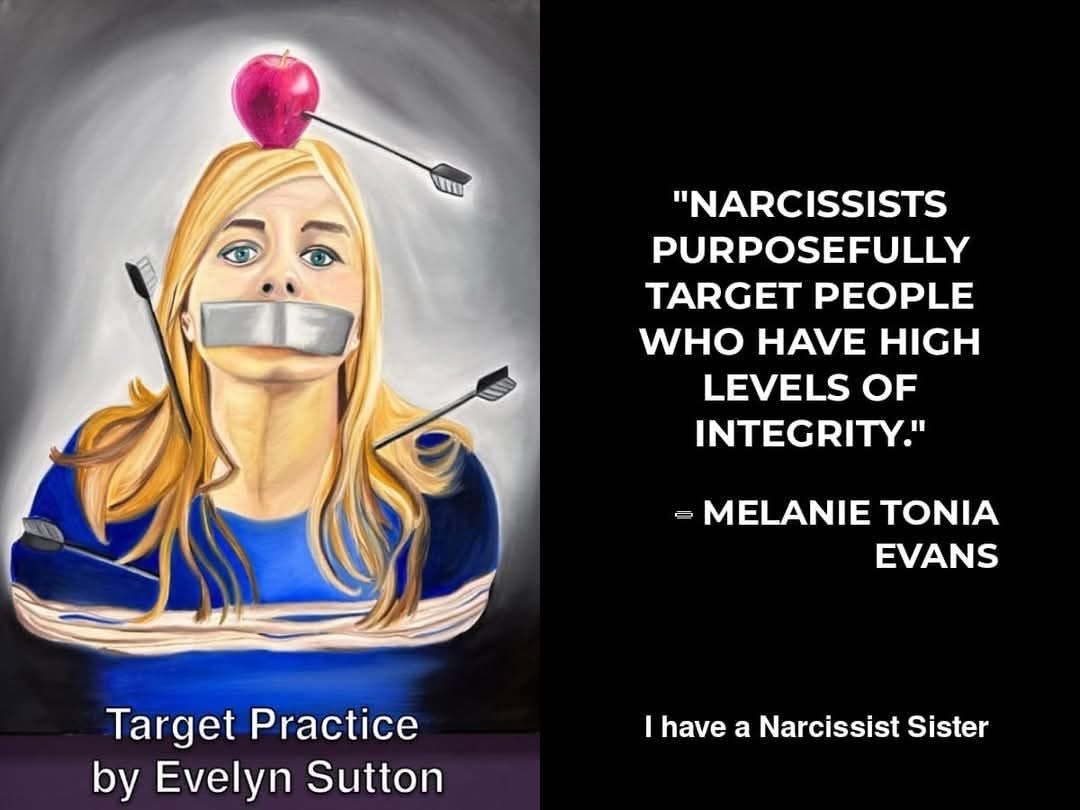
The Narcissist Target

Narcissists often make mistakes and hurt people around them. They look for victims who are forgiving and will overlook their mistakes. Forgiving people are easy to manipulate and control because they are less likely to hold the narcissist accountable for their actions.

They also look for victims who are highly empathetic because they are more likely to put the narcissist’s needs before their own. Empathetic people are also less likely to see the narcissist’s flaws and more likely to make excuses for their behaviour.

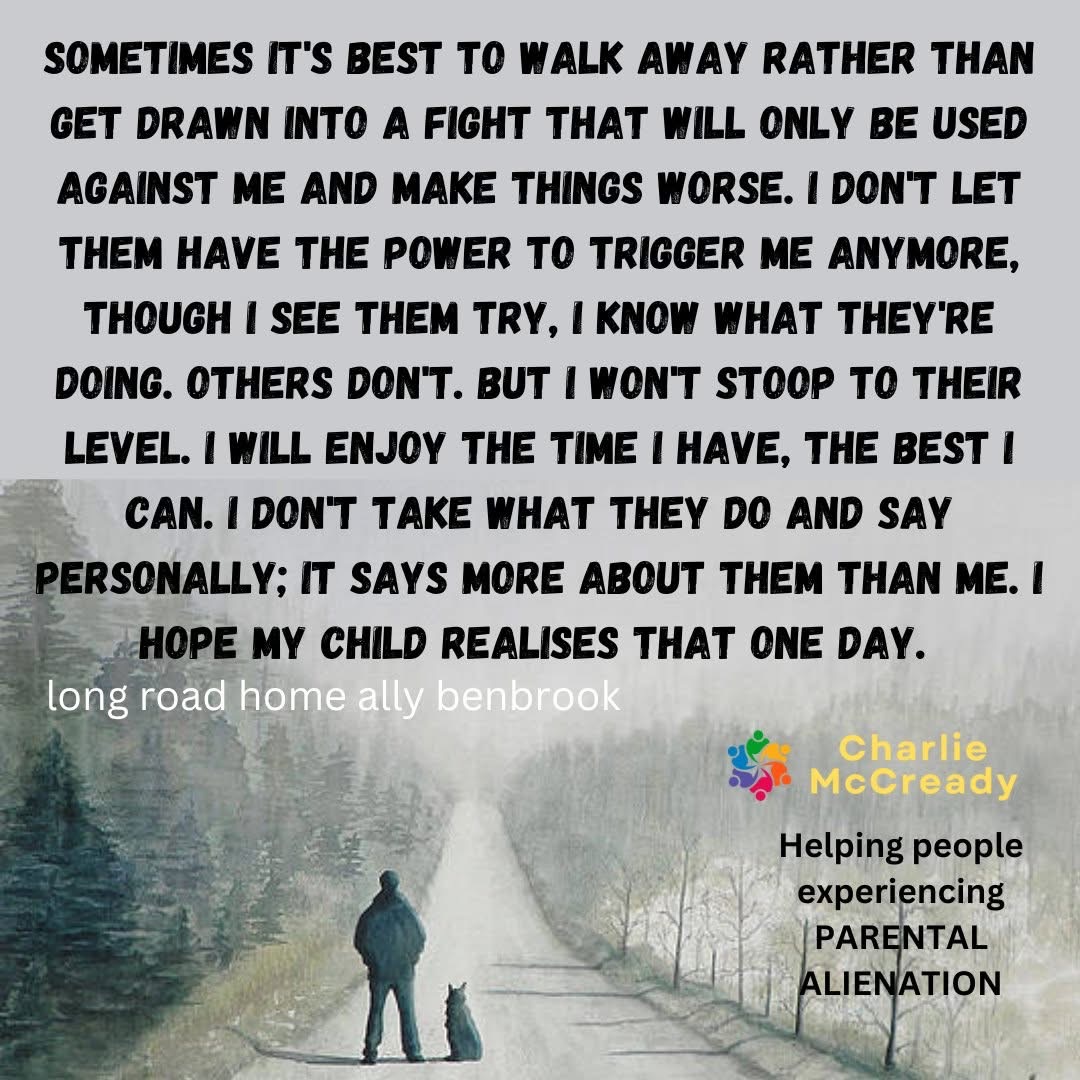
Powerless Triggers – Charlie McCready

I’ve come to understand that this isn’t about me personally; it’s a deeply rooted attachment pathology, and complex family dynamic involving disordered parenting. It’s spiralled into a situation where my child’s thoughts, beliefs and behaviours have been significantly influenced – trauma-bonded, coercively controlled, emotionally manipulated. Learning about this has helped me see the bigger picture, though I am working on my sense of isolation, frustration, injustice, and of course the grief. There’s nothing like it. People say it’s like a ‘living bereavement’ and that’s so true. It seems people don’t truly understand this unless they’ve been through it, and alienated parents are united in feeling let down by the mental health and family court system.

Still, I’ve learned a lot. I’ve learned not to react to the hurtful behaviour anymore. Sometimes, I catch myself just shaking my head, thinking, ‘Oh, this again.’ It’s like recognising a pattern. I remind myself that ‘this too will pass.’ My focus now is on maintaining my love for my child, even if they can’t see it right now. Detaching with love has become my way of preserving our bond through this difficult time. Nobody can take the love I have for my child away from me. Nothing and no one.

Conscious parenting plays a significant role here. It’s about recognising the importance of my child’s emotional well-being even when they may not fully comprehend it themselves. So, I make an effort to create a safe and loving space for them whenever/should they ever walk through my door. My door, and my heart, are open. I don’t let their negative behaviour dictate my response. Instead, I model the behaviour I want them to see—unconditional love, patience, and understanding. It’s challenging, but it’s also empowering because I believe this will help me and it will help my child heal and come back into my life when they’re ready.

Meanwhile I’m getting on with my life and not feeling sad or guilty about it. I have my moments, but I’m focussing on the present not the past, the love not the loss. If I can do it, and I’ve been in the pits of despair believe me, I know you can too.

#charliemccready

#parentalalienationcoach

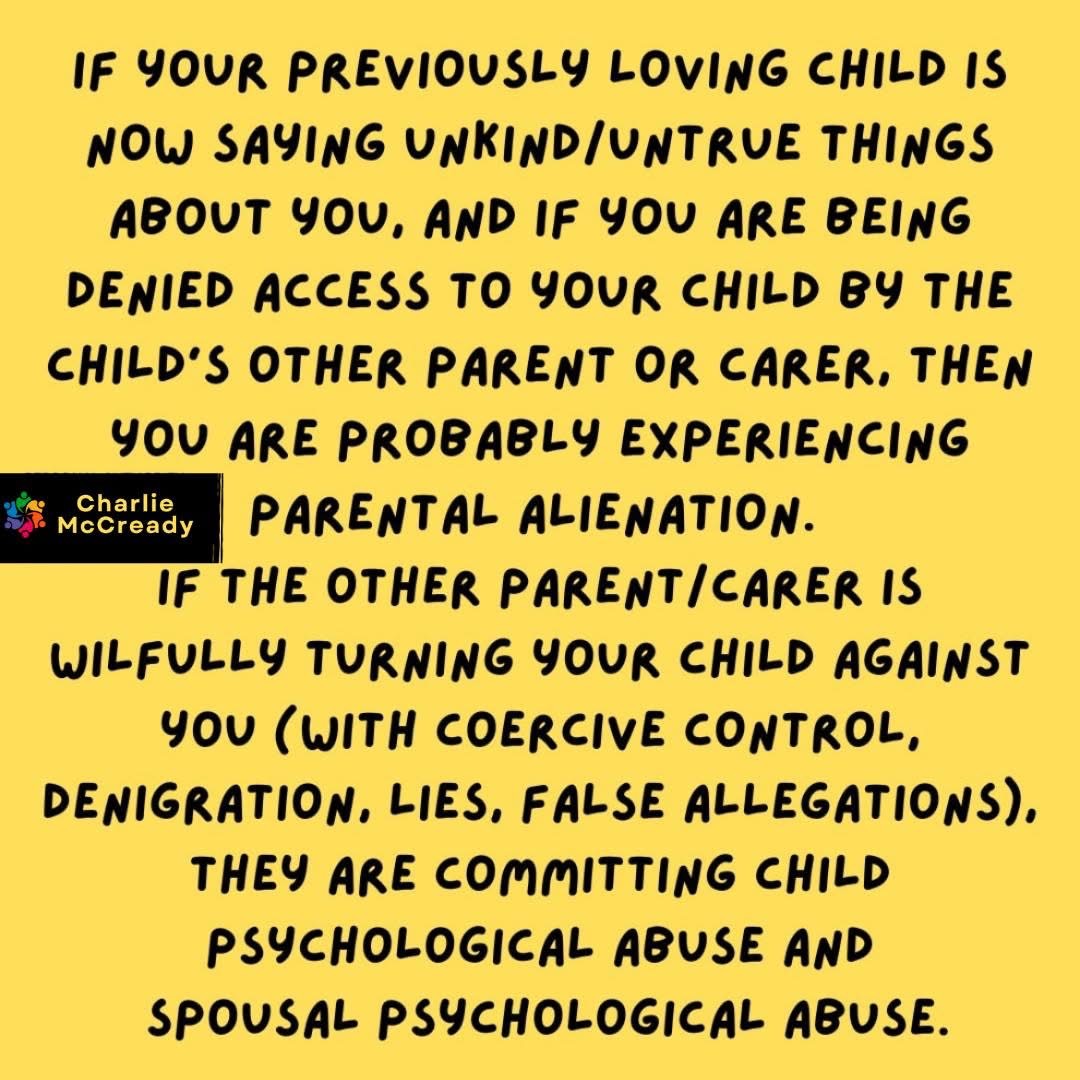
Spousal & Child Psychological Abuse via Narcissist

I post daily, spreading awareness about parental alienating behaviours, trying to empower you with a greater understanding, hoping to uplift you a little, and letting you know you’re not alone.

Parental alienation, often termed pathogenic parenting or an attachment disorder, encapsulates manipulative behaviours and psychological dynamics within familial relationships. A previously loving child will begin to change their behaviours, generally around the time of their parent’s separation or divorce, though it may have begun unnoticed earlier. If challenged, there will be denials by the other parent or caregiver that they unduly influence the child.

Their tactics often include coercive control, where the pathogenic parent exerts undue influence over the child through various forms of psychological manipulation (punishment/reward), intimidation, and threats. Coercive control serves to instil fear and dependency in the child, thereby undermining their relationship with the targeted parent.

Furthermore, the pathogenic parent engages in denigration, systematically disparaging the targeted parent in the child’s eyes through a campaign of lies, false allegations, and character assassination. By poisoning the child’s perception of the targeted parent, the pathogenic parent perpetuates a cycle of emotional abuse, both towards the child and the targeted parent.

Parental alienation shares parallels with Stockholm syndrome, wherein the child develops a skewed allegiance to the pathogenic parent out of fear, dependency, and perceived survival. This complex interplay of coercive control and psychological manipulation constitutes not only child psychological abuse but also spousal psychological abuse, as the targeted parent is subjected to ongoing trauma and victimization.

Parental alienation represents a severe breach of trust, perpetuating cycles of trauma and dysfunction. Recognising the insidious nature of these behaviours is crucial in addressing and combatting them, as it requires a comprehensive understanding of the underlying dynamics and a concerted effort to prioritise the well-being of both the child and the targeted parent.

#charliemccready

#parentalalienationcoach

#alienatedchild

#narcissisticabuseawareness

#narcissisticparent