
Tag: patriarchy
Narcissist parent get same treatment as they abused you with
Leaders
Narcissist- Wolf in Sheep’s clothing
Rockefeller – ownership of many companies
Children : Rejection of targeted parent ,for survival
WHO & Gates
Indoctrination/Parental Alienation- Charlie McCready
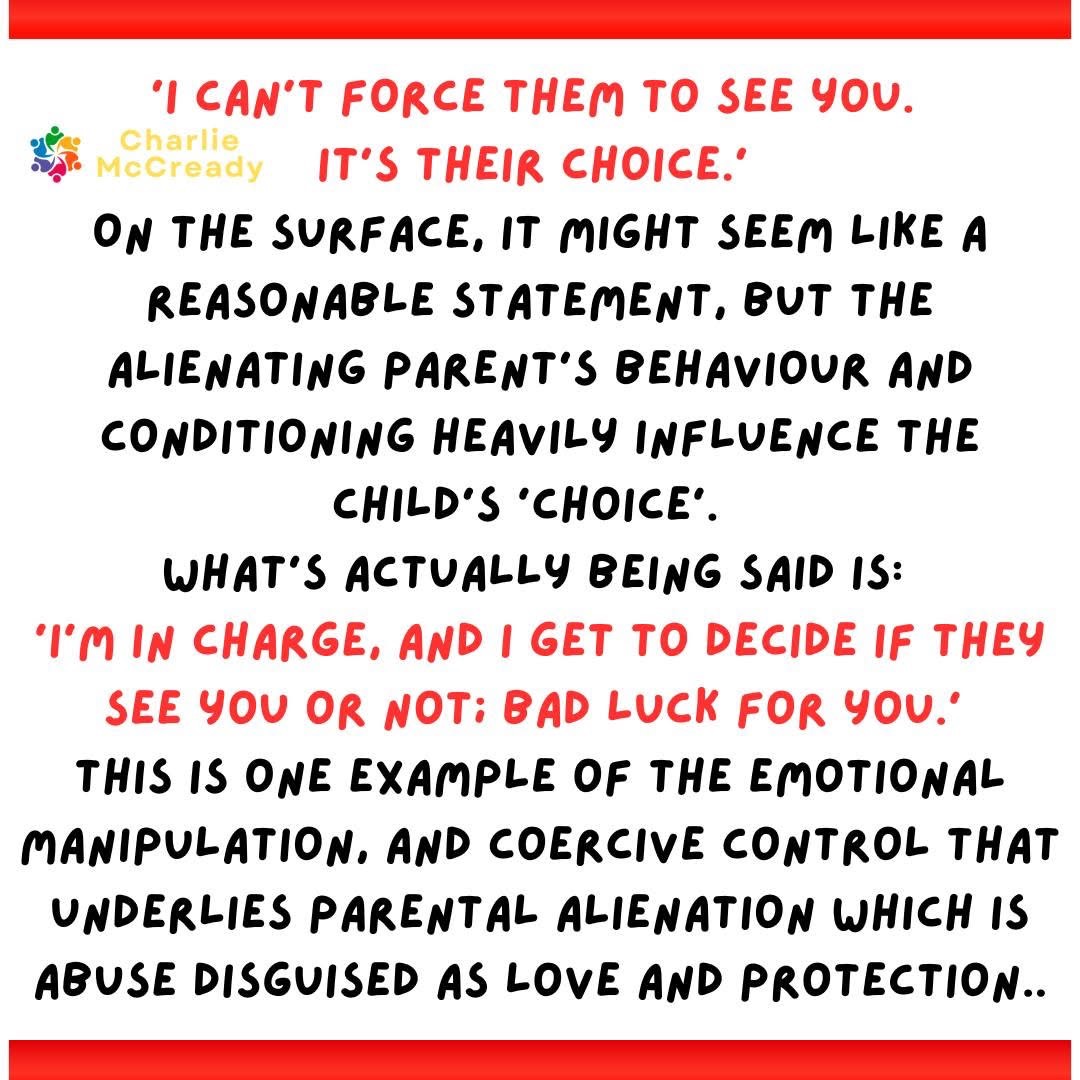
The idea that the alienating parent is not standing in the way of your relationship with your child is pure theatre. It’s an act. Behind the scenes, they’ve already given the child their lines and coached them into believing the character they’re supposed to play. Indoctrination, such as when a child is alienated and without justification for their rejection of you, is what’s happening. The child isn’t being given choices. They’ve already been coercively controlled and enmeshed into an alignment with the alienating parent.
A child’s expression of wishes holds such power and is often a deciding factor in proceedings concerning them, but it should be acknowledged as a voice, not a choice. Placing the child in a position where they must select one parent over the other goes beyond being inappropriate. Children often desire things at age 8 or 9 that they’d go nowhere near ten years later. I’ll give you an example. I thought it would be incredibly cool to be a lion tamer. Thankfully my parents didn’t think to put me in a lion’s den with a whip and a whistle, thinking that my needs must be met because this is what I believed was right for me. I also wanted to be able to fly, and they didn’t send me off to be operated on with wings attached to me surgically. Of course, children need to be heard, but they also have to be guided, nurtured, given boundaries while not being totally indoctrinated. Children might not know better than to wish for something detrimental to them, as in the case of being allowed to choose to reject a loved, loving parent, having been encouraged by the alienating parent to do so.
Research shows that many adults who, in their youth, rejected a parent, having been given a lot of pressure to do so by the other parent, later came to regret it and wished somebody would have had the sense to help them realise this was not a good idea – friends, family, legal or mental health professionals, anybody.
Taking, ‘it’s their choice’ at face value fails to recognise the extent of coercive control, psychological abuse, and manipulation at play, which can have profound negative effects on the child’s emotional development and well-being.
#charliemccready
#parentalalienationcoach
#adversechildhoodexperiences
#CoerciveControl
#custodybattle
#parentalalienation
#narcissisticparent
#mothersmatter
#FathersMatterToo
#FathersMatter
#FamilyCourt
#coercivecontrolawareness
#parentalalienationawareness
#mothersrights
#FathersRights
#ChildCustody
#traumabonding
#familycourts
Prolonged Ruptured Attachment Syndrome
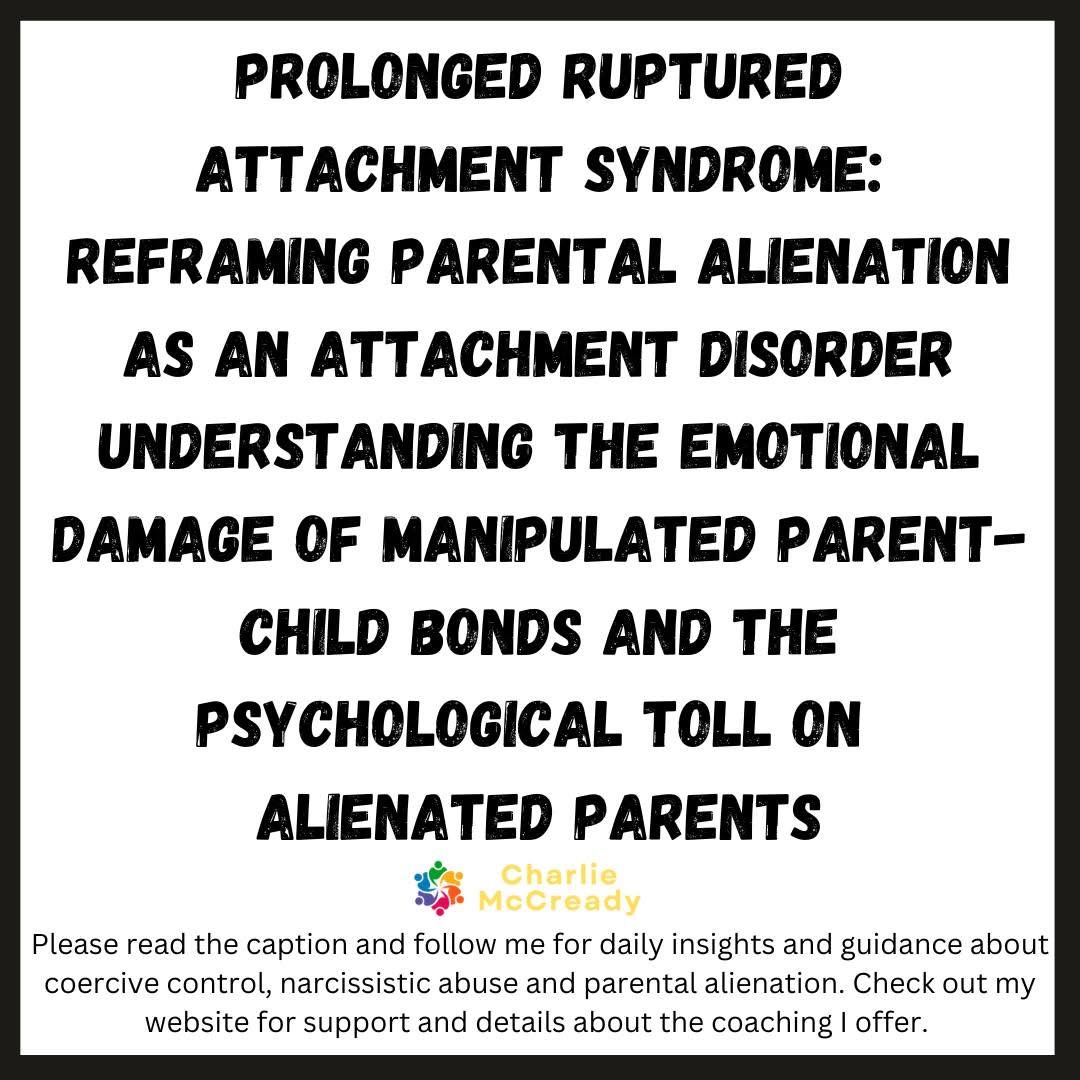
Parental alienation can be understood as an attachment disorder, where the child is manipulated into rejecting one parent, disrupting the natural attachment bonds. This psychological harm mirrors what is described in Prolonged Ruptured Attachment Syndrome (PRAS), a framework introduced by Martin Seager and colleagues. While PRAS was not developed to address parental alienation, it offers a new and potentially valuable lens for understanding the emotional damage caused by the disruption of attachment.
In cases of parental alienation, the rupture in attachment is not a clean break. Rather, it’s a painful disruption that leaves the relationship in a state of unresolved limbo—neither fully severed nor easily healed. Many alienated parents describe what feels like a living bereavement. This mirrors PRAS, where people are unable to find emotional closure because their attachment to a significant person remains unsettled. Seager describes PRAS as existing “somewhere between trauma and grief,” a state that is neither fully traumatic nor fully grief-stricken but something in between. For alienated parents, this is reflected in the constant uncertainty of not knowing if reconciliation with their child will ever happen. The pain, as Seager explains, is “ongoing without closure.”
PRAS highlights that the emotional toll of such ruptures is not just a one-time loss but an enduring, unresolved pain. The psychological effects of parental alienation are profound. This kind of emotional suffering can lead to trauma, grief, anxiety, and helplessness, making it harder for both parents and children to heal.
Healing from the emotional damage caused by these attachment disruptions requires more than just time. For alienated parents, this means specialised support to help navigate the complexities of reconnection and recovery. PRAS also underscores the importance of recognising that emotional healing from attachment ruptures needs understanding and compassionate care.
Published in Psychreg Journal of Psychology in December 2024, the newly conceptualised mental health condition, Prolonged Ruptured Attachment Syndrome (PRAS), while not developed with parental alienation in mind, offers a potentially helpful framework, with its findings validating the distress caused by attachment disruptions. Applying this to parental alienation could pave the way for more effective, empathetic responses and support for affected families.
#charliemccready
#parentalalienationcoach
#prolongedrupturedattachmentsyndrome
#emotionalabuse
Doctors – The Reality
Sadly this is fact .
Many drs do not continue their education
after graduation, many learn from the
pharmaceutical industry in a ” best in
show”.
It’s been normalized which is why I see
holistic !
 GreatCosmicMothersUnite