High conflict homes effects on kids

A groundbreaking study using brain scans has revealed a disturbing parallel: children exposed to intense family conflict show brain changes similar to those found in combat veterans. That’s right — the emotional warfare inside a home can mimic the neurological toll of literal battlefield trauma.

Researchers found that kids who witness chronic yelling, aggressive arguments, or domestic tension have altered brain activity in areas linked to fear, stress, and emotional regulation. These are the same brain regions often affected in soldiers returning from war zones.

The amygdala, a part of the brain responsible for processing threats and fear, becomes hypersensitive, constantly on alert. Meanwhile, the prefrontal cortex, which helps manage emotions and make rational decisions, often becomes underdeveloped or impaired. This combination can lead to long-term emotional difficulties, anxiety, or even PTSD-like symptoms later in life.

What makes this even more alarming is that many families underestimate the impact of loud fights or emotional tension on children. But the science is clear: a child’s brain is shaped by the emotional climate they grow up in.

This discovery highlights the urgent need for family therapy, safe environments, and emotional education to protect developing minds. Just because there are no visible bruises doesn’t mean the damage isn’t real.

#DidYouKnowFacts #childpsychology #brainfacts #MindMirror #familyhealth #TraumaScience

High Conflict – Charlie McCready

A wise and wonderful parent I’ve worked with made a very good point about the term ‘high conflict’, typically used to define divorces between a warring couple. In other words, we all get thrown in together, even though our character and behaviour might be polar opposites. One parent might be actively working towards a peaceful resolution, genuinely seeking an amicable resolution for the well-being of the children, and understanding the importance of maintaining a healthy relationship between both parents. The other is engaging in alienating behaviours, including provocation, false allegations, lies, withholding information, and limiting or blocking contact. ⁠

Labelling both parents as ‘high conflict’ without discerning the underlying dynamics can be detrimental. It might unintentionally equate the legitimate concerns and actions of one parent with the manipulative behaviours of the other. It’s important for all involved who seek to be able to differentiate between legitimate conflict resolution efforts and manipulative tactics. It’s unhelpful to call both parents ‘high conflict’, and it is particularly lenient towards the alienating parent and less kind to the parent seeking a peaceful way forward. This labelling can create a false equivalency, perpetuating an environment where the true victim of alienation is treated as if they are equally responsible for the conflict. ⁠

A more psychologically informed approach, understanding the underlying dynamics of parental alienation, and acknowledging the intricate emotional interplay between the child, alienating parent and targeted parent, could lead to a fairer assessment of the situation, potentially protecting the child from the harmful effects of alienation. This approach requires mental health professionals, legal experts, and all involved parties to recognise that alienation often stems from a complex web of psychological factors, including unresolved conflicts, emotional manipulation, and distorted perceptions. ⁠

#charliemccready

#parentalalienationcoach

#highconflictcoparenting

#highconflictdivorce

#narcissisticparent

Inside the mind of Domestic Abusers

Let’s acknowledge that Domestic Abuse

in 2025 is Intimate Partner Violence

High Conflict

Mercenary , Manipulative Malignant

It is Spiritual

It is physical and psychological

It is financial, the never ending story

of projected blasphemy’s that create

an aura of heroic survival despite

the insanity of your partner .

Hatred lives in the heart of racist ,

discrimination, who superiority

rules all around him .

youtube.com/watch

Episode Thirteen: Shattering the Silence on Domestic Abuse by @Cynthia Ramsaran · Zencastr

In honor of Mother’s Day, this special episode takes a personal turn as Romona Jackson, founding president and CEO of the Women’s Advocacy Center, [https://www.womensadvocacycenter.org/] discusses the often stigmatized topic of domestic abuse. Despite the empowerment of women in modern society, the blame and shame surrounding domestic violence persist. Romona sheds light on the far-reaching impact of domestic abuse, which extends beyond the household and affects entire communities.

This episode explores the origins of the Women’s Advocacy Center, the reasons behind the lingering stigma, and the critical intersections between domestic abuse, mental health, and substance abuse. 

Don’t miss Romona’s insights on an upcoming forum [https://womensadvocacycenter.networkforgood.com/events/70557-2024-community-forum?fbclid=IwZXh0bgNhZW0CMTAAAR1tNXAfZxBb7c5tqIXO9_r6EETMXwlI4ShOIC1_UBRhXYTA5LXCYhMqCZQ_aem_AVihw785dgZA1ne9ThbQPnoz5dtENu6ja8vJ5OjVt9BJKldKCcZD696q4GwdA2hyG_oCTL038VKBsHnwis4DPVpi] that aims to raise awareness and provide support for survivors.

— Read on zencastr.com/z/FsfAjPdG

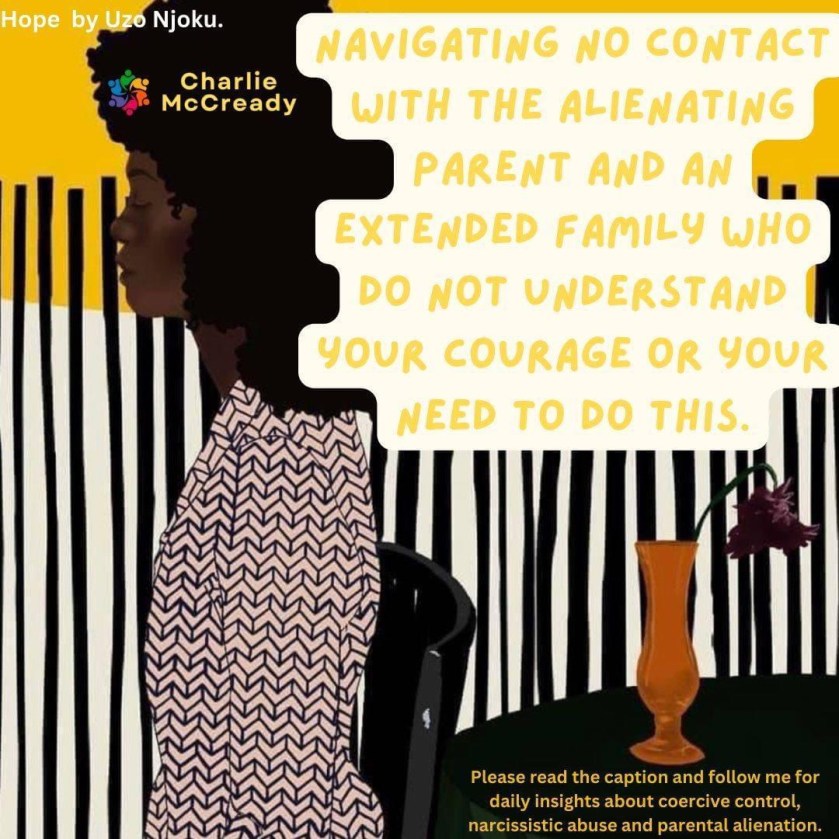
Navigating No Contact – Charlie McCready

Your extended family may simply not understand you. They might believe it’s in everyone’s best interest that you reconcile with your ex-partner. ‘For the sake of the children’, they say! All they know is that you’re struggling and the children have cut off, or distanced themselves from you, and perhaps from them too. They don’t understand what’s really going on, and to be honest, most of us were blindsided by it too, having never heard of ‘parental alienation’ until it was happening to us, our partner or someone we know.⁠

Going no contact and having unsupportive family members is not for the faint of heart. If you find yourself reading this post, know that you are taking a massively courageous step in your life. You are understanding and coming to accept this is where you’re at. Just because your family members don’t understand why you are going no contact, doesn’t mean you’ve done anything wrong. And if they’re not willing to try to understand, it’s not your job to explain or justify yourself. You’ve got enough going on just dealing with all this. When we protect ourselves from narcissistic people, we often discover the chameleon nature of the narcissist and see how in their other relationships, they may be present yet another facade. Extended family members may know the narcissistic in your life is a pillar of the community or great fun or ‘successful’ or charming or whatever it is, but this is just the front, the Hollywood facade. This is partly why extended family members and friends may not understand it from your point of view, and may wrongly think you’re being overdramatic or selfish. You are not. You are being self-protecting. This is a huge difference. Remind yourself that those who have your back or want to understand will. Those that do not will reveal their closed mindedness or personal agenda to you. Taking care of ourselves sometimes means going against the grain. It sometimes means doing things radically differently than the status quo. It also can entail trusting our intuition over the words of others and staying firmly rooted in our boundaries. I send you courage and love. Stay strong. ⁠

#charliemccready #9StepProgram #parentalalienationcoach #parentalalienationischildabuse #parentalalienationisreal #parentalalienationawareness #highconflictcoparenting #coparentingwithanarcissist #coparenting #highconflictdivorce #divorce #familylaw #FamilyCourt #childabuse #narcissisticfather #narcissisticmother #narcissisticparent #narcissisticabuseawareness #narcissist #narcissists #narcissisticabuserecovery #narcissisticabusesurvivor #narcissisticrelationship #narcissisticpersonalitydisorder #narcissisticpersonality #narcissism #narcissismawareness #alienatedmother #alienatedparent #alienated #alienatedfather #alienatedchild

Narcissist see you as arrogant.

I understood at some point,that speaking , thinking , acting like he did was important to him.

He projected I mirrored him, and he could tell how I felt , but I also absorbed his shadow and it only grew like a fungus . I couldn’t walk away by that time, because of his imprinting my unworthiness , and lack of confidence in myself developed, as I gave away my power, believing him .

He did not and does not have any emotional intelligence , resisted growth and change , knowing not himself , or any importance in these life skills , and wasn’t interested in knowing me.

I did know I was strong , and powerful upon becoming a Mother. His participation in destroying the Mother Child relationship , indeed creating the foundation to our 3 sons that I did not deserve their support nor love .

That was crystal clear in 1993 .

Divine saw what was my reality , karma will correct all wrongs, of this I am sure .

youtube.com/watch

Childress : Professional Knowledge

The “established scientific and professional knowledge of the discipline” of professional psychology is:

Attachment – Bowlby and others
Family systems therapy – Minuchin and others
Personality disorders – Beck and others
Complex trauma – van der Kolk and others
Child development – Tronick and others
Self psychology – Kohut and others
ICD-10 & DSM-5 diagnostic systems

2.04 Bases for Scientific and Professional Judgments
Psychologists’ work is based upon established scientific and professional knowledge of the discipline.

If the psychologist’s work is NOT based upon the established scientific and professional knowledge of the discipline, then they are in violation of Standard 2.04 Bases of Scientific and Professional Judgments – they are unethical psychologists.

Psychologists are required to know the established scientific and professional knowledge of the discipline based on their background education, training, and professional experience.

2.01 Boundaries of Competence
(a) Psychologists provide services, teach, and conduct research with populations and in areas only within the boundaries of their competence, based on their education, training, supervised experience, consultation, study, or professional experience.

If the psychologist is providing services outside the boundaries of their competence based on their education, training, and experience, then they are unethical psychologists for violation to Standard 2.01 Boundaries of Competence.

Psychologists must base their opinions contained in their recommendations, reports, and diagnostic or evaluative statements, including forensic testimony, on information and techniques sufficient to substantiate their findings.

9.01 Bases for Assessments
(a) Psychologists base the opinions contained in their recommendations, reports, and diagnostic or evaluative statements, including forensic testimony, on information and techniques sufficient to substantiate their findings. (See also Standard 2.04, Bases for Scientific and Professional Judgments .)

If the opinions of the psychologist as contained in their recommendations, reports, and diagnostic or evaluative statements is NOT based on information sufficient to substantiate their findings, then they are unethical psychologists in violation of Standard 9.01 Bases of Assessment.

Information: Bowlby – Minuchin – Beck – van der Kolk – Tronick – Kohut – ICD-10 & DSM-5 diagnostic systems

Techniques: Mental Status Exam of thought and perception

Parents have rights guaranteed to them by the ethics code of the American Psychological Association. Ethical practice is mandatory, not optional, for all psychologists.

The “forensic” psychologists control the licensing boards. All court-involved complaints made to licensing boards are given to “forensic” psychologists for review – and they exempt themselves from all ethical standards of practice… because they can.

We need to expose the corruption of the licensing boards. Make them cover-up their unethical practice… over-and-over again. You have rights – but only if you stand up and demand your rights.

They won’t give them to you – the licensing boards are not set up to protect the consumer from unethical practice by “forensic” psychologists – they are set up to protect the unethical “forensic” psychologists from accountability for their ignorant, incompetent, and unethical practice.

Google ignorant: lack of knowledge or information

They are ignorant by definition of the English language – and they are too lazy to learn what they’re doing.

2.03 Maintaining Competence
Psychologists undertake ongoing efforts to develop and maintain their competence.

Google incompetence: inability to do something successfully

Did they solve your child’s pathology? They are ignorant and incompetent. They solve nothing because their are ignorant, lazy, and unethical.

Google negligence: failure to take proper care in doing something. Law: failure to use reasonable care, resulting in damage or injury to another.

Were their violations of Standard 2.04 Bases for Scientific and Professional Judgments, Standard 2.01 Boundaries of Competence, Standard 2.03 Maintaining Competence, and Standard 9.01 Bases for Assessment, of the APA ethics code negligent professional practice?

The pathology of concern is a shared persecutory delusion with the allied parent as the primary case – also called the “inducer” (American Psychiatric Association, 2000). The ICD-10 diagnosis for a shared persecutory delusion is F24.

From the journal, Family Court Review:

From Walters & Friedlander: “In some RRD families [resist-refuse dynamic], a parent’s underlying encapsulated delusion about the other parent is at the root of the intractability (cf. Johnston & Campbell, 1988, p. 53ff; Childress , 2013). An encapsulated delusion is a fixed, circumscribed belief that persists over time and is not altered by evidence of the inaccuracy of the belief.”

Walters, M. G., & Friedlander, S. (2016). When a child rejects a parent: Working with the intractable resist/refuse dynamic. Family Court Review, 54(3), 424–445.

From the APA: “Shared Psychotic Disorder can occur in larger number of individuals, especially in family situations in which the parent is the primary case and the children, sometimes to varying degrees, adopt the parent’s delusional beliefs.” (American Psychiatric Association, 2000, p. 333)

From the APA: “Persecutory Type: delusions that the person (or someone to whom the person is close) is being malevolently treated in some way.” (American Psychiatric Association, 2000)

Google malevolent: having or showing a wish to do evil to others.

Does the child have a fixed and false belief that is maintained despite contrary evidence that the targeted parent has a “wish to do evil” to the them? Does the allied parent share this fixed and false belief that the targeted parent has a “wish to do evil” to the child? – that would be a shared persecutory delusion.

If you – as the mental health professional, because of your negligence, ignorance, and unethical practice – believe the shared delusion, then you become PART of the shared delusion, you become PART of the pathology.

When that pathology is child abuse – you, the mental health person – become part of the child abuse – you become the child abuser. The “betrayer” – the one who should protect… but doesn’t.

You, the parents, are more powerful than you know, but only if you stand up for your rights – not beg to have someone recognize some made-up pathology – you have rights, but only if you ground yourselves in the “established scientific and professional knowledge” of professional psychology.

You’re the moms. You’re the dads. You just need support. You have support.

This is child abuse – DSM-5 V995.51 Child Psychological Abuse.

This is spousal abuse using the child as the weapon – DSM-5 V995.82.

All psychologists have two legally obligating duties, the duty of care and the duty to protect.

The “forensic” psychologists are failing in their duty to protect the child from child abuse, and they are failing in their duty to protect the targeted parent from spousal emotional and psychological abuse using the child as the weapon.

This is child abuse. This is spousal emotional and psychological abuse using the child as the weapon.

It needs to stop. Now.

Craig Childress, Psy.D.
Clinical Psychologist, CA PSY 18857