To those Responsible – Charlie McCready

Despite being a victim of false allegations and manipulative alienating tactics, the ‘target’ parent finds themselves entrapped in a system that often fails to adequately assess the truth, allowing baseless accusations to persist. The alienated parent, unjustly kept away from their child, experiences a profound sense of loss, rejection, and helplessness. Their relationship with their child deteriorates as the alienating parent continues to poison the child’s mind against them, and often it worsens during custody cases.⁠

Legal and mental health professionals, who are expected to protect the child’s best interests, often fail to intervene effectively. Even when assessments are conducted, they are sometimes ignored or not acted upon, leaving the alienated parent in a state of perpetual despair and disbelief.⁠

The frustration deepens as the ‘rejected’ parent witnesses the alienating parent’s blatant disregard for court orders and their refusal to cooperate in co-parenting. Despite these clear signs of malicious intent, the legal and mental health system often sticks with the status quo/does next to nothing, sometimes even making things worse. ⁠

There is currently no ‘one size fits all’ remedy. But I’d like to share what a parent wrote to me suggesting – something that had worked for him. I paraphrase: “Demand from those in positions of power to put in writing what the allegations are about you. Ask them if your parenting has ever been in question before separation/divorce/allegations. Question them as to whether these allegations are a breach of your right to a private family life.”⁠

This is great because by doing so, you assert your rights but also prompt the professionals to examine the credibility of the allegations thoroughly. If there is no prior evidence or history of concerns, it raises doubts about the authenticity of the claims made during the alienation process. Questioning whether these allegations breach your right to a private family life underscores the fundamental human rights aspect of the situation. This emphasises the need to protect the parent-child relationship and the family’s right to privacy. By raising these questions, the alienated parent not only advocates for their own rights but also challenges the professionals to uphold the principles of fairness, justice, and due diligence in their assessments.

#charliemccready

#parentalalienationcoach

#abuseinthefamily

Indoctrination/Parental Alienation- Charlie McCready

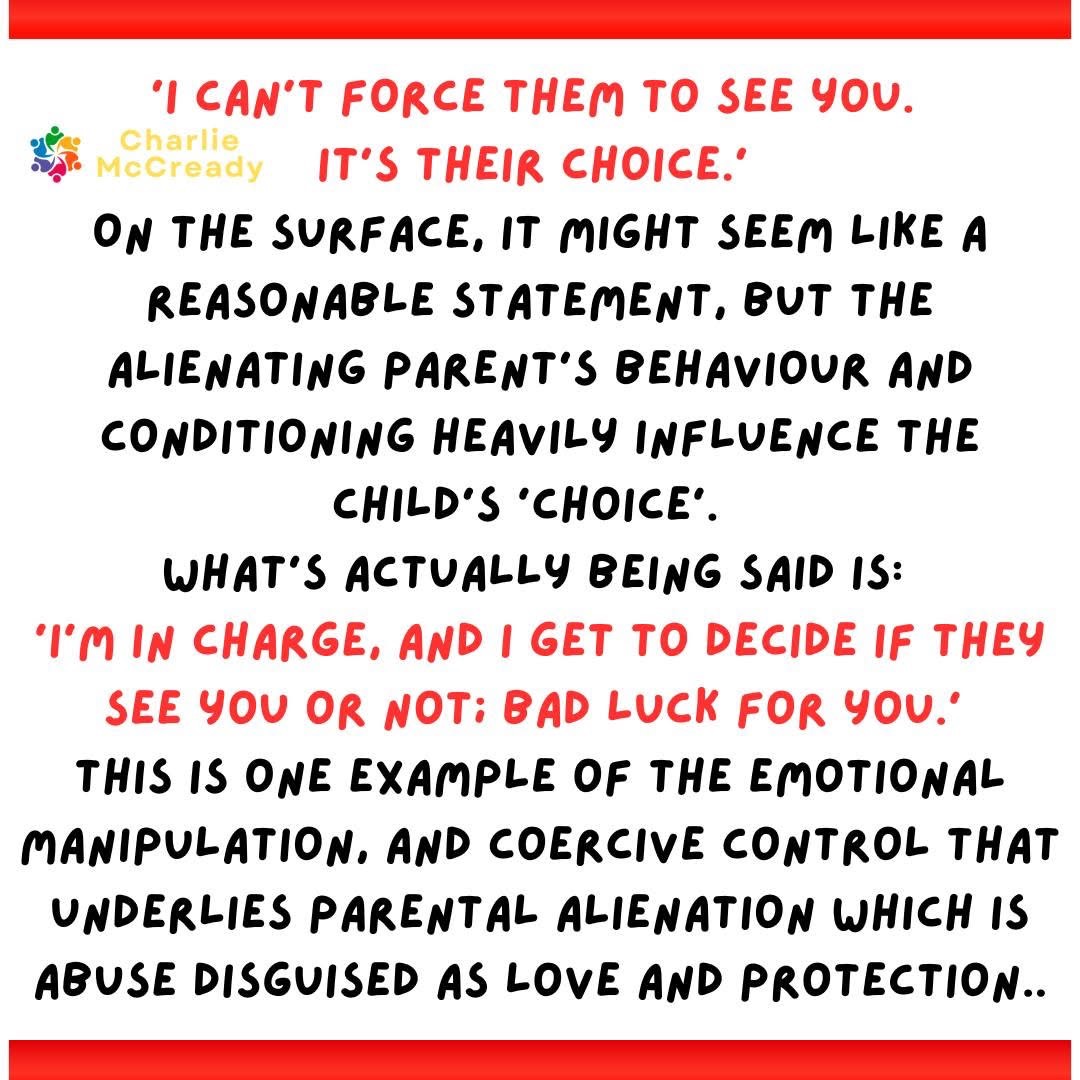
The idea that the alienating parent is not standing in the way of your relationship with your child is pure theatre. It’s an act. Behind the scenes, they’ve already given the child their lines and coached them into believing the character they’re supposed to play. Indoctrination, such as when a child is alienated and without justification for their rejection of you, is what’s happening. The child isn’t being given choices. They’ve already been coercively controlled and enmeshed into an alignment with the alienating parent.⁠

A child’s expression of wishes holds such power and is often a deciding factor in proceedings concerning them, but it should be acknowledged as a voice, not a choice. Placing the child in a position where they must select one parent over the other goes beyond being inappropriate. Children often desire things at age 8 or 9 that they’d go nowhere near ten years later. I’ll give you an example. I thought it would be incredibly cool to be a lion tamer. Thankfully my parents didn’t think to put me in a lion’s den with a whip and a whistle, thinking that my needs must be met because this is what I believed was right for me. I also wanted to be able to fly, and they didn’t send me off to be operated on with wings attached to me surgically. Of course, children need to be heard, but they also have to be guided, nurtured, given boundaries while not being totally indoctrinated. Children might not know better than to wish for something detrimental to them, as in the case of being allowed to choose to reject a loved, loving parent, having been encouraged by the alienating parent to do so.⁠

Research shows that many adults who, in their youth, rejected a parent, having been given a lot of pressure to do so by the other parent, later came to regret it and wished somebody would have had the sense to help them realise this was not a good idea – friends, family, legal or mental health professionals, anybody. ⁠

Taking, ‘it’s their choice’ at face value fails to recognise the extent of coercive control, psychological abuse, and manipulation at play, which can have profound negative effects on the child’s emotional development and well-being.⁠

#charliemccready

#parentalalienationcoach

#adversechildhoodexperiences

#CoerciveControl

#custodybattle

#parentalalienation

#narcissisticparent

#mothersmatter

#FathersMatterToo

#FathersMatter

#FamilyCourt

#coercivecontrolawareness

#parentalalienationawareness

#mothersrights

#FathersRights

#ChildCustody

#traumabonding

#familycourts

Prolonged Ruptured Attachment Syndrome

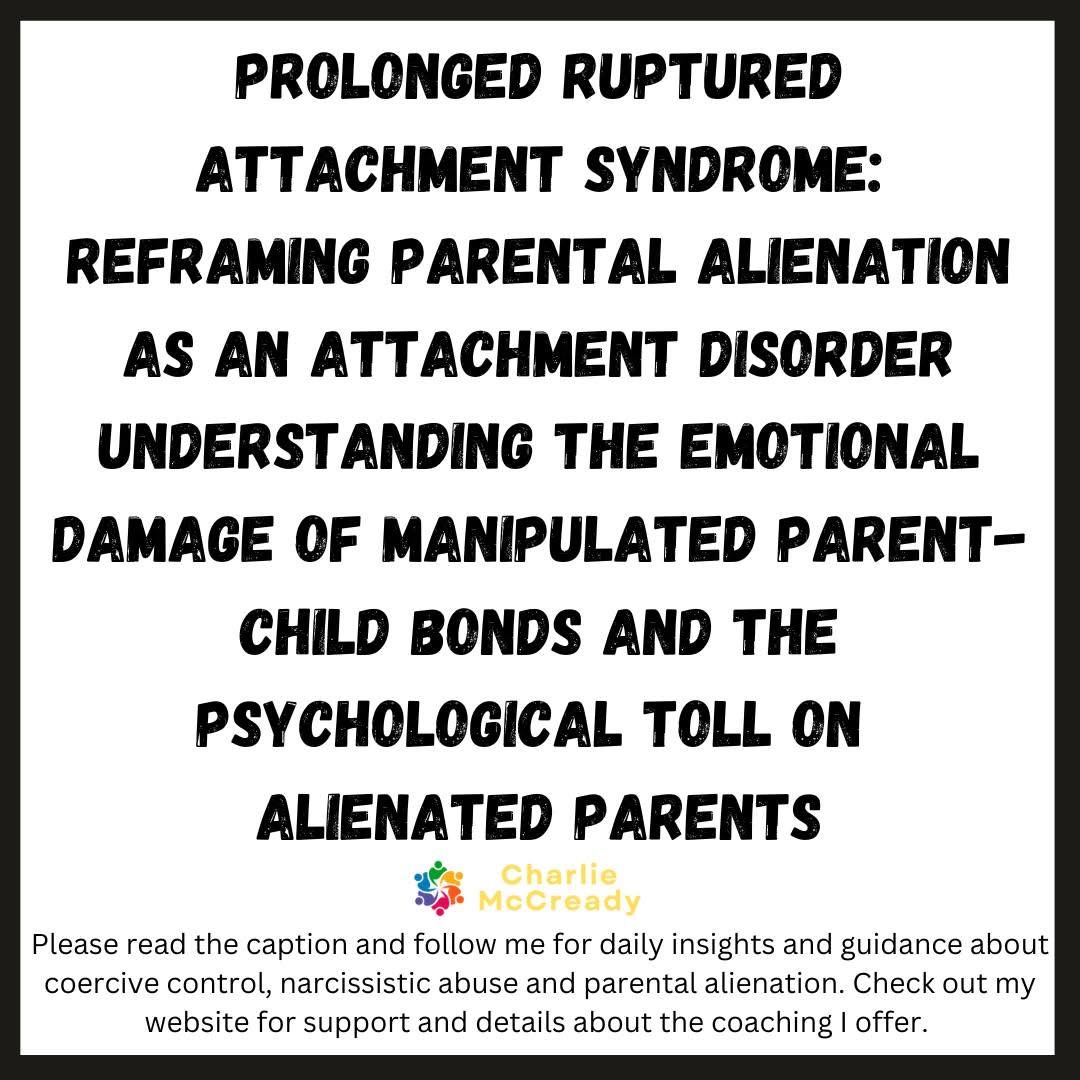
Parental alienation can be understood as an attachment disorder, where the child is manipulated into rejecting one parent, disrupting the natural attachment bonds. This psychological harm mirrors what is described in Prolonged Ruptured Attachment Syndrome (PRAS), a framework introduced by Martin Seager and colleagues. While PRAS was not developed to address parental alienation, it offers a new and potentially valuable lens for understanding the emotional damage caused by the disruption of attachment.⁠

In cases of parental alienation, the rupture in attachment is not a clean break. Rather, it’s a painful disruption that leaves the relationship in a state of unresolved limbo—neither fully severed nor easily healed. Many alienated parents describe what feels like a living bereavement. This mirrors PRAS, where people are unable to find emotional closure because their attachment to a significant person remains unsettled. Seager describes PRAS as existing “somewhere between trauma and grief,” a state that is neither fully traumatic nor fully grief-stricken but something in between. For alienated parents, this is reflected in the constant uncertainty of not knowing if reconciliation with their child will ever happen. The pain, as Seager explains, is “ongoing without closure.”⁠

PRAS highlights that the emotional toll of such ruptures is not just a one-time loss but an enduring, unresolved pain. The psychological effects of parental alienation are profound. This kind of emotional suffering can lead to trauma, grief, anxiety, and helplessness, making it harder for both parents and children to heal.⁠

Healing from the emotional damage caused by these attachment disruptions requires more than just time. For alienated parents, this means specialised support to help navigate the complexities of reconnection and recovery. PRAS also underscores the importance of recognising that emotional healing from attachment ruptures needs understanding and compassionate care. ⁠

Published in Psychreg Journal of Psychology in December 2024, the newly conceptualised mental health condition, Prolonged Ruptured Attachment Syndrome (PRAS), while not developed with parental alienation in mind, offers a potentially helpful framework, with its findings validating the distress caused by attachment disruptions. Applying this to parental alienation could pave the way for more effective, empathetic responses and support for affected families.

#charliemccready

#parentalalienationcoach

#prolongedrupturedattachmentsyndrome

#emotionalabuse

Council for targeted parents NO complaining

The typical therapist has 10 years before

‘burn out ‘ I tested for this , career wise !

I found it was far too much of an

investment … in far too many ways .

I don’t agree with parents being silenced

but I do think highly skilled therapist

who treat Child Psychology Abuse

and have the knowledge that it’s the

continuing High Conflict, intimate parter

violence , often malicious, malignant ,

abuses on Spiritual ,Physical, Psychological,

Mental and Financial, abuse that’s supported

for varied reasons in our current legal and

therapeutic modalities.

Change is here , resting still , more so as

March , predictably dips into chilly weather !

Take care of you😘🤩😴❤️💯

On counselors telling parents they cant complain, they must accept their child’s terms and fairness doesnt matter if you want a relationship and you must remain silent no matter how unfair parental alienation!
You all remind me of the pastor who told me if I was nicer to my husband he wouldn’t beat me! He told me I should be ashamed of myself for showing up at church with bruises on my body! And if I wanted a happy life I need to learn to walk softer on egg shells.
🤮 There comes a time you don’t even want a relationship with them anymore! I’m disgusted by them! Good riddance to cruel people!

Craig Childress, PsyD – Resume

I’ve got my new three licenses business card. Notice you’re third on the list of what I do.

Top of this list is early childhood ages zero-to-five. Then comes ADHD and grumpy angry kids. Then you in the family courts, then adults on personal growth issues.

Now that I have my WA license I’m going to go around the the local preschools to make them aware I’m here. I’m going to offer free consultation to preschools and parents of wee-ones on any domain of concern.

You’re paying for it. I’ll make my money off of you as a consultant in the family courts – that way I can offer free consults to preschools and parents of wee-ones.

Chalk it up to your karma – good job – you’ll be helping the little ones get a healthy start.

Then I’m going to open up an ADHD grumpy-kid practice online in three states, the Pacific coast of CA, OR, and WA. I use a parent-training consultation model with ADHD and ODD (there’s no such thing), which fits well with an Internet mediated service delivery in the states I’m licensed.

Then… I’ll post foundational seminars to YouTube on the diagnosis and treatment of ADHD and grumpy-angry kids – and – on parenting early childhood kids with challenging stuff (autism spectrum and emotional regulation problems).

I’ll bill for the ADHD clients ’cause that’s something entirely separate. Working with the wee-ones is for me, I like the little guys. Solving ADHD is for you guys.

The adult section of my practice is going to expand into death and dying. I’ve worked within that domain in the past with cancer kids at Children’s Hospitals – except they didn’t die because they have good doctors at Children’s Hospitals.

But death and dying is always within a zone of consideration whenever cancer is the diagnosis. When I entered private practice I joined a practice with another cancer psychologist in Pasadena. He worked with adult cancer patients, and I worked with kid cancer patients and their families.

I also have some background in geriatrics. When I entered private practice I checked out the two pathologies I’d never worked with – family court custody conflict and geriatrics. I’ve worked with everything else.

I got a job going to various “assisted care” facilities to assess and treat mental health issues there. THAT is depressing work. I don’t want to work geriatrics like that.

The old are our abandoned. No one sees, no one comes, they are alone. Whoa. Of the two, you needed me more. You have active child abuse (and spousal abuse) undiagnosed and untreated. Child abuse and attachment trauma is my pathology.

So I came to the family courts and fixed things here. There was a lot of fixing to do – you had (have) broken systems. Bad things were (are) happening… by the psychologists.

They are in the “betrayer” role in trauma – the one who should protect… and doesn’t. Oh my… patients should NEVER need to explain the pathology to the doctor. You need to explain the pathology to your doctors.

That’s so bad. So I did things. Now those things are evolving into solutions to fix the broken systems. Once the systems are fixed… you won’t need me anymore.

Hooray! A good clinical psychologist is always working themselves our of a job. For ADHD, for example, I want to fix your problem in six to twelve weeks – of consultation – six to twelve weeks is roughly how long I need to teach parents how to do the relationship based treatment… to fix things.

Less time for the grumpy-angry kids. Holy cow, “Oppositional Defiant Disorder” is such an easy fix – four to six weeks of consultation (then occasionally as-needed).

Do you know what’s easier to fix than ODD (grumpy-angry)? Attachment pathology. With a cooperative parent, I’d anticipate two to six weeks for substantial gain, and twelve weeks for full resolution.

The problem with attachment pathology out in the wild is that we don’t have a cooperative parent. We have a substance abusing parent or a narcissistic-dark parent. Then it becomes a child protection issue and we have to fix the attachment damage in other ways.

I’m a full scope clinical psychologist. I can seriously answer your questions on anything clinical psychology. Anything. Without looking it up, it’s all in my head.

That’s because I’m an old clinical psychologist – it’s the old part.

Now I’m an old-guy too, and I’m specialty trained in humanistic-existential therapy. I figure I can help other old folks along the Pacific coast where I’m licensed via the Internet.

Death and dying makes people uncomfortable, not me. I suspect I can help with transitions.

So individual adults are number four on my list of to-do.

You’re fixed. The moment you want to solve things – you solve things. As long as you don’t want to solve things – you won’t solve things.

It’s a motivational pathology. I’m working on that. We should be transitioning soon. Wheee…

Into complete destruction… then out into a full solution.

If you want to know what’s coming, look where Dr. Childress is positioning himself. I don’t live in today because today keeps vanishing. I live and work in tomorrow, because tomorrow keeps arriving, which makes my life now so much easier.

Oh look, the Petition to the APA just arrived – five years (minus two years for Covid), my estimates are pretty precise.

In five years I’ll be leaving not arriving. This next phase is building out my online presence in ADHD and Early Childhood, and I’ll finish my Diagnosis book and a second edition of Foundations.

Journal articles are in the works. It’s time now.

You know what happens when I have three licenses across the Pacific Coast, right? You have read the ancient prophesies about the Kraken that I’m just now making up, right?

Never mind, it’s too late for you to learn now. Just wait, it’ll all unfold in the calculational lines of the ruliad for observers like us.

Craig Childress, Psy.D.

Clinical Psychologist

WA 61538481

OR 3942 – CA 18857