An in-depth explanation of what children of a narcissist go through and how to help them. Contact us if you need help with this!
— Read on thebetteryouinstitute.com/2022/05/16/children-of-a-narcissist/
Tag: Children
Study Says Motherhood Is Equivalent To Working 2.5 Full-Time Jobs
Do you ever wonder why being a mom is so exhausting? A new study says that motherhood is the equivalent of working 2.5 full-time jobs!
— Read on www.baby-chick.com/study-says-motherhood-is-equivalent-to-working-2-5-full-time-jobs/
The Specter of Trump’s Family-Separation Policy – The Atlantic
Donald Trump and his allies have promised to restore their draconian zero-tolerance immigration policy.
— Read on www.theatlantic.com/magazine/archive/2024/01/trump-2024-reelection-immigration-stephen-miller/676122/=The+Atlantic+-++Politics+-+Family+Separation&utm_term=The+Atlantic+-+Faraway+Readers+-+Trump+2.0+-+Politics&referral=FB_PAID&fbclid=IwAR1TY0TYx-ek6Zq6vywPjku6RLN8oWwegfxkexHcnEJRUGWZNoYxgk29z70_aem_Ac91X-CuQk1BGeCtHzre0jaLYLRv-UwSfkzIo3x8OR9eTmJN_Y1nbeIxidbDfsBW1C3d0uVWfrCZTPBjDLjb3O7_&utm_id=6492462535277
How to Stop Allowing an Adult Child to Walk All Over You | Psychology Today
Take off the “Kick Me” sign and forgive yourself.
— Read on www.psychologytoday.com/intl/blog/liking-the-child-you-love/202310/stop-letting-your-adult-child-walk-all-over-you
Why A Maternal Grandmother Is So Important To A Child
We all know grandparents are important in raising a child, but research shows that genetic bonds of a maternal grandmother are especially beneficial.
— Read on www.healthy-holistic-living.com/why-a-maternal-grandmother-is-so-important-to-a-child/
Bishop sexually abused daughter
Far too much of this going on
Grandparents Give Us Bonus Love That We Should Never Take for Granted – Her View From Home
Grandparents give us bonus love that should never be taken for granted. A grandparent’s love sticks with you for life.
— Read on herviewfromhome.com/grandparents-give-us-bonus-love/
Shared Persecutory Delusions & Lies – Charlie Mc Cready
For most of us, truth is the basis of our relationships and interactions, but there are prolific, even pathological, liars among us. When we don’t make a habit of lying, and we value truth and integrity, we can find it difficult to conceive of a life where deceit is the norm. It’s hard for us to conceive that someone we love/have loved would exploit our honesty, take advantage of us, and not operate with good intentions.
Liars often engage in gaslighting, a manipulative tactic where they deliberately make someone doubt their own reality or perception of events. Gaslighting can create cognitive dissonance in the victim. An internal conflict can lead to confusion, and self-doubt, making it easier for the liar to maintain control and deception. Skilled manipulators are often charming, charismatic and confident, which can further mask their dishonesty.
People who are high in Machiavellianism (unemotional, indifferent to morality, manipulative, often using deceit to achieve their goals) tend to tell significantly more lies than a typical person. Studies reveal that those with highly concealed, low self-esteem lie more. Those who view lying as acceptable, a means to an end, also tend to be the more prolific liars. Those who feel entitled, and those in high-status occupations have been found to be more likely to lie more.
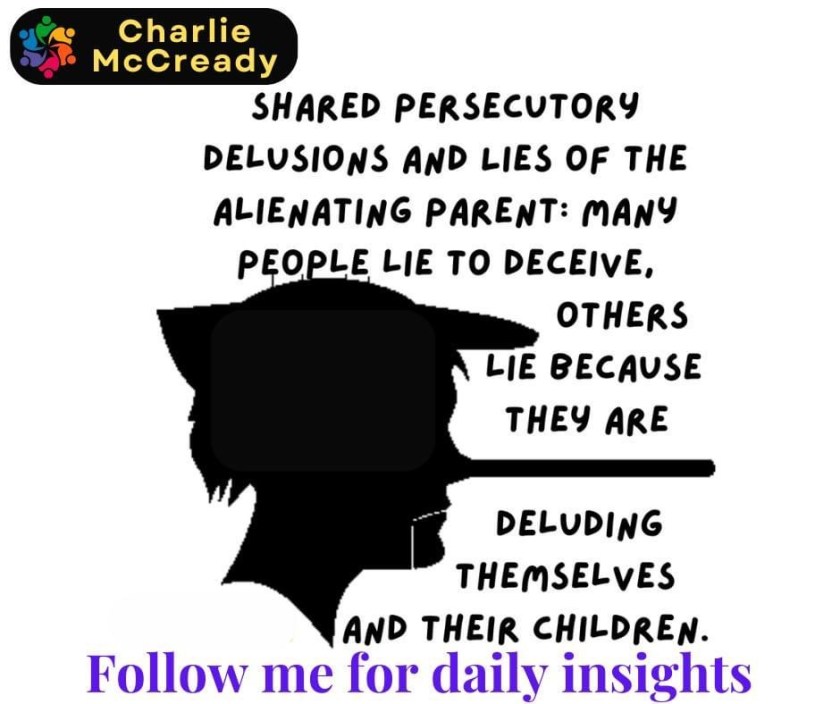
Why do liars lie? Lies can be a coping mechanism, a defence against perceived threats, or a means to achieve personal gain. Those who lie often develop diversions, and intricate stories and justifications, making it difficult for others to discern the truth. Shared persecutory delusions refer to situations where alienating parents, often with narcissistic tendencies or those suffering from certain mental health disorders, create false beliefs and convince their children of the same. Alienating parents manipulate mental health and family court professionals through gaslighting and deceit, saying they only act in the best interest of the child. By presenting a distorted version of events and casting the targeted parent in a negative light, they create confusion and doubt, leading the ‘experts’ to align with the manipulative narrative. The professionals’ lack of awareness of alienating behaviours allows the abusive parent to have their lies believed, and when they ‘win’ (get away with it), they remain convinced of their own righteousness.
They don’t always get away with it. More of them have broken relationships. Having said that, narcissists and Machiavellian types will stay with people who don’t challenge or confront them and who will tolerate, ignore or even support their deceit and lies, particularly if they benefit too. This applies to business and romantic relationships.
#charliemccready #9stepprogram #parentalalienationcoach #parentalalienationawareness #parentalalienationisreal #parentalalienation #parentalalieantionischildabuse #alienatedchild #alienatedmother #alienatedparent #alienatedfather #rejectedparent #rejectedmother #rejectedfather #highconflictcoparenting #coparenting #coparentingwithanarcissist #highconflictdivorce #divorce #FamilyLaw #FamilyCourt #childabuse #psychologicalchildabuse #narcissisticchildabuse #narcissisticfather #narcissist #narcissisticrelationship #narcissisticabuserecovery #narcissisticparent #narcissisticmother #narcissisticpersonalitydisorder #narcissisticabuseawareness
#narcissismawareness #narcissism
The Best Acts of Kindness for Kids—For Every Age And Budget
If you’re looking for random acts of kindness for kids, here are the best ideas for every age and budget to help you raise kind kids.
— Read on happyyouhappyfamily.com/random-acts-of-kindness-for-kids/
Persecutory Delusion – Craig Childress PsyD
Persecutory Delusion
Diagnosis is a pattern-match of symptoms to diagnostic criteria. The pathology of concern in the family courts surrounding child custody conflict is a possible shared (induced) persecutory thought disorder created in the child from the pathogenic parenting of an allied narcissistic-borderline-dark personality parent. The definition of a persecutory delusion is provided by the American Psychiatric Association:
From the APA: “Persecutory Type: delusions that the person (or someone to whom the person is close) is being malevolently treated in some way.” (American Psychiatric Association, 2000)
Google malevolent: having or showing a wish to do evil.
Writing in the journal, Family Court Review, Walters and Friedlander (2016) describe the shared persecutory delusion that is often present in the family courts surrounding child custody conflict and attachment pathology displayed by the child:
From Walters & Friedlander: “In some RRD families [resist-refuse dynamic], a parent’s underlying encapsulated delusion about the other parent is at the root of the intractability (cf. Johnston & Campbell, 1988, p. 53ff; Childress, 2013). An encapsulated delusion is a fixed, circumscribed belief that persists over time and is not altered by evidence of the inaccuracy of the belief.” (Walters & Friedlander, 2016, p. 426)
From Walters & Friedlander: “When alienation is the predominant factor in the RRD [resist-refuse dynamic}, the theme of the favored parent’s fixed delusion often is that the rejected parent is sexually, physically, and/or emotionally abusing the child. The child may come to share the parent’s encapsulated delusion and to regard the beliefs as his/her own (cf. Childress, 2013).” (Walters & Friedlander, 2016, p. 426).
Based on the nature and severity of the attachment pathology in the family courts, I recommend that a proper assessment for a possible shared (induced) persecutory delusion be conducted with families in high-conflict custody litigation that will return an accurate diagnosis regarding the nature of the pathology in the family, to then guide the development of an effective treatment plan to fix the pathology in the family.
The concern is that the allied parent is psychologically controlling and manipulating the child into creating a false pathology,
From Barber & Harmon: “Psychological control refers to parental behaviors that are intrusive and manipulative of children’s thoughts, feelings, and attachment to parents. These behaviors appear to be associated with disturbances in the psychoemotional boundaries between the child and parent, and hence with the development of an independent sense of self and identity.” (Barber & Harmon, 2002, p. 15)
From Soenens and Vansteenkiste: “Psychological control can be expressed through a variety of parental tactics, including (a) guilt-induction, which refers to the use of guilt inducing strategies to pressure children to comply with a parental request; (b) contingent love or love withdrawal, where parents make their attention, interest, care, and love contingent upon the children’s attainment of parental standards; (c) instilling anxiety, which refers to the induction of anxiety to make children comply with parental requests; and (d) invalidation of the child’s perspective, which pertains to parental constraining of the child’s spontaneous expression of thoughts and feelings.” (Soenens & Vansteenkiste, 2010, p. 75)
Participation in Child Abuse
One of the prominent professional dangers of misdiagnosing a shared persecutory delusion is that if the mental health professional and/or the Court misdiagnoses the pathology of a shared persecutory delusion and believes the shared delusion as if it was true, then the mental health professional and/or the Court become part of the shared delusion, they become part of the pathology. When that pathology is the psychological abuse of the child by an allied pathological parent, then the mental health professional and/or the Court become participants in the parent’s psychological abuse of the child by validating to the child that the child’s false (delusional) beliefs are true when they are, in fact, symptoms of an induced persecutory delusion.
The Court’s decision-making will be much enhanced by an accurate diagnosis of the problem returned by mental health services BEFORE making custody decisions influenced by the child’s pathology.
Craig Childress, Psy.D.
Clinical Psychologist, CA PSY 18857