Secrets of Narcissistic

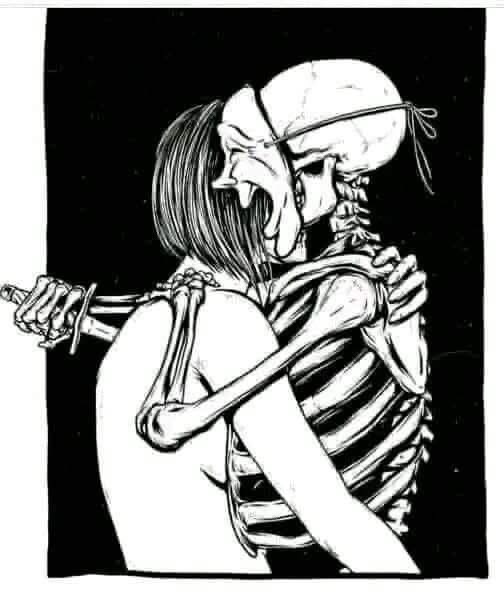
When you’re in a relationship with a narcissist, there will always be another secret life going on behind your back.

This is because these people are very empty, and they need stimulation from multiple sources just to face existence. They’ll be doing drugs or pornography. They’ll be stringing multiple partners through flirting and emotional affairs. They will be chasing financial intrigue that occasionally gets them into scams and trouble.

The reason they must flirt with other people is also because they’re seeking to move on to other people who don’t know the games they play.

They know they’ll get bored with you eventually, or you’ll learn to resist their shenanigans. And since being alone would kill them, they begin to groom possible replacements among anyone whom they can charm.

You’ll also notice this habit of making promises to you and then using those promises as a dangling carrot to get compliance from you. If you don’t do what they want, they’ll withdraw the promise.

Sometimes, they’ll deny having promised at all, or they postpone it until you give up. The truth is that they never intended to fulfill it in the first place.

Narcissists have lost all sense of right and wrong.

Everything is about satisfying themselves.

When you finally leave, they’ll circle back to you, pretending to be checking on you when actually they’re checking if they still have access.

If you have a child with them, they would weaponise that child to torture you until you cut them off totally or you manage to enforce boundaries with the help of the law.

But the child will be scarred or wasted by the counter parenting and objectification from the narcissist.

Society knows very little about narcissists.

Sometimes, you stay because you fear the pain of letting go until you realize the pain you’re already taking for holding on.

Other times, you think you’re staying for the children until you realise that the narcissist is turning all of them into other small narcissists and broken empaths.

Your solution is to recognize that this person is incapable of peace. They’re only excellent at pretending and confusing you.

You will never have a life until you detach from them and direct your life towards wholeness and emotional stability đź’ś

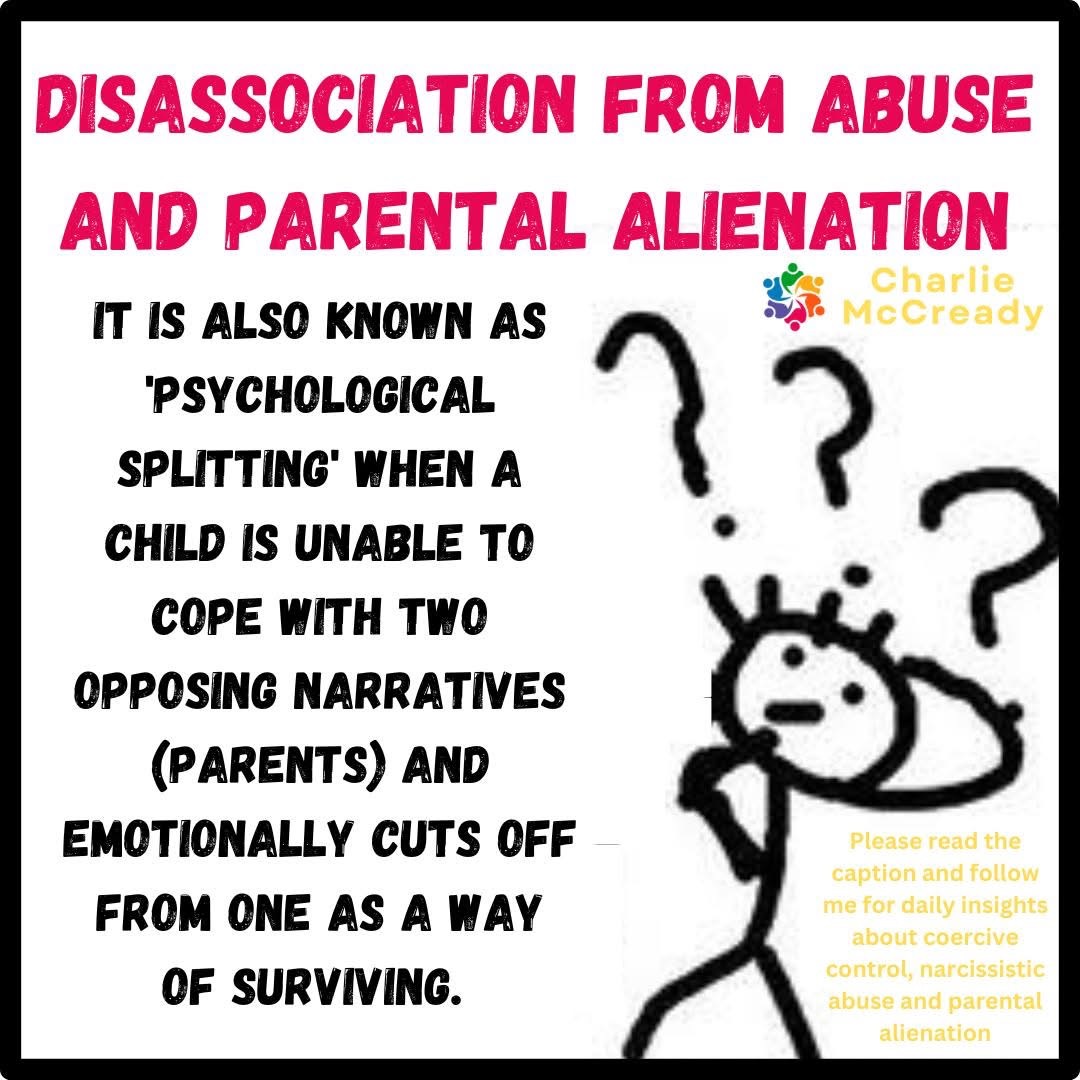
Psychological Splitting from Abuse /Parental Alienation – Charlie McCarthy

The emotional strain and confusion resulting from parental conflict can be overwhelming. The child may feel powerless, torn between loyalty to both parents or fearful of displeasing the ‘favoured’ alienating parent. Fear of displeasing the alienating parent, coupled with emotional manipulation and coercion, may prompt the child to distance themselves emotionally from the targeted parent, resorting to disassociation as a protective measure or psychologically ‘split’. This is because the child’s mind instinctively resorts to disassociation to protect itself from intense emotional distress.

Disassociation offers the child a psychological escape from the distress caused by parental alienation. By emotionally detaching from the alienated parent, the child shields themselves from the pain and confusion of their situation, essentially numbing themselves to cope with the overwhelming emotional turmoil.

However, despite the challenges posed by this emotional cut-off/disassociation, there is hope for children affected by parental alienation. Children can overcome this defence mechanism and reconnect with the alienated parent. Even from afar, the alienated parent can be a beacon of stability and love, providing a role model for their child. With time, understanding, and intervention, reconnection is possible, offering healing and restoration to families affected by parental alienation.

#charliemccready

#parentalalienationcoach

#narcissisticabuseawareness

#coercivecontrol

#parentalalienation

Alienating Parents believe their own lies /💯🙌

The motivations and psychological processes of alienating parents can vary, making it challenging to generalise their behaviour. In some cases, alienating parents may genuinely believe their lies, deluding themselves into thinking they are protecting their children or acting in their best interest. These individuals might have convinced themselves that the target, alienated parent is a danger or unworthy of the child’s love, and they may genuinely believe the false narrative they have constructed. Their actions may be driven by cognitive dissonance, where they unconsciously justify their behaviour to align with their self-image as a “good” parent, even as their actions cause harm.

On the other hand, some alienating parents may knowingly lie and manipulate the situation to further their agenda and “win” at all costs, even if it means hurting their children in the process. This behaviour can stem from deep-seated resentment, anger, or a desire for revenge against the target parent. These individuals may display narcissistic or sociopathic traits, seeking to control and dominate others, and believe that alienating the child is a way to achieve this control. They may even derive pleasure from causing pain to the target parent and feel powerful when manipulating the child’s

Sometimes, the alienating parent’s behaviour may be a combination of self-delusion and calculated manipulation. They might have started with negative emotions towards the target parent but then become consumed by those feelings, weaving a web of lies and distortions to reinforce their beliefs and justify their actions. This complex mix of cognitive dissonance, narcissism, and calculated manipulation can create a toxic environment for the child, where they are caught in a battle between their parents.

The consequences of parental alienation on the children and the target parent can be severe and have long-lasting emotional and psychological effects. Understanding the dynamics of parental alienation and its impact on all parties involved helps develop effective interventions to address this form of emotional abuse.

#charliemccready

#parentalalienationcoach

#coercivecontrol

#ParentalAlienationSyndrome

Justifying mistreatment/ Narcissism

A narcissist or toxic person will find every excuse in the book to justify their mistreatment or abuse.

They believe that because they “feel” a certain way about you, were “told” something about you, “heard” something about you, or “think” something negative about you, they are entitled to:

• Disrespect you

• Devalue you

• Bully you

• Try to control you

• Treat you badly

• Take their anger out on you

They will always blame their actions and behaviors on you or someone else. They rarely apologize to those they hurt—unless it benefits them or gets them something they want.

Your worth is not defined by their projections. Refuse to be a part of their cycle and take back your power.

#WordsOfSteele #ShatteredSilence #RadiantResilience #TruthPrevails #BoldAndUnbreakable #LetSandiSteeleGO

Agatha Christy – Grief & Betrayal early on

I can relate

Agatha Christie’s life took a dramatic turn in 1926. At the age of thirty-five, she was plunged into despair by the loss of her mother and the betrayal of her husband, Archie, who left her for another woman. This double blow sent her spiraling into a deep depression, leaving her feeling utterly lost and disillusioned. The only solace she found was in the love of her seven-year-old daughter, Rosalind.

Born into wealth and privilege in 1890, Agatha had shown a remarkable talent for writing from a young age. She married Archie Christie, a dashing pilot, in 1914. Together, they weathered the storms of World War I and welcomed their daughter in 1919. By the time her marriage began to unravel, Agatha had already established herself as a successful author with five acclaimed detective novels.

As she slowly emerged from the shadows of her failed marriage, Agatha turned to writing as a source of comfort and escape. A journey on the Orient Express offered a brief respite, but it was an archaeological dig in Iraq in 1930 that truly transformed her life. There, she met Max Mallowan, a younger archaeologist, and their love story blossomed. They married later that year and embarked on a lifelong partnership filled with love, adventure, and intellectual companionship.

The year 1926, a year of immense pain and uncertainty, marked a turning point in Agatha Christie’s life. In the decades that followed, she would go on to become one of history’s most celebrated authors, penning over 70 best-selling novels and creating the longest-running play ever staged. Her second marriage brought her happiness, and both she and Max received prestigious honors: Max was knighted in 1968, and Agatha was made a Dame of the British Empire in 1971.

Agatha Christie passed away on January 12, 1976, at the age of 85. With over two billion copies of her books sold worldwide, she remains the best-selling novelist of all time. Her enduring legacy is a testament to her resilience, her extraordinary talent, and her ability to turn adversity into triumph.