Grief

Grief has a way of isolating us. The sort of sadness that overwhelms us with a heavy, aching heart from morning til night-time is hard to move through, and we have to do it slowly, one day at a time.

As Khalil Gibran said in The Prophet: “Love knows not its own depth until the hour of separation” We feel detached from the rest of the world, contained in our body vessels and moving through the day as if we’re not really here at all. Who are we now? For alienated parents with their children gone from their lives, they hardly feel like a parent anymore, though they are still parents, most definitely, and always will be. The loss leaves a void. We don’t want to fill it because we want to feel the ‘missing’ and the sadness keeps them in mind. It’s scary to have to rethink who we are and repurpose our lives.

Will we ever feel happy again? Yes. But it doesn’t happen overnight. We find moments. We figure out how to live our lives without the one/s we love. We become unafraid again. We treat ourselves as someone we love. Each day, we take one step in front of the other, and we move forward doing the best we can. And when we need to rest, we rest. Along the way, we do find peace, love and happiness again.

If you are going through parental alienation, know you’re not alone. I’ve been through it myself. Personally and professionally, I have over 20 years of experience. I am reunited with my children and here to offer support with daily posts on social media and also with the coaching I offer. Feel free to reach out to me anytime.

#charliemccready

#parentalalienationcoach

#familycourts

#parentalalienationawareness

I see you

“I see you.

The ones who can’t sleep at night because our soul doesn’t know peace. The ones who look for the beauty in darkness because it’s all we have.

The ones who love the wolves, instead of fearing them.

The ones who play the same sad songs over and over, to feel every ounce of our emotions.

The ones who wake up each day and place a smile on our face for the sake of others, so no one worries about you.

I see you, the ones who struggle to wake up and fight each day.

The ones who have more bad days than good under their belt.

I see you still getting up and trying, even if every ounce of you internally wants to quit.

I see you, fantasizing over the fairy tale, even if life has given you the exact opposite.

I see you never losing hope.

The hopeless romantics, the empaths, the fighters.

I see you, and you are beautiful because you never give up. You’re beautiful because you allow yourself to feel the highs and the lows, and accept that life comes with both.

I see you, but it’s time for you to see yourself, the way the rest of us see you. You are more than enough, and your depths do not make you hard to love. They make you even more worthy of love. And it all starts with the love you give yourself.

I see you, the world hasn’t been kind to you.. but I will.

I see you, because in you, I see me.

And I want you to know that you are not alone.”

( ✍️ Brianna Terese Vigil )

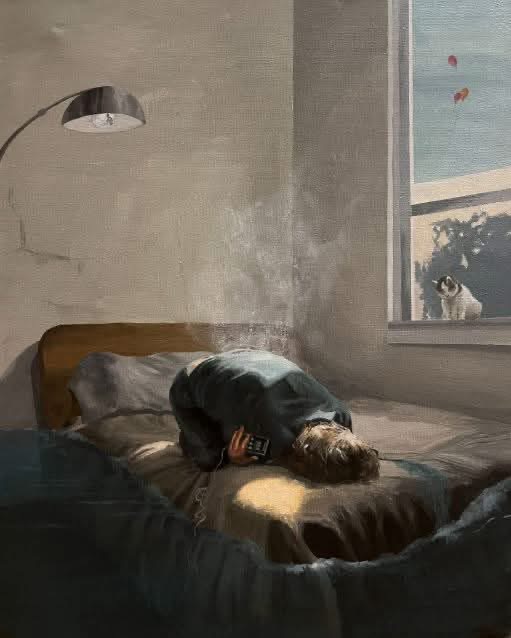
Art : Vikita Bueno

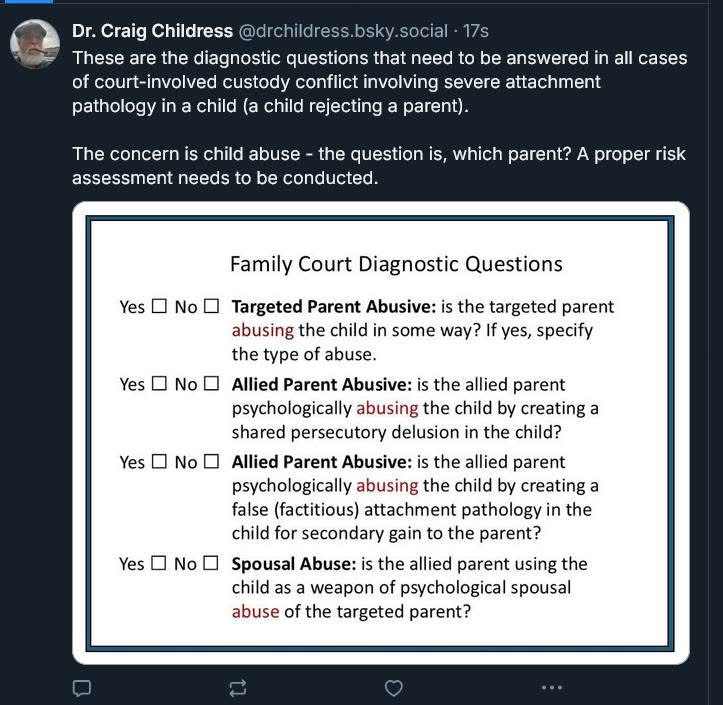
Dr Craig Childress PsyD : Diagnoses Breakthrough 🎊 Child Phycological Abuse

I’ve been thinking…

Now that I have the three DSM-5 Diagnoses seminars up on my YouTube channel, 1) the DSM-5 Diagnosis, 2) Diagnosing a Persecutory Delusion, and 3) Diagnosing a Factitious Disorder Imposed on the Child, I know what my next Diagnosis Chapter is…

4) Diagnosing Child Abuse

Because the forensic custody evaluators never diagnosed the child abuse – they never diagnosed anything, they do something different of their own devising – they put all the legal professionals to sleep… like things weren’t that important.

This is child abuse. We need an accurate diagnosis in six to eight weeks.

Which means the legal system must respond much-much more quickly… however we also need the psychologists to conduct the clinical diagnostic assessments.

Parents and the courts can ask for a diagnostic assessment of the family conflict as much as you want, if the psychologists don’t do that then it’s not available.

A diagnostic assessment is being withheld from parents and the courts for the personal financial gain of the forensic custody evaluators.

I’m in the AFCC now. I’ll be encountering the forensic custody evaluators there, and they’ll be encountering me.

Paradigms are changing. It’s not incremental change, it’s transformational change. Forensic custody evaluations are entirely leaving – bye-bye – a failed experiment on parents and children.

Clinical psychology is returning, diagnosis and treatment.

All mental health professionals have duty to protect obligations. This is child abuse – and spousal abuse of the targeted parent by the allied using the child, and the child’s induced pathology, as the spousal abuse weapon.

Duty to protect obligations are active – we need to get a proper risk assessment with an accurate diagnosis within six to eight weeks.

Since it will be a disputed diagnosis, each litigant-parent should be allowed to appoint a consultant to participate in the diagnostic assessment sessions through telehealth.

The ONLY cause of the child’s symptoms – a child seeking to flee a parent; a directional change in a primary motivational system – is child abuse by one parent or the other.

We need a clinical diagnostic assessment for child abuse to the appropriate differential diagnoses for each parent. How do we assess for child abuse?

That’s what I’ll explain in the next seminar: Diagnosing Child Abuse.

I served as the Clinical Director for a three-university assessment and treatment center for children ages 0-to-5 in foster care, CPS was our primary referral source.

I’ve personally treated all four forms of child abuse, and I have lead the treatment teams for all forms of child abuse that have included CPS social worker involvement.

I should describe how to assess for child abuse.

Craig Childress, Psy.D.

Clinical Psychologist

WA 71538481

OR 3942 – CA 18857

Mother

We can hold the grief and sadness of not having that Mom… or we can heal those wounds and try to see her humanely . I regret that lost the ability to heal while she was still in her body .

It’s very difficult to acknowledge that our children are so detached from feeling anything but hatred … I’ve accessed my part ( that I’m aware of ) and amassed the varied influences that lead to alienation , fear , hatred and detachment.

www.facebook.com/share/r/1E9LcMqzZ2/

Tears – Charlie McCready

I cried very easily , often in frustration for not being heard or valued . Dad called them Crocodile 🐊 tears or water works and often teased me for my sensitivity .

X was immune to my sensitivity and tears . He’d make like he was crying ( no tears ) on a few occasions.

I’m not ashamed of my tears or emotions as a SSHP . I tear up in laughter , in compassion, at beauty and in pain or frustration .

” Laughter and Crying are the same release”-Joni Mitchell

I rarely cry and could use a good cry on a mountain top where I could scream as well! Releasing years of abusive overlords and watching folks succumb to fuckery in our world …

Blame as an escape

Thinking that my years of abuse , the varied betrays aided in my personal growth while I was drugged via psychiatric ineptitude! If continues .. so the tables are turned and balance will be restored, as I graduate 🧑‍🎓

*

“Your suffering is never caused by the person you’re blaming.”

Blame is an easy escape, but it never leads to freedom and encases you in a prison of false perception. It’s tempting to believe that suffering is caused by someone else—that their words, their actions, or their choices are the reason for the pain. But what if the real source of suffering isn’t what they did, but the way it is perceived, processed, and held onto?

The mind has a way of creating narratives. It builds stories around pain, assigning fault and attaching emotions to past wounds. But the moment blame is given away, power is also given away. Blame keeps the focus outward, waiting for someone else to change, apologize, or make things right. But what if peace doesn’t depend on their actions? What if it has always been an internal choice?

No one can control how others act. People will make mistakes, they will be unfair, they will disappoint. But what happens next—the response, the emotions carried forward, the way the situation is interpreted—is entirely within personal control. And this is where true strength lies: in realizing that suffering isn’t created by the external, but by the attachment to what cannot be changed.

Personal accountability is not about excusing others—it’s about reclaiming power. It’s the understanding that while pain is real, suffering is optional. It’s the choice to see difficult situations as lessons instead of burdens, to shift perspective from victimhood to growth. The world will not always be kind, but inner peace is not determined by external forces.

Letting go of blame is not about denying hurt; it’s about refusing to let it define the future. When responsibility is taken for thoughts, reactions, and emotions, life no longer feels like something that happens *to* you, but something shaped *by* you.

Freedom begins the moment responsibility is claimed. The choice is always there: to remain bound by blame or to step forward in strength. In the end, the only true control is over oneself, and that is where real peace is found.