

Tag: Children
Dark Psychology of family weaponized rage
Keep standing in your truth – Charlie McCready
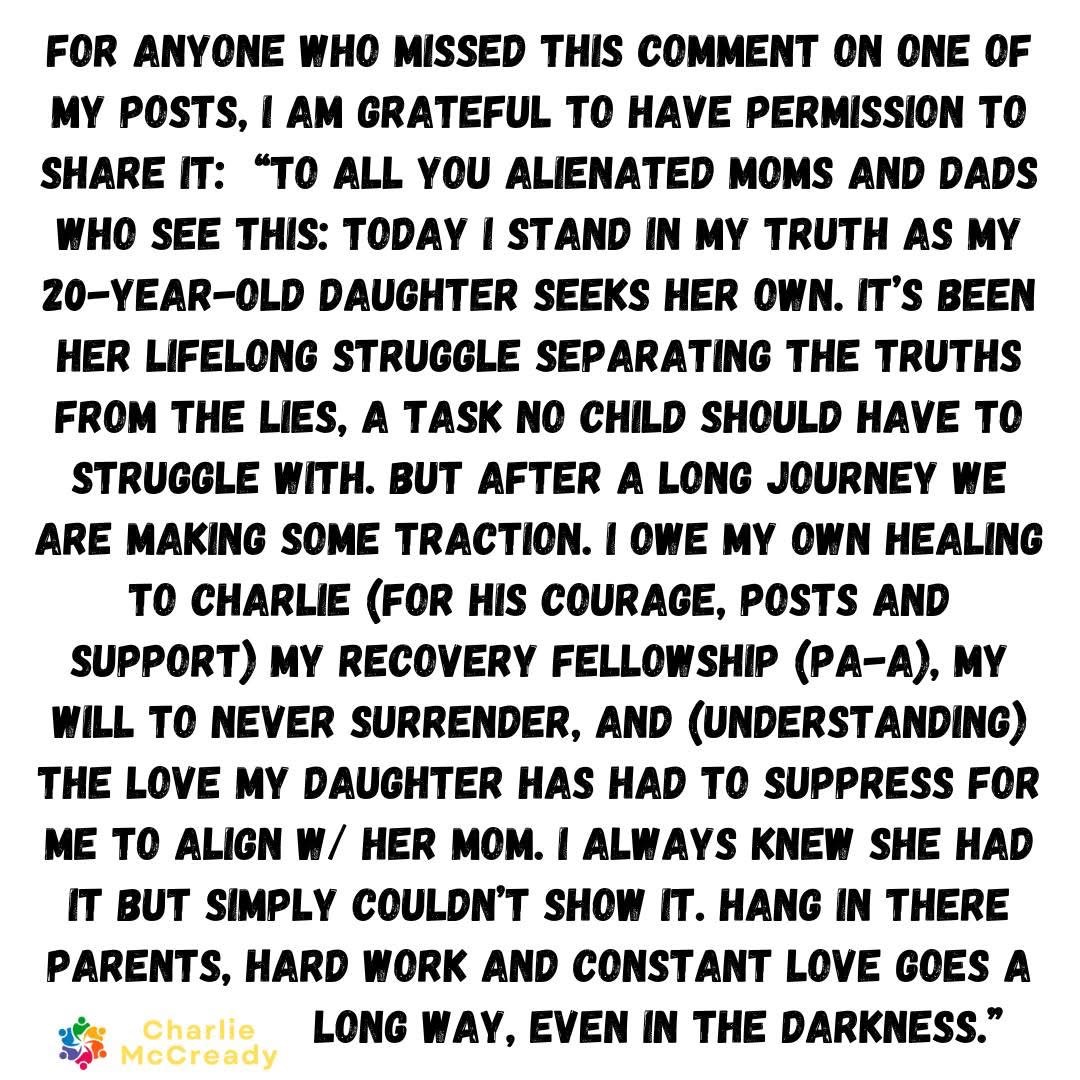
This father’s words are a testament to the resilience it takes to endure parental alienation. It can be a long and painful journey, but healing yourself is just as important as holding onto hope for your child. Taking care of your mental and emotional well-being doesn’t mean giving up—it means staying strong enough to be there when your child is ready.
Parental alienation can make you feel powerless, but the love between parent and child is not so easily erased. Even when they cannot show it, even when they have been taught to suppress it, that bond still exists.
Keep going. Keep healing. Keep standing in your truth.
#charliemccready
#parentalalienationcoach
#alienatedchild
#alienatedparent
#narcissisticabuseawareness
#narcissisticparent
Harmful Dynamic of Parental Alienation on the child
Children subjected to the harmful dynamic known as parental alienation, exhibit distinct attitudes and behaviours. They become fixated on denigrating one parent, reciting numerous grievances, and treating that parent as if they hold no value. What’s even more concerning is that many deeply alienated children express desires for the parent’s demise or disappearance. Strikingly, they do so without any accompanying guilt or remorse for their hostile behaviour. Children who have experienced physical abuse, typically fear the person abusing them, adopting a compliant demeanour to avoid further harm. They do no such thing with the alienated parent they reject because they say they’re not safe, or unwelcome in their life – with no real justification for these accusations and a previously loving relationship. Often their reasons are trivial or irrational like disliking being asked to help around the house, or not swearing, or any other reasons which do not warrant the rejection and hatred. Again, this contrasts with abused children who can offer justifiable and real evidence for their aversion.
Ordinarily, children, especially in the teenage years, hold a mix of sentiments toward their parents, including both love and loathing. However, children subjected to parental alienation often lack ambivalence. They struggle to articulate anything positive about the alienated parent while protecting the preferred (alienating, abusive) parent with whom they are aligned and being indoctrinated. During parental disputes, these children instinctively side with their preferred parent and accept without question that parent’s allegations against the alienated parent. Their expressions of criticism often mirror the aligned parent’s grievances, even if they don’t fully understand the words and phrases used. This happens despite their insistence that their rejection of the parent is solely their own decision, unaffected by the parent they have been induced to favour.
As the alienation deepens, it extends beyond just the parent. It encompasses other family members and friends on the alienated parent’s side. Even hobbies and interests. Even pets. It is ‘hatred by association’. It is irrational and yet can become powerfully ingrained behaviour. It might be a cherished grandparent who they no longer want to see. It is tragic for all involved. The only person who might be considered a ‘winner’ is the alienating parent. ‘Winner’ is not a word to describe their behaviour. ‘Abuser’ is much more fitting.
#charliemccready
#parentalalienationcoach
#parentalalienationawareness
#childrensrights

Dark things done to kids in USA educational system
Definitely lots of room for improvement 💯
www.jchristoff.com/blog/3-dark-things-the-system-does-to-children-that-very-few-notice
Mother vs Wife
Moms Breaking Cycles 🙌
To the moms breaking cycles they never asked to be part of.
To the ones learning how to feel, how to cry, how to forgive, all while raising babies who won’t have to carry the same weight.
I see you.
It’s not easy healing from what hurt you while showing up with love, patience, and softness for your kids.
It’s not easy being the first to say “this ends with me.”
But it is brave. It is powerful. It is world-changing.
Keep going, mama.
Every time you choose connection over control, every time you apologize, every time you pause to breathe…
You are doing the work that will ripple through generations.
And that matters more than you know.
Learning the truth of your being alienated
Charlie McCready- Lawyers $$$$
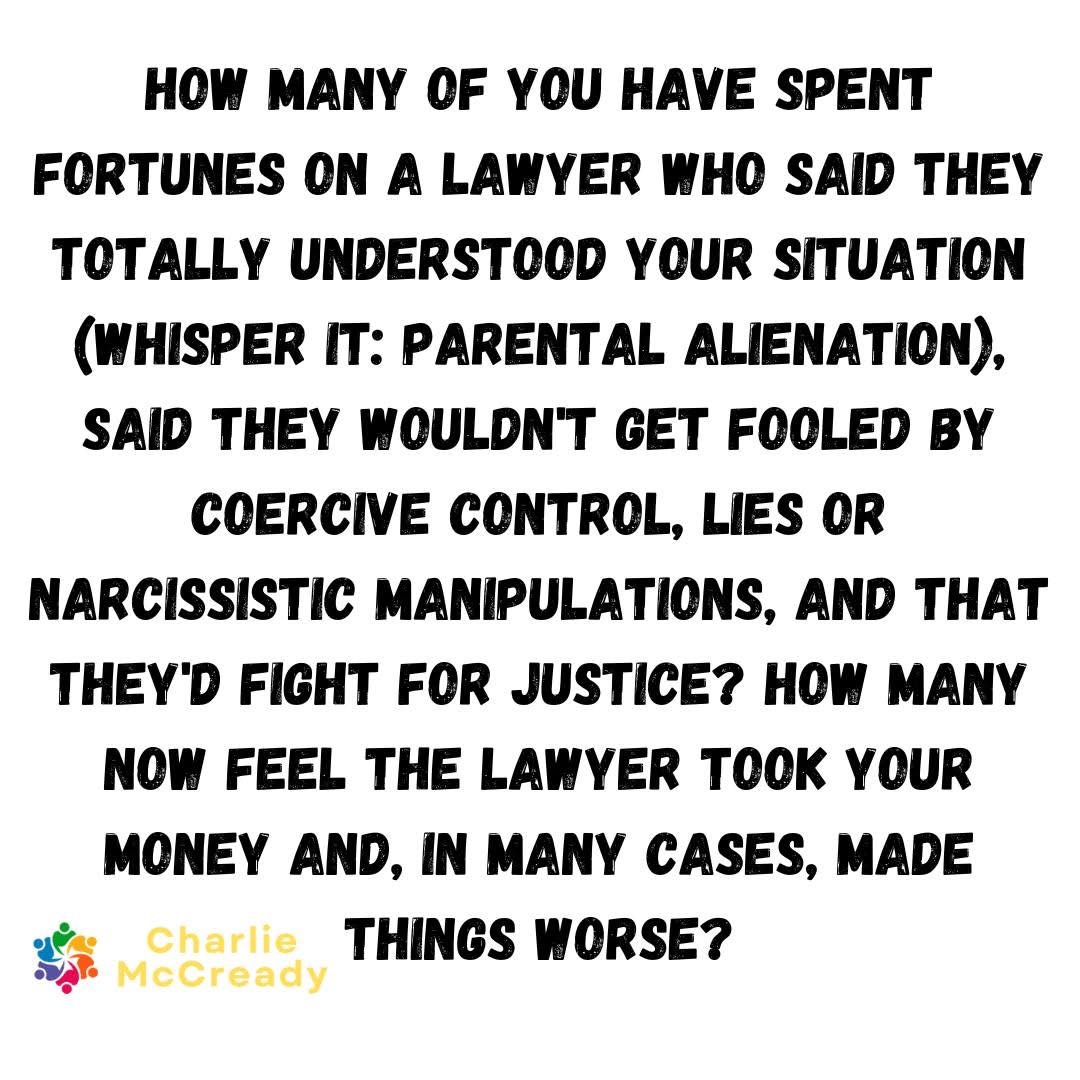
Does anyone care to comment? When I have more time, I’d like to gather more data on what alienated parents have actually experienced in the family court system. How long did it take? What was the outcome? How much money was spent? Did it lead to reunification? If the court ordered contact, was it enforced—and if so, how did that go?
Alienated parents often pour their life savings into a legal system they once believed would protect their rights and their children’s well-being—only to emerge financially drained, emotionally shattered, and, in many cases, no closer to justice.
This highlights the urgent need for reform. Lawyers dealing with these cases should be trained to recognise attachment disordered parental alienation – the false narratives and coercive, manipulative behaviours that drive it. The legal system must do better, not only for parents who are being erased from their children’s lives but, most importantly, for the children themselves—caught in a battle they never chose.
Perhaps we expect too much. Perhaps we should know better by now. After all, injustice isn’t confined to family courts or parental alienation. Look at the wider world—those who commit crimes often walk free, while those who expose them suffer the consequences. The alienated parent is no different: seeking truth in a system that too often fails to protect the innocent while enabling the abuse.
I don’t mean to sound cynical. I try to stay focused on solutions. But we shouldn’t have to ‘fight’ to see our own children in a court of justice—because we are not criminals. We are parents. Parental alienation isn’t simply a legal matter; it’s a psychological and relational issue—one that the law is often ill-equipped to handle. And for many, prolonged legal action is not only financially impossible but also emotionally destructive. While sometimes necessary, court should be a last resort, used only when every other effort to protect a child’s well-being has been exhausted.
If you are going through what’s commonly known as ‘parental alienation’, know you’re not alone. I’ve been through it myself. Personally and professionally, I have over 20 years of experience. I am reunited with my children and here to offer support with daily posts on social media and also with the coaching I offer. Feel free to reach out to me anytime.
#charliemccready
#parentalalienationcoach
#parentalalienation
#parentalalienationawareness
#alienatedchild
Narcissist: unable to love- Charlie McCready
Narcissistic alienating parents are characterised by a self-centred, manipulative, and exploitative nature. They prioritise their own needs, desires, and self-image above the well-being of others, including their children. Here are some key points:
Lack of empathy: Narcissistic individuals often struggle with empathy, which is the ability to understand and share the feelings of others. They have difficulty recognising and validating the emotional experiences of their children or anyone else in their lives. Their focus is primarily on themselves and their own needs.
Manipulative and controlling behaviour: Narcissistic parents tend to manipulate and control those around them to maintain a sense of power and superiority. They may use tactics such as gaslighting, guilt-tripping, emotional manipulation, and coercive control to assert dominance and maintain control over their children.
Exploitation of relationships: They view relationships as opportunities for personal gain rather than genuine connections based on mutual care and support. They may exploit their partner’s and their children’s love and loyalty to serve their own agenda, using them as extensions of themselves rather than recognising their autonomy and individual needs. This also goes for other family members and work associates, in fact, anyone in their lives.
Lack of genuine love and care: Narcissistic individuals struggle to experience and express genuine love and care for others. Their primary focus is obtaining admiration, attention, and validation. As a result, their relationships, including those with their children, lack the depth, emotional connection, and authentic care that healthy relationships require.
Superficial charm and manipulation: They often appear charming, charismatic, and even loving in the early stages of a relationship. However, their behaviour tends to be manipulative, self-serving, and inconsistent over time. Their actions are primarily driven by a need for control, admiration, and validation rather than genuine care and concern.
They lose interest when someone no longer ‘serves’ them. When someone calls out their behaviour, they’ll go on the attack to protect their interests/lies. It’s important to recognise that not all alienating parents are narcissistic, and not all narcissistic parents engage in parental alienation. But when these two dynamics intersect, the results can harm and damage the child’s well-being and the parent-child relationship.
#charliemccready
#parentalalienationcoach
#narcissisticabuseawareness
#narcissisticparent
#traumabonding

 GreatCosmicMothersUnite