Alienated Children – Cognitive Dissonance

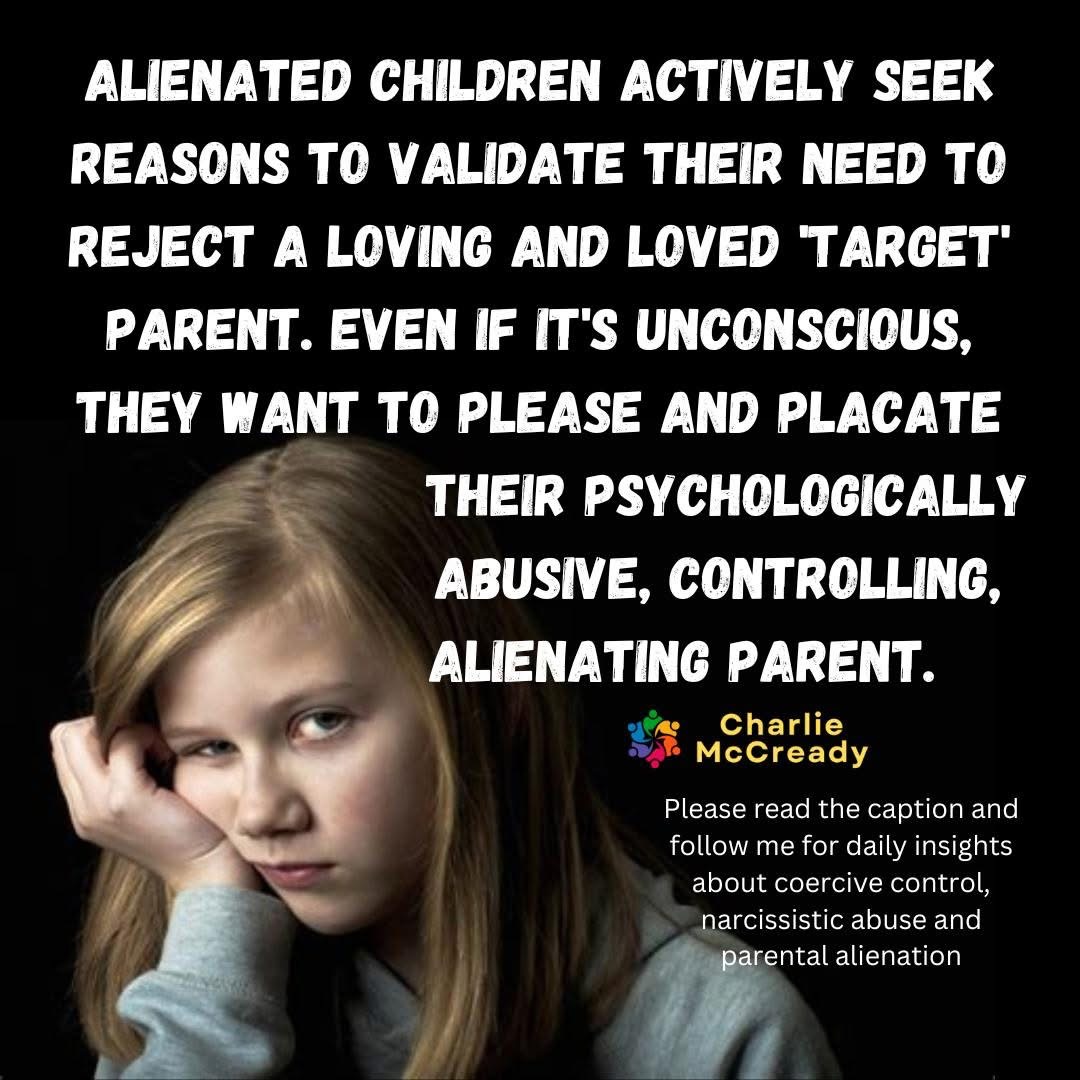
Alienated children often suffer from cognitive dissonance as they struggle to reconcile the negative narrative imposed on them by the alienating parent and their own genuine feelings and memories of the ‘target’ parent. This can lead them to seek reasons to justify their rejection of a loved, loving, available and non-abusive parent. It’s also a means to align with the alienating parent who presents as stronger and apparently safer. This is what the child wants – safety, security, love. Initially, they may subconsciously prioritise pleasing the controlling alienating parent to avoid conflict or further manipulation. ⁠

The alienated child consciously or unconsciously seeks evidence, often exaggerated or distorted, that supports the negative image the alienating parent has portrayed of the ‘target’ parent. Information can be twisted out of all recognition. There are many examples of this. A phone call can be called harassment. Gifts can be bribery. Virtually everything can seem wrong as the alienating parent repositions it, and unfortunately, the child learns this behaviour and starts to put it into practise themselves. This can involve past and present events. Happy memories can be erased and reprogrammed in a negative light. ⁠

But it has to be remembered that when the child does this, it is a way of surviving a dreadful ordeal and somehow trying to justify and validate the behaviours they’ve been coerced into. I’ve heard it so many times from adults who were alienated children that it really helped them to know their rejected parent was always there for them, waiting, in the background, with love, giving them hope that one day everything would be okay.⁠

#charliemccready

#parentalalienationcoach

#alienatedchild

#parentalalienationawareness

#CoerciveControl

#FamilyCourt

#childpsychologicalabuse

#attachmenttheory

#parentalalienation

#custody

#ChildCustody
Parental Alienation is Not Gender Specific – Charlie Mc Cready

The latest BBC (14 March 2025) article says that parental alienation claims are sometimes used strategically in family court cases and, in doing so, is downplaying the reality that alienation itself is a well-documented form of psychological abuse rooted in coercive control and attachment disruption. Emphasising alienation as a manipulative tactic without properly recognising its legitimate existence harms alienated parents and their children. Alienating behaviours—whether intentional or unconscious—are extensively supported by clinical and legal research. Labelling it as a “pseudoscience” because of its historical association with the outdated “Parental Alienation Syndrome” is both misleading and harmful.⁠

The article repeats the troubling narrative that allegations of domestic abuse should automatically take precedence over claims of alienation. This was the crux of a BBC report in December, and thank you to all of you who wrote in to complain (this is acknowledged in the article). I strongly believe this continuing binary framing creates a false hierarchy of harm. In reality, both domestic abuse and parental alienation can coexist. An abusive parent might falsely claim alienation to deflect from their behaviour, while an alienating parent might fabricate domestic abuse claims to justify cutting off contact. Courts must investigate ALL allegations thoroughly rather than setting up a default presumption that one form of harm outweighs the other. Protecting children requires understanding the complexity of these cases—not reducing them to a simplistic “abuse versus alienation” framework.⁠

I also believe a critical flaw in the Family Justice Council’s recommendations is the suggestion that judges—not psychologists—should determine whether parental alienation has occurred. Judges may lack the specialised training needed to recognise the subtle patterns of psychological manipulation that define alienation. Excluding mental health professionals from these assessments risks leaving children exposed to emotional abuse that may not be immediately visible to a legal professional.

The gendered framing in the article is also concerning. The implication that fathers are more likely to use parental alienation as a weapon and mothers are more often victims of domestic abuse

reflects outdated stereotypes. In reality, I can say my partner and I both suffered, the parents I work with – mothers and fathers – suffer the same. I’d say the differences are in presumed familial relationships and stereotypes, which again are unhelpful. Both mothers and fathers can be victims or perpetrators of alienation and abuse. Alienation is not a gendered issue—it is a psychological and relational one. A gender-neutral, child-centred perspective is essential for understanding the true dynamics of alienation and abuse.

Alienated parents already face immense psychological and emotional strain navigating a system that often fails to recognise the coercive control and emotional abuse they—and their children—are enduring. Until parental alienation is treated with the same seriousness as other forms of abuse, many children will remain trapped in harmful family dynamics, cut off from a loving parent. A balanced and evidence-based approach—grounded in the realities of both domestic abuse and alienation—is essential to ensuring that children’s welfare remains the central focus of family court decisions.

This is not just a legal issue—it’s a safeguarding issue. The failure to adequately address parental alienation means failing the very children the system is supposed to protect.

#charliemccready

#parentalalienationcoach

#highconflictcoparenting

#FamilyCourt

#FamilyCourtReform

#FamilyCourtCorruption

#custodybattle

Craig Childress, PsyD – Child Attachment Pathology & Child Abuse

I think I’m going to Coffee talk you twice tomorrow.

In the first one I’ll answer a question. In the second I’m going to talk to teachers – and the principal. For schools, it’s mostly the principal who’s involved, but the teacher should know what’s up.

Mostly teachers need to keep their heads down and remain non-involved… mostly it’s navigating the parent conferences. It’s the principal and the front office where most of the inter-parental action happens.

Sometimes it’s the records thing. Sometimes it’s a child tantrum in the office at exchange. Sometimes it’s a missed pick-up because the allied parent already picked the child up.

Triangulation is a hallmark of manipulative pathology. General public bystanders need to de-triangulate. It’s the psychologists who should be handling it. But they’re not.

Everything is a problem because the doctor psychologists in the family courts aren’t doing their job of fixing the problem. That’s their profession, that’s their job – to fix the mental health problem.

In this case, child attachment pathology and child abuse.

This isn’t a custody issue. Its a treatment issue. We need to fix the problem. To fix the problem we first have to identify what the problem is – i.e., which parent is abusing the child?

Diagnosis guides treatment. If we try to treat cancer with insulin, the patient dies from the misdiagnosed cancer. What is the diagnosis?

Start there. Once we have an accurate diagnosis for what the problem is, then we can develop an effective treatment plan to fix the problem… whatever the problem is.

That’s what we do in healthcare. You go to the doctor when you’re sick and the doctor diagnoses what’s causing your problem and then gives you a treatment plan to fix the problem.

Diagnosis first, then treatment. The treatment depends on the diagnosis, are we treating cancer or diabetes – which parent is abusing the child?

If a child is rejecting a parent, one parent or the other is abusing the child because abusive parenting is the ONLY thing that causes a symptom of a child rejecting a parent.

The ONLY diagnostic question is which parent is abusing the child?

Once the doctors start doing their job… everything will be fixed because they’ll fix the problem.

I should tell you how to fix problems. Maybe I should start with the basics of behavior change. Do you want to change any aspect of your life? I should tell you how to do that.

It’s relatively easy. The problem is you won’t do it. It’s called “resistance” and it arrived with Freud and has been the obstacle forever after.

I should tell you about Alfred Adler and why people want their problems. I should tell you about depression and anxiety too – just kind of orientations.

Should I tell you about Sapolsky and how it doesn’t matter what you do because it’s all Determined? Probably not.

I should talk to the teachers and principals to give them suggestions for navigating their child end of inter-parental custody conflict. We’ll see how the spirit moves me.

Craig Childress, Psy.D.
Clinical Psychologist
WA 61538481
OR 3942 – CA 18857

Inside the mind of Domestic Abusers

Let’s acknowledge that Domestic Abuse

in 2025 is Intimate Partner Violence

High Conflict

Mercenary , Manipulative Malignant

It is Spiritual

It is physical and psychological

It is financial, the never ending story

of projected blasphemy’s that create

an aura of heroic survival despite

the insanity of your partner .

Hatred lives in the heart of racist ,

discrimination, who superiority

rules all around him .

youtube.com/watch

Alienating Parent & Narcissism -Charlie McCready

It has been established that in most cases an Alienator is Narcissistic.

Despite its prevalence and devastating consequences, parental alienation remains one of the most misunderstood and underreported forms of abuse, sometimes, in itself, invalidated and maligned, with dire repercussions for families, and this, in turn, damages the very fabric of our societies.

At its core, parental alienation involves a distorted and toxic manipulation of familial relationships, particularly in the context of separation or divorce. It encompasses a spectrum of abusive behaviours, from emotional manipulation and coercive control to psychological abuse and child maltreatment. An alienating parent nefariously orchestrates it, but it can also involve step-parents, grandparents and others. Far too often, it’s further enabled by anyone, including professionals in the mental health and legal space, who doesn’t recognise and understand the dynamics behind the pathology. ‘Parental alienation’ is often disguised as love and protectiveness by a caring, concerned parent. In contrast, the more mentally healthy, ‘target’ parent who seeks peaceful resolution and a form of co-parenting can be mistaken for the agitator and the problem, particularly when the ‘voice of the child’ (coached and aligned with the alienating parent) has the last word. Sometimes, the ‘target’ alienated parent doesn’t even get to share their side of things. And this very divisiveness, this black-and-white thinking, is to the advantage of the triangulating (divide and conquer) adversarial parent in an adversarial situation. This is generalising, of course; there are many grey areas, and it’s not to say the alienating parent can’t sometimes act with genuine love, and the ‘target’ parent doesn’t sometimes, especially given the injustice, grief and anger, this situation evokes, act as the more emotional parent. The alienating parent, by contrast, can come across as calm, confident, charming … and this is before we throw narcissistic traits into the mix too

Furthermore, the targeted parent, unjustly maligned and emotionally battered, often faces the isolation of not being heard and understood and a labyrinthine legal and mental health landscape. The true extent of the abuse often eludes well-meaning professionals who may inadvertently contribute to the perpetuation of parental alienation due to a lack of awareness and understanding. Mental health professionals, legal practitioners, and communities must be equipped to recognise the signs, intervene effectively, and provide the necessary resources for healing and reconciliation. It’s a false economy not to invest in a better understanding and support for those caught up in ‘parental alienation’. The repercussions extend far beyond the immediate family unit when the harm it causes impacts communities, schools, and society at large. By acknowledging and addressing this form of abuse, we could pave the way for healthier, more connected societies where the sacred bonds of family are honoured and the well-being of children is prioritised above all.

#charliemccready

#parentalalienationcoach

#alienatedchild

#childpsychologicalabuse