

Tag: trauma
Keep standing in your truth – Charlie McCready
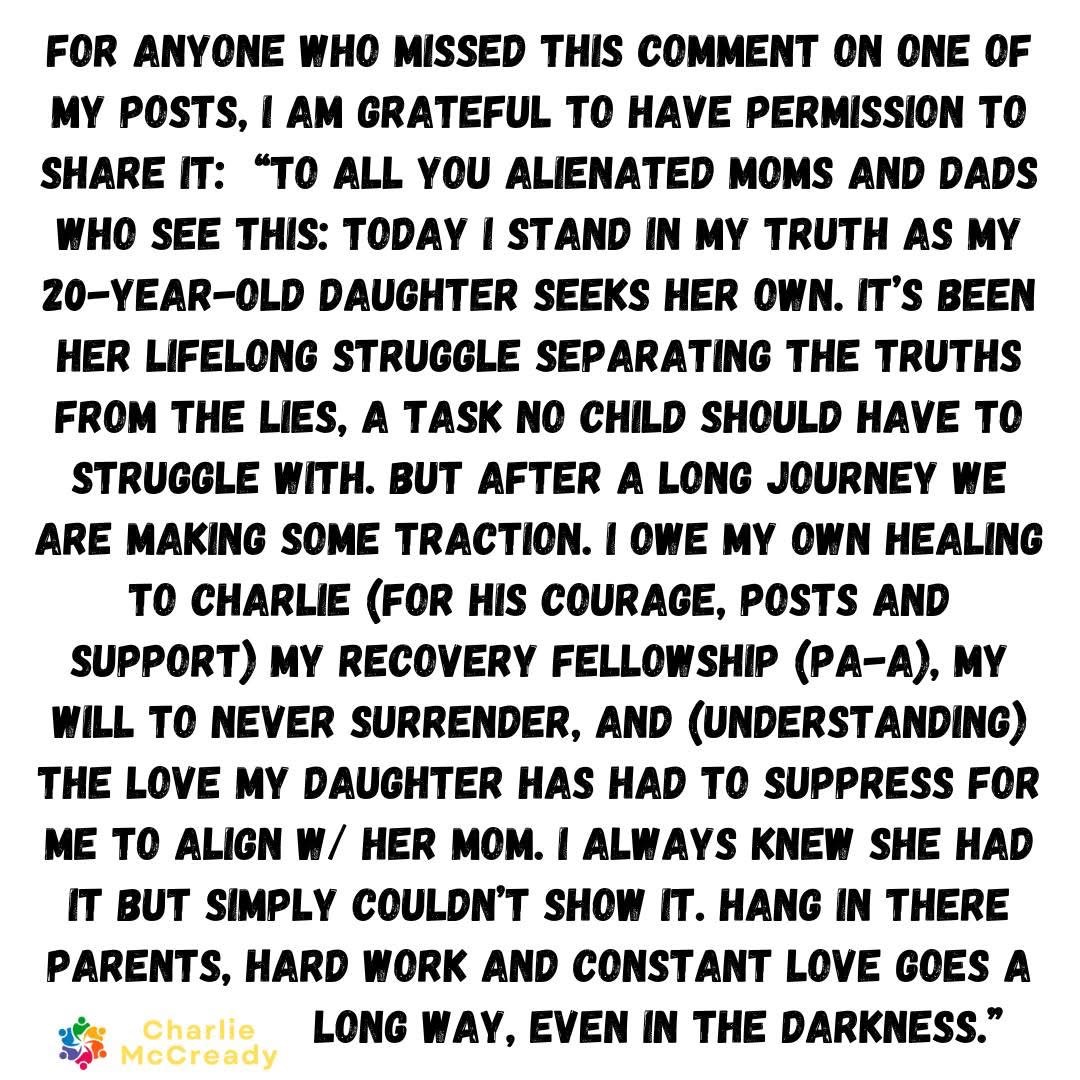
This father’s words are a testament to the resilience it takes to endure parental alienation. It can be a long and painful journey, but healing yourself is just as important as holding onto hope for your child. Taking care of your mental and emotional well-being doesn’t mean giving up—it means staying strong enough to be there when your child is ready.
Parental alienation can make you feel powerless, but the love between parent and child is not so easily erased. Even when they cannot show it, even when they have been taught to suppress it, that bond still exists.
Keep going. Keep healing. Keep standing in your truth.
#charliemccready
#parentalalienationcoach
#alienatedchild
#alienatedparent
#narcissisticabuseawareness
#narcissisticparent
Harmful Dynamic of Parental Alienation on the child
Children subjected to the harmful dynamic known as parental alienation, exhibit distinct attitudes and behaviours. They become fixated on denigrating one parent, reciting numerous grievances, and treating that parent as if they hold no value. What’s even more concerning is that many deeply alienated children express desires for the parent’s demise or disappearance. Strikingly, they do so without any accompanying guilt or remorse for their hostile behaviour. Children who have experienced physical abuse, typically fear the person abusing them, adopting a compliant demeanour to avoid further harm. They do no such thing with the alienated parent they reject because they say they’re not safe, or unwelcome in their life – with no real justification for these accusations and a previously loving relationship. Often their reasons are trivial or irrational like disliking being asked to help around the house, or not swearing, or any other reasons which do not warrant the rejection and hatred. Again, this contrasts with abused children who can offer justifiable and real evidence for their aversion.
Ordinarily, children, especially in the teenage years, hold a mix of sentiments toward their parents, including both love and loathing. However, children subjected to parental alienation often lack ambivalence. They struggle to articulate anything positive about the alienated parent while protecting the preferred (alienating, abusive) parent with whom they are aligned and being indoctrinated. During parental disputes, these children instinctively side with their preferred parent and accept without question that parent’s allegations against the alienated parent. Their expressions of criticism often mirror the aligned parent’s grievances, even if they don’t fully understand the words and phrases used. This happens despite their insistence that their rejection of the parent is solely their own decision, unaffected by the parent they have been induced to favour.
As the alienation deepens, it extends beyond just the parent. It encompasses other family members and friends on the alienated parent’s side. Even hobbies and interests. Even pets. It is ‘hatred by association’. It is irrational and yet can become powerfully ingrained behaviour. It might be a cherished grandparent who they no longer want to see. It is tragic for all involved. The only person who might be considered a ‘winner’ is the alienating parent. ‘Winner’ is not a word to describe their behaviour. ‘Abuser’ is much more fitting.
#charliemccready
#parentalalienationcoach
#parentalalienationawareness
#childrensrights

Unresolved Grief
Definitely: the ” Living connection ” for a Mom experiences living unresolved grief , which is the intent and mission of their non co parent .
One of the toughest things is that there’s no closure for the alienated parent. No justice. Ambiguous loss is a term that came about in the 1970s. A researcher called Pauline Boss studied military families, specifically those of soldiers missing in action. The body is not found, but until recovered, they could be alive. It can also be the case that someone is physically there but psychologically not, such as with Alzheimer’s. It is difficult to mourn in these circumstances. It is unresolved grief. Many people call the experience of parental alienation a kind of ‘living bereavement’ which describes this phenomenon. It can also be that we don’t or can’t accept our loss. Resilience and hope can help us accept our situation. Anticipatory grief is one we prepared ourselves, as we know the loss is coming, as with an Alzheimer’s patient, we lose them incrementally, while they’re still alive. And ‘frozen grief’ can make us numb and stuck. Ambiguous grief is, in a way, shapeless, and we have to make the best sense of it that we can. It is the only way. Facing up to our situation, and gaining a better understanding, is a step towards our healing, and we need to do this to lead the way for our alienated children. Focus on the love, not the loss, and the present not the past and strive to be happy, no matter what.
I have been through the trauma of alienation, and am totally invested in helping others. As well as my daily posts, I offer 1:1 coaching, and a 9-step program. Reach out if you’d like to know more about how I could help you.
#charliemccready
#parentalalienationcoach
#narcissisticabuseawareness
#ambiguousloss
#healing
#mentalhealth
#emotionalabuse
#coercivecontrol
#gaslighting
#triangulation

Being a threat to a narcissist & their family
Just human
Mother vs Wife
Moms Breaking Cycles 🙌
To the moms breaking cycles they never asked to be part of.
To the ones learning how to feel, how to cry, how to forgive, all while raising babies who won’t have to carry the same weight.
I see you.
It’s not easy healing from what hurt you while showing up with love, patience, and softness for your kids.
It’s not easy being the first to say “this ends with me.”
But it is brave. It is powerful. It is world-changing.
Keep going, mama.
Every time you choose connection over control, every time you apologize, every time you pause to breathe…
You are doing the work that will ripple through generations.
And that matters more than you know.
Learning the truth of your being alienated
Weaponized Children – Charlie McCready
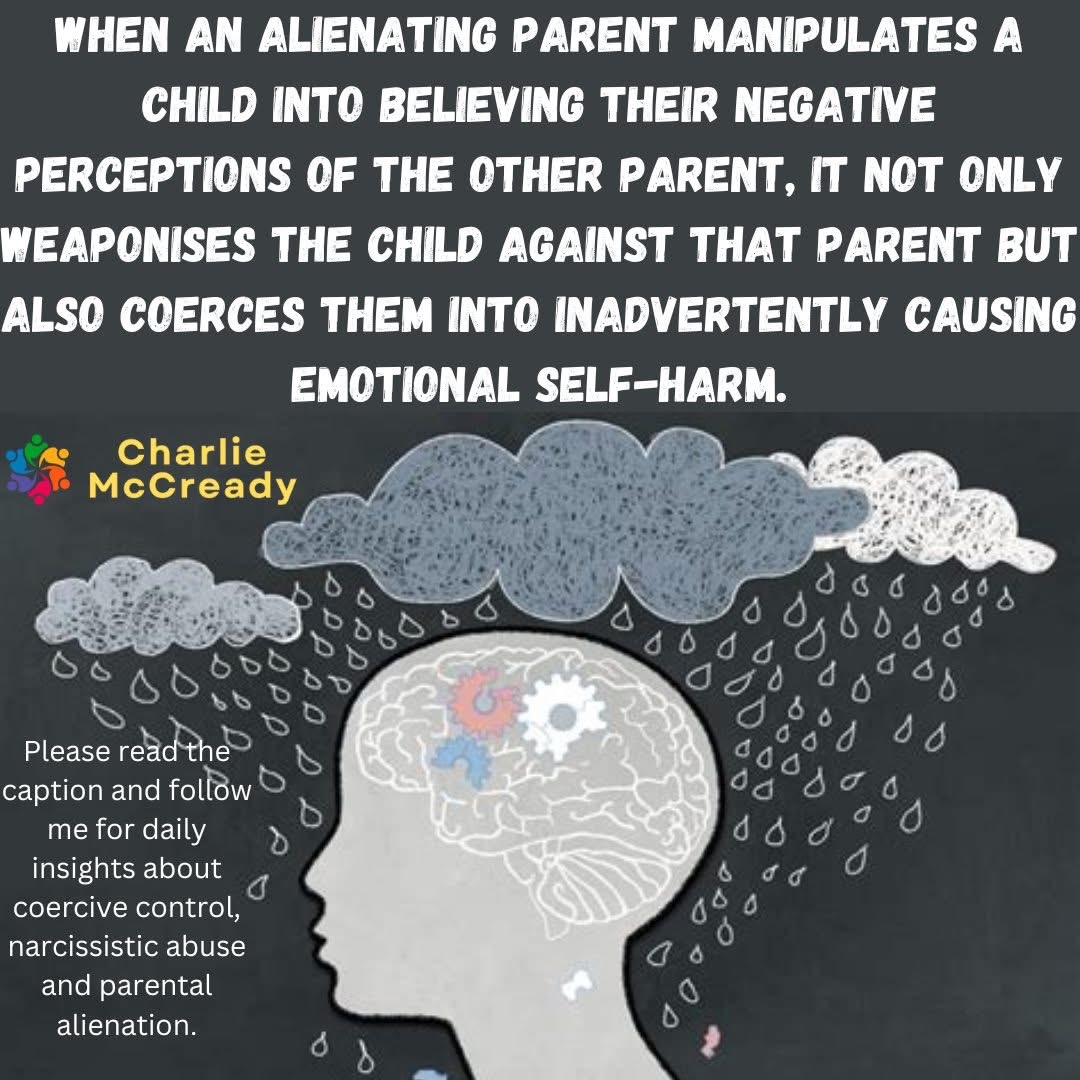
Emotionally self-harming behaviour in an alienated child, driven by the coercive control of a disordered, alienating parent, reflects the painful clash between their genuine affection for a targeted parent and the manipulated negative perceptions imposed by the alienator. This internal conflict, known as cognitive dissonance, creates distress and confusion as the child tries to reconcile their love for the targeted parent with the false narrative they’ve been coerced into accepting. This conflict not only impairs their emotional well-being but also impacts their neurological functioning. Negative thinking patterns about a parent they love can distort their brain’s perception of reality, disrupting healthy neural pathways and perpetuating emotional distress, ultimately compromising their overall emotional development.
Coping mechanisms for these detrimental effects involve a range of approaches, some of which are positive and constructive, while others might be less so.
Therapeutic interventions that promote critical thinking, self-awareness, and emotional regulation can play a pivotal role in helping the child navigate their conflicting emotions. Encouraging them to express their feelings openly and safely explore their emotions within a therapeutic setting can gradually help untangle the web of manipulated beliefs.
Additionally, nurturing healthy relationships with extended family, friends, and professionals who provide unwavering support and encourage positive interactions can serve as protective factors against the emotional self-harm imposed by the alienating parent’s control. Engaging in creative outlets, physical activities, and hobbies that offer a healthy way to release emotional tension and boost self-esteem can also contribute to their overall well-being. However, it’s essential to recognise that not all coping mechanisms are beneficial; some children might turn to negative coping strategies like alcohol or drugs to numb their pain, which can further compound their emotional challenges and hinder their growth. Thus, providing guidance and support to help them choose healthier ways to manage their emotions becomes paramount in their healing journey.
My posts are here not to alarm or upset but to spread awareness about what’s known as ‘parental alienation’ and to provide guidance to those who are going through it, as I did myself. Apart from these daily posts, which I hope help you know you’re not alone, and to better understand it’s an attachment disorder, a pathology, it’s not you; please reach out if I can help with the coaching I offer.
#charliemccready
#parentalalienationcoach
#childrensrights
#mothersrights
#fathersrights
 GreatCosmicMothersUnite