Brutality of being alienated/ targeted – Charlie McCready

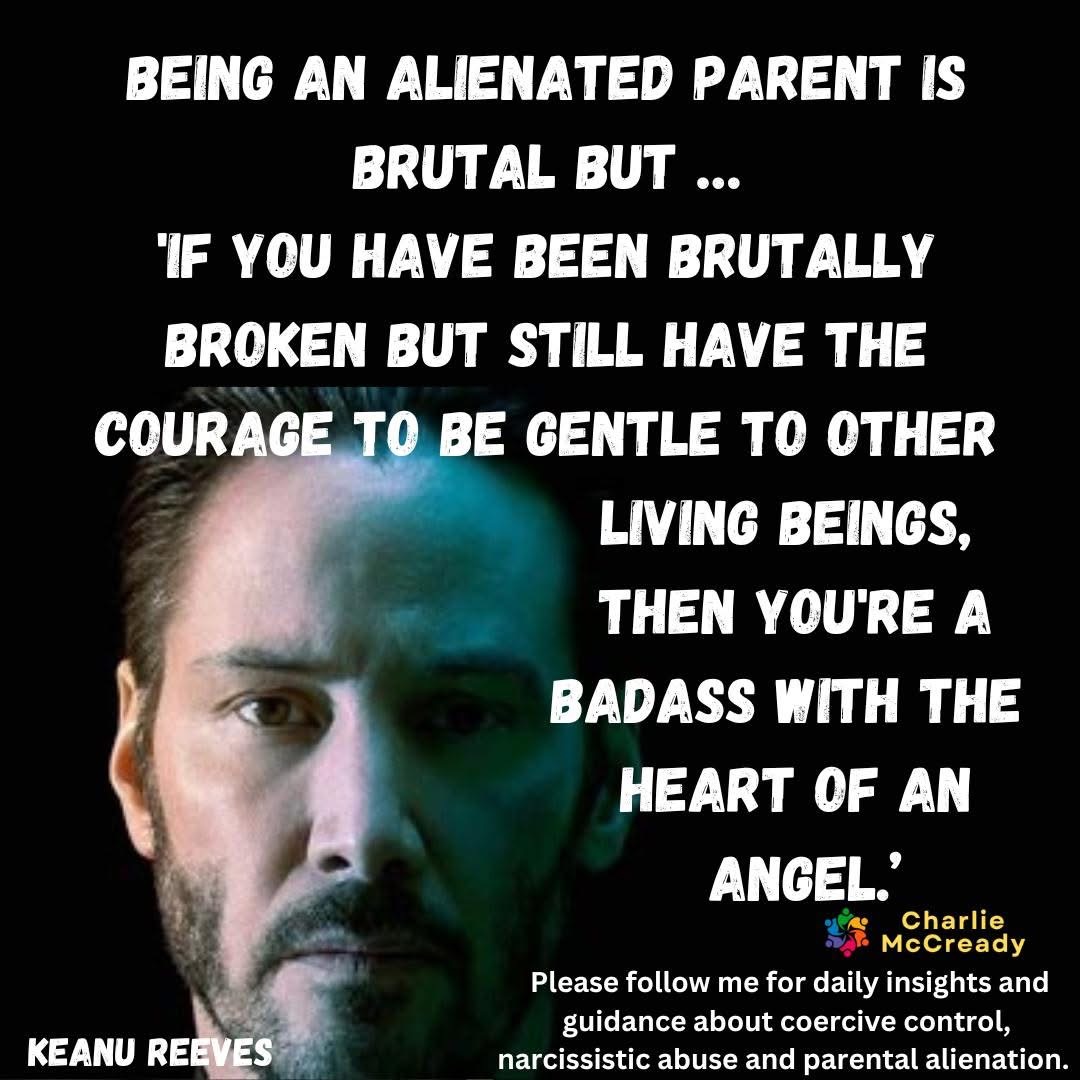
Being an alienated parent is brutal. It’s a unique trauma, leaving you caught between deep grief, searing injustice, and the unrelenting confusion of watching those who should support you turn a blind eye. It’s not just about losing a child; it’s about facing spousal or partner psychological abuse, which in turn becomes psychological abuse against your child. And despite this, if you choose to stay kind, to refuse to let bitterness corrupt you, to remain open-hearted despite your pain—that, in the words of Keanu Reeves, makes you a true badass. And I agree. ⁠

Keanu Reeves is no stranger to tragedy. Having lost his best friend, his partner, and their unborn child, he could have succumbed to bitterness and isolation. Instead, he became known for his humility, kindness, and resilience. His quote speaks to your journey, if you are an alienated parent (step-parent, grandparent, or child). Despite being ‘brutally broken’, the courage to keep showing up, offering love, and being a safe harbour for others is a powerful statement of your amazing, strong, beautiful character.⁠

In a world that often misjudges the alienated parent, where your efforts are dismissed or misunderstood, choosing to still show compassion and not lash out takes incredible strength. Like Reeves’ iconic roles, where characters break free from oppressive systems—like in The Matrix—alienated parents must summon that inner resolve, facing a relentless enemy not with anger, but with unwavering integrity.⁠

If you follow my posts, you’ll know I’m a big fan of The Matrix. I often compare the experience of an alienated child to that of being trapped in the fabricated world of the film. The alienating parent constructs an ‘unreality’ and the child is programmed to believe a distorted version of the truth. They’re caught in a world where up is down, love is hate, and rejection is loyalty. Like stepping out of The Matrix, the day they finally take their own ‘red pill’ and see the truth will be disorientating and painful. But you, standing steadfast in your love, are the lifeline they need when they’re ready to break free.

It’s the hardest path to take—to keep being gentle when the world has been anything but. Yet by doing so, you not only hold space for your child’s eventual awakening but also set yourself free from the trap of reactive anger and despair. True strength is knowing your worth without needing others to acknowledge it, and offering love without expecting anything in return.

In choosing to embody the strength and gentleness Keanu describes, you’re not just surviving—you’re transforming grief into power, and that makes you a true badass with the heart of an angel.

NB: Hollywood attracts people with talent—and a fair degree of narcissism too. Beneath the glitz and glamour, it’s a world full of manipulation, deceit, and image control. Many stories are now emerging about abuse, blackmail, and betrayal in an industry where ruthless self-interest is often the norm. While shocking, I hope this exposure is part of the detox the world needs. But even in such darkness, there are a few lights—you are one of them.

#charliemccready

#parentalalienationcoach

#alienatedchild

#narcissisticabuseawareness

#parentalalienationawareness
Emotional Safety 🍾💯

In psychology, emotional safety refers to an emotional state achieved in attachment relationships wherein each individual is open and vulnerable. The concept is primarily used by couples’ therapists to describe intimate relationships. When a relationship is emotionally safe, the partners trust each other and routinely give each other the benefit of the doubt in questionable situations. When emotional safety is lost, the partners are inclined to be distrustful, looking for possible hidden meanings and potential threats in each other’s words and behaviors.

Remember, emotional safety includes mutual respect, open communication, empathy, and consistent support. Building this foundation strengthens the neural pathways associated with trust and intimacy, leading to a more fulfilling and lasting connection.

Emotional safety is a basic human need and an essential building block for all healthy human relationships.

Emotional safety is the visceral feeling of being accepted and embraced for who you truly are and what you feel and need.

Feeling chronically emotionally unsafe causes intense psychological distress—and, often, greater isolation and more difficulty reaching out.

“Precaution is better than cure.”

Emotional safety is about being authentic and sharing thoughts and feelings with another person without any fear. Frequent criticism and invalidating remarks, especially from a loved one, is a sure path to stripping any relationship of emotional safety.

Key Takeaways 🗝 :

Safety doesn’t happen by accident.

When safety is first, you last.

Check yourself before you wreck yourself. Accidents hurt, safety doesn’t.

No Safety, Know Pain. Know Safety, No Pain.

I didn’t loose you

I didn’t lose you.

I just stopped chasing.

And there’s a difference.

Because if I had kept chasing—

if I had kept showing up

every time you pulled away,

if I had kept softening myself

to make room for your distance—

we’d probably still be together.

But I’d be empty.

Chasing you meant abandoning me.

It meant constantly shrinking

to fit into the small spaces

you were willing to offer.

It meant tolerating silence,

reading between the lines,

and accepting breadcrumbs

as if they were a feast.

It meant reaching out

even when you didn’t reach back.

Apologizing just to keep the peace,

even when I wasn’t the one

who broke it.

I get it.

You’re avoidant.

You have wounds so deep

that closeness feels like danger

and love feels like pressure.

And I held space for that—

for as long as I could.

But here’s the truth:

it’s not your fault that you were hurt.

It’s not your fault that life made you guarded.

But it is your responsibility to heal.

It is your choice

to either face your trauma

or let it wreck the people who try to love you.

So no—

I didn’t lose you.

I simply chose not to keep running

after someone who was walking away.

Because love shouldn’t be a chase.

And I shouldn’t have to lose myself

just to keep someone else.

Love should feel safe , even in anger

The way a man handles his anger tells you everything you need to know about his emotional maturity, self-control, and most importantly, how deeply he respects you. See, anybody can love you when it’s easy. When things are sweet, when you’re laughing together, when everything’s going right. But how he treats you when he’s mad? That’s the real test. That’s the moment where all the fluff fades, and his truest self steps forward.
If his first instinct when he’s upset is to belittle you, ignore you, curse at you, bring up your insecurities, or give you silent treatment like he’s punishing you just for having a voice—that’s not love. That’s control. That’s ego. That’s a man who hasn’t learned how to love someone through conflict, only in the absence of it.
But a real man? Even at his worst, he’ll still handle you with care. Even if he’s angry, he’ll take a breath before he speaks. He’ll communicate instead of attack. He’ll say “I need a minute” instead of saying something he’ll regret. Because love doesn’t disappear when emotions run high. If anything, that’s when it’s supposed to show up stronger.
So don’t let “he was just mad” be the excuse that makes you ignore a pattern. Because one day it’s yelling… next it’s slamming doors… and eventually, it’s full-blown emotional damage that you’re left to unpack alone.
Love should feel safe—even in anger. If it doesn’t, it’s not the kind of love you deserve. 💔