
Tag: trauma
Parasitic Predator – Narcissist
Mortal Trouble 👿 with a Narcissist
Targeted Parent Object of Lies by Alienator
I’ll start us off. I was accused of being a ‘slum landlord’ when in fact I used to rent property through the council in a deprived area, the rooms were kept pristine, in fact I couldn’t have rented them through the council if they hadn’t been through all the strict regulations. The rooms were ‘sheltered housing’ for people struggling in life for various reasons including domestic abuse. I hardly made any money, I did it for over ten years, and I wanted to help because I was able to do so.
I was accused of affairs.
On another occasion, in a different situation, I was also accused of causing bulimia. This accusation came from someone who made comments daily about the way people (including my child) look, their size, their appearance etc.
What lies have been told about you?
#charliemccready #9StepProgram #parentalalienation #parentalalienationawareness #highconflictdivorce #Divorce #childabuse #narcissisticchildabuse #narcissisticabuseawareness #narcissisticabuserecovery #narcissism #narcissist

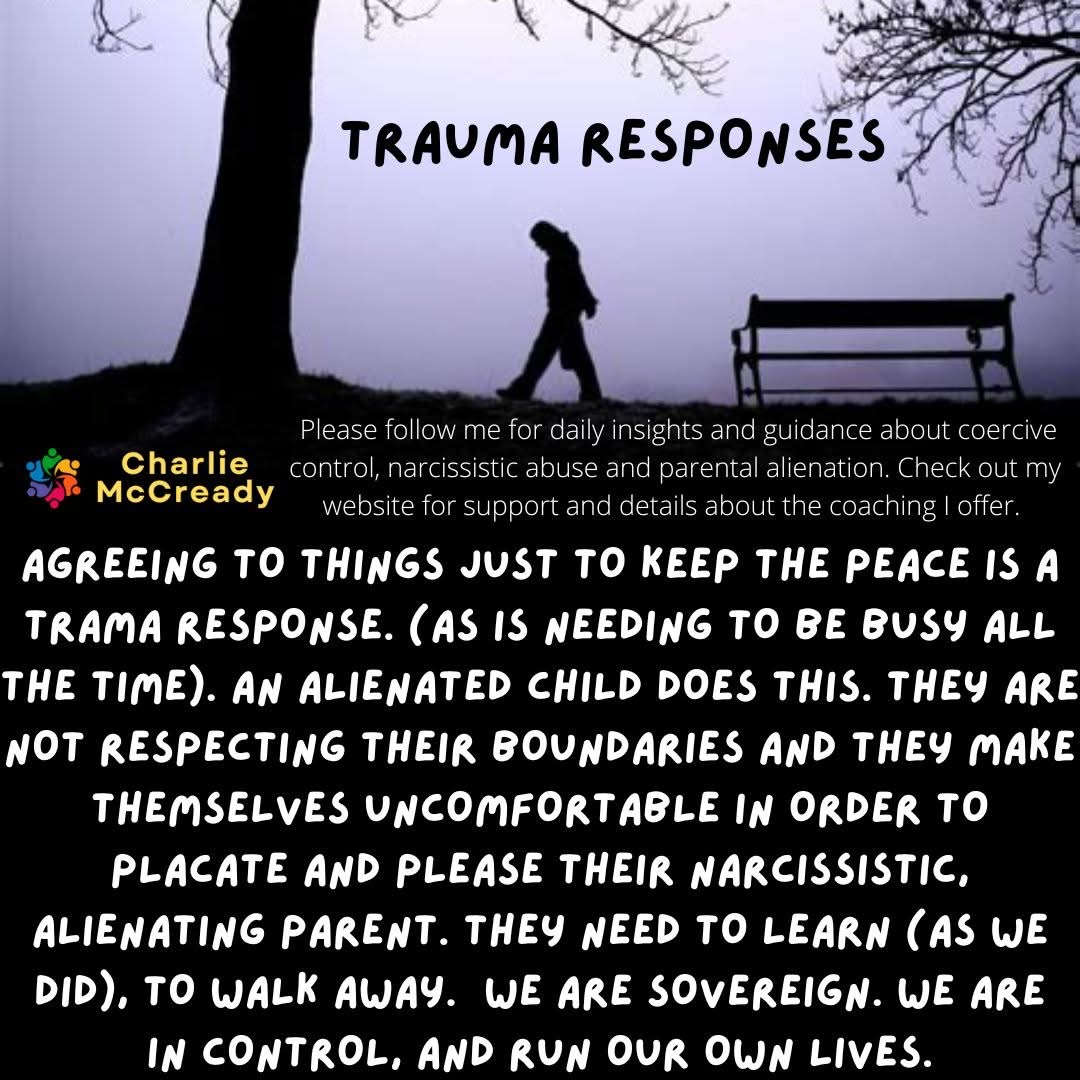
Agreeing just to keep the peace /Trauma Response – Charlie McCready
Agreeing to things just to keep the peace is a trauma response. It’s a way of surviving in a hostile or controlling environment where saying ‘no’ or ‘I don’t believe you’ isn’t an option without severe consequences. This response is often seen in alienated children—children who have been manipulated and coerced to the point that their own needs and feelings no longer matter. Instead, they learn to prioritise the emotions and expectations of the alienating parent. They walk on eggshells, eager to placate and please, because defiance causes even more trauma than they’re already dealing with.
This behaviour becomes a form of self-protection, a way to avoid conflict and ensure that they remain in the good graces of the parent who controls their reality. Over time, these children can lose the ability to recognise their own boundaries, and their sense of self becomes enmeshed with the parent’s demands and manipulations. Their ‘agreeability’ isn’t a sign of compliance but of survival. They’ve learned that resistance leads to emotional punishment—withdrawal of love, guilt trips, or accusations of betrayal. So, they agree, they nod along, and they become what they think the alienating parent wants them to be, sacrificing their own comfort, autonomy, and well-being.
Similarly, the need to be constantly busy can also be a sign of trauma. When a child is caught in a world of conflicting loyalties and intense emotional manipulation, stillness and quiet can become unbearable. There’s research into ADHD and alienated children which is very interesting, if alarming. But being alone with their thoughts means confronting feelings of anxiety, guilt, and confusion—the result of a parent’s relentless campaign to control their mind and emotions. Constant busyness, then, becomes a way to avoid these feelings—a distraction from the chaos brewing beneath the surface.
But this coping strategy comes at a cost. It prevents them from ever truly understanding what they want, who they are, and where their own boundaries lie. Instead, they become attuned to others, hyper-vigilant to the moods and reactions of those around them, and disconnected from their own inner world. The challenge is that these patterns sometimes can persist into adulthood, long after the child has left the direct influence of the alienating parent. We, as alienated parents, have had to learn this the hard way. Many of us lived for years in a state of constant appeasement—agreeing, conceding, and sacrificing parts of ourselves to keep the peace with our abusive ex-partners. It’s taken time, therapy, and a great deal of inner work to realise that
agreeing just to avoid conflict isn’t harmony. And we’ve had to learn to say ‘no’, to walk away, and to reclaim our sense of sovereignty.
The same journey is ahead for our children. They, too, will have to unlearn the trauma responses they developed out of necessity. They will need to realise, as we did, that their value doesn’t lie in their ability to keep the peace, to stay busy, or to put others’ needs before their own. One day, we hope they will come to understand that they are not just the product of a manipulative parent’s expectations. They are not defined by the demands of those who sought to control (or hurt) them. And when our children are ready, we hope they find the strength within themselves—the courage to live life on their own terms.
#charliemccready
#parentalalienationcoach
#traumabond
#traumabonding
#emotionalabuse
#mentalhealth
#mothersmatter
#FathersMatterToo
#FathersMatter
#FamilyCourt
#custody
#parentalalienation
#childcustody
#mothersrights
#fathersrights
#childrensrights
#custodybattle
#parentalalienationawareness
Indoctrination/Parental Alienation- Charlie McCready
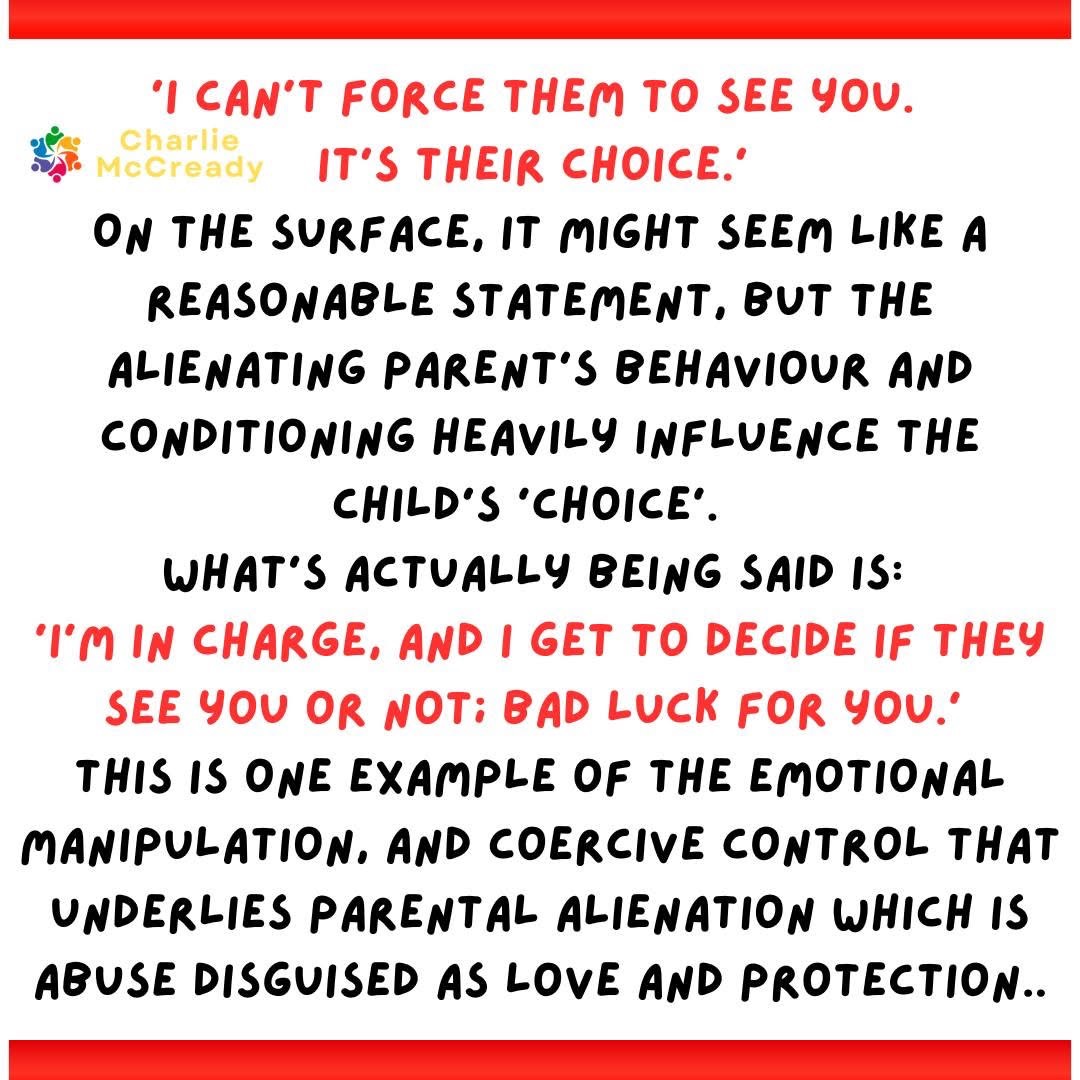
The idea that the alienating parent is not standing in the way of your relationship with your child is pure theatre. It’s an act. Behind the scenes, they’ve already given the child their lines and coached them into believing the character they’re supposed to play. Indoctrination, such as when a child is alienated and without justification for their rejection of you, is what’s happening. The child isn’t being given choices. They’ve already been coercively controlled and enmeshed into an alignment with the alienating parent.
A child’s expression of wishes holds such power and is often a deciding factor in proceedings concerning them, but it should be acknowledged as a voice, not a choice. Placing the child in a position where they must select one parent over the other goes beyond being inappropriate. Children often desire things at age 8 or 9 that they’d go nowhere near ten years later. I’ll give you an example. I thought it would be incredibly cool to be a lion tamer. Thankfully my parents didn’t think to put me in a lion’s den with a whip and a whistle, thinking that my needs must be met because this is what I believed was right for me. I also wanted to be able to fly, and they didn’t send me off to be operated on with wings attached to me surgically. Of course, children need to be heard, but they also have to be guided, nurtured, given boundaries while not being totally indoctrinated. Children might not know better than to wish for something detrimental to them, as in the case of being allowed to choose to reject a loved, loving parent, having been encouraged by the alienating parent to do so.
Research shows that many adults who, in their youth, rejected a parent, having been given a lot of pressure to do so by the other parent, later came to regret it and wished somebody would have had the sense to help them realise this was not a good idea – friends, family, legal or mental health professionals, anybody.
Taking, ‘it’s their choice’ at face value fails to recognise the extent of coercive control, psychological abuse, and manipulation at play, which can have profound negative effects on the child’s emotional development and well-being.
#charliemccready
#parentalalienationcoach
#adversechildhoodexperiences
#CoerciveControl
#custodybattle
#parentalalienation
#narcissisticparent
#mothersmatter
#FathersMatterToo
#FathersMatter
#FamilyCourt
#coercivecontrolawareness
#parentalalienationawareness
#mothersrights
#FathersRights
#ChildCustody
#traumabonding
#familycourts
Prolonged Ruptured Attachment Syndrome
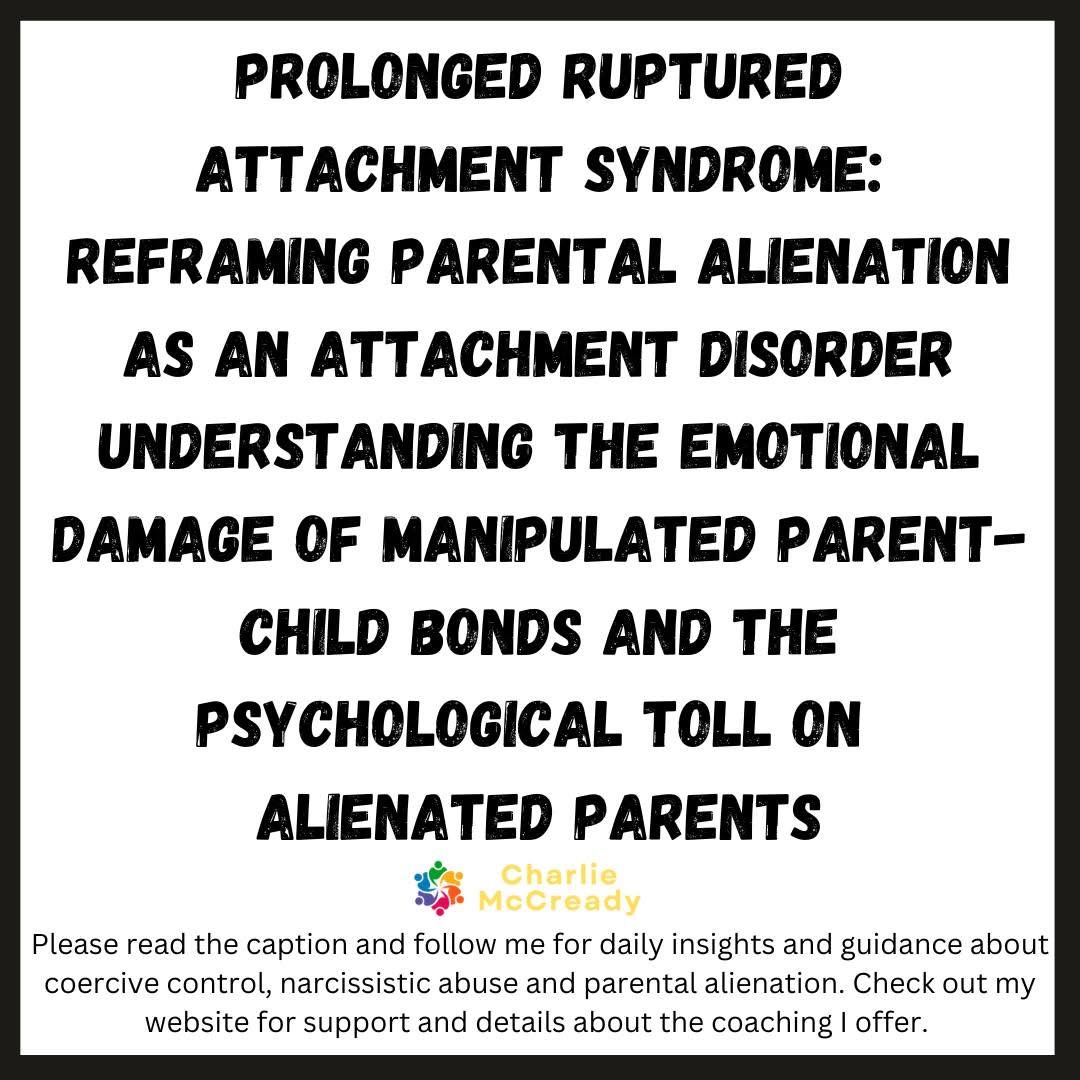
Parental alienation can be understood as an attachment disorder, where the child is manipulated into rejecting one parent, disrupting the natural attachment bonds. This psychological harm mirrors what is described in Prolonged Ruptured Attachment Syndrome (PRAS), a framework introduced by Martin Seager and colleagues. While PRAS was not developed to address parental alienation, it offers a new and potentially valuable lens for understanding the emotional damage caused by the disruption of attachment.
In cases of parental alienation, the rupture in attachment is not a clean break. Rather, it’s a painful disruption that leaves the relationship in a state of unresolved limbo—neither fully severed nor easily healed. Many alienated parents describe what feels like a living bereavement. This mirrors PRAS, where people are unable to find emotional closure because their attachment to a significant person remains unsettled. Seager describes PRAS as existing “somewhere between trauma and grief,” a state that is neither fully traumatic nor fully grief-stricken but something in between. For alienated parents, this is reflected in the constant uncertainty of not knowing if reconciliation with their child will ever happen. The pain, as Seager explains, is “ongoing without closure.”
PRAS highlights that the emotional toll of such ruptures is not just a one-time loss but an enduring, unresolved pain. The psychological effects of parental alienation are profound. This kind of emotional suffering can lead to trauma, grief, anxiety, and helplessness, making it harder for both parents and children to heal.
Healing from the emotional damage caused by these attachment disruptions requires more than just time. For alienated parents, this means specialised support to help navigate the complexities of reconnection and recovery. PRAS also underscores the importance of recognising that emotional healing from attachment ruptures needs understanding and compassionate care.
Published in Psychreg Journal of Psychology in December 2024, the newly conceptualised mental health condition, Prolonged Ruptured Attachment Syndrome (PRAS), while not developed with parental alienation in mind, offers a potentially helpful framework, with its findings validating the distress caused by attachment disruptions. Applying this to parental alienation could pave the way for more effective, empathetic responses and support for affected families.
#charliemccready
#parentalalienationcoach
#prolongedrupturedattachmentsyndrome
#emotionalabuse
We are all Wounded
We Are All Wounded
We are all wounded,
bearing invisible scars that lie deep within our souls—
where no light dares to reach.
We move through life with hearts stitched together
by trembling hands and whispered hopes,
praying that no one looks too closely.
The world teaches us to wear masks,
to force a smile when it hurts,
to cover our cracks and pretend we are whole.
But the truth is, we are all broken—
each of us carrying untold stories
we’re too scared to share.
The mother who sheds silent tears
long after her children have drifted to sleep.
The man who laughs the loudest,
masking an emptiness that echoes through the night.
The friend who always says, “I’m fine,”
because she knows that no one truly asks twice.
We bleed differently.
Some wounds are fresh—
still raw and aching to the touch.
Others have formed fragile scabs,
but the pain lingers like a ghost,
haunting us when we press too hard.
And some are buried so deep
we’ve convinced ourselves they don’t exist—
until something unexpected tears them open again.
Maybe it was betrayal that shattered you.
Maybe it was the love you poured out
that was never returned.
Maybe it was the dream you chased
only to be left with empty hands.
Or the person you lost too soon—
a void that time has failed to fill.
Maybe it was the harsh words you endured as a child,
or the deafening silence when you needed comfort most.
But listen, love—
your wounds do not make you weak.
They make you human.
They are proof of a life fiercely lived,
of battles fought with a heart brave enough to feel.
Your pain is a testament to your strength,
to the resilience of a soul
that refuses to give up.
And though we are all wounded,
we are also healers—
carrying soft words in our hearts,
offering comfort through unspoken understanding.
We mend each other with kind gestures,
with the warmth of a gentle touch,
with a reminder whispered in the quiet—
“You’re not alone.”
That is how we begin to heal.
So do not hide your wounds.
Do not pretend they are invisible.
Let them breathe—
let them teach you tenderness,
reminding you that every soul you meet
is fighting a battle unseen.
We are all wounded,
but we are also unbreakable.
We may stumble, but we rise again.
We may break, but we rebuild—
stronger, wiser, and braver than before.
Our scars are stories—
not just of pain and loss
but of courage and survival.
So if you feel broken today,
know this, my love—
you are not alone.
You belong to a world of souls
who wear their cracks with grace,
shining light through their brokenness.
And that—
that is what makes us beautifully,
irrevocably human.

Professional Evaluation of 47
Common traits , shared by several people
 GreatCosmicMothersUnite