Loyalty

Loyal people take things deeply to heart—not because they are fragile, but because their hearts beat with an unshakable devotion to those they love. They would never hurt you in the way they have been hurt, because their love is steadfast, unwavering, and pure.

When they give, they give everything. There’s no half-heartedness, no hesitation. Their generosity flows from a place of profound sincerity. When they stand by your side, they do so with an allegiance that knows no bounds. Their loyalty is not contingent on circumstances; it is a promise, a bond forged in trust and integrity. They expect nothing less than the same from the ones they care for.

Loyalty is one of the rarest and most priceless treasures you can encounter in this world. In a society where many are driven by convenience, self-interest, and transient connections, those who stay true, even when the road gets tough, are a rare gem—something precious that must never be taken for granted.

People who are truly loyal wear their hearts openly for the world to see. They love with a depth that surpasses the ordinary, trust with a belief that runs unyielding, and invest themselves completely in the relationships they cherish. This profound level of commitment makes them sensitive—not fragile, but deeply attuned to the feelings of others. When they are hurt, it isn’t because they are overreacting; it’s because they would never subject you to the same pain. They hold themselves to a standard of honor, and in their hearts, they expect nothing less from those they love.

Their disappointment is never born of entitlement, but from an unshakable faith in mutual respect and reciprocity. They give honesty, consistency, and loyalty without expectation—but they do hope to see those virtues reflected back. And when that reflection isn’t there, it cuts deeper than any wound. Not because they cannot bear pain, but because they have chosen, with every part of their being, never to be the source of that pain for someone they hold dear.

Loyalty is never a sign of weakness—it is a mark of strength, of profound character, and of a heart that refuses to be hardened by betrayal. Those who possess it are the ones who stand by you when everyone else walks away, who will believe in you when others doubt you, and who will be there when you need them most.

If you are fortunate enough to have loyal people in your life, recognize their worth. Cherish them, honor them, and protect their hearts as they protect yours. For once loyalty is lost, it is a rare thing to ever regain. And when you find it, you’ve discovered something irreplaceable—something that transcends the fleeting nature of this world and touches the eternal.

Craig Childress, PsyD – Resume

I’ve got my new three licenses business card. Notice you’re third on the list of what I do.

Top of this list is early childhood ages zero-to-five. Then comes ADHD and grumpy angry kids. Then you in the family courts, then adults on personal growth issues.

Now that I have my WA license I’m going to go around the the local preschools to make them aware I’m here. I’m going to offer free consultation to preschools and parents of wee-ones on any domain of concern.

You’re paying for it. I’ll make my money off of you as a consultant in the family courts – that way I can offer free consults to preschools and parents of wee-ones.

Chalk it up to your karma – good job – you’ll be helping the little ones get a healthy start.

Then I’m going to open up an ADHD grumpy-kid practice online in three states, the Pacific coast of CA, OR, and WA. I use a parent-training consultation model with ADHD and ODD (there’s no such thing), which fits well with an Internet mediated service delivery in the states I’m licensed.

Then… I’ll post foundational seminars to YouTube on the diagnosis and treatment of ADHD and grumpy-angry kids – and – on parenting early childhood kids with challenging stuff (autism spectrum and emotional regulation problems).

I’ll bill for the ADHD clients ’cause that’s something entirely separate. Working with the wee-ones is for me, I like the little guys. Solving ADHD is for you guys.

The adult section of my practice is going to expand into death and dying. I’ve worked within that domain in the past with cancer kids at Children’s Hospitals – except they didn’t die because they have good doctors at Children’s Hospitals.

But death and dying is always within a zone of consideration whenever cancer is the diagnosis. When I entered private practice I joined a practice with another cancer psychologist in Pasadena. He worked with adult cancer patients, and I worked with kid cancer patients and their families.

I also have some background in geriatrics. When I entered private practice I checked out the two pathologies I’d never worked with – family court custody conflict and geriatrics. I’ve worked with everything else.

I got a job going to various “assisted care” facilities to assess and treat mental health issues there. THAT is depressing work. I don’t want to work geriatrics like that.

The old are our abandoned. No one sees, no one comes, they are alone. Whoa. Of the two, you needed me more. You have active child abuse (and spousal abuse) undiagnosed and untreated. Child abuse and attachment trauma is my pathology.

So I came to the family courts and fixed things here. There was a lot of fixing to do – you had (have) broken systems. Bad things were (are) happening… by the psychologists.

They are in the “betrayer” role in trauma – the one who should protect… and doesn’t. Oh my… patients should NEVER need to explain the pathology to the doctor. You need to explain the pathology to your doctors.

That’s so bad. So I did things. Now those things are evolving into solutions to fix the broken systems. Once the systems are fixed… you won’t need me anymore.

Hooray! A good clinical psychologist is always working themselves our of a job. For ADHD, for example, I want to fix your problem in six to twelve weeks – of consultation – six to twelve weeks is roughly how long I need to teach parents how to do the relationship based treatment… to fix things.

Less time for the grumpy-angry kids. Holy cow, “Oppositional Defiant Disorder” is such an easy fix – four to six weeks of consultation (then occasionally as-needed).

Do you know what’s easier to fix than ODD (grumpy-angry)? Attachment pathology. With a cooperative parent, I’d anticipate two to six weeks for substantial gain, and twelve weeks for full resolution.

The problem with attachment pathology out in the wild is that we don’t have a cooperative parent. We have a substance abusing parent or a narcissistic-dark parent. Then it becomes a child protection issue and we have to fix the attachment damage in other ways.

I’m a full scope clinical psychologist. I can seriously answer your questions on anything clinical psychology. Anything. Without looking it up, it’s all in my head.

That’s because I’m an old clinical psychologist – it’s the old part.

Now I’m an old-guy too, and I’m specialty trained in humanistic-existential therapy. I figure I can help other old folks along the Pacific coast where I’m licensed via the Internet.

Death and dying makes people uncomfortable, not me. I suspect I can help with transitions.

So individual adults are number four on my list of to-do.

You’re fixed. The moment you want to solve things – you solve things. As long as you don’t want to solve things – you won’t solve things.

It’s a motivational pathology. I’m working on that. We should be transitioning soon. Wheee…

Into complete destruction… then out into a full solution.

If you want to know what’s coming, look where Dr. Childress is positioning himself. I don’t live in today because today keeps vanishing. I live and work in tomorrow, because tomorrow keeps arriving, which makes my life now so much easier.

Oh look, the Petition to the APA just arrived – five years (minus two years for Covid), my estimates are pretty precise.

In five years I’ll be leaving not arriving. This next phase is building out my online presence in ADHD and Early Childhood, and I’ll finish my Diagnosis book and a second edition of Foundations.

Journal articles are in the works. It’s time now.

You know what happens when I have three licenses across the Pacific Coast, right? You have read the ancient prophesies about the Kraken that I’m just now making up, right?

Never mind, it’s too late for you to learn now. Just wait, it’ll all unfold in the calculational lines of the ruliad for observers like us.

Craig Childress, Psy.D.

Clinical Psychologist

WA 61538481

OR 3942 – CA 18857

Parental Alienation- Charlie McCready

“The only thing necessary for the triumph of evil is for good men to do nothing.” – Edmund Burke⁠

The problem with good people doing nothing, often due to constraints like job remits or instructions not to step in and take action, is that it sometimes allows harmful situations or injustices to persist unchecked. Their inaction enables the continuation of wrongdoing, And so it is with parental alienation. ⁠

There’s a story about a teacher with a fishbowl on his desk. Before leaving the room, he gave strict instructions to his class not to touch the fish. He took a fish from its bowl and placed it on his desk. When the teacher had gone, the school kids stared at each other, shrugging their shoulders, confused and unsure what to do. They sat there. They stared at the fish, flapping desperately. Dying before their very eyes. One girl couldn’t bear it anymore. She rushed to the desk and put the fish back in the bowl. The teacher returned to the class. She expected to be reprimanded, but she didn’t care. Nor did he. Instead, he congratulated her and proceeded to give a lesson on how it’s sometimes best to break the rules, especially in a life-and-death situation. ⁠

The problem with legal and mental health experts is that they tend to go by the book, but as parental alienation is yet to be recognised officially, there is no standardised method of identifying it, taking action, or supporting the true victims of this psychologically abusive family violence – the children and ‘target’ parents. Too often, they do nothing. And this is worse. It’s harmful to do nothing. ⁠

However, I do believe this will change. Just as we now know, cigarettes are not healthy. We have safeguarding measures for domestic abuse (especially women). In time, parental alienation will be recognised as abuse.

#charliemccready

#parentalalienationcoach

#alienatedchild

#childpsychologicalabuse

#familycourts

#parentalalienationawareness

#custody

#FamilyCourt

#parentalalienation

#healing

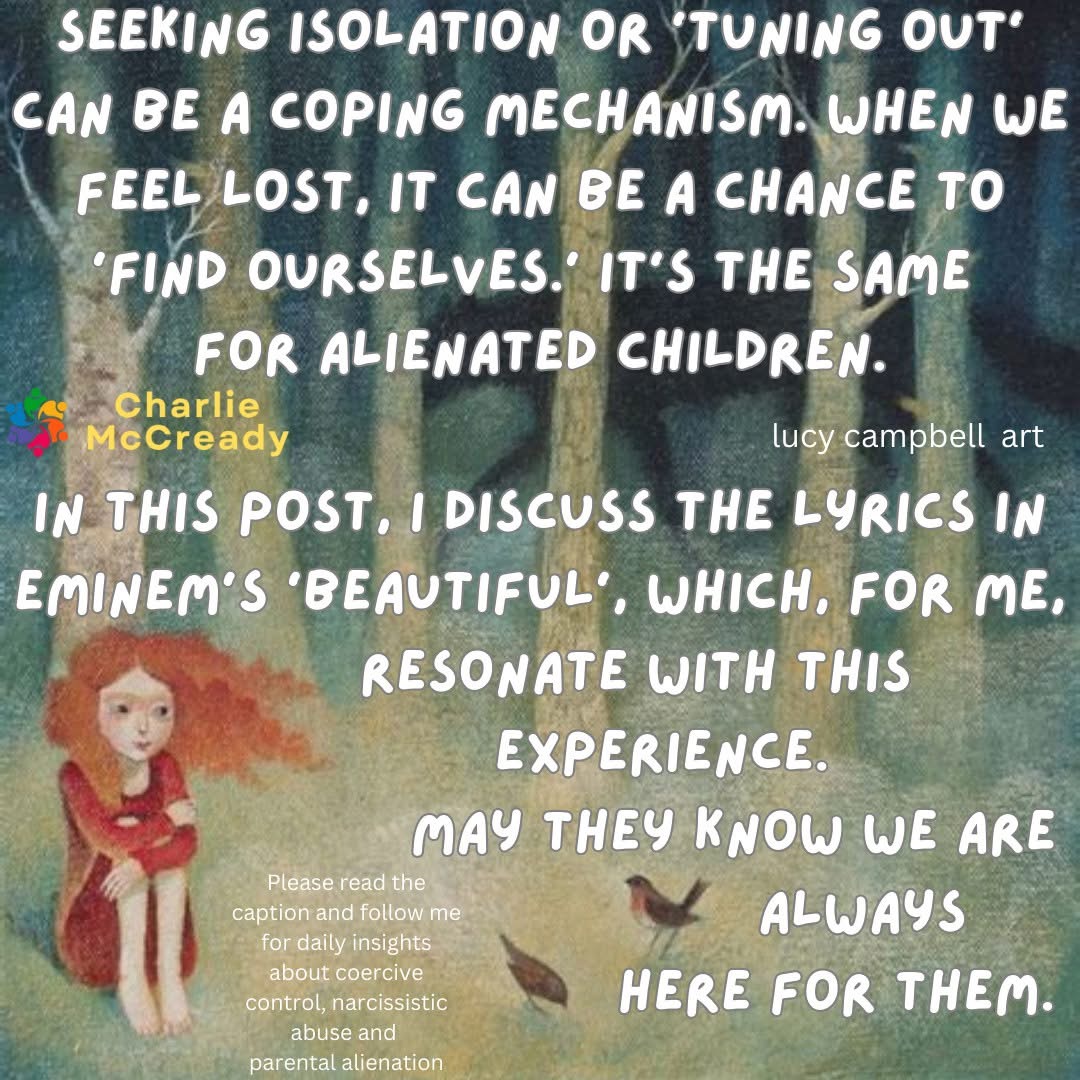
Isolating ; Tuning Out in Parental Alienation

I noticed the distancing – preempting what I later became ‘parental alienation’ – happen sometime before my children left. When it was particularly unpleasant and upsetting in those weeks and months before they moved to the other side of the world, I tried to remind myself that this was how they were bracing themselves to cope with such a monumentally life-changing, scary/exciting/brave/unknown decision. I didn’t always deal with it well, either. I’d been through parental alienation before, as a step-parent in 2001, but this took me to another level of grief long before the alienation kicked in.

It was 2009, and in the time before they left, Eminem’s’ Beautiful’ was played a lot in my children’s bedrooms. It’s a song that expresses a struggle with depression, self-doubt and a yearning for understanding, acceptance, and a desire for a better life. After they’d gone and I heard the song, I grieved. I convinced myself that the lyrics were a child’s hope for a bridge between worlds, and that mine could come back anytime. The time with their other parent became permanent, and then I was cut off, no longer necessary, and even deemed unsafe. It’s the 180 turnaround from good parent with happy, healthy children to monster that’s nonsensical and horrifying.

But they don’t lose us – we’re still here.

The song ‘Beautiful’, to me, is about alienation. It’s about longing for connection after being rejected, building ourselves up no matter how many times we’re set back or fall. We and our children are disconnected by enforcement and manipulation. We cope with it the best we can. The ‘distancing’ or ‘emotional cutoff’ is also known as disassociation. This is something in our children that the alienating parent can exacerbate, too.

There are times we have to let things run their course. We need the time and space to figure things out, and so do they. We’re still here. Mine did figure things out, reach out, and they came back. It is my heartfelt wish that yours do, too.

#charliemccready

#parentalalienationcoach

#alienatedchild

#parentalalienation

#familycourts

#childpsychologicalabuse

#parentalalienationawareness

#adversechildhoodexperiences

#FamilyCourt

#custody

#custodybattle

#ChildCustody

WhooWhoo❤️💯

Unfortunately, for me this apt dissertation

of a loving relationship has had a short

shelf life , or masked the non demonstrably

and yes , I ignored the ” red flags ” that

indicated his avoidance of intimacy , touch,

kissing , compliments and honest

vulnerability . I began to understand the

basic roots of this detachment ,

the rages that were sudden , and the lack

of desire to grow as an individual and as

parents , a couple , people …

And I withered …I lost my place … I was

disposed of . Donna no longer exists .

And the many losses , the gross amount of

of lies ….

Disproved , Accredited. Cycle Closed

I doubt marriage is in my future but love

is , and it’s gonna be trippin’!

When a man and a woman get married and get to have frequent sex, it is easy to neglect the little ways of affection and the focus becomes sex. “You are already giving each other sex. That is the furthest two people can go when it comes to physical connection, so why bother with lesser connections?” Some might think.

Some people get touched by their spouse only when sex is the agenda. This wasn’t the case when they were getting to know each other. Don’t be such a spouse. Even though now you can get unlimited and unrestricted sex from your spouse, don’t forget to do these little, innocent, warm things… ✍

1. Hugging your spouse. Something as simple as a hug.

2. Kissing your spouse on other places besides the lips such us the forehead, cheeks, fingers, back, neck.

3. Cuddling with your spouse.

4. Holding hands with your spouse even if just for a while.

5. Squeezing your spouse’s hand to show care, unity, love.

6. Studying your spouse’s body. Focusing on other areas besides penis, vagina, clit and nipples.

7. Complimenting your spouse beyond his/her sexuality.

8. Staying naked together, not because you want to have sex, but because you are comfortable with each other.

9. Sometimes eating from the same bowl/plate.

10. Looking out for each other.

11. Making time to have quality moments together.

12. Talking about feelings.

These little gestures show affection in a big way. No one is ever too grown to receive or give affection; so stop trying to act like you’re too grown for these little acts of affection if you want your marriage to be warm.

It is sad how when a man and woman are dating they treat each other so well as they look forward to marriage then when they get married they treat each other worse and more casual than they did when dating. Love should be progressive, not retrogressive. If your heart out of love led you to treat your spouse so well when you were dating, then your heart is not the problem; your pride is. You still have the same heart. A loving heart never grows old. You did it then, and if you want to, you can do it today.

Many think that the way to spice up their dull marriage is to have more sex. But actually, the way to do it is to go back to how you treated each other before marriage when marriage was a wonderful idea. Go back to doing those little acts of affection and you will see that you two will stop having just sex, you will start to make love… ✍

Intimacy + Affection + Pleasure = LOVE MAKING.

Adverse Childhood Experiences-Charlie McCready

Adverse Childhood Experiences (ACEs) are potentially traumatic events from 0 to 17. The original study in 1998 identified seven categories of ACEs, including physical and emotional abuse, neglect, parental substance abuse, parental mental illness, domestic violence, and having an incarcerated parent. These experiences were found to have lasting and profound impacts on mental health, physical well-being, and overall development. The research found that children who experienced four or more ACEs were 12 times more likely to suffer from alcoholism, depression, drug abuse, and suicide attempts. Subsequent research expanded the list of ACEs to include parental separation/divorce due to the recognised adverse effects it has on children’s well-being.⁠

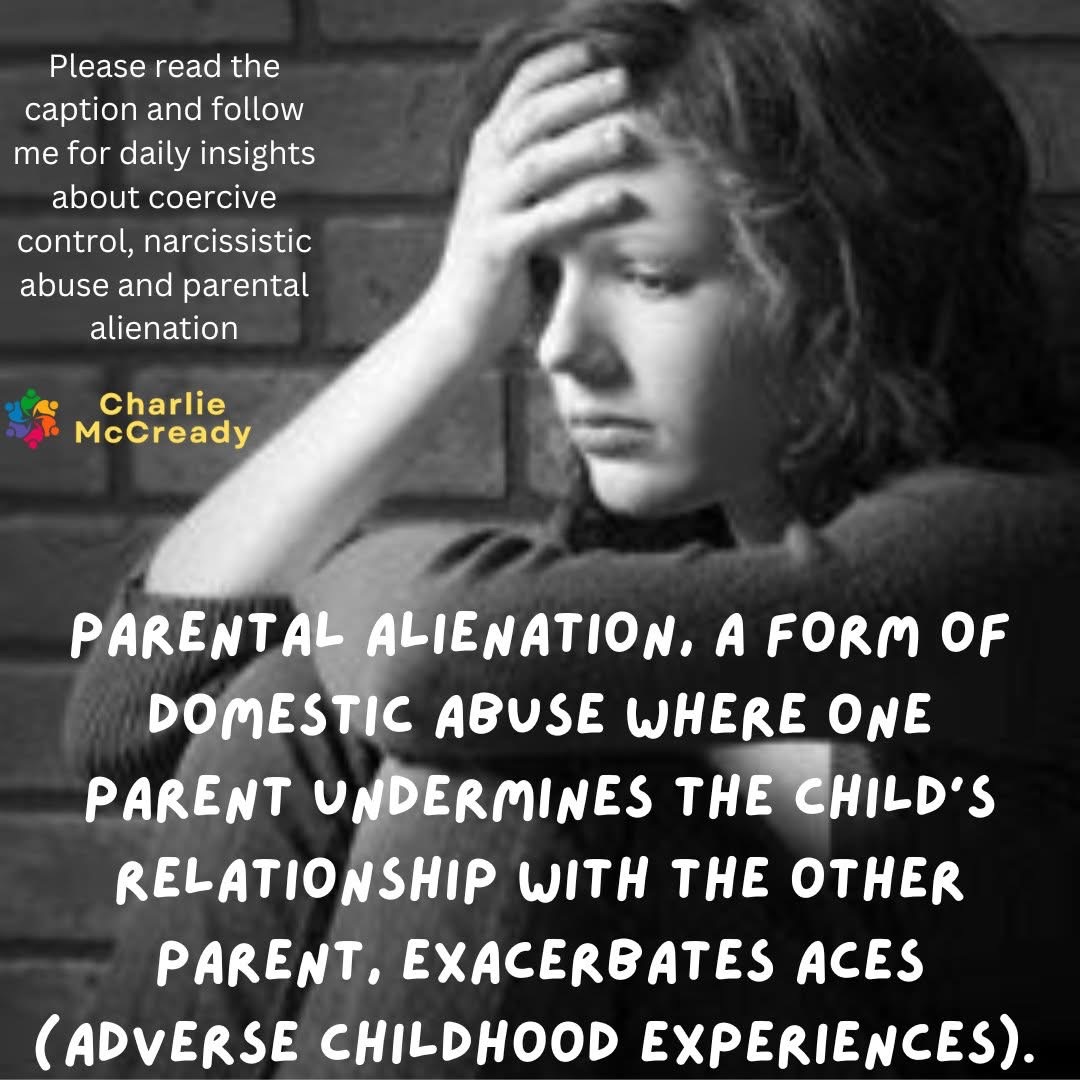
Parental alienation, a form of emotional abuse, usually following parental separation/divorce, usually involves at least these two ACEs. The attachment system, vital for forming bonds between children and parents, is severely impacted by parental alienation. It can lead to persistent fear and stress. The complete severance of a parent-child bond constitutes psychological abuse and damages this attachment system. Addressing parental alienation is imperative to safeguard children from the lasting trauma it inflicts.⁠

Those who have faced ACEs are not alone. It’s estimated that 1 in 6 adults experienced as many as 4 ACEs before they turned 18. Support can be found through trauma-focused therapy, support groups, self-care, exercise, healthy living, but there is an urgent need for greater awareness about the problem of parental alienation and training for mental health and legal professionals working with separating families so that there is early detection and intervention. Let us collectively work towards a world where children can thrive, breaking the cycle of ACEs and creating a nurturing environment that fosters their potential and well-being.⁠

#charliemccready

#parentalalienationcoach

#alienatedchild

#childpsychologicalabuse

#narcissisticparent

#parentalalienationawareness

#FamilyCourt

#parentalalienation

#adversechildhoodexperiences

#familycourts

#ChildCustody