

Tag: relationships
Covert Narcissist are the worst
Responsibility for the damage
When You’re the One Who Did the Fucking Damage
By Zen Prem
I didn’t break her heart.
I just drained her soul over time and called it a phase.
She asked for connection.
I rolled my eyes and gave her a fucking TED Talk on why she shouldn’t need it.
It’s easy to talk about being betrayed.
But what about when you were the one holding the match?
I didn’t cheat. I didn’t scream. I just withheld. I just made her feel like she was too much, too often. And then called her unstable
I was the one who made her question her sanity, not by screaming or storming out, but by going quiet.
By deflecting. By saying, “You’re overreacting,” when she was just trying to make sense of the way my eyes started disappearing long before my body did.
I was the man who said all the right things
while living like a walking contradiction.
The man who called her paranoid for checking my phone while I was out there building back-up plans on dating apps
I swore I’d deleted.
The man who said, “Of course I love you,”
but couldn’t sit in the room for five minutes when she cried.
And when she finally stopped trying?
When she went quiet?
I had the audacity to call her cold.
I used to think betrayal had to look like a one night stand. Something obvious.
Something Hollywood.
I thought I was being “conscious” because I didn’t rage or cheat.
But you can ghost someone while living in the same house
Because the truth is that sometimes betrayal is just not showing the fuck up.
It’s apathy. It’s absence. It’s the moment she needed reassurance and I gave her logic. It’s when she reached for me and I reached for my excuses.
And then I had the balls to be confused
about why she couldn’t bounce back.
Why she didn’t trust me the same.
Why she hesitated when I touched her.
But trust isn’t a switch.It’s a nervous system. And once you’ve made someone feel unsafe, you don’t get to ask them to be soft on your schedule.
You don’t get to stab someone emotionally
and then rush their recovery because it’s inconvenient for you to sit in the discomfort you created.
So if you’re reading this thinking,
“Shit. I was him,”
good.
That’s the start.
But don’t rush in to fix it with fucking flowers and promises. Don’t perform guilt hoping to speed past the part where she doesn’t believe a fucking word you say.
Don’t fucking bullshit yourself.
Sit in it.
Hold it.
Earn her safety back, … if she even wants you to.
Because real repair isn’t about the right apology. … It’s about becoming someone who doesn’t need to apologise again.
And sometimes you don’t get to be forgiven.
Sometimes she heals, and never fucking looks back.
You don’t get her back.
You just get the lesson.
By Zen Prem (Noah David)
Co-author of Beyond Bullshit To Bliss
with Samantha Spiro
BeyondBullshitToBliss #Love #Peace
Narcissist Abuse Surviors
Narcissist Abuse Kills
Insecure Attachment & Alienated Children – Charlie McCready
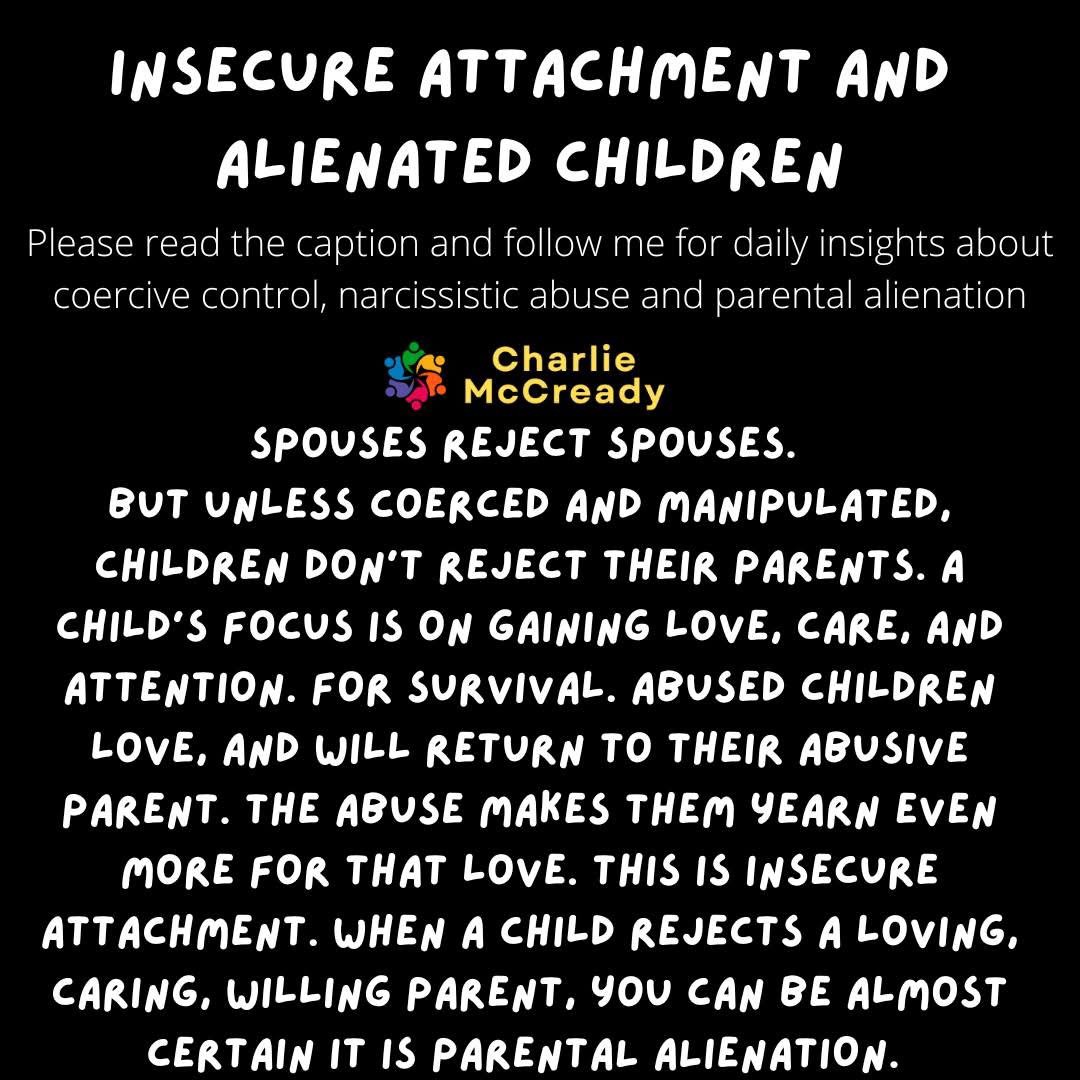
Insecure attachment and parental alienation are deeply intertwined and illuminate the profound impact of emotional manipulation on children. In contrast to estrangement, where rejection may be rooted in valid reasons, parental alienation involves the unjustified, coerced rejection of a parent who was once loved and has never stopped loving their child. In situations of psychological abuse, children, out of fear and the instinctual drive for survival, may gravitate towards the seemingly stronger, albeit abusive, parent, seeking safety in the very source of their distress. This is sometimes referred to as ‘identification with the aggressor’. This is an attachment disorder involving cognitive dissonance and ‘splitting’, and it exploits the child’s fundamental need for love, care, and security, leading to severe emotional consequences.
Insecure attachment refers to a pattern of relational behaviour in which a child, due to inconsistent caregiving or a lack of emotional responsiveness from caregivers, develops difficulties in forming secure, trusting relationships, and this, in cases of ‘parental alienation’ will specifically be the ‘target’ rejected parent. Insecure attachment in a child often results from inconsistent or neglectful parenting, where a child’s basic emotional and physical needs are not consistently met. Again, this will stem from alienating behaviours in their ‘aligned’ parent. Insecurely attached children may exhibit clingy or avoidant behaviour, struggle with self-esteem and self-worth, and have difficulties regulating their emotions.
An alienated/psychologically abused child who has experienced the accompanying insecure attachment will benefit from a great deal of empathy and perhaps also counselling and support groups. The child needs to feel safe in relationships and in the world, rebuilding trust and the ability to develop secure attachments while healing from the effects of parental alienation.
#charliemccready
Peace speaks louder than lies
No more space
Alienated Child – Charlie McCready
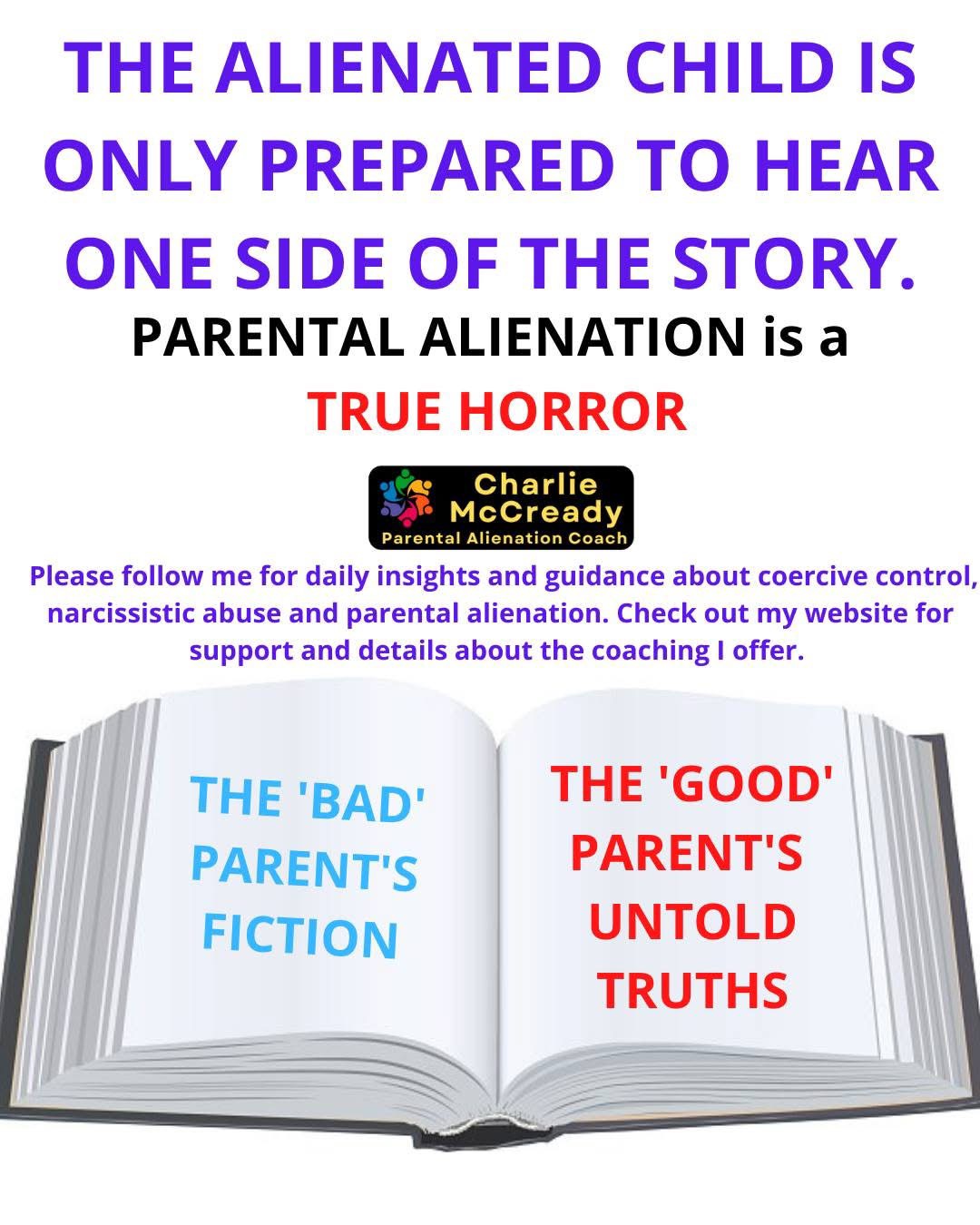
The alienated child unconsciously aligns with the parent who is presenting themselves as being good, loving, protective, ‘the only one’. The child then consciously rejects the apparently ‘bad’ parent. Despite how it might appear, this is agonising, traumatic, confusing, and upsetting to them, and yet all the anger and negativity induced is projected onto the ‘target’ parent. It’s quite easy to manipulate this alienation (denigration, judgement, emotional cut-off and/or actual no contact) when that child only hears only one side of the story, over and over again. It’s a horror story, a fiction they come to believe is real. The triangulation/alienation keeps the truth out of bounds and censored, and the ‘target’ parent becomes the monster in the story, a creation of the alienating parent’s imagination and disordered pathology. , The rejection of a loving parent by the alienating child is a coping mechanism. They ‘split’ – good, bad – and think they hate the ‘bad’ parent, and love the ‘good’ parent. This child is terrified of being abandoned by the parent who has inflicted forced compliance and shared persecutory delusions on their child, telling the child they’re the only parent … it’s trauma bonding, similar to Stockholm syndrome, and it is, of course, emotional and psychological abuse. To re-establish any relationship with the rejected parent, that child basically needs to find the courage (because of induced shame, guilt, fear, confusion, anger … the whole parental alienator’s toxic pathology) to hear the other side of the story. In many cases, it might be a story that the target parent is unable to tell if it causes more pain to that child. Often it is better to close the book on the past. It depends on the child and situation. You have to ‘read’ them to see how much they would benefit from hearing anything from previous chapters. It’s painful for any of us – our alienated children being no exception – to find out we’ve been duped, controlled, manipulated, emotionally abused deprived of the love and nurture of a loving, available parent, and believing them to be something they are not. If and when your alienated child reaches out, keep your words in the present tense, and loving, turning the page on the past, and focussing on creating a better future moving forwards.
#charliemccready
#parentalalienationcoach
#alienatedparent
#traumabonding
#coparentingwithanarcissist
Man cannot handle the same hurt he gives a woman
A man can’t handle the same hurt he gives a woman—and that’s a truth most won’t admit.
She cries. Breaks down. Questions herself. Holds on longer than she should. Tries to make it work even when her heart is breaking. She carries pain in silence, forgives what she shouldn’t, and still hopes he’ll change. She fights with herself trying to understand how someone she loved so deeply could cause so much damage.
And when she finally walks away?
It’s only after carrying far more than anyone ever should.
But him?
The moment he feels a fraction of the same pain—a missed text, an unanswered call, a shift in energy—he’s spiraling. Angry. Hurt. Accusing.
He made her feel invisible… but can’t stand being ignored for a second. He gave her silence, but can’t handle it himself. He broke her trust—but suddenly, every small distance feels like betrayal.
Because when a woman starts mirroring his energy, he has no choice but to face himself. And that reflection? It’s too heavy. Too real.
Men want women to absorb pain without breaking—like strength is endless in her, while they give nothing back.
But here’s the truth:
Just because she carried it doesn’t mean it was light.
She was strong—not because she wanted to be alone—but because she had no other option.
So yes.
Men say “she changed.”
But really?
She just got tired of feeling everything—and getting nothing in return.

 GreatCosmicMothersUnite