
Antidepressant Exposure In Utero May Negatively Impact Motor Skills in 2-Year-Old Children – Mad In America

I networked and became friends with a gal who had an experience with antidepressants upon birthing her 1st child who had breathing problems and she was thrust into nightmarish thoughts , quickly stopping the RX and started researching which led to developing a website , addressing the drugging of Moms and babies.

Another gal in my Buddhist group was pregnant with her 1st child , had epilepsy and was told to continue to take her RX and I felt uneasy as she told me the name of the drug ..The baby died at birth…

This must be addressed , it must be stopped asap

A new study in Frontiers of Pharmacology finds that antidepressant use during pregnancy is linked to reduced motor skills in children at 2 years old. The Study finds antidepressant use during pregnancy may impact motor skills of child
— Read on www.madinamerica.com/2023/12/antidepressant-exposure-in-utero-may-impact-motor-skills-in-2-year-old-children/

Trans generational trauma- Craig Childress PsyD

Trans-Generational Trauma

Prager, J. (2003). Lost childhood, lost generations: the intergenerational transmission of trauma. Journal of Human Rights, 2, 173-181.

Note the journal.

From Prager: “What is lost, in a word, is an identity that demarcates the children’s experience from their parents: what is produced, in the same instance, is lost childhoods and lost generations.” (p. 174)

From Prager: “Freud suggests that overwhelming experience is taken up into what passes as normal ego and as permanent trends within it; and, in this manner, passes trauma from one generation to the next. In this way, trauma expresses itself as time standing still… Traumatic guilt — for a time buried except through the character formation of one generation after the next — finds expression in an unconscious reenactment of the past in the present.” (p. 176)

From Prager: “Trauma, as a wound that never heals, succeeds in transforming the subsequent world into its own image, secure in its capacity to re-create the experience for time immemorial. It succeeds in passing the experience from one generation to the next. The present is lived as if it were the past. The result is that the next generation is deprived of its sense of social location and its capacity to creatively define itself autonomously from the former… when time becomes distorted as a result of overwhelming events, the natural distance between generations, demarcated by the passing of time and changing experience, becomes obscured.” (p. 176)

10 Duties We Have Towards Our Parents When They Get Older – Creative Healthy Family

What do we owe our aging parents, morally and ethically speaking? Find out in these 10 duties we have towards our parents when they get older.
— Read on www.creativehealthyfamily.com/10-duties-we-have-towards-our-parents-when-they-get-older/

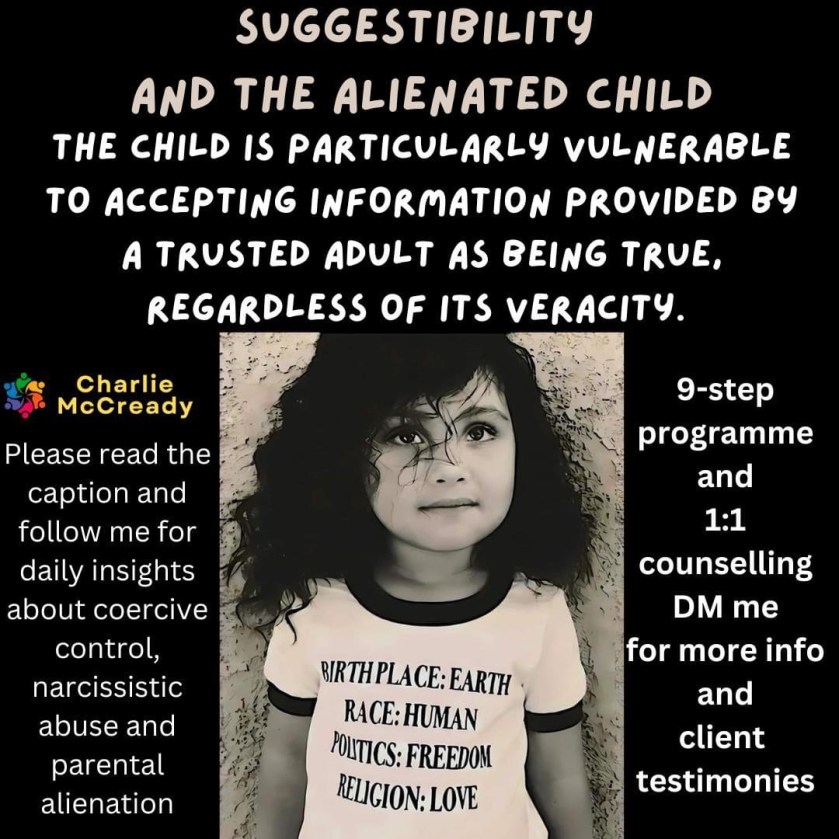
Suggestibility and the Alienated Child

The line between intervention and investigation can become fuzzy through suggestibility, and its outcome manipulated when questioning a child’s truth and beliefs. People often equate children to sponges that soak up information as they grow and learn about the world around them. They are vulnerable and suggestible. Repeated questioning can make someone believe they’re not giving the ‘right’ answer. If only asked once, there’s less chance of the answer changing. An alienating parent might ask: Did you have a good time with your mum/dad? The child will not only hear the tone of voice, but if asked often, the child will understand that ‘yes’ might not be the correct answer and change it to a ‘no.’ Another technique, conscious or not, is to offer two choices (yes/no) so that the child has less chance to elaborate and the parent controls the narrative, doing most of the talking. The parent may even ask a ‘leading question’ which leans towards an established assumption or bias. All the question demands is confirmation, not conversation. In law, this is called ‘suggestive interrogation.’ Suggestive questioning elicits different answers ie. ‘How did you feel when your mum/dad hit you?’ instead of ‘What happened when the argument started?’ The first question presumes abuse. Younger children are more suggestible than older ones. They may ‘recall’ things from prompts rather than real memories. The longer they’re exposed to false narratives, the foggier their memories become (like adults too). ‘I don’t know’ should be a perfectly valid answer. A child doesn’t know. They’re confused, frightened, angry, sad – alienation from a parent is traumatic. Unreliable answers are more likely in stressful situations too. Children want to please and placate the alienating parent. So much emphasis is put on the ‘voice of the child’ in making important decisions, but this is hugely problematic because they’re so suggestible and aligned with the more aggressive, controlling (alienating) parent, and this should all be taken into account.

#suggestibility

#parentalalienation

#parentalalienationawareness

#coercivecontrol

#FamilyCourt

#psychologicalabuse

#fathersrights

#mothersrights

#Fathers4Justice

#parentsrights

#custodybattle

Why aren’t Americans getting married? – Deseret News

The 2023 American Family Survey finds fewer people think marriage is essential. Experts talk about stable families and what children need to thrive. Read more
— Read on www.deseret.com/2023/12/5/23973225/american-attitudes-about-marriage-survey

Why aren’t Americans getting married? – Deseret News

Interviews with the 30/40 years olds years back, stated they would have

” beta marriages ” , and receive every 10 years , and separate if the relationship wasn’t doing well without a lot of legal interference.

The 2023 American Family Survey finds fewer people think marriage is essential. Experts talk about stable families and what children need to thrive. Read more
— Read on www.deseret.com/2023/12/5/23973225/american-attitudes-about-marriage-survey