Don’t Abandon Your Inner Child

…and possibly your biological children.⁠

I see so many beautiful souls who believe that by forgiving the narcissist and giving them another chance, they can help the narcissist feel accepted and loved. They believe they can appeal to the narcissist’s hurt inner child and that this might create a breakthrough in the relationship.⁠

But instead of miraculous breakthroughs, lives are being destroyed. Families are broken. Loved ones suffer. ⁠

For these reasons, then, we should resist the call that we show greater sympathy for these abusive individuals, at least to the extent that by doing so we are causing greater and unnecessary harm to ourselves and other members of our family. ⁠

Why show patience with the narcissist when they are repeatedly inflicting deep wounds upon us and when they are having such harmful effects on our children and their emotional development? ⁠

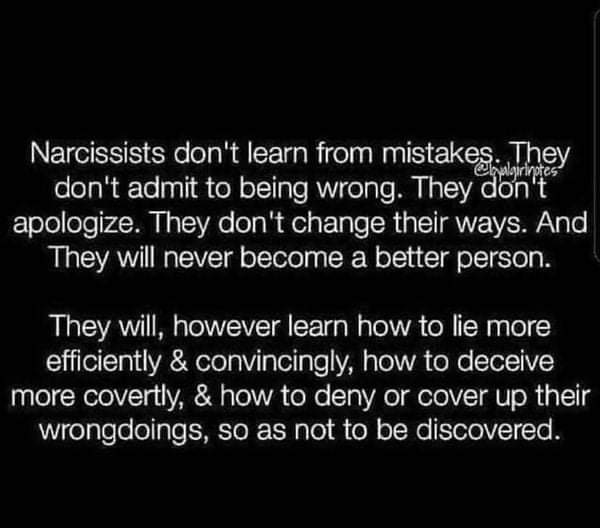
While it’s true that most narcissists were wounded as children, we must realize that those children are now gone. In their place are adults with underdeveloped levels of emotional maturity, deficient attachment capabilities, and a complete inability to empathize with others. ⁠

What’s left in the place of those wounded children are scheming manipulators who don’t give a care about anyone except themselves and their own immediate needs.⁠

Our energies are wasted on the narcissist and are better devoted elsewhere—to improving our own lives and giving our children the sort of childhood that will enable them to have healthy relationships and happy lives.⁠

The pain that ending a relationship with a narcissistic partner will bring leads people to hope and look for some other way. ⁠

Articles that hold out promises of narcissists changing and of your improving your relationship with them are stepping in to serve that misguided need. But, the truth is: it’s dangerous to keep a narcissist in one’s life. The ripple effect from doing this is far beyond the scope of what people can generally comprehend while in the midst of abuse.

If you’d like gentle guidance on taking your power back from the narcissist, join me and other wonderful thrivers in my therapist-approved program for narcissistic abuse recovery.

You will learn real-life ways to develop new and empowering habits that heal – AND are backed by psychology and neuroscience.

For full details of this nurturing program, click here:

Your friend on the journey. xo ❤️

( #📷 @kim.saeed )

Childress : NPD Pathology & Delusions

Narcissistic Pathology & Delusions

The narcissistic personality collapses into persecutory delusions under stress – like the stress created by their public rejection during and surrounding divorce.

This is a known fact about narcissistic personality pathology, that it collapses into persecutory and paranoid delusions under stress.

Theodore Millon is considered among the top experts in personality disorder pathology. He is author of the Millon Clinical Multi-Axial Inventory (MCMI), considered the gold standard assessment instrument of personality disorder pathology.

Theodore Millon wrote the book on personality pathology. Look at the title of the book. Then listen to what he says about narcissistic personality pathology.

Millon. T. (2011). Disorders of personality: Introducing a DSM/ICD spectrum from normal to abnormal. Hoboken: Wiley.

From Millon: “Under conditions of unrelieved adversity and failure, narcissists may decompensate into paranoid disorders. Owing to their excessive use of fantasy mechanisms, they are disposed to misinterpret events and to construct delusional beliefs. Unwilling to accept constraints on their independence and unable to accept the viewpoints of others, narcissists may isolate themselves from the corrective effects of shared thinking. Alone, they may ruminate and weave their beliefs into a network of fanciful and totally invalid suspicions.” (Millon, 2011, pp. 407-408).

From Millon: “Among narcissists, delusions often take form after a serious challenge or setback has upset their image of superiority and omnipotence. They tend to exhibit compensatory grandiosity and jealousy delusions in which they reconstruct reality to match the image they are unable or unwilling to give up. Delusional systems may also develop as a result of having felt betrayed and humiliated. Here we may see the rapid unfolding of persecutory delusions and an arrogant grandiosity characterized by verbal attacks and bombast.” (Millon, 2011, pp. 407-408).

It is a known fact of the pathology that the narcissistic personality will collapse into persecutory delusions under stress.

The rejection inherent to divorce will present the narcissistic parent with conditions of unrelieved adversity and failure. The narcissistic parent will decompensate into persecutory delusions.

We know this. This is an established fact about narcissistic personality pathology

Shared (induced) Delusional Disorder

The pathology of a shared delusional disorder is also called an induced delusional disorder.

Wehmeier Barth, & Remschmidt (2003). Induced Delusional Disorder. Psychopathology,

37-45.
https://www.karger.com/Article/Abstract/69657

From Wehmeier Barth, & Remschmidt: “Induced delusional disorder (or shared paranoid disorder), also known as folie à deux, is a fairly uncommon disturbance characterized by the presence of similar psychotic symptoms in two or more individuals. Most often the symptoms are delusional. Usually the ‘primary’ case, i.e. the individual who first develops psychotic symptoms, can be distinguished from one or more ‘secondary’ cases, in whom the symptoms are induced.”

From the American Psychiatric Association: “Usually the primary case in Shared Psychotic Disorder is dominant in the relationship and gradually imposes the delusional system on the more passive and initially healthy second person… Although most commonly seen in relationships of only two people, Shared Psychotic Disorder can occur in larger number of individuals, especially in family situations in which the parent is the primary case and the children, sometimes to varying degrees, adopt the parent’s delusional beliefs.” (American Psychiatric Association, 2000, p. 333)

Shared (induced) Delusions in Family Courts

The journal Family Court Review is the flagship journal of the AFCC.

From Walters & Friedlander: “In some RRD families [resist-refuse dynamic], a parent’s underlying encapsulated delusion about the other parent is at the root of the intractability (cf. Johnston & Campbell, 1988, p. 53ff; Childress, 2013). An encapsulated delusion is a fixed, circumscribed belief that persists over time and is not altered by evidence of the inaccuracy of the belief.” (Walters & Friedlander, 2016, p. 426)

From Walters & Friedlander: “When alienation is the predominant factor in the RRD [resist-refuse dynamic}, the theme of the favored parent’s fixed delusion often is that the rejected parent is sexually, physically, and/or emotionally abusing the child. The child may come to share the parent’s encapsulated delusion and to regard the beliefs as his/her own (cf. Childress, 2013).” (Walters & Friedlander, 2016, p. 426)

Walters, M. G., & Friedlander, S. (2016). When a child rejects a parent: Working with the intractable resist/refuse dynamic. Family Court Review, 54(3), 424–445.

Diagnosis Guides Treatment

In healthcare, all of healthcare, including all of mental health care, diagnosis guides treatment. The treatment for cancer is different than the treatment for diabetes.

Is there a shared (induced) persecutory delusion created by the pathogenic parenting of the allied parent? Creating delusional thought disorder pathology in the child that then destroys their attachment bond to the other parent is a DSM-5 diagnosis of V-995.51 Child Psychological Abuse.

Diagnosis guides treatment. Is the DSM-5 diagnosis V995.51 Child Psychological Abuse? Was a proper risk assessment for possible Child Psychological Abuse conducted?

Apply knowledge to solve pathology, ignorance solves nothing.

2.04 Bases for Scientific and Professional Judgments
Psychologists’ work is based upon established scientific and professional knowledge of the discipline.

Craig Childress, Psy.D.
Clinical Psychologist, CA PSY 18857

https://www.karger.com/Article/Abstract/69657

Sherrie Campbell ,PhD – Disordered Thoughts

Severely character disordered people don’t care how much good you do for them. When you are going above and beyond for them, helping them, hearing them or supporting them, they greedily take it as long as it fits with the narrative of who they think they are. However, when you give them honest feedback on how their egocentric ways are creating problems in their lives they turn on you and cast you as the bad guy. They totally erase all the support you’ve given them over the years.

They prefer to play the victim than to accept feedback, healthy boundaries set on them, or the normal changes that take place in relationships over the course of life. They turn on you regardless of if what you share with them could get them closer to the things they claim they want.

The mindset to hold is these types have such intense pride problems that they cannot see how it would benefit them to be more flexible or open. It’s too hard on their egos. This is when they start throwing tantrums and making public displays of how they have been victimized. They would rather act like this to get what they want than to act like an adult.

Not your circus not your monkey.

Hovering

Obsession, Targets Death Wishes, Not Responsible, Selective Recall, Controler, Malignant , Unforgiving

Being in a relationship with a narcissist feels so convoluted and devastating because they trap you with falsified moments of trust. ⁠

In these precious moments, you experience a sense of profound security and comfort. You believe they genuinely care about you.⁠

You sense that the narcissist understands you in a way nobody else can. You feel like you’re crazy if you decide to leave. But it’s all a thinly veiled lie built on advanced manipulation.⁠

Because you’ll feel safe and appreciated during the narcissist’s HOOVEriNG, you’ll want to stay close to the narcissist. ⁠

But they become a sneaky, well-dressed predator, one who knows how to flatter your every flaw and compliment your every quirk.⁠

At first, it’s exciting. Because let’s face it. Who doesn’t like to feel adored? Who doesn’t want all the attention and validation? Who doesn’t want to feel unconditionally accepted and appreciated?⁠

But when the surface cracks, the narcissist’s uglier, authentic colors start to emerge. The darkness reveals itself. It may happen slowly. An insult here and there. A passive-aggressive comment. Blame or accusations that don’t make sense. You typically brush them off at first. After all, nobody is perfect, right?⁠

Then you suddenly can’t do anything correctly. Suddenly, you’re the enemy, the ugly fool, the stupid and incompetent person who keeps messing up. The narcissist becomes increasingly meaner. You start feeling increasingly insecure, worthless, uncertain of your every move. ⁠

Suddenly, you’re walking on eggshells in your own home, ashamed and fearful of your next step.⁠

This is the true outcome of narcissistic hoovering. That’s why it’s crucial to remember during times the narcissist is trying to woo you back into their crazy that they are a wolf in sheep’s clothing…not to be trusted under any circumstances.

( #📷 @kim.saeed )

Waiting for Change

HOW MUCH TIME AND HEARTACHE DID IT COST YOU, WAITING FOR AND IMAGINING THE NARCISSIST WOULD CHANGE? I wasted…wait for it…half my adult life! Time I can’t get back. A dead life filled with confusion and hurt.

I decided to put that behind me and to stop thinking about the past, and to try to have a good present and future. I asked myself, “What can I do today to make my life a little bit better?” I dated some…not much. When I decided to just concentrate on making my life better right now, and on my children, one day, about year later, I met the love of my life.

I had no hesitation about being friends. Everything went so easy. We got along well with our kids. Learned to laugh again and enjoy ourselves. Love grew out of that experience.

I used to use the metaphor “falling in love”, but now I think the better analogy is of a tree growing. When we met, a seed was planted, and soon sprouted, and as time passed, it began to grow. Trees grow slowly, but they can get very large…large enough to withstand anything. It was not how I imagined it would happen. But that’s what happened.

Now I think of love, not as excitement, but as quietly resting in the shade of the tree, protected by its outspread arms, smiling, laughing, caring, feeling totally secure in every respect…personally, emotionally, financially, and it every way. That’s love that lasts.

Watch “The Narcissistic Mother in Law and Her Son’s Toxic Sidechick” on YouTube

Heartbreaking to be leveraged

Allowed to be a limited part of , instead of Divine Counterpart .

Anger and rage at this bond .

Disregard for the abuse witnessed , lack of respect for lack of support and honor .

Oh yes , siblings were in the flow too…

It was easy to dispose of me , shut me up and carry on a public asanation , distorting truths defying God

Parental Alienation – Science and Law

The two authors William Bernet and Demosthenes Lorandos will be interviewed tonight January 27, 2022 Forwarded information by Lena Hellblom Sjögren from Family Access – Fighting for Children´s Rights Families Divided TV Airs Tonite @ 9 PM EST! Dr. William Bernet and Dr. Demosthenes Lorandos!! Please Join Us! Family Access – Fighting for Children’s Rights https://www.familyaccessfightingforchildrensrights.com/families-divided-tv-show.htmlClick […]

Parental Alienation – Science and Law