
This is not right
Tag: Children
Bridge over troubled water – Charlie McCready
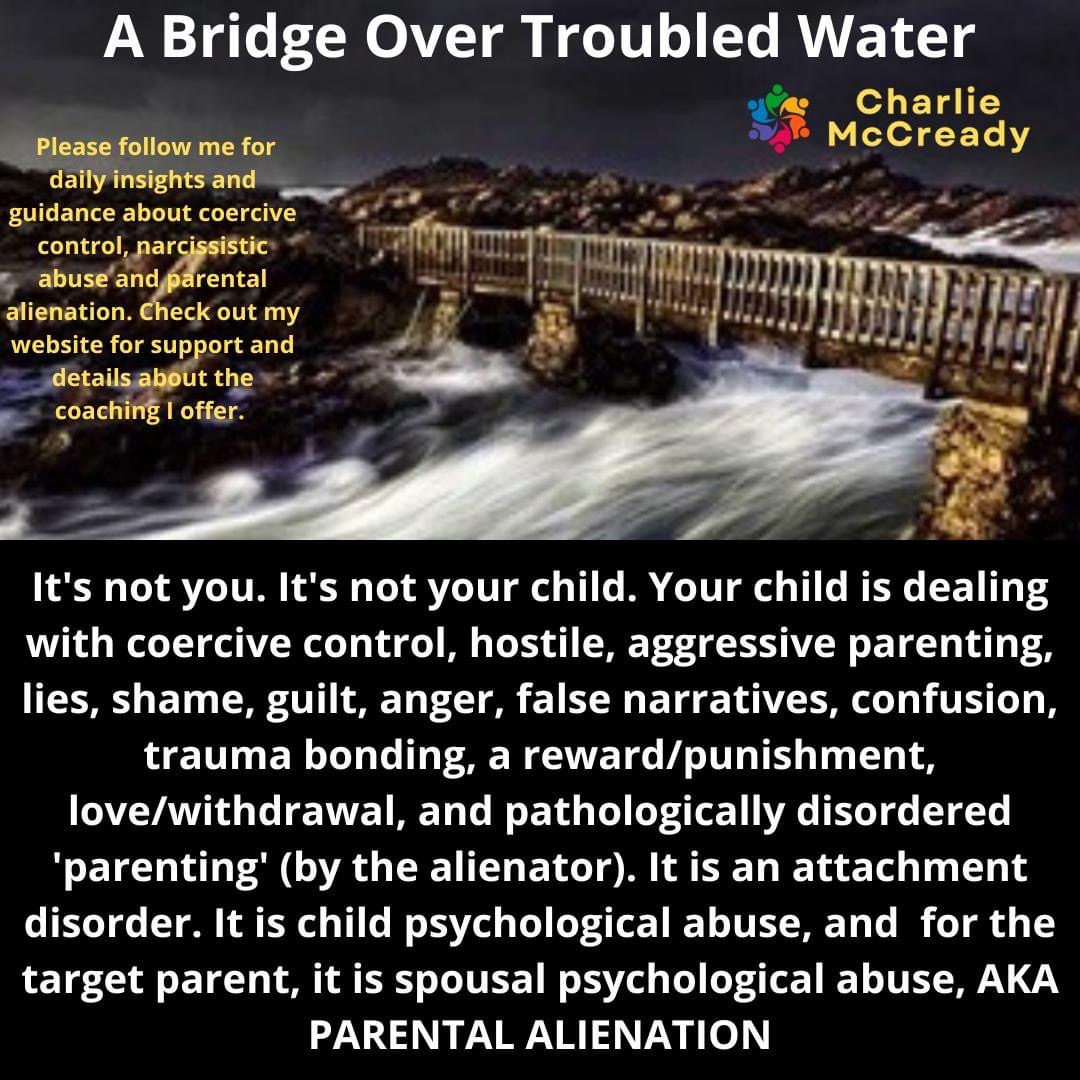
The most profoundly healing and helpful thing we can offer our alienated child/ren is our own healing. That is the same whether they’re currently in our lives or not. It doesn’t help them to know we’re in pain (angry, grieving, holding onto the past) and it doesn’t draw them back to us, quite the opposite. They also suffered and if they’re ever aware of the part they’ve played (or been induced into playing) there’s enormous guilt and grief and shame for them too. We subconsciously hold onto grief as a reminder, a bridge of sorts to the old life we miss, our alienated child. We feel the void, the ache in our hearts as a physical sensation that, in some ways, we find it hard to let go of, almost as if to do so means we’re forgetting, not doing enough, and we’re not allowed to be happy without feeling guilty. But we owe it to ourselves, and our child/ren to be happy and lead the way. It’s not selfishness. It’s strong and it’s loving. Even without children around, we can start working on ourselves. Healing ourselves is also the way to heal the world. One person at a time, the more we heal, the more people around us can too. It has a ripple effect. Someone has to stop the generational trauma – let it be you. Psychologist, D.W. Winnicott, said we don’t need to be perfect parents, we just need to avoid harming our children. Most of us have childhood wounds, and if we don’t sort them out, we can inadvertently pass them down. As we say, hurt people hurt people, so do healed people heal people.
#charliemccready
#parentalalienationcoach
#parentalalienation
#FamilyCourt
#alienatedparent
#FathersMatter
#mothersmatter
Forensic Custody Evaluation-Craig Childress
Wanna see something?
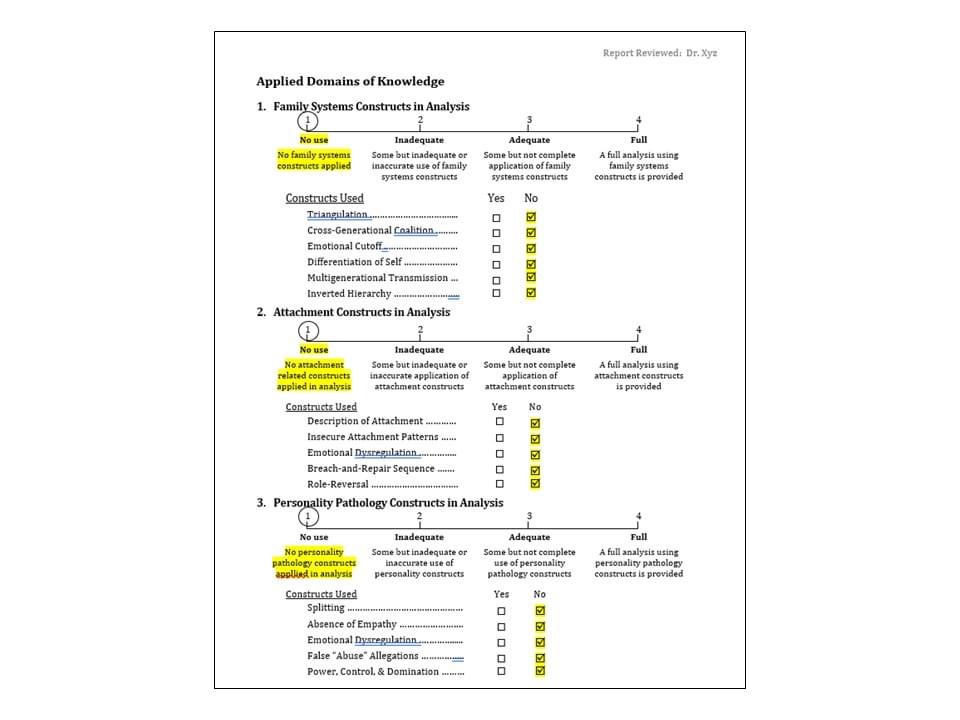
When I conduct a line-by-line review of a forensic custody evaluation, I generate a Checklist of Applied Knowledge at the end of my review.
The Checklist of Applied Knowledge provides a structured way to document compliance with Standard 2.04 and the application of the “established scientific and professional knowledge of the discipline” as the bases for their professional judgments.
It’s a 4-page checklist with a one-page written Summary. Here’s the written Summary for a recent review:
______________________________
Checklist of Applied Knowledge for Dr. Xyz
A Checklist of Applied Knowledge was used to evaluate Dr. XYZ’s application of the established scientific and professional knowledge of the discipline as the bases for her professional judgments. Based on a review of Dr. XYZ’s report, no domain of established professional knowledge was evident in application as the bases for her professional judgments.
Applied Knowledge:
• Family Systems: Despite Dr. XYZ being tasked with assessing a family conflict, no family systems constructs were evident in her reporting or analysis.
• Attachment: Despite Dr. XYZ assessing severe attachment pathology being displayed by the children toward their father, no application of attachment constructs was evident in her reporting or analysis of the family conflict.
• Trauma Pathology: Despite Dr. XYZ assessing issues of possible child abuse, as well as issues of possible spousal abuse, no constructs from complex trauma or child abuse were evident in her reporting or analysis of the family conflict.
• Personality Pathology: Despite indicators in the reported data of possible personality pathology in a parent (possible narcissistic-borderline-dark personality pathology), no constructs from personality pathology were evident in her reporting or analysis of the family conflict.
• Child Development: Despite assessing childhood pathology across multiple child developmental levels, no constructs from child development were evident in her reporting or analysis.
• Self Psychology: Despite assessing the psychological development of children within the parent-child relationship, no constructs from self psychology were applied regarding the psychological development of children in the parent-child psychological relationship.
• DSM-5 Diagnostic System: No diagnostic constructs from the DSM-5 were applied, despite multiple relevant differential diagnoses including:
1) a possible shared shared/induced persecutory delusion (DSM-5 297.1)
2) a possible factitious attachment pathology being imposed on the child for secondary gain to the parent (DSM-5 300.19),
3) possible psychological child abuse (DSM-5 V995.51)
4) possible spousal psychological abuse of the father by the mother using the children’s induced pathology as the spousal abuse weapon (DSM-5 V995.82)
.
Diagnostic Formulation
No diagnosis was provided by Dr. XYZ. No discussion of any diagnostic issues was provided. No theoretical orientation was evident in case formulation, and no organized case formulation was offered.
Treatment Plan Formulation
No treatment plan formulation was offered.
_____________
Hello, I’m Dr. Childress. It’s a pleasure to meet you. I’ve been asked by an attorney in this matter to review your report.
Craig Childress, Psy.D.
Clinical Psychologist, CA PSY 18857
Unhealthy Parents who control adult children
Masculine needs challenging , not over praising
Killing the Spirit of Learning
Narcissist Turn Home into Hell
I concur with all this
 GreatCosmicMothersUnite