Unresolved Grief

Definitely: the ” Living connection ” for a Mom experiences living unresolved grief , which is the intent and mission of their non co parent .

One of the toughest things is that there’s no closure for the alienated parent. No justice. Ambiguous loss is a term that came about in the 1970s. A researcher called Pauline Boss studied military families, specifically those of soldiers missing in action. The body is not found, but until recovered, they could be alive. It can also be the case that someone is physically there but psychologically not, such as with Alzheimer’s. It is difficult to mourn in these circumstances. It is unresolved grief. Many people call the experience of parental alienation a kind of ‘living bereavement’ which describes this phenomenon. It can also be that we don’t or can’t accept our loss. Resilience and hope can help us accept our situation. Anticipatory grief is one we prepared ourselves, as we know the loss is coming, as with an Alzheimer’s patient, we lose them incrementally, while they’re still alive. And ‘frozen grief’ can make us numb and stuck. Ambiguous grief is, in a way, shapeless, and we have to make the best sense of it that we can. It is the only way. Facing up to our situation, and gaining a better understanding, is a step towards our healing, and we need to do this to lead the way for our alienated children. Focus on the love, not the loss, and the present not the past and strive to be happy, no matter what. ⁠

I have been through the trauma of alienation, and am totally invested in helping others. As well as my daily posts, I offer 1:1 coaching, and a 9-step program. Reach out if you’d like to know more about how I could help you.

#charliemccready

#parentalalienationcoach

#narcissisticabuseawareness

#ambiguousloss

#healing

#mentalhealth

#emotionalabuse

#coercivecontrol

#gaslighting

#triangulation

Not being like the Alienating parent- Charlie McCready

Moving on from the anguish of parental alienation is a process that doesn’t happen overnight. It requires a conscious effort and resilience, as grief, injustice and anger can have a powerful hold on us, keeping us tethered to both the past and the present pain. Parental alienation is often described as a living bereavement. It’s ongoing. It’s unfinished business. But however difficult it may be, choosing to move forward is often the best course of action.

Parental alienation is profoundly isolating and traumatic, made worse by the fact that it is widely misunderstood and poorly supported. In some circles, it’s outright denied. The lack of recognition and action raises an obvious question—why is nothing being done? The reality is that the legal system, as it stands, often serves its own interests rather than prioritising the well-being of families. It operates on delay, deflection, and bureaucracy, allowing alienation to take hold while the targeted parent fights a ever steepening uphill battle. Even when alienation is recognised, enforcement is weak or non-existent.

While parental alienation may become a legal battle, at its core, it is an attachment disorder caused by pathogenic parenting—deeply unhealthy, psychologically damaging, and rooted in coercion, manipulation, and control. It is not a normal parent-child dynamic; it is an induced psychological condition that thrives on fear, guilt, and distorted loyalty.

Now, let’s talk about the alienating parent and their pursuit of revenge. This is what drives many of them. Their actions are not grounded in love or concern for the child but in a pathological need to control and punish. They draw others into their conflicts, creating division and chaos. Their wounded ego demands retribution—especially against the “target” parent, who may have exposed the truth about them or triggered their own abandonment issues. But there’s no excuse. They should be working through their issues, not destroying their child in the process. Instead, they refuse accountability. They project, manipulate, and engage in coercive control, turning their own children into unwitting pawns in their vendetta.

This is narcissistic parenting at its most destructive—erasing the child’s ability to form secure, healthy attachments and forcing them into an unnatural psychological alignment with the alienating parent. And yet, what’s striking is how these people remain stuck in a cycle. They don’t change. They don’t grow. They repeat the same toxic patterns.

Who would want to be like the alienating parent with their lives full of manipulation, deceit, and emotional abuse? Their existence is a façade, a charade built on falsehoods, and their actions perpetuate suffering for all around them. We got out of their lives, and we await our children realising why we did this and that maybe they should do the same.

Reach out if I can help you, as I’m helping many others, with the coaching I offer.

#charliemccready

#parentalalienationcoach

#mothersmatter

#FathersMatterToo

#FathersMatter

#emotionalabuse

#emotionalabuserecovery

#parentalalienation

#narcissisticabuseawareness

#parentalalienationawareness

#narcissticparent

#childrensrights

#fathersrights

#mothersrights

#custody

#childcustody

#FamilyCourt

#custodybattle

Live no Bereavement – Charlie McCready

For many target parents, the loss of a child feels like a kidnapping or a death that has no closure – a living bereavement. It is agonising. For the alienated child, they are unwitting victims of terrorism. While they can be quite afraid of their captors (the aligned/alienating parent), it is like ‘Stockholm Syndrome’ because they’re also afraid of abandonment by them or not being loved by them, having been induced to believe they are their only hope, their lifeline. They’re led to believe that any relationship or affection towards the ‘enemy’, the target, alienated parent, will only bring them trouble and more suffering. Undoubtedly, this is a psychologically abusive experience for both target parents and alienated children. But we need to find some kind of acceptance. Some way towards peace of mind. Looking back, focusing on the past and the pain is not the way forward. It keeps us stuck. We have to be okay with the present moment. The now. This is the starting point. Right now.

If you face these challenges, know you’re not alone. I have been through the trauma of alienation, and with over 20 years of experience, I am totally invested in helping others. As well as my daily posts, I offer 1:1 coaching, and a 9-step program. I’m glad to say clients who do my program talk of gaining emotional and mental resilience and peace of mind, often within just a few weeks of starting. I help my clients understand and deal with their alienated child/ren, the alienating parent, plus how to overcome and survive the many challenges. Please send me a message if you are interested to know more, or you can visit my website.

#charliemccready

#parentalalienationcoach

#childcustody

#parentalalienation

#fathersrights

Continued Domestic Abuse via PA

Parental alienation is a deeply harmful form of psychological abuse and coercive control, making it a clear instance of post-separation domestic abuse. Yet the term itself has been deliberately distorted by groups with ideological and financial motives, often because statistical patterns show that more fathers experience it than mothers. However, this is not, and never has been, a gendered issue. It affects countless devoted parents—both mothers and fathers—who are unjustly torn from their children’s lives by manipulation and control.⁠

At its core, parental alienation is an abuse of power. The parent with primary residency is typically in the strongest position to alienate the child, preying on their most primal fear: abandonment. But alienation is not exclusive to resident parents—non-resident parents can also engage in these tactics. Children, caught in the crossfire, are coerced into rejecting one parent to secure the approval of the other, often without realising how they are being manipulated. The psychological consequences are severe and long-lasting. Adults who were alienated as children are now speaking out, confirming the devastation they endured. Ignoring their testimonies only serves to protect those who inflicted the harm.⁠

Despite its severity, parental alienation has yet to be formally recognised in the UK as the child protection issue it so clearly is. Initially, the Domestic Abuse Act 2021 acknowledged alienating behaviours within its draft statutory guidance, listing clear examples of coercive control that align with parental alienation. However, after just over 1,000 responses to a public consultation, these references were removed in July 2022. This wasn’t because the harm was disproven—it was a political decision, driven by those who find the term ‘contentious.’ Even organisations such as Women’s Aid acknowledge that these behaviours are abusive, yet they continue to reject the term ‘parental alienation’ itself, leaving alienated parents fighting an uphill battle in family courts.⁠

The truth is, parental alienation is already reflected in existing legal definitions of domestic abuse. The Domestic Abuse Act explicitly identifies coercive and controlling behaviours, including isolating a victim from supportive family and professionals, blocking communication, using children as weapons of control, making threats, and inflicting psychological harm. Yet despite these behaviours being recognised in law, many professionals still fail to connect them to the reality of parental alienation, leaving children unprotected from its devastating effects.

History shows that abusive behaviours often go unchallenged until enough people demand change. Marital rape was once dismissed as a private matter. Coercive control took years to be legally recognised. Now, alienated children are beginning to break free and reclaim their voices—not the ones shaped by fear and coercion, but their true, authentic voices. More of them are reaching out, joining my coaching calls with their targeted parents, and confirming what we have always known: parental alienation is real. The tide is turning. Recognition is coming. Hold strong.

#charliemccready

#parentalalienationcoach

#domesticabuseawareness

#childpsychologicalabuse

#alienatedchild

Weaponized Children – Charlie McCready

Emotionally self-harming behaviour in an alienated child, driven by the coercive control of a disordered, alienating parent, reflects the painful clash between their genuine affection for a targeted parent and the manipulated negative perceptions imposed by the alienator. This internal conflict, known as cognitive dissonance, creates distress and confusion as the child tries to reconcile their love for the targeted parent with the false narrative they’ve been coerced into accepting. This conflict not only impairs their emotional well-being but also impacts their neurological functioning. Negative thinking patterns about a parent they love can distort their brain’s perception of reality, disrupting healthy neural pathways and perpetuating emotional distress, ultimately compromising their overall emotional development.

Coping mechanisms for these detrimental effects involve a range of approaches, some of which are positive and constructive, while others might be less so.

Therapeutic interventions that promote critical thinking, self-awareness, and emotional regulation can play a pivotal role in helping the child navigate their conflicting emotions. Encouraging them to express their feelings openly and safely explore their emotions within a therapeutic setting can gradually help untangle the web of manipulated beliefs.

Additionally, nurturing healthy relationships with extended family, friends, and professionals who provide unwavering support and encourage positive interactions can serve as protective factors against the emotional self-harm imposed by the alienating parent’s control. Engaging in creative outlets, physical activities, and hobbies that offer a healthy way to release emotional tension and boost self-esteem can also contribute to their overall well-being. However, it’s essential to recognise that not all coping mechanisms are beneficial; some children might turn to negative coping strategies like alcohol or drugs to numb their pain, which can further compound their emotional challenges and hinder their growth. Thus, providing guidance and support to help them choose healthier ways to manage their emotions becomes paramount in their healing journey.

My posts are here not to alarm or upset but to spread awareness about what’s known as ‘parental alienation’ and to provide guidance to those who are going through it, as I did myself. Apart from these daily posts, which I hope help you know you’re not alone, and to better understand it’s an attachment disorder, a pathology, it’s not you; please reach out if I can help with the coaching I offer.

#charliemccready

#parentalalienationcoach

#childrensrights

#mothersrights

#fathersrights

Charlie McCready- Lawyers $$$$

Does anyone care to comment? When I have more time, I’d like to gather more data on what alienated parents have actually experienced in the family court system. How long did it take? What was the outcome? How much money was spent? Did it lead to reunification? If the court ordered contact, was it enforced—and if so, how did that go?⁠

Alienated parents often pour their life savings into a legal system they once believed would protect their rights and their children’s well-being—only to emerge financially drained, emotionally shattered, and, in many cases, no closer to justice.⁠

This highlights the urgent need for reform. Lawyers dealing with these cases should be trained to recognise attachment disordered parental alienation – the false narratives and coercive, manipulative behaviours that drive it. The legal system must do better, not only for parents who are being erased from their children’s lives but, most importantly, for the children themselves—caught in a battle they never chose.⁠

Perhaps we expect too much. Perhaps we should know better by now. After all, injustice isn’t confined to family courts or parental alienation. Look at the wider world—those who commit crimes often walk free, while those who expose them suffer the consequences. The alienated parent is no different: seeking truth in a system that too often fails to protect the innocent while enabling the abuse.⁠

I don’t mean to sound cynical. I try to stay focused on solutions. But we shouldn’t have to ‘fight’ to see our own children in a court of justice—because we are not criminals. We are parents. Parental alienation isn’t simply a legal matter; it’s a psychological and relational issue—one that the law is often ill-equipped to handle. And for many, prolonged legal action is not only financially impossible but also emotionally destructive. While sometimes necessary, court should be a last resort, used only when every other effort to protect a child’s well-being has been exhausted.

If you are going through what’s commonly known as ‘parental alienation’, know you’re not alone. I’ve been through it myself. Personally and professionally, I have over 20 years of experience. I am reunited with my children and here to offer support with daily posts on social media and also with the coaching I offer. Feel free to reach out to me anytime.

#charliemccready

#parentalalienationcoach

#parentalalienation

#parentalalienationawareness

#alienatedchild

Disordered Pathogenic Parenting – Charlie McCready

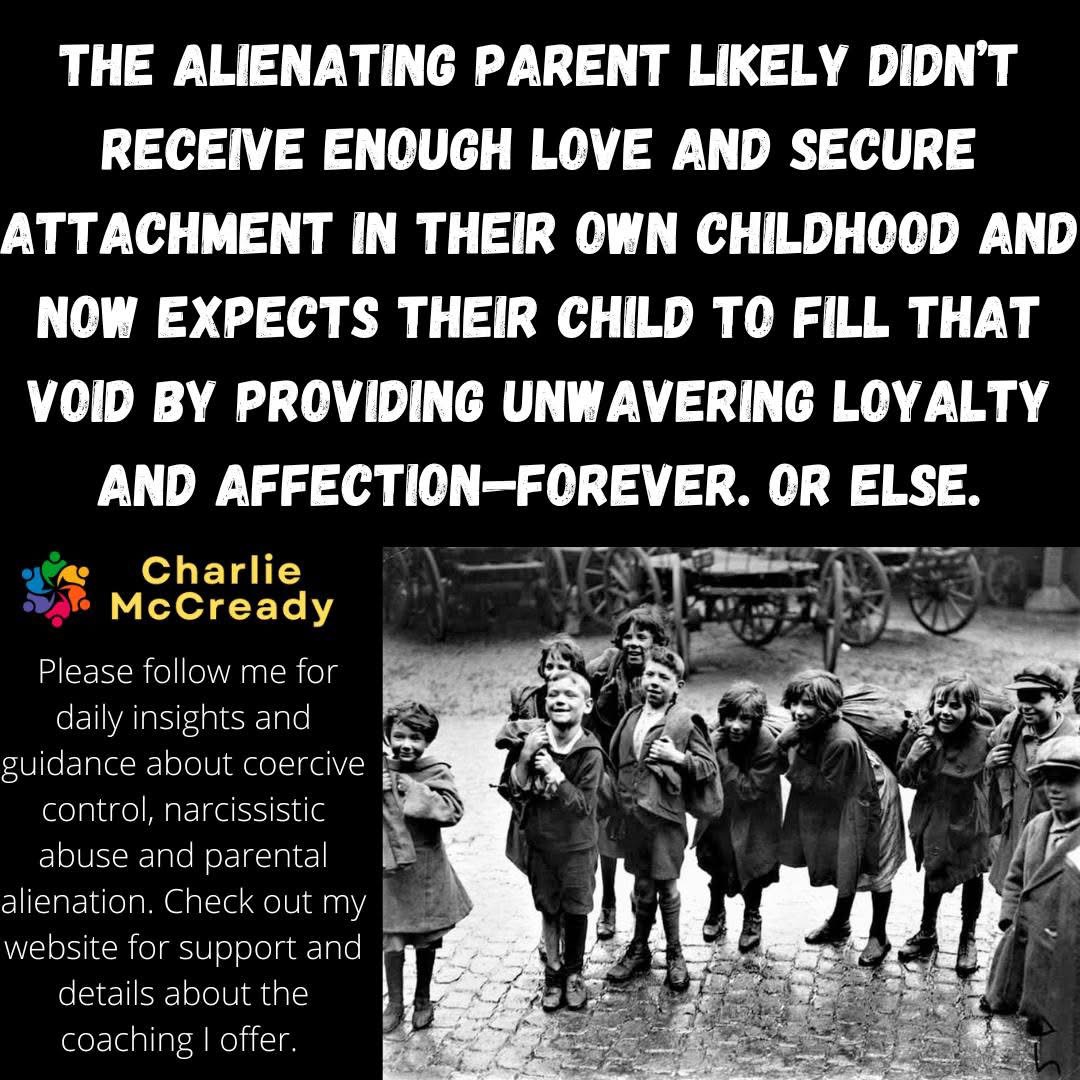
In many cases (though not all of course), the alienating parent operates from a place of deep-seated emotional neediness rooted in their own childhood experiences. If they lacked sufficient love and secure attachment during their formative years, they may have developed an attachment style characterised by anxiety or insecurity. This void creates an overwhelming desire for their child to fulfil unmet emotional needs—an expectation for unwavering loyalty and affection.⁠

In this dynamic, the child becomes a vessel for the parent’s unresolved trauma and unfulfilled desires. The alienating parent may project their need for love onto the child, expecting them to provide the unconditional support and affirmation they missed out on. This demand can manifest as controlling or possessive behaviour, where the parent subtly or overtly communicates that love and loyalty come with conditions: to reject, demonise, or distance themselves from the other parent. Truly a cruel thing to inflict on a child – some do this unconsciously, others quite deliberately. ⁠

For the child, if they do not comply or fail to provide the desired level of loyalty, it may trigger the alienating parent’s fear of abandonment and inadequacy. They might respond with manipulation, guilt, or emotional coercion, reinforcing the notion that the child’s love is contingent upon rejecting the other parent. The underlying message is clear: the child must choose sides and prioritise the alienating parent’s needs or risk losing the affection and approval they crave. Again, this is disordered, pathogenic parenting. ⁠

Ultimately, this creates a toxic cycle of dependence and alienation, where the child feels torn between their natural bond with both parents and the appalling expectations imposed by the alienating parent. It undermines the child’s sense of autonomy, fosters confusion, and cultivates a skewed perception of love—one that is contingent on loyalty rather than the unconditional acceptance and support that every child deserves.⁠

#charliemccready

#parentalalienationcoach

#parentalalienation

#alienatedchild

Charlie McCready -The Reality of Parental alienation

This post will resonate with those who understand the reality of what’s commonly known as parental alienation. The alienator is skilled and practised in telling us that we no longer have children, that we don’t deserve to see them, that we’re no good. If they can say such shocking, untrue things to us, just imagine the false narratives they are feeding others—and, most devastatingly, our children. And why? In short, and for the vast majority of us, it’s simply and most devastatingly, to punish us. In doing so, they are also punishing the children, tearing them away from a loving, willing, and available parent.They distort the child’s thinking, erode their beliefs, and attack any real connection.The divorce has nothing to do with the children, yet the alienator will try to turn an ex-partner into an ex-parent. This is not love. This is not healthy. This is disordered, selfish, and psychologically abusive behaviour.

Knowing the truth about the alienator and their behaviours doesn’t bring our children back, but it’s important to understand the pathology. It’s also vital not to react to their provocations and abuse, however tempting it may be. Because, at present, ‘parental alienation’ is not recognised as abuse in its own right. While coercive control, one of the alienator’s favoured methods, is recognised in many jurisdictions as abuse, mental health and legal professionals still focus on what is deemed ‘in the child’s best interests’. But when the child is indoctrinated, terrorised, and made to feel unloved/abandoned, their voice is no longer authentic. This is not a genuine expression of their will—it’s the result of manipulation/coercive control (abuse). It’s akin to Stockholm Syndrome, or even brainwashing. Still, the result of the indoctrination is what the experts often focus on when making their decisions, and to further complicate matters, false allegations are often thrown into the mix to delay progress.

Even though the child is coerced into aligning with the alienating parent, this was never their choice. If they had made this decision freely, it would be ‘estrangement,’ and some form of natural separation from home/parents is part of growing up, especially during adolescence. But children ideally want healthy relationships with both parents—not just with the bullying, alienating, and coercively controlling one. This is their right. Denying them this is abuse in itself.

#charliemccready

#parentalalienationcoach

#divorce

#divorced

#custody

Behind closed doors – Silence of Social Services

If you’ve ever been pulled into the system—whether through social services, the family courts, or both—you know how heavy the silence can be.

Maybe you were supported. Maybe you were broken. Maybe you’re still carrying questions no one ever answered.

What matters is: your story deserves to be told.

The system thrives on silence. But silence doesn’t mean protection—it means isolation. And it’s time that changed.

This blog exists to give voice to the untold stories. To break the silence around what really happens behind closed doors.

Whether your experience was positive, painful, or somewhere in between, your truth can help others feel less alone—and help drive the change we need to see.

You are not invisible. Your voice is not too small.

And your story—yes, yours—might be the one that finally opens a door for someone else.

~ The Girl Speaks †~

Behind Closed Doors: The Silence That Speaks Louder