

Tag: abuse narcissistic behavior
Targeted Parent Object of Lies by Alienator
I’ll start us off. I was accused of being a ‘slum landlord’ when in fact I used to rent property through the council in a deprived area, the rooms were kept pristine, in fact I couldn’t have rented them through the council if they hadn’t been through all the strict regulations. The rooms were ‘sheltered housing’ for people struggling in life for various reasons including domestic abuse. I hardly made any money, I did it for over ten years, and I wanted to help because I was able to do so.
I was accused of affairs.
On another occasion, in a different situation, I was also accused of causing bulimia. This accusation came from someone who made comments daily about the way people (including my child) look, their size, their appearance etc.
What lies have been told about you?
#charliemccready #9StepProgram #parentalalienation #parentalalienationawareness #highconflictdivorce #Divorce #childabuse #narcissisticchildabuse #narcissisticabuseawareness #narcissisticabuserecovery #narcissism #narcissist

Victim vs Survivor- Charlie McCready
A victim can be described as someone who has experienced harm, pain, or trauma – someone who experiences parental alienation and having their children unjustly turned against them. This harm inflicted by the alienating parent might be emotional, psychological, or even, in some cases, physical.
On the other hand, a survivor has faced the same adversity but has taken a different path in response to it. Typically, when we realise what’s happening, we’re shocked and can become paralyzed by the trauma. This is accompanied by a sense of helplessness and inability to move forward. Many don’t want to ‘move on’ in any way as they fear this means quitting or somehow giving up on their alienated children. Overcoming this horrific and poorly understood and supported experience is no mean feat. Reclaiming your strength and joy in life is not easy, but it is possible, and when others see you do it, you empower them to do the same. Overcoming trauma, including parental alienation, involves understanding the pathology, accepting it’s happened/is happening, and healing, self-discovery, and personal growth. It often requires rebuilding a sense of self-worth.
Alienated parents and alienated children survive this experience in different ways. For example, alienated children psychologically ‘split’ due to cognitive dissonance and the inability to hold two contrasting ideas. In this way, unawareness (as with emotional cutoff) is a powerful survival technique when information threatens their status quo. It safeguards them from potential harm or distress. Being unaware or avoiding certain truths becomes a coping strategy. They may unconsciously choose to remain ignorant or suppress awareness to shield themselves from the potential negative consequences of that knowledge. They may be burying feelings of shame, guilt and confusion behind a show of confidence, criticism, and grandiosity.
The healing journey for both alienated parents and children involves recognising the harm inflicted, fostering genuine self-acceptance, moving out of any sense of victimhood, and experiencing growth and resilience that empowers you to survive all ongoing conflicts or challenges.
#charliemccready
#parentalalienationcoach
#narcissisticparent
#OvercomingAdversity
#parentalalienation
#parentalalienationawareness
#FamilyCourt
#ChildCustody

Resentful Narcissist
Impact on mental health due to Parental Alienation
Last year, I wrote about the stellar work of Professor Ben Hine, a Professor of Applied Psychology, and so it was a real pleasure to recently hear him discussing his groundbreaking research into the effects of family breakdowns, separation, and divorce on parents and children. His research, conducted in collaboration with other luminaries in the field, such as Jennifer Harman, sheds crucial light on the prevalence and impact of parental alienating behaviours (PABs) as well as their profound impact on mental health, and it offers valuable insights into what needs to change to address this pervasive issue.
You can find his research papers online, but here is an overview:
To understand the scale of the problem, his team surveyed over 1,000 separated or divorced parents in the first national study of its kind in the UK. When asked directly whether they had experienced PABs, 39.2% of participants reported that they had. However, when specific behaviours were described to them, this number rose to 59.1%. This stark difference highlights how difficult it can be to identify PABs, even for those who have suffered from them, underscoring the need for greater awareness and understanding.
The study also uncovered the severe mental health consequences of PABs. Participants who had experienced alienation reported significantly higher levels of post-traumatic stress disorder (PTSD), depression, and even thoughts of suicide. The damage caused by PABs is not just a “difficult family dynamic”; it is a form of psychological abuse with far-reaching consequences for parents and children alike.Many also disclosed that their experiences of PABs were accompanied by domestic violence, echoing similar findings in studies conducted in the US and Canada.
Professor Hine emphasised the importance of developing a comprehensive response to this issue. He called for better mental health support for families, including training for professionals, the creation of support groups, and access to counselling. Schools and the legal system also need to be involved, as they are often on the front lines of these complex family dynamics. Equally vital is the need for large-scale public awareness campaigns to educate society about the existence and impact of PABs, helping to reduce stigma and encourage action. As you know if you read my posts, I advocate this myself, and could not agree more strongly.
The research also revealed the importance of refining the tools used to identify PABs. The gap between participants’ direct responses and their recognition of specific behaviours shows that alienation is often hidden or misunderstood. By improving these tools, researchers and professionals can better understand the scope of the problem and develop more effective interventions.
The pervasiveness of Parental Alienating Behaviors demands urgent attention and concerted action from policymakers, professionals, and society. By acknowledging the intricate dynamics of post-separation relationships and prioritizing the well-being of affected families, we can work towards fostering healthier parent-child bonds and mitigating the enduring impact of parental alienation on individuals and communities.
#charliemccready
#parentalalienationcoach
#coercivecontrol
#FamilyCourt
#alienatingbehaviour
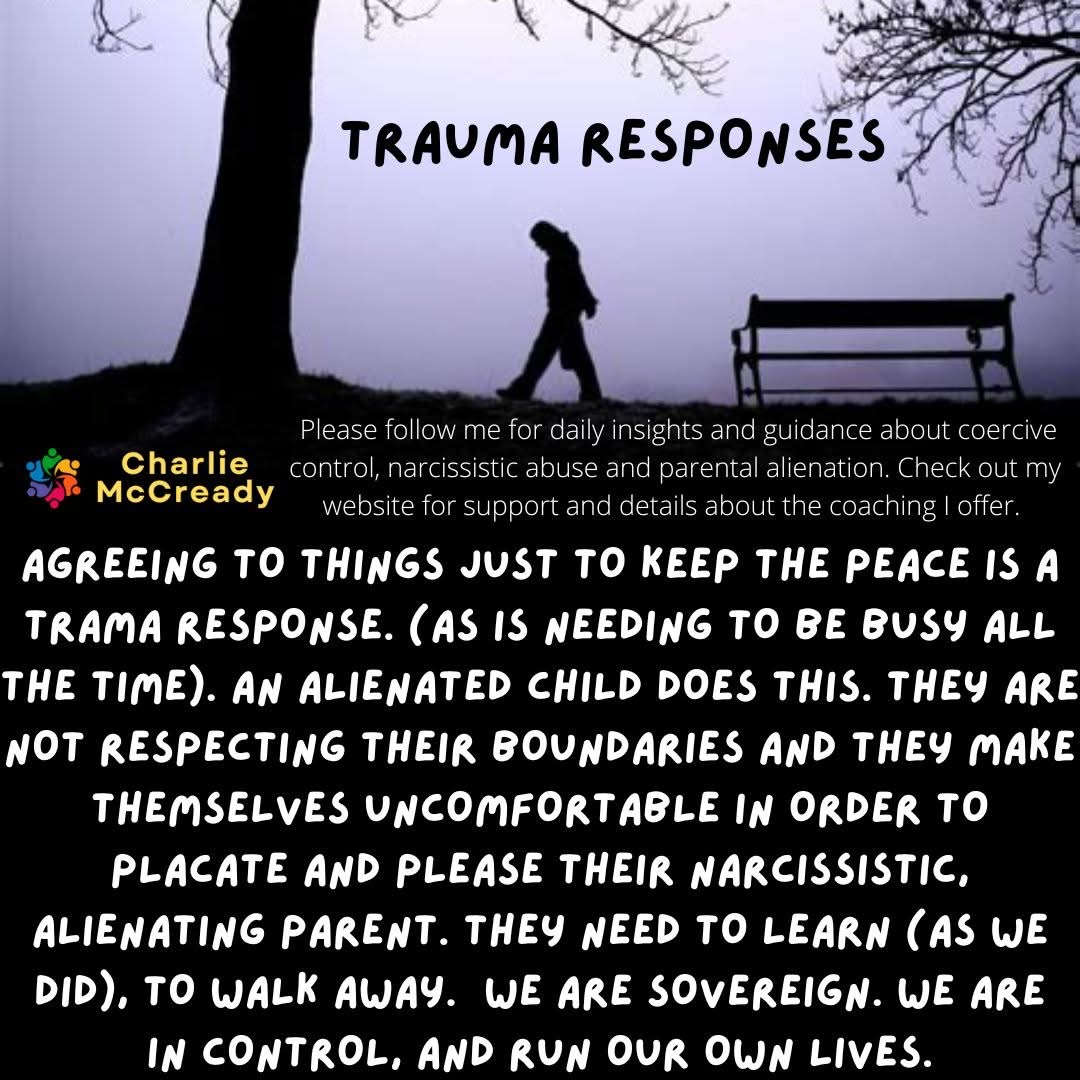
Agreeing just to keep the peace /Trauma Response – Charlie McCready
Agreeing to things just to keep the peace is a trauma response. It’s a way of surviving in a hostile or controlling environment where saying ‘no’ or ‘I don’t believe you’ isn’t an option without severe consequences. This response is often seen in alienated children—children who have been manipulated and coerced to the point that their own needs and feelings no longer matter. Instead, they learn to prioritise the emotions and expectations of the alienating parent. They walk on eggshells, eager to placate and please, because defiance causes even more trauma than they’re already dealing with.
This behaviour becomes a form of self-protection, a way to avoid conflict and ensure that they remain in the good graces of the parent who controls their reality. Over time, these children can lose the ability to recognise their own boundaries, and their sense of self becomes enmeshed with the parent’s demands and manipulations. Their ‘agreeability’ isn’t a sign of compliance but of survival. They’ve learned that resistance leads to emotional punishment—withdrawal of love, guilt trips, or accusations of betrayal. So, they agree, they nod along, and they become what they think the alienating parent wants them to be, sacrificing their own comfort, autonomy, and well-being.
Similarly, the need to be constantly busy can also be a sign of trauma. When a child is caught in a world of conflicting loyalties and intense emotional manipulation, stillness and quiet can become unbearable. There’s research into ADHD and alienated children which is very interesting, if alarming. But being alone with their thoughts means confronting feelings of anxiety, guilt, and confusion—the result of a parent’s relentless campaign to control their mind and emotions. Constant busyness, then, becomes a way to avoid these feelings—a distraction from the chaos brewing beneath the surface.
But this coping strategy comes at a cost. It prevents them from ever truly understanding what they want, who they are, and where their own boundaries lie. Instead, they become attuned to others, hyper-vigilant to the moods and reactions of those around them, and disconnected from their own inner world. The challenge is that these patterns sometimes can persist into adulthood, long after the child has left the direct influence of the alienating parent. We, as alienated parents, have had to learn this the hard way. Many of us lived for years in a state of constant appeasement—agreeing, conceding, and sacrificing parts of ourselves to keep the peace with our abusive ex-partners. It’s taken time, therapy, and a great deal of inner work to realise that
agreeing just to avoid conflict isn’t harmony. And we’ve had to learn to say ‘no’, to walk away, and to reclaim our sense of sovereignty.
The same journey is ahead for our children. They, too, will have to unlearn the trauma responses they developed out of necessity. They will need to realise, as we did, that their value doesn’t lie in their ability to keep the peace, to stay busy, or to put others’ needs before their own. One day, we hope they will come to understand that they are not just the product of a manipulative parent’s expectations. They are not defined by the demands of those who sought to control (or hurt) them. And when our children are ready, we hope they find the strength within themselves—the courage to live life on their own terms.
#charliemccready
#parentalalienationcoach
#traumabond
#traumabonding
#emotionalabuse
#mentalhealth
#mothersmatter
#FathersMatterToo
#FathersMatter
#FamilyCourt
#custody
#parentalalienation
#childcustody
#mothersrights
#fathersrights
#childrensrights
#custodybattle
#parentalalienationawareness
Indoctrination/Parental Alienation- Charlie McCready
The idea that the alienating parent is not standing in the way of your relationship with your child is pure theatre. It’s an act. Behind the scenes, they’ve already given the child their lines and coached them into believing the character they’re supposed to play. Indoctrination, such as when a child is alienated and without justification for their rejection of you, is what’s happening. The child isn’t being given choices. They’ve already been coercively controlled and enmeshed into an alignment with the alienating parent.
A child’s expression of wishes holds such power and is often a deciding factor in proceedings concerning them, but it should be acknowledged as a voice, not a choice. Placing the child in a position where they must select one parent over the other goes beyond being inappropriate. Children often desire things at age 8 or 9 that they’d go nowhere near ten years later. I’ll give you an example. I thought it would be incredibly cool to be a lion tamer. Thankfully my parents didn’t think to put me in a lion’s den with a whip and a whistle, thinking that my needs must be met because this is what I believed was right for me. I also wanted to be able to fly, and they didn’t send me off to be operated on with wings attached to me surgically. Of course, children need to be heard, but they also have to be guided, nurtured, given boundaries while not being totally indoctrinated. Children might not know better than to wish for something detrimental to them, as in the case of being allowed to choose to reject a loved, loving parent, having been encouraged by the alienating parent to do so.
Research shows that many adults who, in their youth, rejected a parent, having been given a lot of pressure to do so by the other parent, later came to regret it and wished somebody would have had the sense to help them realise this was not a good idea – friends, family, legal or mental health professionals, anybody.
Taking, ‘it’s their choice’ at face value fails to recognise the extent of coercive control, psychological abuse, and manipulation at play, which can have profound negative effects on the child’s emotional development and well-being.
#charliemccready
#parentalalienationcoach
#adversechildhoodexperiences
#CoerciveControl
#custodybattle
#parentalalienation
#narcissisticparent
#mothersmatter
#FathersMatterToo
#FathersMatter
#FamilyCourt
#coercivecontrolawareness
#parentalalienationawareness
#mothersrights
#FathersRights
#ChildCustody
#traumabonding
#familycourts
Prolonged Ruptured Attachment Syndrome
Parental alienation can be understood as an attachment disorder, where the child is manipulated into rejecting one parent, disrupting the natural attachment bonds. This psychological harm mirrors what is described in Prolonged Ruptured Attachment Syndrome (PRAS), a framework introduced by Martin Seager and colleagues. While PRAS was not developed to address parental alienation, it offers a new and potentially valuable lens for understanding the emotional damage caused by the disruption of attachment.
In cases of parental alienation, the rupture in attachment is not a clean break. Rather, it’s a painful disruption that leaves the relationship in a state of unresolved limbo—neither fully severed nor easily healed. Many alienated parents describe what feels like a living bereavement. This mirrors PRAS, where people are unable to find emotional closure because their attachment to a significant person remains unsettled. Seager describes PRAS as existing “somewhere between trauma and grief,” a state that is neither fully traumatic nor fully grief-stricken but something in between. For alienated parents, this is reflected in the constant uncertainty of not knowing if reconciliation with their child will ever happen. The pain, as Seager explains, is “ongoing without closure.”
PRAS highlights that the emotional toll of such ruptures is not just a one-time loss but an enduring, unresolved pain. The psychological effects of parental alienation are profound. This kind of emotional suffering can lead to trauma, grief, anxiety, and helplessness, making it harder for both parents and children to heal.
Healing from the emotional damage caused by these attachment disruptions requires more than just time. For alienated parents, this means specialised support to help navigate the complexities of reconnection and recovery. PRAS also underscores the importance of recognising that emotional healing from attachment ruptures needs understanding and compassionate care.
Published in Psychreg Journal of Psychology in December 2024, the newly conceptualised mental health condition, Prolonged Ruptured Attachment Syndrome (PRAS), while not developed with parental alienation in mind, offers a potentially helpful framework, with its findings validating the distress caused by attachment disruptions. Applying this to parental alienation could pave the way for more effective, empathetic responses and support for affected families.
#charliemccready
#parentalalienationcoach
#prolongedrupturedattachmentsyndrome
#emotionalabuse
Love is never enough for a Narcissist
Relationships with narcissists are some of the most mentally and emotionally exhausting experiences a person can go through.
This is the one relationship where your love, kindness, and loyalty don’t bring closeness, but instead invite betrayal, anger, and devaluation.
The harder you love them, the more they seem to want to break you.
At first, a narcissist will mirror everything you want to see. They will make you feel special, adored, and irreplaceable. They will listen intently, act supportive, and say all the right things to gain your trust.
It feels like the connection you’ve always wanted—until it isn’t.
Over time, things shift. The same person who once admired you now seems irritated by your presence.
The one who used to appreciate your kindness now belittles you for it.
The same loyalty they once praised suddenly feels like a weakness they exploit.
You start to feel like you can’t do anything right, no matter how hard you try.
Narcissists thrive on control. They manipulate through guilt, gaslighting, and emotional highs and lows. One day they make you feel like you’re everything to them, and the next, they withdraw affection, lash out, or treat you like you don’t matter.
It keeps you stuck in a cycle—always trying to get back to the good moments, always blaming yourself when things go wrong.
The truth is, a narcissist’s love is conditional, but their hatred is not. The better you are to them, the more they want to tear you down. They see your kindness as weakness, your love as something to exploit, and your loyalty as something they own.
The more you give, the less they respect you.
Trying to love a narcissist doesn’t heal them—it drains you. You will bend over backward to prove your worth, but they will never be satisfied.
They don’t want love; they want power. The moment they feel they have complete control, they lose interest or seek ways to break you further.
Walking away is the only way to win. Narcissists don’t change, and they don’t suddenly wake up one day and appreciate you.
The love, kindness, and loyalty you so freely gave to them – give it back to yourself. That’s where true healing begins.

 GreatCosmicMothersUnite