

Tag: abuse narcissistic behavior
Narcissist blame game
Healing the narcissist
Parallel Parenting -Charlie McCready
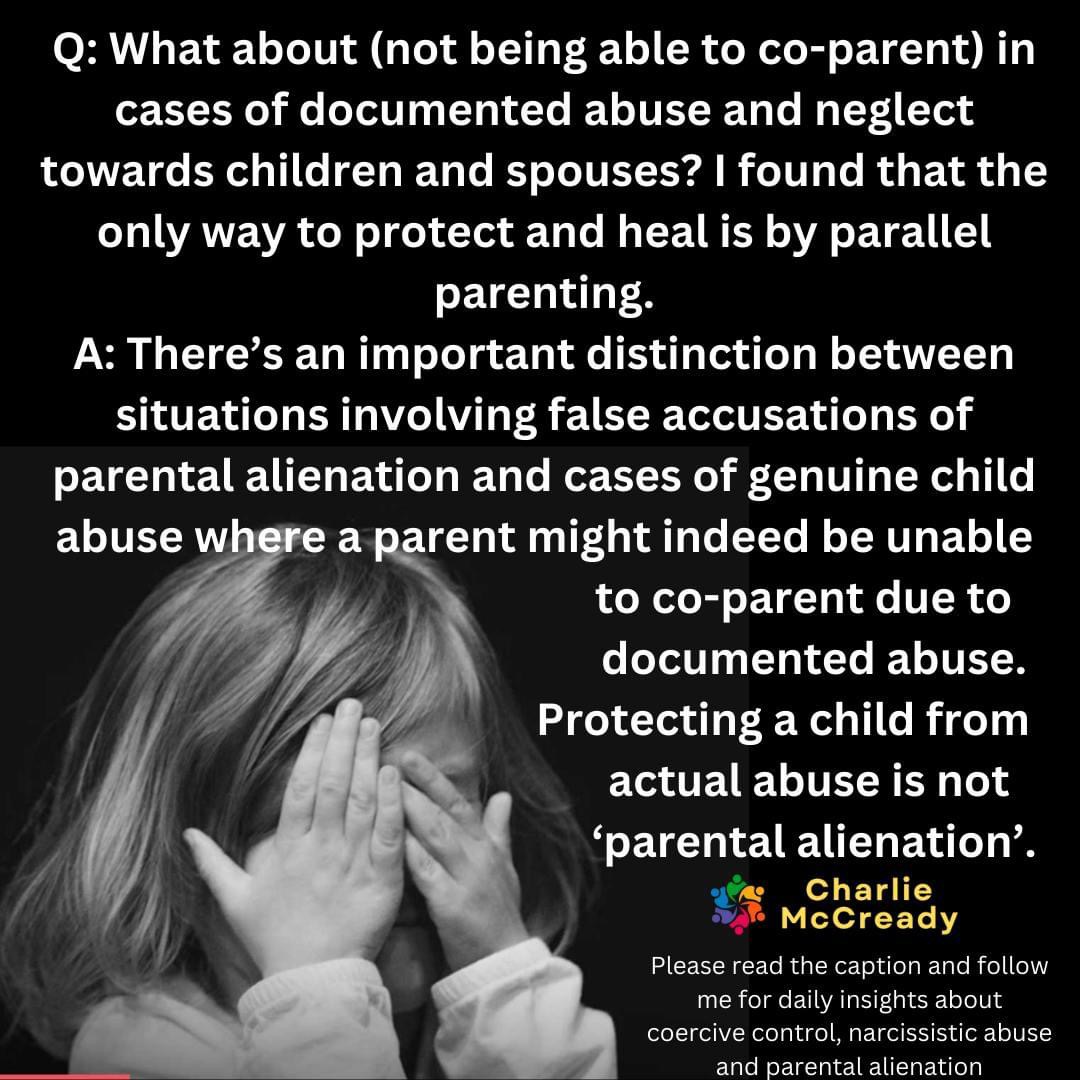
In cases of documented abuse and neglect towards children and spouses, the priority must always be the safety and well-being of the child. Parallel parenting can be a necessary approach in such situations, where the focus shifts from collaboration between parents to minimizing contact and interactions to ensure the safety of all involved parties.
Parallel parenting allows for the establishment of clear boundaries and guidelines for communication and decision-making, reducing the potential for further conflict and harm. It provides a structured framework for parents to fulfil their responsibilities while minimizing direct contact and exposure to abusive behaviours.
While the concept of parallel parenting may not completely resolve the underlying issues of abuse and neglect, it can provide a necessary safeguard for vulnerable individuals and facilitate a more stable environment for children to thrive. Additionally, it may be accompanied by legal measures such as restraining orders or supervised visitation to further ensure the safety of all parties involved.
The distinction between parental alienation and cases of documented abuse and neglect emphasises the paramount importance of protecting children from harm and taking appropriate actions to address and prevent further abuse. In cases of documented abuse, it’s crucial for professionals and authorities to prioritize the safety of the child and take appropriate actions to protect them from further harm. This may include intervention from child protective services, legal measures to restrict contact with the abusive parent, and providing support and resources for the non-abusive parent and child to heal and rebuild their lives.
#charliemccready #9StepProgram #parentalalienationcoach #parentalalieantionischildabuse #parentalalienationawareness #parentalalienationisreal #parentalalienationischildabuse #highconflictcoparenting #CoParenting #coparentingwithanarcissist #highconflictdivorce #divorce #familylaw #familycourt #childabuse #narcissisticfather #narcissisticmother #narcissisticparent #narcissticabuserecovery #narcissisticabuseawareness #narcissist #narcissists #narcissisticrelationship #narcissisticpersonalitydisorder #narcissism #narcissismawareness #alienatedchild #alienatedmother #alienatedfather #alienatedparent #alienated
The narcissist marriage of servitude / Control not connection
When you marry a narcissistic man, you never get a chance to be a wife; instead, you take on the role of a mother because these adults behave like man-children.
They go to work Monday through Friday and then spend their weekends sitting in front of a laptop, downloading music, playing video games, or making messes for you to clean up.
You find yourself single and a father simultaneously, taking on the burden of responsibilities without the support of a partner.
Narcissists don’t marry for love or partnership; they marry because they want a maid, cook, secretary, banker, and a nanny.
They crave control, not connection. Their selfish desires consume them, leaving you to run the household, raise the children, and satisfy their every whim.
Your dreams of a loving and equal relationship are shattered, replaced by the harsh reality of servitude.
As days turn into weeks, and weeks into years, you become a shadow of your old self.
Your identity is erased, replaced by the exhausting duties of handling a narcissist’s life.
You are obliged to sacrifice your own desires, interests and friendships to accommodate their demands.
Emotional childbirth is suffocating, leaving you drained, resentful, and wondering how you ended up in this nightmare.
You’re not alone in this fight.
Many women have fallen prey to the charming facade of a narcissist, only to find themselves trapped in a loveless and ungrateful role.
Remember, you deserve better.
You deserve a partner who loves, supports, and respects you.

Defining Parental Alienation
There is some debate surrounding the term “parental alienation” that reflects broader complexities within the realms of mental health, legal practice, and social dynamics. Let’s break it down:
Parental Alienation: This term is recognised chiefly by those who have experienced it for themselves, it is a way for us to find each other in what otherwise is an isolating, traumatic experience. The term itself refers to a situation where one parent deliberately manipulates their child’s perception of the other parent, often leading to the child’s unjustified rejection or hostility towards that parent where, before separation or divorce, there existed a good, loving bond.
Some renowned experts in the field prefer the term “attachment disorder” or “attachment-based parental alienation” to describe the dynamics seen in what others might label as “parental alienation.” The argument is that focusing on attachment disorders provides a more nuanced understanding of the underlying psychological mechanisms. Others criticise the term “parental alienation”, claiming it to be ‘debunked’ ‘pseudoscience’ which is misused in legal contexts. Certain women’s advocacy groups argue that the term “parental alienation” can be weaponized by abusive individuals, particularly men, to deflect accountability and continue exerting control over their former partners.
However, with all this debate, we are divided rather than united in combating the real problem, which is partner/spousal and child psychological abuse. The focus should not solely be on debating semantics or labels but rather on addressing the actual harm inflicted upon children and families when one parent uses them as pawns in their own conflicts. Whether termed “parental alienation” or viewed through the lens of attachment disorders, the fundamental issue is the manipulation and abuse of children for personal gain or vengeance. By prioritizing the well-being of children and holding accountable those who engage in such harmful behaviours, we can work towards fostering healthier familial relationships and protecting vulnerable individuals from further harm.
#charliemccready #9StepProgram #parentalalienationcoach #parentalalienationawareness #parentalalienationisreal #parentalalieantionischildabuse #parentalalienation #highconflictcoparenting #coparenting #coparentingwithanarcissist #highconflictdivorce #divorce #familylaw #familycourt #childabuse #narcissisticfather #narcissisticmother #narcissisticparent #narcissisticabuserecovery #narcissist #narcissisticabuseawareness #narcissisticpersonalitydisorder #narcissisticabusesurvivor #narcissism #narcissismawareness #alienatedchild #alienatedmother #alienatedparent #alienatedfather #
#alienated

The Alienator -Charlie McCready
Your child’s true nature is loving. So is yours. Believe it or not, it is the same for the alienating parent, the narcissistic abuser – love. They just lost their way. The alienating parent’s unloving, controlling, destructive, vengeful disordered pathological nature has come about through fear, through experiences in their past that remain unresolved and unhealed. And they are incredibly jealous of your love. They dread it because it’s powerful. What you need to do is remember your incredible loving nature and don’t let them dim your light with their dark, controlling ways and fear.
Fear has a way of distorting perceptions and causing people to react in ways that may not align with an innate loving nature. The experience of fear can lead to a desire to control others or situations to protect themselves. This control can manifest in various forms, such as manipulation, dominance, or jealousy.
Jealousy often arises when they perceive you still possess a capacity for love or experience fulfilling relationships. Despite their best endeavours to break you. They feel a sense of lack, a void, a disconnect from love. Instead of recognising and addressing their fears and insecurities, they project their envy onto you, onto anyone who seems to be confronting, challenging, or ego-wounding them.
Love and fear are opposing forces. Love encourages openness, empathy, and understanding, while fear often leads to closed-mindedness, defensiveness, and a need to control. Recognising and understanding the role of fear in unloving behaviours can be a starting point for personal growth and transformation. If the narcissistic abuser or alienating parent could address their fears and insecurities, and their pathological parenting, if they could take responsibility rather than blaming others, they too could reconnect with their ability to love. They would remember their child’s sovereignty and everyone’s sovereignty.
#charliemccready
#parentalalienationcoach
#parentalalienation
#parentalalienationawareness
#highconflictcoparenting
#divorce
#FathersMatter
#mothersmatter
#custodybattle
#custody
#FamilyCourt

 GreatCosmicMothersUnite