

Tag: family
Impact on mental health due to Parental Alienation
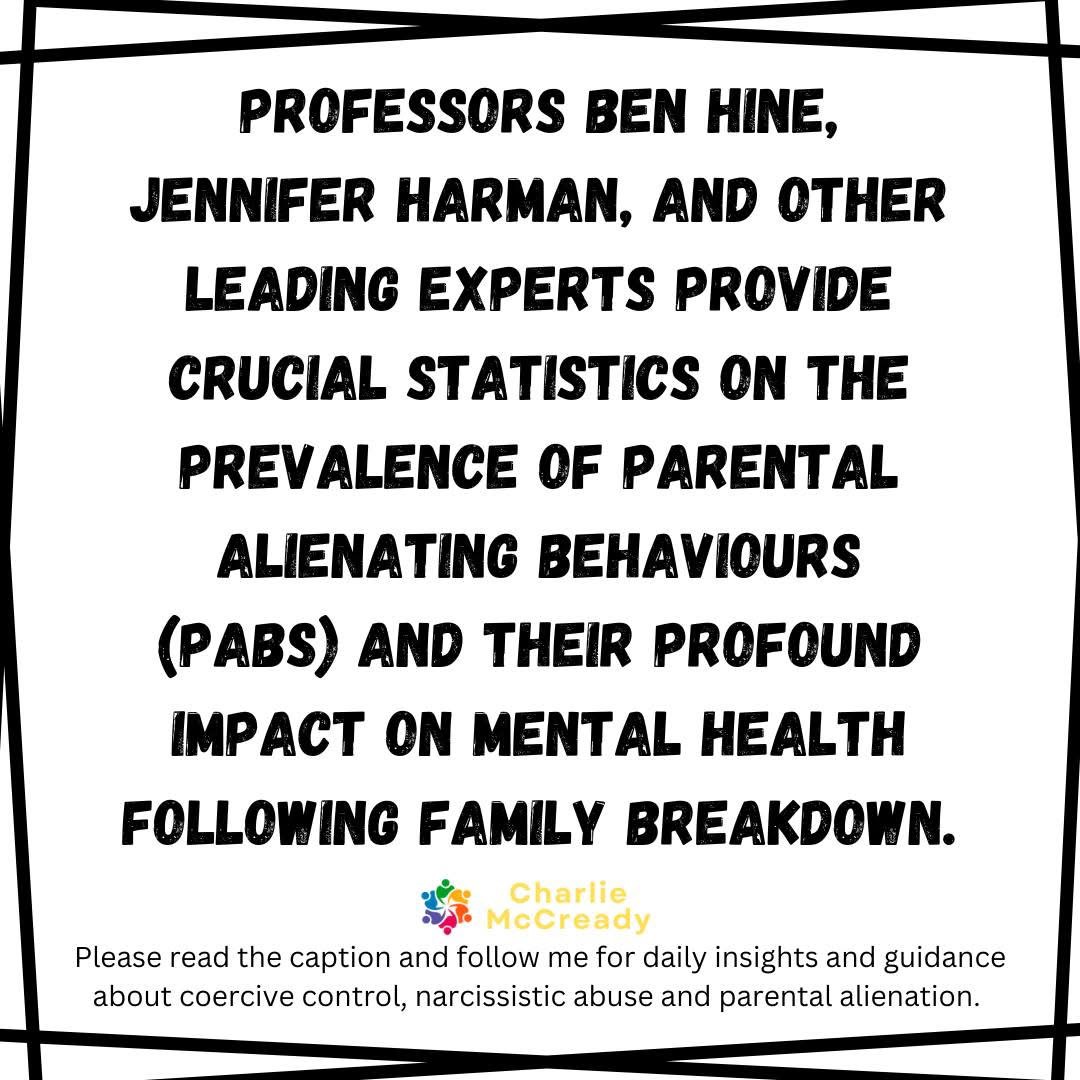
Last year, I wrote about the stellar work of Professor Ben Hine, a Professor of Applied Psychology, and so it was a real pleasure to recently hear him discussing his groundbreaking research into the effects of family breakdowns, separation, and divorce on parents and children. His research, conducted in collaboration with other luminaries in the field, such as Jennifer Harman, sheds crucial light on the prevalence and impact of parental alienating behaviours (PABs) as well as their profound impact on mental health, and it offers valuable insights into what needs to change to address this pervasive issue.
You can find his research papers online, but here is an overview:
To understand the scale of the problem, his team surveyed over 1,000 separated or divorced parents in the first national study of its kind in the UK. When asked directly whether they had experienced PABs, 39.2% of participants reported that they had. However, when specific behaviours were described to them, this number rose to 59.1%. This stark difference highlights how difficult it can be to identify PABs, even for those who have suffered from them, underscoring the need for greater awareness and understanding.
The study also uncovered the severe mental health consequences of PABs. Participants who had experienced alienation reported significantly higher levels of post-traumatic stress disorder (PTSD), depression, and even thoughts of suicide. The damage caused by PABs is not just a “difficult family dynamic”; it is a form of psychological abuse with far-reaching consequences for parents and children alike.Many also disclosed that their experiences of PABs were accompanied by domestic violence, echoing similar findings in studies conducted in the US and Canada.
Professor Hine emphasised the importance of developing a comprehensive response to this issue. He called for better mental health support for families, including training for professionals, the creation of support groups, and access to counselling. Schools and the legal system also need to be involved, as they are often on the front lines of these complex family dynamics. Equally vital is the need for large-scale public awareness campaigns to educate society about the existence and impact of PABs, helping to reduce stigma and encourage action. As you know if you read my posts, I advocate this myself, and could not agree more strongly.
The research also revealed the importance of refining the tools used to identify PABs. The gap between participants’ direct responses and their recognition of specific behaviours shows that alienation is often hidden or misunderstood. By improving these tools, researchers and professionals can better understand the scope of the problem and develop more effective interventions.
The pervasiveness of Parental Alienating Behaviors demands urgent attention and concerted action from policymakers, professionals, and society. By acknowledging the intricate dynamics of post-separation relationships and prioritizing the well-being of affected families, we can work towards fostering healthier parent-child bonds and mitigating the enduring impact of parental alienation on individuals and communities.
#charliemccready
#parentalalienationcoach
#coercivecontrol
#FamilyCourt
#alienatingbehaviour
Agreeing just to keep the peace /Trauma Response – Charlie McCready
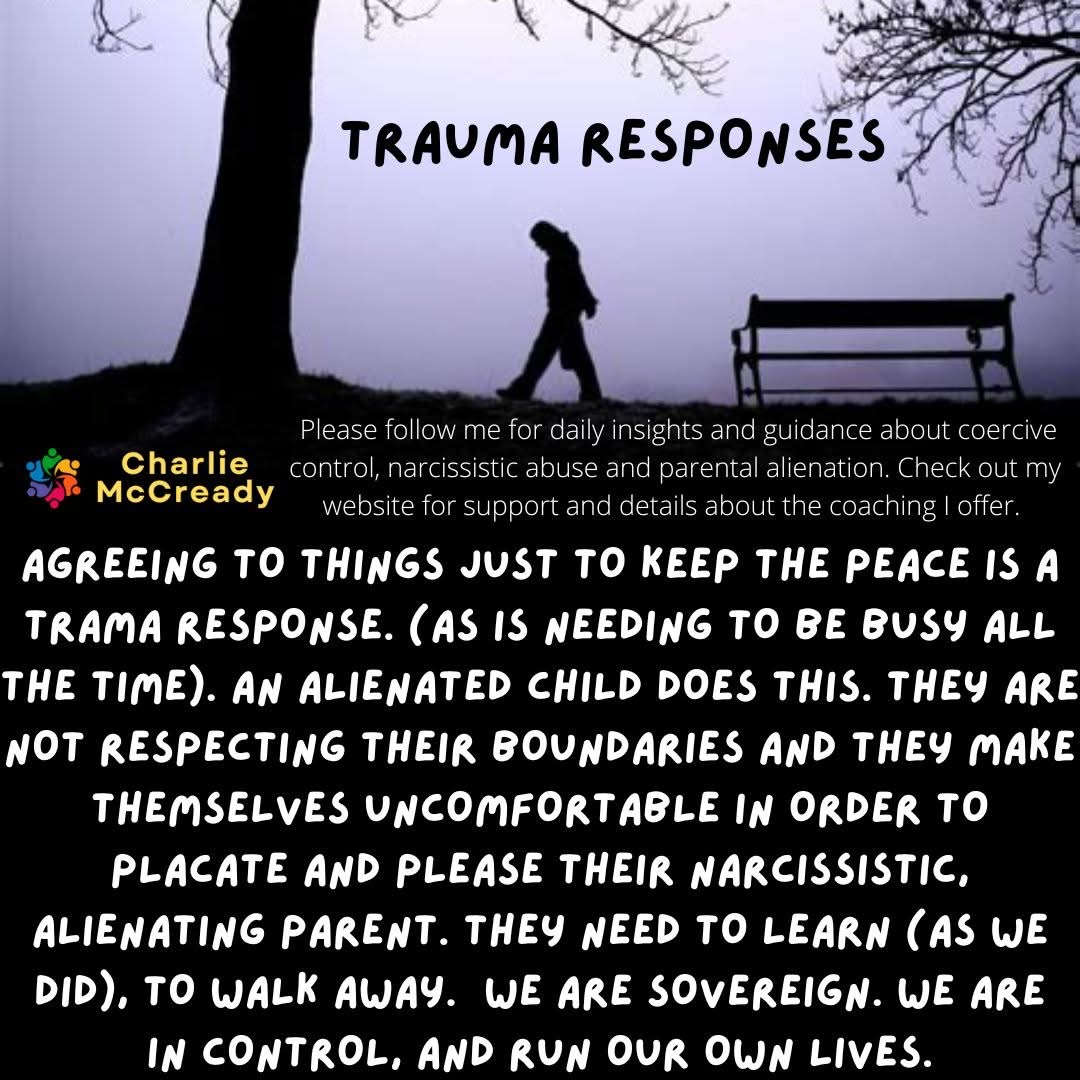
Agreeing to things just to keep the peace is a trauma response. It’s a way of surviving in a hostile or controlling environment where saying ‘no’ or ‘I don’t believe you’ isn’t an option without severe consequences. This response is often seen in alienated children—children who have been manipulated and coerced to the point that their own needs and feelings no longer matter. Instead, they learn to prioritise the emotions and expectations of the alienating parent. They walk on eggshells, eager to placate and please, because defiance causes even more trauma than they’re already dealing with.
This behaviour becomes a form of self-protection, a way to avoid conflict and ensure that they remain in the good graces of the parent who controls their reality. Over time, these children can lose the ability to recognise their own boundaries, and their sense of self becomes enmeshed with the parent’s demands and manipulations. Their ‘agreeability’ isn’t a sign of compliance but of survival. They’ve learned that resistance leads to emotional punishment—withdrawal of love, guilt trips, or accusations of betrayal. So, they agree, they nod along, and they become what they think the alienating parent wants them to be, sacrificing their own comfort, autonomy, and well-being.
Similarly, the need to be constantly busy can also be a sign of trauma. When a child is caught in a world of conflicting loyalties and intense emotional manipulation, stillness and quiet can become unbearable. There’s research into ADHD and alienated children which is very interesting, if alarming. But being alone with their thoughts means confronting feelings of anxiety, guilt, and confusion—the result of a parent’s relentless campaign to control their mind and emotions. Constant busyness, then, becomes a way to avoid these feelings—a distraction from the chaos brewing beneath the surface.
But this coping strategy comes at a cost. It prevents them from ever truly understanding what they want, who they are, and where their own boundaries lie. Instead, they become attuned to others, hyper-vigilant to the moods and reactions of those around them, and disconnected from their own inner world. The challenge is that these patterns sometimes can persist into adulthood, long after the child has left the direct influence of the alienating parent. We, as alienated parents, have had to learn this the hard way. Many of us lived for years in a state of constant appeasement—agreeing, conceding, and sacrificing parts of ourselves to keep the peace with our abusive ex-partners. It’s taken time, therapy, and a great deal of inner work to realise that
agreeing just to avoid conflict isn’t harmony. And we’ve had to learn to say ‘no’, to walk away, and to reclaim our sense of sovereignty.
The same journey is ahead for our children. They, too, will have to unlearn the trauma responses they developed out of necessity. They will need to realise, as we did, that their value doesn’t lie in their ability to keep the peace, to stay busy, or to put others’ needs before their own. One day, we hope they will come to understand that they are not just the product of a manipulative parent’s expectations. They are not defined by the demands of those who sought to control (or hurt) them. And when our children are ready, we hope they find the strength within themselves—the courage to live life on their own terms.
#charliemccready
#parentalalienationcoach
#traumabond
#traumabonding
#emotionalabuse
#mentalhealth
#mothersmatter
#FathersMatterToo
#FathersMatter
#FamilyCourt
#custody
#parentalalienation
#childcustody
#mothersrights
#fathersrights
#childrensrights
#custodybattle
#parentalalienationawareness
Indoctrination/Parental Alienation- Charlie McCready
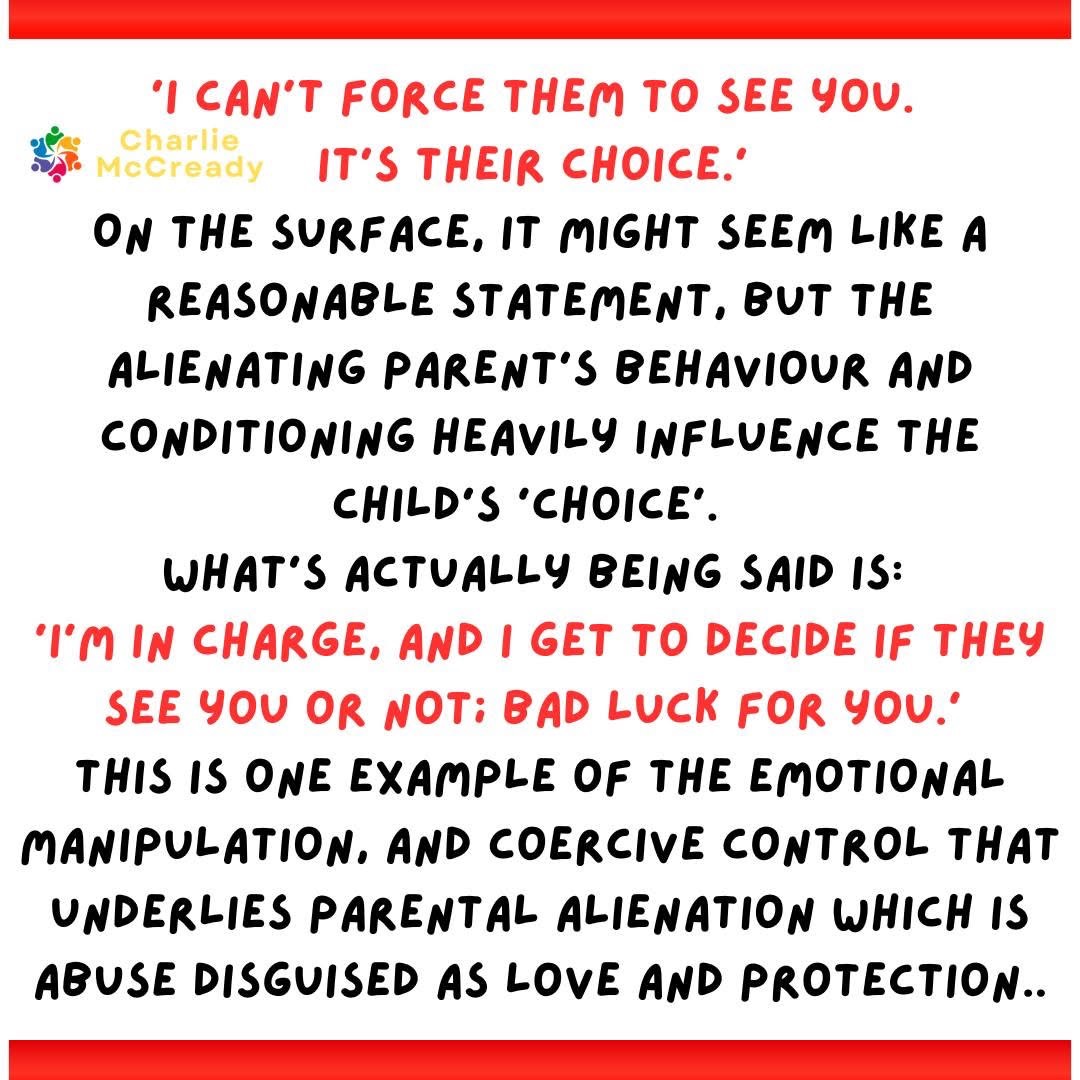
The idea that the alienating parent is not standing in the way of your relationship with your child is pure theatre. It’s an act. Behind the scenes, they’ve already given the child their lines and coached them into believing the character they’re supposed to play. Indoctrination, such as when a child is alienated and without justification for their rejection of you, is what’s happening. The child isn’t being given choices. They’ve already been coercively controlled and enmeshed into an alignment with the alienating parent.
A child’s expression of wishes holds such power and is often a deciding factor in proceedings concerning them, but it should be acknowledged as a voice, not a choice. Placing the child in a position where they must select one parent over the other goes beyond being inappropriate. Children often desire things at age 8 or 9 that they’d go nowhere near ten years later. I’ll give you an example. I thought it would be incredibly cool to be a lion tamer. Thankfully my parents didn’t think to put me in a lion’s den with a whip and a whistle, thinking that my needs must be met because this is what I believed was right for me. I also wanted to be able to fly, and they didn’t send me off to be operated on with wings attached to me surgically. Of course, children need to be heard, but they also have to be guided, nurtured, given boundaries while not being totally indoctrinated. Children might not know better than to wish for something detrimental to them, as in the case of being allowed to choose to reject a loved, loving parent, having been encouraged by the alienating parent to do so.
Research shows that many adults who, in their youth, rejected a parent, having been given a lot of pressure to do so by the other parent, later came to regret it and wished somebody would have had the sense to help them realise this was not a good idea – friends, family, legal or mental health professionals, anybody.
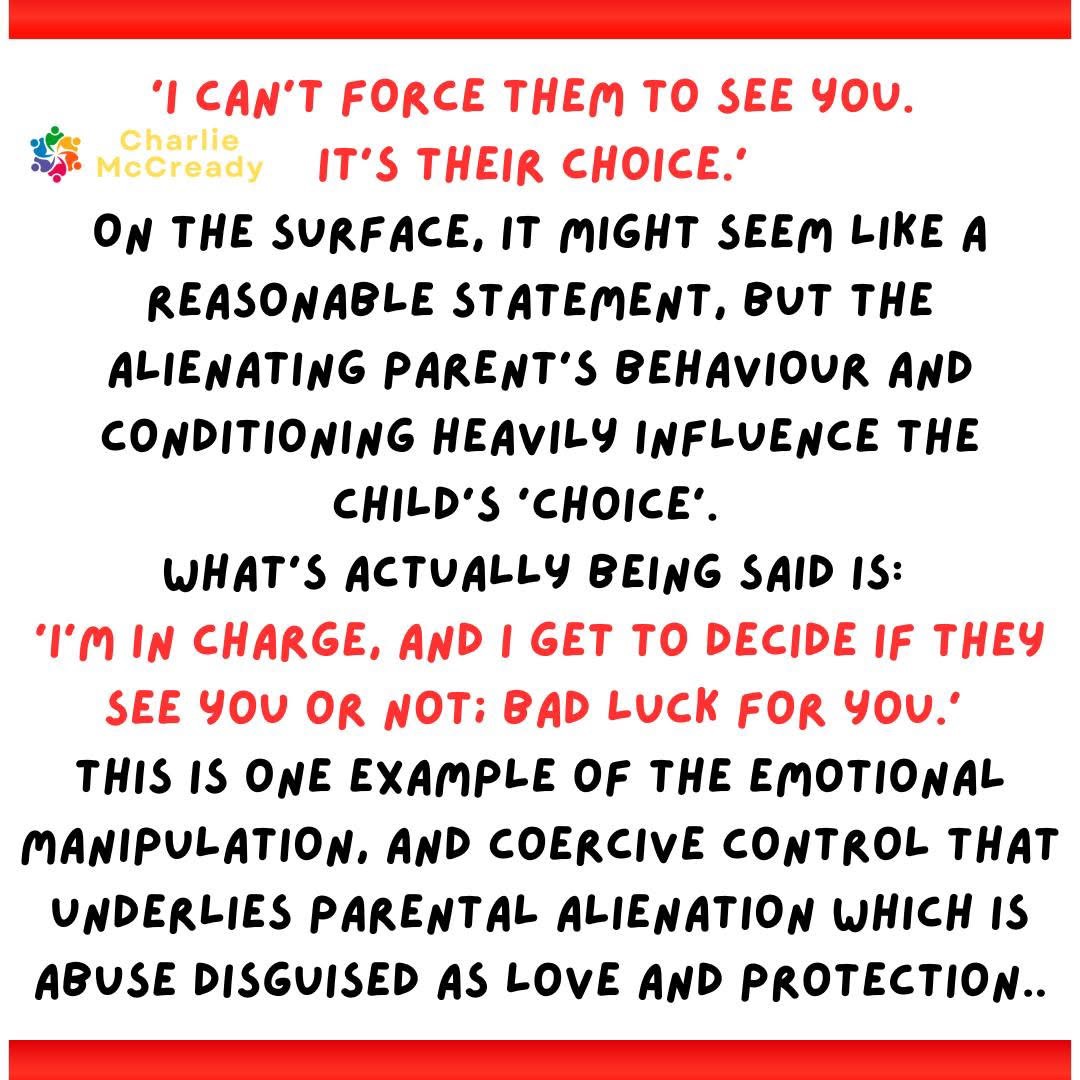
Taking, ‘it’s their choice’ at face value fails to recognise the extent of coercive control, psychological abuse, and manipulation at play, which can have profound negative effects on the child’s emotional development and well-being.
#charliemccready
#parentalalienationcoach
#adversechildhoodexperiences
#CoerciveControl
#custodybattle
#parentalalienation
#narcissisticparent
#mothersmatter
#FathersMatterToo
#FathersMatter
#FamilyCourt
#coercivecontrolawareness
#parentalalienationawareness
#mothersrights
#FathersRights
#ChildCustody
#traumabonding
#familycourts
Do courts favor women ?
Mediators – Craig Childress PsyD
Hmm… for mediators…
Mediators are often the first contact point for the mental health system, they are the interface between the legal system’s dispute resolution and mental health communication and negotiation skills.
They are also the system’s first contact point for the presence of a high-conflict narcissistic-borderline-dark personality parent in the family, which expands into clinical concerns for possible psychological child abuse if there’s significant child pathology present.
Mediators are not qualified to make the diagnosis – it’s a sophisticated pathology of patterns. However, they should be qualified to recognize the initial patterns of concern and recommend additional clinical diagnostic assessment for the family.
What child symptoms should warrant a referral for a clinical diagnostic assessment?
Any attachment symptoms, i.e., problems in love and bonding with either parent should receive a clinical diagnostic assessment of the child’s attachment pathology to the differential diagnoses of concern for each parent.
When we have significant attachment pathology displayed by a child, child abuse concerns become a prominent consideration and need a proper risk assessment to the differential diagnoses of concern for each parent.
Whenever there is post-divorce attachment pathology displayed by a child, Dr. Childress wants to be reassured about possible child abuse.
A child rejecting a parent is a disorganized attachment – i.e., the child has no organized strategy to bond to the parent. Disorganized attachment is caused by abusive or psychotic range parenting.
So… if the child displays no organized strategy to bond to the parent, then there is abusive or psychotic range parenting somewhere in the family. That is the type of parenting that creates disorganized attachment.
Look at the targeted parent first. Is the targeted parent abusing the child in some way? If not, then it’s the allied parent who is causing the child’s disorganized attachment to the targeted parent (for secondary gain to the allied parent).
One or the other. That’s the ONLY thing that causes that set of child symptoms – i.e., a child rejecting a parent, a directional change in a primary motivational system. If a child is rejecting a parent (disorganized attachment), then there is abusive range parenting by one parent or the other.
Diagnosing a persecutory delusion is an affirmative diagnosis. It’s not made based on history, we pop the delusion out right in our session using a Mental Status Exam of thought and perception, a sweep of their frontal lobe linear-logical reasoning system.
See Diagnosis Series 4: Diagnosing a Persecutory Delusion
Diagnosing a factitious disorder imposed on the child is a diagnosis by rule-out. To diagnose a factitious disorder we FIRST have to rule out all possible real causes, then we only have one thing left…. that it’s not a true pathology, it’s a false disorder (for secondary gain).
See Diagnosis Series 5: Diagnosing a Factitious Disorder Imposed on a Child
When the person produces a false disorder in themselves for secondary gain (often for financial gain), it’s a Factitious Disorder. When they produce a false disorder in the child for secondary gain (typically for emotional gain), it’s a Factitious Disorder Imposed on Another.
Wikipedia on FDIA says the diagnosis of FDIA is given to the adult, and the child receives a child abuse diagnosis.
From Wikipedia FDIA: “In DSM-5, the diagnostic manual published by the American Psychiatric Association in 2013, this disorder is listed under 300.19 Factitious disorder. This, in turn, encompasses two types: Factitious Disorder Imposed on Self; Factitious Disorder Imposed on Another (Previously Factitious Disorder by Proxy); the diagnosis is assigned to the perpetrator; the person affected may be assigned an abuse diagnosis (e.g. child abuse).”
Creating a delusional thought disorder in the child (a psychotic level pathology) that then destroys the child’s attachment bond to the other parent (a false/factitious attachment pathology imposed on the child for secondary gain to the allied parent), represents a DSM-5 diagnosis of V995.51 Child Psychological Abuse.
So? Is that what we have in this family? “I don’t know” is not a proper answer to the question. I’m asking if the child is being psychologically abused by a narcissistic-borderline-dark personality parent… that question needs a timely answer please.
In all cases of child abuse, we always protect the child.
All. Every time. We always protect the child from child abuse. Is there child abuse?
Mediators are the first contact point. There are two potential mediation topics – property and child custody. Financial property mediation is not a significant concern, get the accountants.
It’s the child custody concerns that raise possible child abuse issues. Is either parent worried about possible child abuse by the other parent?
If either parent is worried about possible abusive range parenting by the other (e.g., psychological child abuse), then a proper clinical diagnostic risk assessment for the child and family is warranted.
If you have a concern that the allied parent is psychologically abusing the child, tell the mediator. Tell the mediator you have an expert in clinical psychology who’s consulting on your family conflict and ask them to watch my YouTube video: Speaking to Court-Involved Mediators.
What video? The next one.
Craig Childress, Psy.D.
Clinical Psychologist
WA 61538481
OR 3942 – CA 18857

PA is a Sinister Form of Domestic Abuse
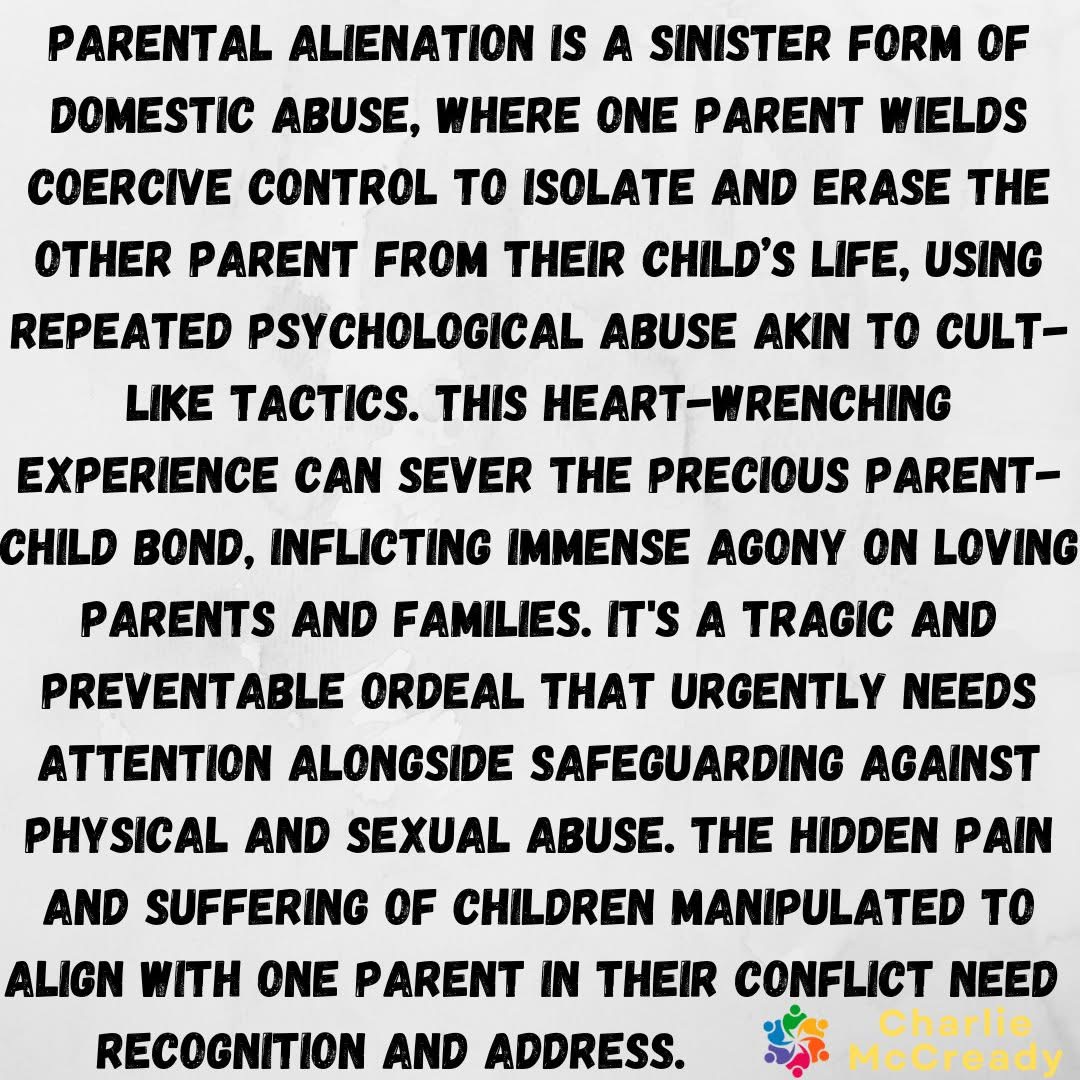
Parental alienation is a complex attachment disorder in which one parent psychologically, wilfully, and covertly conditions a child to fear and despise the other parent—whether mother or father. This results in the child’s unjustified rejection of a loving parent and anyone associated with them. Through a relentless campaign of lies, coercion, and manipulation, the alienating parent enforces their control, exploiting the child’s vulnerability. These destructive behaviours often surface after a high-conflict separation or divorce, stemming from a need for vengeance. While it’s non-gendered, it’s frequently associated with a cluster B personality disorder, such as narcissism. Parental alienation is not a custody issue—it’s a profound issue of child protection, a mental health crisis, and a form of psychological abuse that demands urgent recognition and action.
It goes by many names—‘the excluded parent’ phenomenon, pathogenic parenting, hostile aggressive parenting, child alienation, intractable contact, psychological manipulation, chronic litigation, spousal abuse, family bond obstruction… but by any name, it is abuse. And it is woefully misunderstood, maligned, and mistreated.
We are here to spread awareness, inform, and uplift. Millions are suffering in this pandemic of grief and injustice. This is a crisis that demands our attention.
Please follow me for daily insights, and visit my website to learn more about the coaching I offer—whether group sessions or 1:1 support.
#charliemccready
#parentalalienationcoach
#parentalalienation
#parentalalienationawareness
Emotional Coercion, Psychological Abuse & Manipulation- Charlie McCready
The idea that the alienating parent is not standing in the way of your relationship with your child is pure theatre. It’s an act. Behind the scenes, they’ve already given the child their lines and coached them into believing the character they’re supposed to play. Indoctrination, such as when a child is alienated and without justification for their rejection of you, is what’s happening. The child isn’t being given choices. They’ve already been coercively controlled and enmeshed into an alignment with the alienating parent.
A child’s expression of wishes holds such power and is often a deciding factor in proceedings concerning them, but it should be acknowledged as a voice, not a choice. Placing the child in a position where they must select one parent over the other goes beyond being inappropriate. Children often desire things at age 8 or 9 that they’d go nowhere near ten years later. I’ll give you an example. I thought it would be incredibly cool to be a lion tamer. Thankfully my parents didn’t think to put me in a lion’s den with a whip and a whistle, thinking that my needs must be met because this is what I believed was right for me. I also wanted to be able to fly, and they didn’t send me off to be operated on with wings attached to me surgically. Of course, children need to be heard, but they also have to be guided, nurtured, given boundaries while not being totally indoctrinated. Children might not know better than to wish for something detrimental to them, as in the case of being allowed to choose to reject a loved, loving parent, having been encouraged by the alienating parent to do so.
Research shows that many adults who, in their youth, rejected a parent, having been given a lot of pressure to do so by the other parent, later came to regret it and wished somebody would have had the sense to help them realise this was not a good idea – friends, family, legal or mental health professionals, anybody.
Taking, ‘it’s their choice’ at face value fails to recognise the extent of coercive control, psychological abuse, and manipulation at play, which can have profound negative effects on the child’s emotional development and well-being.
#charliemccready
#parentalalienationcoach
#adversechildhoodexperiences
#CoerciveControl
#custodybattle
#parentalalienation
#narcissisticparent
#mothersmatter
#FathersMatterToo
#FathersMatter
#FamilyCourt
#coercivecontrolawareness
#parentalalienationawareness
#mothersrights
#FathersRights
#ChildCustody
#traumabonding
#familycourts
Craig Childress, PsyD – Resume
I’ve got my new three licenses business card. Notice you’re third on the list of what I do.
Top of this list is early childhood ages zero-to-five. Then comes ADHD and grumpy angry kids. Then you in the family courts, then adults on personal growth issues.
Now that I have my WA license I’m going to go around the the local preschools to make them aware I’m here. I’m going to offer free consultation to preschools and parents of wee-ones on any domain of concern.
You’re paying for it. I’ll make my money off of you as a consultant in the family courts – that way I can offer free consults to preschools and parents of wee-ones.
Chalk it up to your karma – good job – you’ll be helping the little ones get a healthy start.
Then I’m going to open up an ADHD grumpy-kid practice online in three states, the Pacific coast of CA, OR, and WA. I use a parent-training consultation model with ADHD and ODD (there’s no such thing), which fits well with an Internet mediated service delivery in the states I’m licensed.
Then… I’ll post foundational seminars to YouTube on the diagnosis and treatment of ADHD and grumpy-angry kids – and – on parenting early childhood kids with challenging stuff (autism spectrum and emotional regulation problems).
I’ll bill for the ADHD clients ’cause that’s something entirely separate. Working with the wee-ones is for me, I like the little guys. Solving ADHD is for you guys.
The adult section of my practice is going to expand into death and dying. I’ve worked within that domain in the past with cancer kids at Children’s Hospitals – except they didn’t die because they have good doctors at Children’s Hospitals.
But death and dying is always within a zone of consideration whenever cancer is the diagnosis. When I entered private practice I joined a practice with another cancer psychologist in Pasadena. He worked with adult cancer patients, and I worked with kid cancer patients and their families.
I also have some background in geriatrics. When I entered private practice I checked out the two pathologies I’d never worked with – family court custody conflict and geriatrics. I’ve worked with everything else.
I got a job going to various “assisted care” facilities to assess and treat mental health issues there. THAT is depressing work. I don’t want to work geriatrics like that.
The old are our abandoned. No one sees, no one comes, they are alone. Whoa. Of the two, you needed me more. You have active child abuse (and spousal abuse) undiagnosed and untreated. Child abuse and attachment trauma is my pathology.
So I came to the family courts and fixed things here. There was a lot of fixing to do – you had (have) broken systems. Bad things were (are) happening… by the psychologists.
They are in the “betrayer” role in trauma – the one who should protect… and doesn’t. Oh my… patients should NEVER need to explain the pathology to the doctor. You need to explain the pathology to your doctors.
That’s so bad. So I did things. Now those things are evolving into solutions to fix the broken systems. Once the systems are fixed… you won’t need me anymore.
Hooray! A good clinical psychologist is always working themselves our of a job. For ADHD, for example, I want to fix your problem in six to twelve weeks – of consultation – six to twelve weeks is roughly how long I need to teach parents how to do the relationship based treatment… to fix things.
Less time for the grumpy-angry kids. Holy cow, “Oppositional Defiant Disorder” is such an easy fix – four to six weeks of consultation (then occasionally as-needed).
Do you know what’s easier to fix than ODD (grumpy-angry)? Attachment pathology. With a cooperative parent, I’d anticipate two to six weeks for substantial gain, and twelve weeks for full resolution.
The problem with attachment pathology out in the wild is that we don’t have a cooperative parent. We have a substance abusing parent or a narcissistic-dark parent. Then it becomes a child protection issue and we have to fix the attachment damage in other ways.
I’m a full scope clinical psychologist. I can seriously answer your questions on anything clinical psychology. Anything. Without looking it up, it’s all in my head.
That’s because I’m an old clinical psychologist – it’s the old part.
Now I’m an old-guy too, and I’m specialty trained in humanistic-existential therapy. I figure I can help other old folks along the Pacific coast where I’m licensed via the Internet.
Death and dying makes people uncomfortable, not me. I suspect I can help with transitions.
So individual adults are number four on my list of to-do.
You’re fixed. The moment you want to solve things – you solve things. As long as you don’t want to solve things – you won’t solve things.
It’s a motivational pathology. I’m working on that. We should be transitioning soon. Wheee…
Into complete destruction… then out into a full solution.
If you want to know what’s coming, look where Dr. Childress is positioning himself. I don’t live in today because today keeps vanishing. I live and work in tomorrow, because tomorrow keeps arriving, which makes my life now so much easier.
Oh look, the Petition to the APA just arrived – five years (minus two years for Covid), my estimates are pretty precise.
In five years I’ll be leaving not arriving. This next phase is building out my online presence in ADHD and Early Childhood, and I’ll finish my Diagnosis book and a second edition of Foundations.
Journal articles are in the works. It’s time now.
You know what happens when I have three licenses across the Pacific Coast, right? You have read the ancient prophesies about the Kraken that I’m just now making up, right?
Never mind, it’s too late for you to learn now. Just wait, it’ll all unfold in the calculational lines of the ruliad for observers like us.
Craig Childress, Psy.D.
Clinical Psychologist
WA 61538481
OR 3942 – CA 18857

Parental Alienation- Charlie McCready
“The only thing necessary for the triumph of evil is for good men to do nothing.” – Edmund Burke
The problem with good people doing nothing, often due to constraints like job remits or instructions not to step in and take action, is that it sometimes allows harmful situations or injustices to persist unchecked. Their inaction enables the continuation of wrongdoing, And so it is with parental alienation.
There’s a story about a teacher with a fishbowl on his desk. Before leaving the room, he gave strict instructions to his class not to touch the fish. He took a fish from its bowl and placed it on his desk. When the teacher had gone, the school kids stared at each other, shrugging their shoulders, confused and unsure what to do. They sat there. They stared at the fish, flapping desperately. Dying before their very eyes. One girl couldn’t bear it anymore. She rushed to the desk and put the fish back in the bowl. The teacher returned to the class. She expected to be reprimanded, but she didn’t care. Nor did he. Instead, he congratulated her and proceeded to give a lesson on how it’s sometimes best to break the rules, especially in a life-and-death situation.
The problem with legal and mental health experts is that they tend to go by the book, but as parental alienation is yet to be recognised officially, there is no standardised method of identifying it, taking action, or supporting the true victims of this psychologically abusive family violence – the children and ‘target’ parents. Too often, they do nothing. And this is worse. It’s harmful to do nothing.
However, I do believe this will change. Just as we now know, cigarettes are not healthy. We have safeguarding measures for domestic abuse (especially women). In time, parental alienation will be recognised as abuse.
#charliemccready
#parentalalienationcoach
#alienatedchild
#childpsychologicalabuse
#familycourts
#parentalalienationawareness
#custody
#FamilyCourt
#parentalalienation
#healing

 GreatCosmicMothersUnite