

Tag: child Psychological abuse
Parental Alienation – Jordan Peterson
Father Wound
Children waking to Pathogenic Parenting – Charlie McCready
As they grow older and gain more life experience, the alienated child may start to question the narrative that has been imposed upon them and realise the manipulation and control tactics employed by one of their parents (typically it’s a parent). They may become aware of the discrepancies between the image of the targeted parent presented by the alienating parent and the reality they observe themselves. This is why it’s so important we do all we can to remain non-reactive, calm, loving … as I cover in many of my posts.
This realisation can be a gradual process, sparked by various factors such as interactions with the targeted parent, exposure to different perspectives, or their own inner reflection. As the child starts to critically analyze the situation, they may begin to see the patterns of emotional manipulation, denigration, and falsehoods employed by the alienating parent. They may recognise the parent’s ulterior motives, such as jealousy, vengeance, or a desire for control.
Becoming aware of the disordered parenting of the alienating parent can be a transformative and emotionally challenging experience for the child. It may evoke a range of emotions, including anger, confusion, and a deep sense of betrayal. However, this awareness can also be a catalyst for personal growth and healing as the child begins to reclaim their own voice and establish their own identity independent of the alienating parent’s influence. It opens the door to the possibility of reconnecting with the targeted parent and developing healthier relationships based on truth, understanding, and mutual respect.
Hold on, my friends. Stay strong. Stay loving. Strive to be happy.
#charliemccready
#parentalalienationcoach
#reactiveabuse

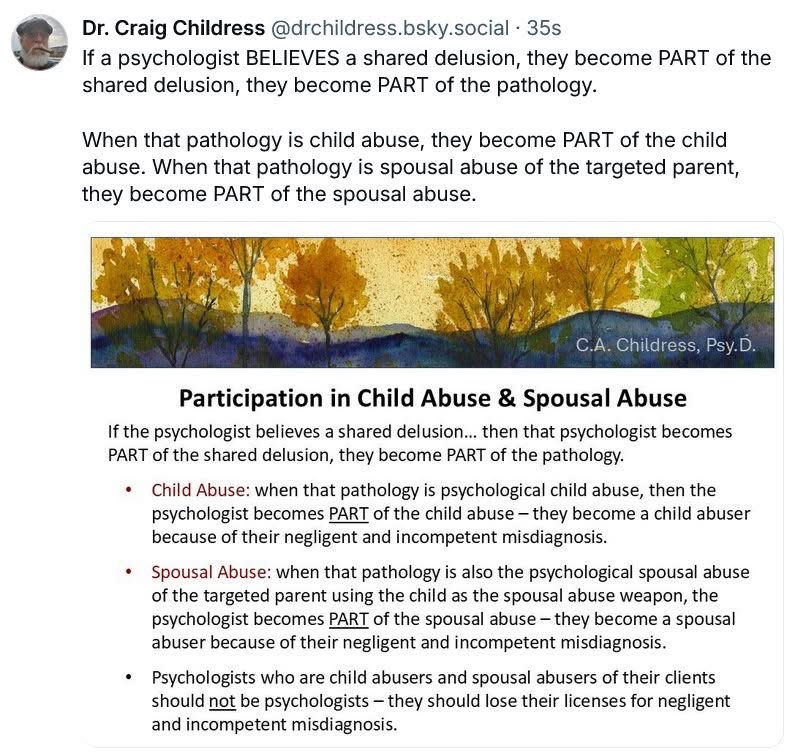
Participation in Child Abuse & Spousal Abuse – Craig Childress PsyD
All psychologists – all mental health professionals – have a duty to protect.
There are three dangerous pathologies – suicide – homicide – abuse (child, spousal, elder). Whenever a psychologist encounters a potentially dangerous pathology (suicide, homicide, abuse), duty to protect obligations are active and the psychologist must take three actions:
1. Conduct a proper risk assessment for the danger involved – suicide, homicide, abuse – or ensure that a proper risk assessment gets conducted (such as referring the suicidal person to the ER for evaluation, notifying the police of a homicidal danger).
2. The psychologist must take an affirmative protective action (such as increasing frequency of therapy for a suicidal client).
3. The psychologist must chart the affirmative protective action taken in the patient’s medical record – if it’s not charted, it never happened.
There are two possible causes of a child rejecting a parent (a child seeking to flee a parent), child abuse by the targeted-rejected parent – OR – child psychological abuse by the allied parent (i.e., inducing a shared persecutory delusion and false/factitious attachment pathology in the child for secondary gain to the allied parent).
In all – all – cases of a child rejecting a parent (a child seeking to flee a parent), duty to protect obligations are active based on the child’s symptom display and a proper risk assessment needs to be conducted to the appropriate differential diagnoses for each parent,
Failure to conduct a proper risk assessment for a dangerous pathology or to ensure that a proper risk assessment is conducted when a risk assessment is warranted by the symptoms and context represents a negligent failure in the psychologist’s duty to protect.
From Wikipedia Duty to Protect: “In medical law and medical ethics, the duty to protect is the responsibility of a mental health
professional to protect patients and others from foreseeable harm.”
Cornell Law School Definition of Negligence: “Negligence is a failure to behave with the level of care that someone of ordinary prudence would have exercised under the same circumstances. The behavior usually consists of actions, but can also consist of omissions when there is some duty to act.”
A psychologist who becomes a participating child abuser and spousal abuser because of their negligent misdiagnosis should NOT be a psychologist.
Someone will need to explain to me why an incompetent psychologist who is a participating child abuse and spousal abuser of their clients because of their negligent misdiagnosis should be a psychologist.
From where I sit – participating child abusers should NOT be psychologists – participating spousal abusers should NOT be psychologists.
All psychologists have a duty to protect.
Craig Childress, Psy.D.
Clinical Psychologist
WA 61538481
OR 4392 – CA 18857
Child who estrange us❤️💯
I saw this picture today that captures, via the artist’s rendering, just one of the emotions we feel as mothers of children who estrange us.

Parental Alienator
Narcissist Relationships
When you’re in a relationship with a narcissist, there will always be another secret life going on behind your back.
This is because these people are very empty, and they need stimulation from multiple sources just to face existence. They’ll be doing drugs or pornography. They’ll be stringing multiple partners through flirting and emotional affairs. They will be chasing financial intrigue that occasionally gets them into scams and trouble.
The reason they must flirt with other people is also because they’re seeking to move on to other people who don’t know the games they play.
They know they’ll get bored with you eventually, or you’ll learn to resist their shenanigans. And since being alone would kill them, they begin to groom possible replacements among anyone whom they can charm.
You’ll also notice this habit of making promises to you and then using those promises as a dangling carrot to get compliance from you. If you don’t do what they want, they’ll withdraw the promise.
Sometimes, they’ll deny having promised at all, or they postpone it until you give up. The truth is that they never intended to fulfill it in the first place.
Narcissists have lost all sense of right and wrong. Everything is about satisfying themselves.
When you finally leave, they’ll circle back to you, pretending to be checking on you when actually they’re checking if they still have access.
If you have a child with them, they would weaponise that child to torture you until you cut them off totally or you manage to enforce boundaries with the help of the law.
But the child will be scarred or wasted by the counter parenting and objectification from the narcissist.
Society knows very little about narcissists.
Sometimes, you stay because you fear the pain of letting go until you realize the pain you’re already taking for holding on.
Other times, you think you’re staying for the children until you realize that the narcissist is turning all of them into other small narcissists and broken empaths.
Your solution is to recognize that this person is incapable of peace. They’re only excellent at pretending and confusing you.
You will never have a life until you detach from them and direct your life towards wholeness and emotional stability.
#karmasays
Disclaimer : I hereby declare that I do not own the rights to this post.
All rights belong to the owner.
©️ No Copyright Infringement Intended.

Craig Childress PsyD – Case Manager
Hey – hey – hey – have I got news for you.
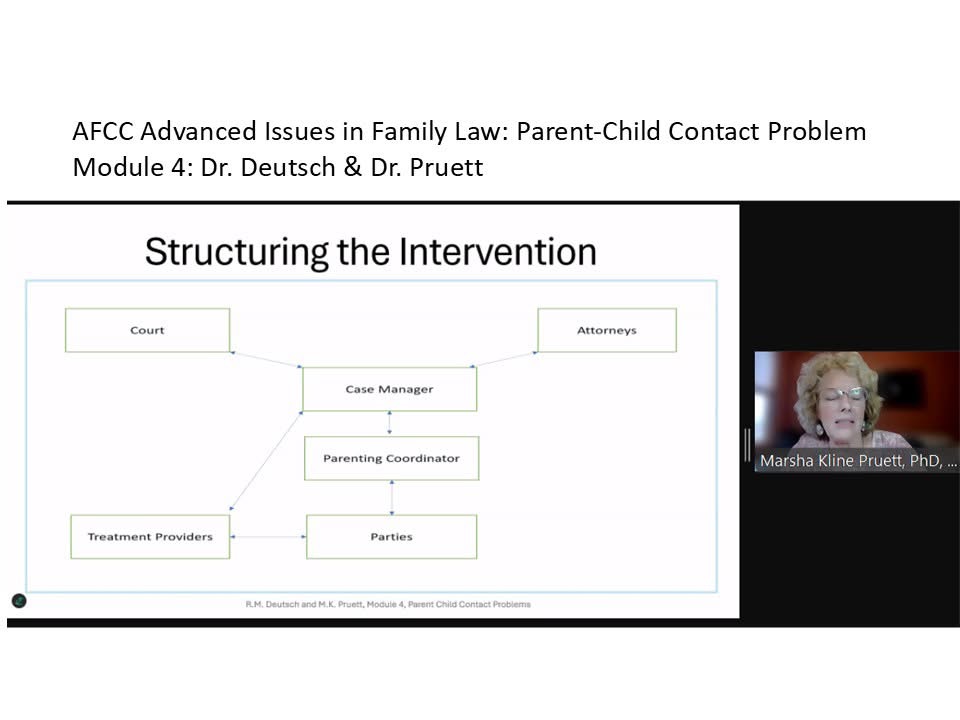
The forensic psychologists – Drs. Deutsch & Pruett – are recommending a Case Manager to oversee family treatment – as a liaison role between the family therapist and the Court.
See – here’s their chart. They put the Case Manager in a connecting liaison role with the Parenting Coordinator, the Family Therapist, the Attorneys, and the Court.
See that? The only people the Case Manager doesn’t connect to is the litigant parents (who are being treated by the family therapist).
I could do that.
That’s the perfect role for me, don’t you think? If someone suggests a Case Manager – say okay and propose me.
I’ll make sure the child and family receive a high-quality assessment that accurately diagnoses the pathology in the family 100% of the time with effective treatment fully resolving the diagnosed problem in six months.
I can do that.
I’m a clinical psychologist – I know about treatment – I’m a clinical psychologist, and I know what diagnosis guides treatment. I know how to do that – diagnose and treat pathology – I can work with the involved professionals and make sure that happens.
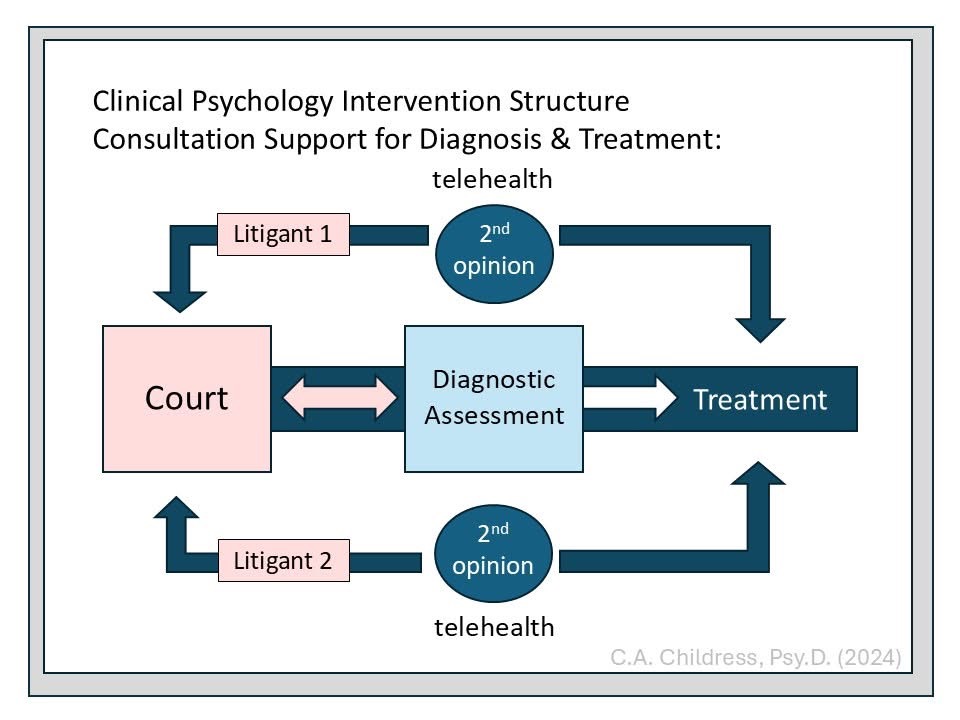
Isn’t that interesting? I think so. I have another model actually, based on a standard healthcare model of second-opinion consultation.
I don’t think we need a Case Manager ($$$) or a Parenting Coordinator ($$$), and the Attorneys hardly at all hopefully ($$$).
We need to stop adding people to the parent’s payroll.
I think Dr. Deutsch and her friends want to be Case Managers who don’t actually do anything except tell other people how to not do anything too.
But hey, if somebody wants a Case Manager – I’ve lead treatment teams with CPS involvement. I can organize a treatment team and make sure the Court gets accurate information (and effective treatment) from the mental health services.
I can do that.
Hey… do you know what we should do? Debate the two structures. The AFCC can host an online Debate:
Debate: Forensic vs Clinical Intervention Structures
Clinical Intervention Structure: Dr. Childress
Forensic Intervention Structure: Dr. Deutsch
That’d be fun.
Craig Childress, Psy.D.
Clinical Psychologist
WA 61538481
OR 4392 – CA 18857
Weaponized Children waken
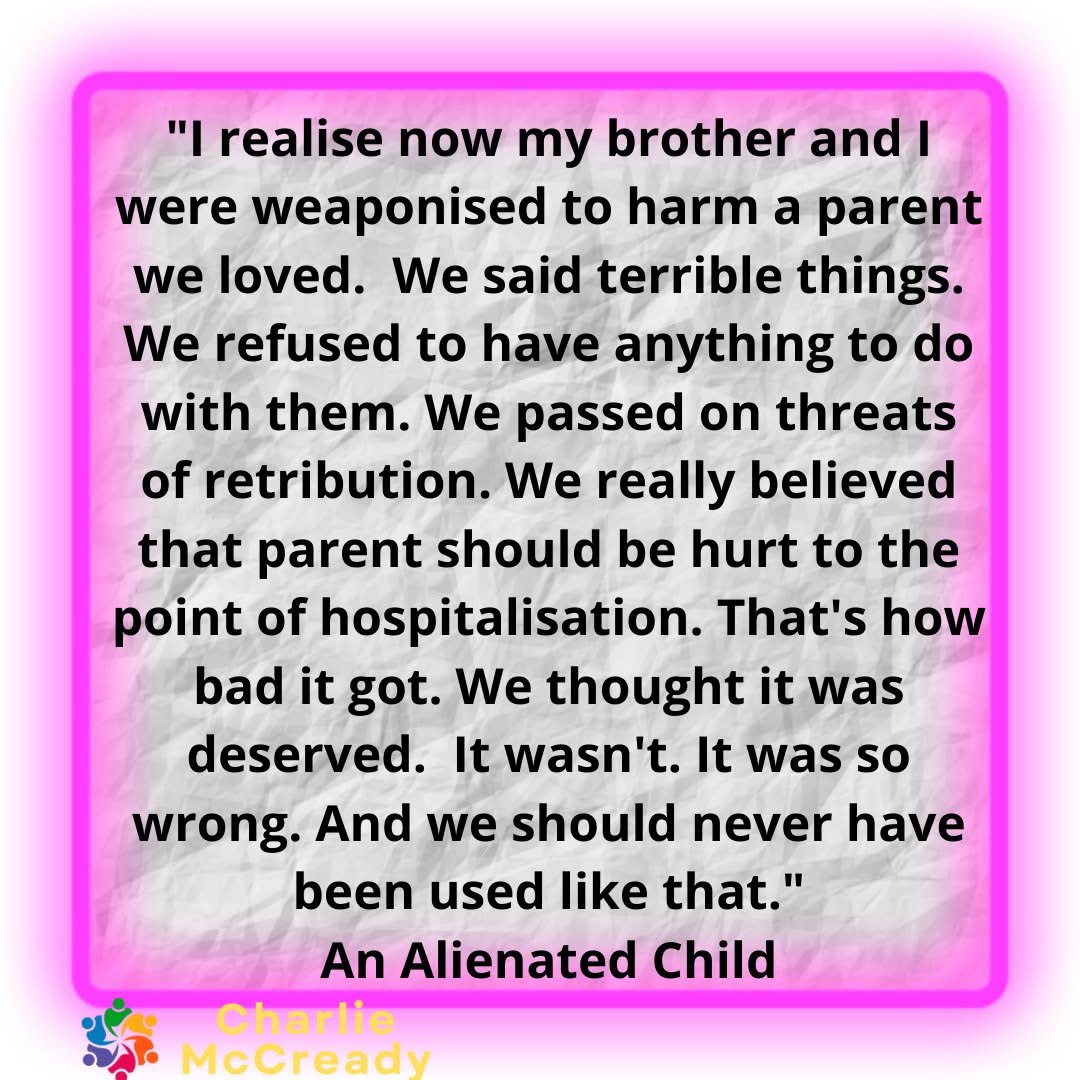
As an alienated child grows older and gains more independence, they may begin to have a deeper understanding of the manipulation and coercion they experienced. They may start to realise that they were used as a weapon to reject a parent they once loved and who loved them unconditionally. This realisation can evoke a wide range of emotions, including betrayal, anger, confusion, and sadness.
The alienated child may feel betrayed because they were led to believe hurtful and false narratives about the targeted parent, causing them to say and do things that they now recognise were unjust and harmful. They may feel guilty and regret their actions, and have different ways of dealing with this.
As they mature and gain a broader perspective, some alienated children may try to see both sides of the story rather than solely aligning with the aggressive alienating parent. They may feel a longing to reconnect with the rejected parent and seek understanding and reconciliation. However, the process of navigating these complex emotions can be challenging, as they may still harbour feelings of anger and resentment towards the alienating parent. They may also have to work hard to ‘deprogramme’ as if detoxing from years of poisonous narratives.
Ultimately, each alienated child’s experience and feelings may vary based on their unique circumstances and individual resilience. Some may choose to distance themselves from the alienating parent, on realising the toxicity of the relationship, while others may strive to establish a healthier connection, aiming for personal growth and healing. The journey towards finding peace and restoring the parent-child relationship can be a difficult and multifaceted one, requiring support, therapy, and a commitment to self-reflection and understanding.
#charliemccready
#parentalalienationcoach
#parentalalienation
#FamilyCourt
#parentalalienationawareness
#childcustody
#custodybattle
 GreatCosmicMothersUnite