

Tag: education
Giving / Relationships
Inverted Polarity / Men-Women
Freeze Mode via Narcissist
Oceans Below Earth
I’ve heard this for years and believe it could be true
Cro- Magons
My information says Cro- Magons originated in East Africa and were O – blood types
Eat Right for your blood type and the companion supplement, book was my source of information.
Stone Age ingenuity! This 15,000-year-old hut in Mezhirich, Ukraine, was built by Cro-Magnons using mammoth bones!
What are Cro-Magnons?
Cro-Magnons and modern humans (Homo sapiens) share many similarities, as Cro-Magnons are an early group of Homo sapiens. However, there are a few differences that can be noted:
Time Period:
– Cro-Magnons: Lived approximately 40,000 to 10,000 years ago during the Upper Paleolithic period.
– Modern Humans: Represent the current population, with a continuous presence from around 200,000 years ago to the present.
Physical Characteristics:
– Cro-Magnons: Generally robust and muscular with broader faces, prominent brow ridges, and larger jaws. Their cranial capacity was around 1,600 cubic centimeters, which is within the range of modern humans but on the higher end.
– Modern Humans: More gracile (slender) build with a smaller face, less prominent brow ridges, and smaller jaws. The average cranial capacity is about 1,350 cubic centimeters.
Cultural and Technological Development:
– Cro-Magnons: Known for their advanced tool use, cave paintings, and sculptures. They had a complex culture with evidence of symbolic thinking, art, and possibly early forms of religion.
– Modern Humans: Have developed highly advanced technology, complex societies, diverse cultures, and sophisticated languages. Modern humans have made significant advancements in science, medicine, and the arts.
Genetics:
– Cro-Magnons: Genetically similar to modern humans, as they are direct ancestors. Some genetic differences exist due to natural selection and genetic drift over thousands of years.
– Modern Humans: Show a wider genetic diversity due to the larger and more interconnected global population.
Habitat and Adaptation:
– Cro-Magnons: Primarily lived in Europe and Western Asia, adapting to the cold climates of the last Ice Age.
– Modern Humans: Inhabit diverse environments across the globe, from the Arctic to tropical regions, with advanced technology and culture aiding in adaptation.
Where are they? Did they go extinct?
The term “extinction” may not be entirely accurate when referring to Cro-Magnons, as they are considered an early group of Homo sapiens, and their genetic legacy continues in modern humans.
Cro-Magnons interbred with other Homo sapiens populations and possibly with Neanderthals. This genetic mixing led to the integration of Cro-Magnon genes into broader human gene pools, making it difficult to distinguish them as a separate group over time.

Boys who deserve more activity
Ancestral Wisdom
Raised by parents who were raised by farmers and in the Depression era and held all things in that trauma .
Before he exited , Dad was showing so much gratitude for each and everything I did for him ; he often asked if I were taking such and such , and I said no Dad, I’m leaving it for you !
His whole demeanor changed to a softness and gratitude was there 💯❤️
Dad was also responsible for showing me how to repurpose things and how maintenance and rehabbing helped lengthen the life of something !
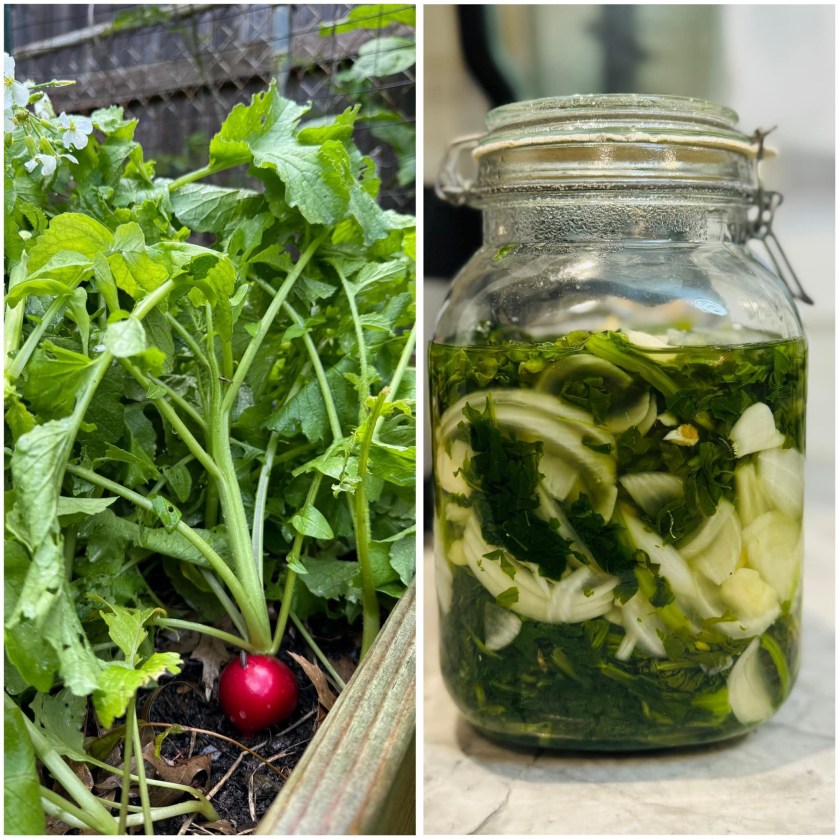
I called my Mom to lament my failed radish crops this year. Due to the unexpected heat wave in early April, most of the cool-weather radishes bolted early and failed to develop the crunchy bulbous roots that all gardeners look forward to as an early Spring harvest.
But in her usual true fashion, Mom calmly shrugged with a graceful “That’s okay!” – her signature response to anything from a trivial disappointment to a life-altering crisis. “You can make Dưa Củ Cải Chua with the green leaves,” referring to the traditional Vietnamese fermented mustard greens, but instead of mustard greens (Dưa Cải), this version would use radish greens as an alternative (Dưa Củ Cải).
It was a brilliant idea that illustrates the two enduring principles behind everything Mom does: 1) Do what you can with what you have, and 2) waste nothing. And not only Mom, but all of my ancestors have latched on to these two anchoring lessons in order to sustain our bloodline this far, after so many years of war, colonialism, and upheavals that constantly uprooted their lives.
They have mastered the art of taking the good with the tragedy, even when the only good is the fact that the tragedy is finally over, like when a band aid that has been slowly tearing off the fresh wound is finally lifted from the tender skin. They never were afforded the time to wallow in their grief for too long.
After all, when my great-grandmother, her daughter-in-law, and her two-year-old grandson were separated from the adult male members of the family on May 1st, 1975 on the refugee ship, the first words my great-grandmother stoically told her daughter-in-law were: “From now on, your focus is to raise and protect your son. You don’t worry about where your husband is.”
Keep in mind: her daughter-in-law’s husband is her SON. It probably took all of her strength to be that composed about possibly never seeing her son again, but like all of my ancestors who had no choice, she focused on what she could control at the time. It wasn’t the only time in her life when that laser-sharp sense of focus had to be summoned.
That was an extreme example, of course, but I’m grateful to have these stories and wise sage like my Mom to reshape my perspectives in any situation, and to remind me of the ONLY two principles I need to know: 1) Do what you can with what you have, and 2) waste nothing.
‼️ I will share the Dưa Củ Cải Chua recipe below ⬇️ for those who are interested.
Soul Crushed -Deeply Painful / Rewiring =Cold Individual
Breastfeeding produces protection for generations against breast cancer
I breastfed all 3 sons

