The hidden pathogen- Childress

Childress – 2015: 1) Remain Hidden

“What makes this pathogen so particularly malignant and dangerous is that it has a very sophisticated defensive structure. In all my years of providing psychotherapy, I’ve never seen a pathogen’s defensive structure this sophisticated, and dare I say, elegant. The defensive meme-structure (information structure) of this pathogen is extraordinary.

There are three components to the defensive meme-structure of this pathogen

Stay Hidden

The pathogen hides by projecting the focus of blame. The two major projections of blame are,

1) Onto the child; (“It’s not me, it’s the child that… xyz”)

2) Onto the other parent (“It’s the other parent who is the source of the problem.”)

It’s in this latter projection of blame onto you, the other parent, where this pathogen truly excels. Absolutely masterful defensive manipulation of blame onto you. I describe this in Foundations. This defensive meme-structure can reach truly masterful levels of interwoven manipulation and exploitation.

Throughout the alienation process, which can span years of continuing alienation, the pathogen is consistently able to keep the focus of external scrutiny on the parenting practices of you, the targeted parent. And even though you are entirely a normal-range and loving parent, no one ever believes that you are.

Why is that?

It’s a defensive meme-structure of the pathogen. I know what it is and I can describe it in detail. And we will be disabling it. The pathogen lays hidden in the shadows, in the dark recesses. We will be exposing the pathogen to the light.

The pathogen also stays hidden behind the child (that’s, in part, how it keeps the focus on you). It is essentially using the child as a “human shield.” No one sees the pathogen because they naturally assume the child is authentic. No. When this pathogen enacts the pathology, it steals the authentic child.

The child is caught in a role-reversal relationship with the narcissistic/(borderline) parent and is being used as a “regulatory object” to regulate the emotional and psychological state of the parent…

The pathogen remains hidden behind the child.

When other people, including therapists, assume (falsely) that the child is authentic, this then redirects the focus of external attention onto you. By remaining hidden, the pathogen is safe to enact the pathology.

When someone is able to penetrate the veil of concealment that hides the pathogen from view, and so sees the pathogen directly, this exposure of the pathogen threatens the ability of the pathogen to enact the pathology. In response to threat, a second level of defensive meme-structures are activated; ATTACK
ATTACK – Viciously

When the pathogen is seen, the person who has exposed the pathogen becomes a threat to the pathogen’s ability to enact the pathology.

The pathogen needs the pathology. The pathogen requires the pathology. This need to enact the pathology is at the level of a neurologically imposed psychological imperative. There is no other alternative for the pathogen. It MUST enact and maintain the pathology.

When you become an ex-husband, it is an imperative imposed by the structure of the pathogen that you also become an ex-father. There is no other alternative for the pathogen. This MUST occur. When you become an ex-wife, you must become an ex-mother as well. This is a neurologically imposed imperative for the pathogen. There is no other alternative possible for the pathogen.

The pathogen NEEDS the pathology. It requires the pathology.

When someone penetrates the veil of concealment and sees the pathogen, this threatens the pathogen’s ability to enact the pathology. The response of the pathogen to threat is to attack with incredible viciousness and a complete disregard for truth, accuracy, and reality.

Truth, accuracy, and reality will offer NO defense against the pathogen. The attack is not designed to destroy you (in which case truth, accuracy, and reality would provide a defense). The attack is designed to disable you, to nullify your threat, to nullify your ability to interfere with the enactment of the pathology.

The attack is to put you on the defensive, and to put the focus of attention onto you, and thereby take it off the pathogen. Whether the attack succeeds in harming you is secondary to its defensive role of putting the threat posed by the other person on the defensive and thereby nullifying the threat.” (Childress, 2015)

Craig Childress, Psy.D.
Clinical Psychologist, CA PSY 18857

Inherited Bequests Trauma for a child – Craig Childress PsyD

From Shaw: “Exposure to parental narcissistic pathology constitutes cumulative relational trauma, which subverts the development of intersubjective relating capacities in the developing child. This trauma is inherited and bequeathed intergenerationally.” (p. 46)

Shaw, D. (2010). Enter Ghosts: The loss of intersubjectivity in clinical work with adult children of pathological narcissists. Psychoanalytic Dialogues, 20(1), 46-59.

The pathology in the family courts is parental narcissistic-borderline-dark personality pathology. As professionals, both legal and mental health, we need to know where we are.

When we work in ADHD, there’s a set of factors that become part of the picture for that pathology, impulsivity, school behavior problems, medication trials. When we work autism there’s a set of factors that become part of that picture, ABA, special ed at school, sensory regulation.

When we work in the family courts surrounding high-conflict custody litigation, there’s a set of factors that are part of the picture. Parental narcissistic-borderline-dark personality spectrum pathology is a primary defining factor of the pathology.

In the family courts, we’re into the personality disorder spectrum of pathology – narcissistic-borderline-dark personalities; the Dark Triad, Vulnerable Dark Triad, Dark Tetrad.

The pathology in the family courts is a trauma pathology rippling through the family from prior generations. The trauma is currently contained in the personality pathology of the parent. The trauma pathology is being transferred intergenerationally to the child (Shaw, 2010).

The symptom of the trans-generational trauma is the attachment pathology in a parent-child bond. We know it’s a trauma pathology by the severity of the symptoms – trauma adds the adjective “extreme” to any symptom.

Extreme sadness, suicidality – trauma
Extreme anxiety, panic – trauma
Extreme anger, rage – trauma
Extreme behavior, out of control – trauma

When “extreme” is added to any situation, we’re in a trauma pathology. If you’re working with trauma pathology, you MUST know van der Kolk and complex trauma.

van der Kolk and others offer training for professionals in trauma and child development understanding related to complex trauma. Parents, you can take these courses as well. Knowledge is a wonderful thing to have.

NICABM Training
https://www.nicabm.com/

I’m a trauma psychologist out of foster care. I’ve worked child abuse and trauma up-close and personal. I know child abuse. I understand what trauma does.

I’ve also taken the courses offered through NICABM and placed them onto my vitae. I’m a role-model. I’m not an expert, I’m basic competence. If you’re working in the family courts… you should know as much as me.

If you’re working with child abuse and trauma and you don’t know as much as Dr. Childress does about child abuse and trauma, why not? Are you just lazy? Must be. Or don’t you think knowing what you’re doing is necessary to what you do?

Do you think you’re entitled to be ignorant?

You should know more than me. I’m the baseline, I’m the floor not the ceiling. I’m basic competence.

The lives of these children in the family courts hangs in the balance of our professional knowledge and competence. They deserve the highest caliber of professional knowledge and competence.

The highest.

The decision before the court is hugely momentous for determining the future life-course for a child. The court deserves the highest caliber of professional knowledge and competence to assist in its decisions.

The highest.

We have obligations. If that’s too hard, if you don’t want to be the best there is, then go work somewhere else, don’t come to the family courts. Here… we have obligations.

Bowlby – attachment. Know it.

Minuchin – family systems. Know it.

Beck – personality disorders. Know it.

van der Kolk – complex trauma.. Know it.

DSM-5 – know it – use it. Diagnose the pathology – V995.51 Child Psychological Abuse; V995.82 Spouse or Partner Abuse, Psychological. Protect the child. Protect the parent.

We have obligations. The pathology in the family courts is a trauma pathology – narcissistic-borderline-dark personality pathology transferring trauma intergenerationally to the child through the pathogenic parenting that unresolved trauma creates.

In all cases of severe attachment pathology surrounding child custody conflict, a proper risk assessment for possible child abuse needs to be conducted to the appropriate differential diagnoses for each parent.

Google negligence: failure to take proper care in doing something

Trauma is pattern. Pattern repeats itself. Until we stop the trauma from repeating itself – we must protect the child.

Craig Childress, Psy.D.
Clinical Psychologist, CA PSY 18857

Narcissistic Alienating parent

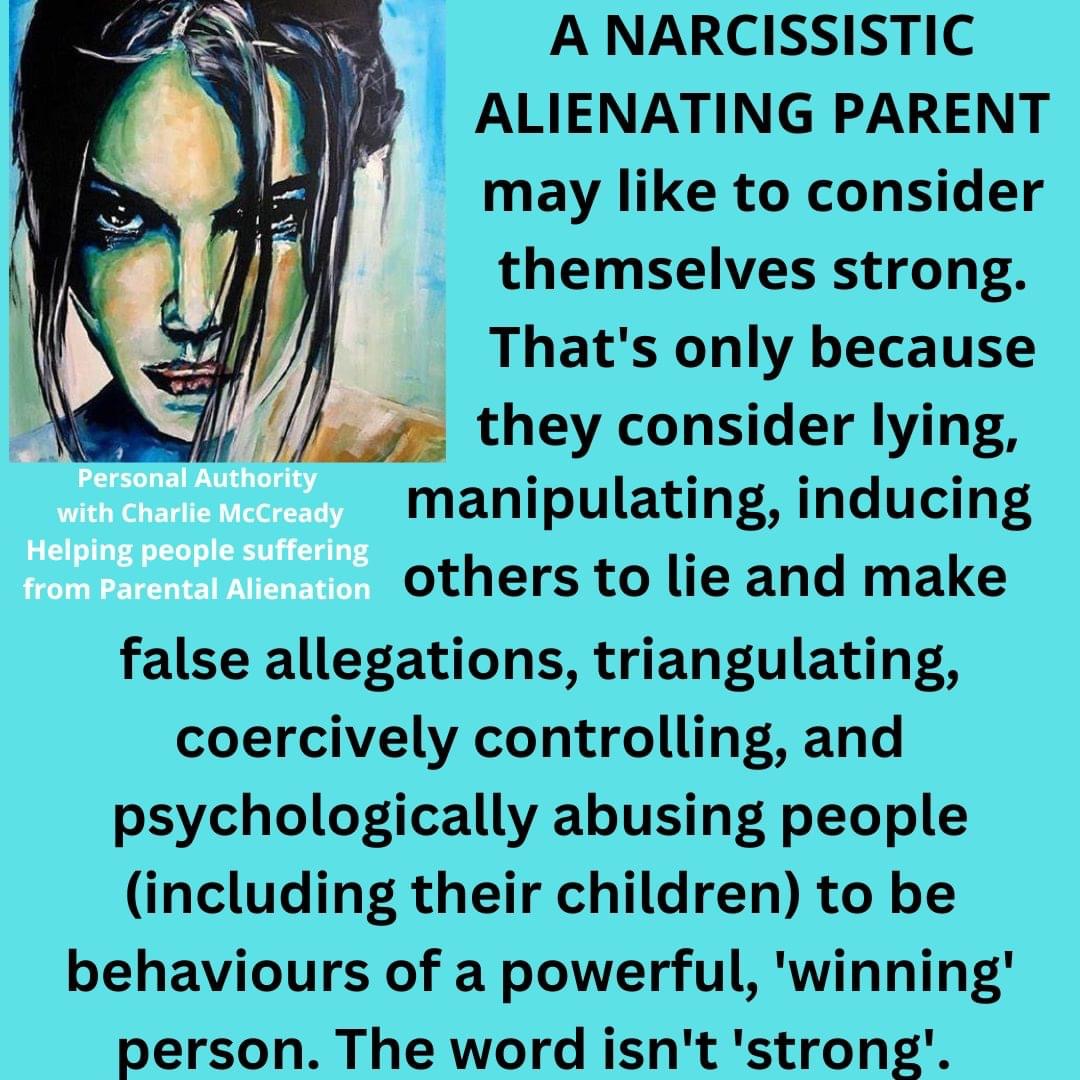
Alienating behaviours generally fall into the category of narcissistic/borderline personality disorders. But they don’t think of themselves like that, such is their grandiosity and delusional mindset of superiority. Unfortunately, they typically refuse cooperation and cooparenting and counselling. They’ll make excuses – including lack of funds. But they’ll happily waste money on custody battles, and prolonged litigation. All they care about is ‘winning’ which is at the cost of everyone else. They don’t take responsibility or look for solutions; instead they blame others, and consider any solution offered to be a threat. Often the narcissistic alienating parent will be the most confident, charming one, they present well because they’re so sure of themselves and the indoctrination of the child, they’re confident they’ll fool everyone. The first person they delude is themselves – that they’re loving, protective and strong. In truth, they’re afraid of ‘losing’ and of sharing, they’re jealous of anyone else having something they believe is theirs alone. They’re vindictive. Court-appointed officials, judges and counsellors must have the skills and experience to recognise true abuse from excuses from those placing the blame elsewhere.

If you like our posts, please help us help others by sharing our posts to other people and sites. My mission is to spread awareness about parental alienation, inform and uplift. We’re also on Instagram, and we’d love you to follow us there too.

[https://www.instagram.com/charliemccready1/](https://l.facebook.com/l.php?u=https%3A%2F%2Fwww.instagram.com%2Fcharliemccready1%2F%3Ffbclid%3DIwAR0tbZJf5tz0mYqU7dFFDSe_uYnBnbLc4gVVXzLe5Gg5hXE13t4NiAv02Nc&h=AT157mLVkeheHeV-pFrlr9BNp-b4eeRQFXpl6BB72NiA00nCCYaTMY1vbzTkyiQQpA2MbNh_ldm4Qa87WmTwEFgJCup_JaENh2Tt7QPX7ziYRk4UIcZeQB3W5GE05YXsOa9ta-m1FOXQ2UmZ0Xkm&__tn__=-UK-R&c%5B0%5D=AT3TevlMnYCQRkuale8uUqWls061s5gUAlKemnkLtdlILfn46ioa6AME_O9UnzC2KhDGNRA2Sb4faOBX3ym0NctzWJLcEbJcPLKJoboMOY_rbDWAOCcOaSDuUyxDvChSyEXCVokhn5csGri9DF9-TBFMg2SIpiuUAo6i_7JMSidemkCs8d4lYQ6o9QI7V7xYqauUrpIPO8jInwQtp3w-QAOAz2rrP8ubqV-tUl7DLopP_HH2fyi-1mw_saQfK8w)

The Personal Authority 9 Step Program helps my clients understand and deal with their alienated child/ren, the alienating parent, plus how to overcome the mental and emotional issues that they experience. This program can help transform your experience of alienation and how you live your life. Typically people experience a change in mindset after a few weeks. Please send me a message if you are interested to know more, and I can send you testimonials and further details on what the program covers and the benefits you could gain.

.

.

.

Deprograming the Alienated Child

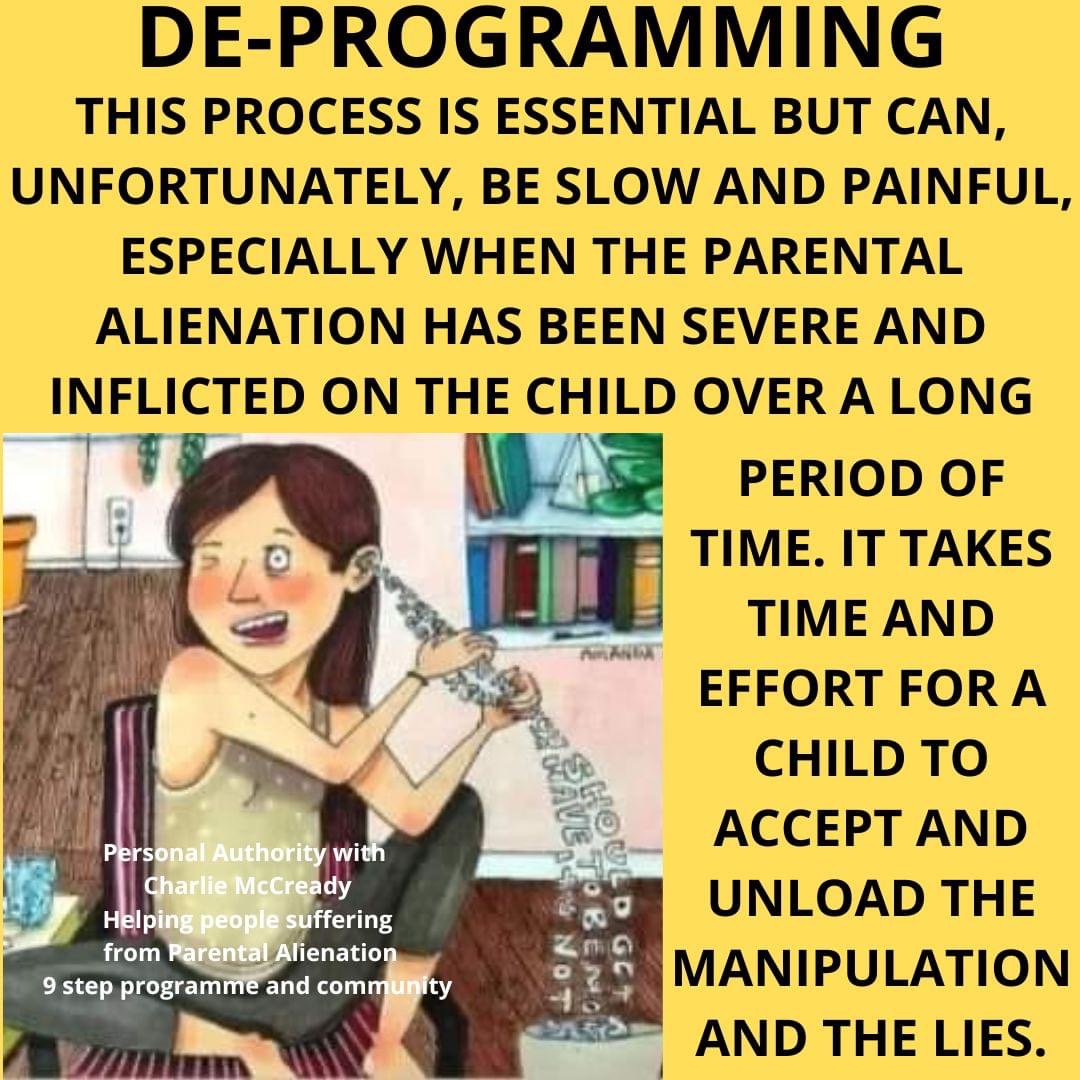
It is extremely difficult for the alienated child to accept that the trusted, favoured, ‘good’ and aligned parent, the one they chose over the ‘bad’ parent, the one they believed, the one they might have even lied for, and done everything they could to please, actually, in truth, had nothing but their own interests, (and vengeance) in mind. The betrayal and shock of this is so awful that it is easier for that child not to believe it. Not only that but it makes them feel so manipulated and gullible. In reality, coercive control is incredibly hard to combat and children believe their parent would never do anything to harm them. Parental alienation is harmful. It is abuse. So it is extremely hard for the child to believe this has been inflicted on them. But the acceptance is the first step in their healing, and de-programming. Undoing what might be years of lies and controlling behaviour. As a target parent, it is a minefield because mentioning parental alienation can insult and upset the child. So we have to tread carefully and be so conscious of their suffering (just as we have suffered too).

If you like our posts, please share them where you think they might be helpful – thanks. And you can see more of our posts on instagram:

[https://www.instagram.com/charliemccready1/](https://www.instagram.com/charliemccready1/?fbclid=IwAR3Vlw6TPNLc2-0hJS4Op59fduIXJYSF0T55wZz9dvXINS9YJWdTFtodv88)

.

You are more than pathology – Craig Childress PsyD

Don’t let the pathology consume you.

You are more than the pathology. You had a life. You have a life. You have a lifetime to come.

You are faced with a challenge. The other parent is pathological – problematic. The other parent is creating attachment pathology in the child toward you for advantages and secondary gain to the pathological parent.

You will need to lead your family into a post-divorce solution of a healthy and successful separated family structure. The child is giving you a problem because the child knows you can solve it. You’re the healthier parent.

The other parent is collapsing into their pathology. It is up to you to lead the family into a solution. You just need support. You want a written treatment plan to fix things.

The pathology wants to drive this into the legal system and make it about custody. You want to move this into the healthcare system and make it about treatment.

Then you must become an informed consumer of mental health services to effectively advocate for yourself and your child. Be kind, always be kind. Be relentless in protecting your child.

The pathogen will try everything it can to destabilize you. Remain in your center-place of confidence. Don’t trigger into your fears. Use your executive functions of linear-logical reasoning and planning ahead.

Shift the focus from custody to treatment, make the pathogen argue against treatment – this will expose it. You want a written treatment plan, for that you’ll need a diagnosis.

Understand the approach. Understand the diagnosis.

In all cases of severe attachment pathology surrounding court-involved custody conflict, a proper risk assessment for possible child abuse needs to be conducted to the appropriate differential diagnosis for each parent.

Patients should NEVER have to explain the pathology to the doctor… but you do. That is a highly concerning professional problem. We will be working to fix it.

The doctors should know as least as much as you do – more. They should know all about cross-generational coalitions and shared persecutory delusions, and they should be explaining the child abuse and spousal abuse pathology to you.

They’re not. You will need to navigate their ignorance.

You remain stable. You remain in your authenticity. You did nothing wrong. It’s not your fault. Bad people are doing bad things, we are going to make them stop.

Don’t let the pathology (problem) consume who you are. You have a challenge, there is a pathology in your family. It’s an attachment pathology, a problem in the love-and-bonding system of the brain. The source of the problem (pathology) is in the unresolved childhood trauma of the pathological (problematic) parent.

This is a pathology of lies. Everything about the pathology is a lie. It is a delusion – a false belief – a delusion is a fixed and false belief maintained despite contrary evidence. No amount of contrary evidence will ever change a delusion because that’s the definition of delusional.

The type of delusion (created in unresolved childhood trauma) is called a “persecutory delusion” – it is a fixed and false belief in supposed victimization.

The American Psychiatric Association provides the following definition of a persecutory delusion:

From the APA: “Persecutory Type: delusions that the person (or someone to whom the person is close) is being malevolently treated in some way.”

The differential diagnosis for severe attachment pathology is child abuse by one parent or the other;

Either the targeted parent is abusing the child, thereby creating the child’s attachment pathology toward that parent,

Or the allied parent is psychologically abusing the child by creating a shared persecutory delusion and false attachment pathology in the child.

One way or the other, the differential diagnosis for severe attachment pathology (i.e., a child rejecting a parent) is child abuse. The only question is, which parent?

In all cases of severe attachment pathology surrounding court-involved custody conflict, a proper risk assessment for possible child abuse needs to be conducted to the appropriate differential diagnosis for each parent.

You have a problem. You need to fix the problem. You need a written treatment plan to fix your problem. That requires a diagnosis. Diagnosis guides treatment. The treatment for cancer is different than the treatment for diabetes.

The treatment for child abuse by the targeted parent is different than the treatment of psychological child abuse by the allied parent. Is there a persecutory delusion present?

Does the child have a fixed and false belief that the child is being “malevolently treated in some way” by the parenting of the targeted parent? Does the allied parent share the child’s fixed and false belief that the child is being malevolently treated in some way by the parenting of the targeted parent?

Is there a shared persecutory delusion?

You don’t want an assessment (you do, but don’t start there). You want a treatment plan (google WikiHow mental health treatment plans). For a treatment plan you will need a diagnosis (diagnosis guides treatment). For a diagnosis, you will need a proper clinical diagnostic risk assessment for possible child abuse to the appropriate differential diagnosis for each parent.

Start with the written treatment plan and don’t let go of that. Hang on and don’t let them shake you loose from treatment – you want things fixed.

That ends with obtaining a proper risk assessment for the proper diagnostic issues of concern. Are you abusing your child? Is the other parent psychologically abusing the child? We need an accurate diagnosis to guide the development of an effective treatment plan.

If we treat cancer with insulin, the patient dies from the misdiagnosed and mistreated cancer.

You need support. You are the protective parent. The mental health professionals should be accurately diagnosing the pathology (problem). They should be providing you with support. They should be your allies in generating a solution – i.e., the successful treatment of the child’s attachment pathology toward a parent.

Diagnosis = identify
Pathology = problem
Treatment = fix it

You have a problem. There is a pathology in your family. It is an attachment pathology, a problem in love-and-bonding. You need to fix it. You want a written treatment plan to fix the problem (pathology) in your family.

The differential diagnoses of concern are:

1) Possible Child Psychological Abuse (DSM-5 V995,51) by the allied parent who is creating a shared persecutory delusion and false attachment pathology in the child,

2) Possible Spouse or Partner Abuse, Psychological (DSM-5 V995.82) of the targeted parent by the allied parent using the child as the weapon.

In all cases of severe attachment pathology surrounding court-involved custody conflict, a proper risk assessment for possible child abuse and possible spousal abuse using the child as the weapon needs to be conducted.

They have duty to protect obligations. They have competence requirements – Standards 2.01, 2.03, 2.04.

Don’t destabilize, don’t trigger into your fears and insecurities. You’re fine, you did nothing wrong. There is a pathology (problem) in your family surrounding love-and-bonding. You’ll need to fix it.

You’ll need help from the mental health professionals in fixing your problem. Be kind. Be resolute. Become an informed consumer of mental health services and the pathology in your family.

It is NOT your obligation to educate the doctor about the pathology they are treating – they should already know. Unfortunately, you do have to educate the forensic psychology people in the family courts.

That speaks to the immensely low quality of professional services in the family courts when the patients are educating the doctors about the nature and treatment of the pathology.

The other parent creates chaos. You remain grounded. You remain authentic to what you know. Develop a plan. Execute the plan. You are the protective parent.

You are the healthier parent. The task ahead is for you to lead your family into a successful post-divorce separated family structure. You just need support.

Craig Childress, Psy.D.
Clinical Psychologist, CA PSY 18857

Childress PsyD – Update

If you are following me on my Facebook page, you are at the tip of the spear.

I am not posting to my blog. Nor am I writing articles. Those things will follow. I’m busy. I’m working.

I’m changing systems. Do you know how to do that? I do. It’s difficult, it’s complex.

I’m going dormant now. In that way I become more active. I’m entering the family courts. You don’t see what I do there, the work of clinical psychologists is confidential to the matter.

My role in the courts is to review the reports of the forensic psychologists. You can imagine what I say. I’m a clinical psychologist – treatment not custody – we do different things.

This is an attachment pathology. The attorney in the matter believes that the application of established knowledge from clinical psychology will be helpful to the court in making its decisions surrounding the child.

I review the material I’m asked to review and I provide an opinion based on the application of the established scientific and professional knowledge from clinical psychology – treatment not custody – regarding the material I’m asked to review.

I’ll write journal articles later. I’ll write blogs when I need them.

I don’t need them right now. Everything will unfold to its ends. We have entered a new phase. When I left your world out there and moved here to the Emerald City in the Pacific Northwest, to my Isle of Avalon off the western shores, things changed.

I moved away from my blog to Facebook because things are moving quickly. Facebook moves quickly – then vanishes – or seems to. Everything on the Internet is documented.

Facebook is the most ephemeral of the media. It communicates quickly the information of most note. I’m a clinical psychologist and I’m working. If you’re here, it’s for a reason.

This is active child abuse. This is active spousal abuse using the child as the weapon. I’ll write journal articles once the child and parent are protected. We’re still in the Safety Plan phase.

As I work doing what I do, the treatment goal has been to empower you parents to protect yourselves and protect your children from emotional and psychological abuse by a narcissistic-borderline-dark personality ex-spouse and parent.

I have given you all the information you need to protect yourself and your child as quickly as I could make it available to you. If you can use it while I’m working – that’s my goal.

If you can’t use the information because the systems surrounding you remain broken… I’ll be coming to fix the systems. That takes time because the powers-that-be don’t want to fix anything.

They don’t want a solution. That is the ONLY problem. The moment they want a solution… there’s a solution.

I’m only one lone clinical psychologist working all by myself. They are many and strong. They don’t want to change. Everyone in the systems want things to remain exactly as they are. It’s called “homeostatic balance” of a dysfunctional system.

The dysfunctional system is stable WITH the symptom present. If we take the symptom away, the dysfunctional system will collapse into chaos. The dysfunctional system NEEDS the symptom. We can’t take the symptom away – the system won’t let us remove the symptom that it needs to remain stable.

The symptom of dysfunction in the family courts is the ignorance and incompetence of the psychologists – the betrayers – the ones who should protect… and don’t. Instead, they financially exploit and feed on the vulnerability of parents caught in the family courts.

The dysfunctional legal and mental health systems are stable WITH the symptom present – the symptom of their ignorance and incompetence stabilizes the dysfunctional systems.

homeo = the same
static = never changing

Homeostatic balance = a same that never changes – it’s stuck

The thing that’s keeping it stuck in never-changing dysfunctional balance is the symptom – their ignorance and incompetence.

How do you break free? The APA ethics code. Doctors are not allowed to be ignorant and incompetent – Standard 2.01 of the APA ethics code. Doctors MUST apply the “established scientific and professional knowledge of the discipline” as the bases for their professional judgments – Standard 2.04 of the APA ethics code.

The established scientific and professional knowledge of the discipline is:

Attachment – Bowlby & others
Family systems – Minuchin & others
Personality disorders – Beck & others
Complex trauma – van der Kolk & others
Child development – Tronick & others
Self psychology – Kohut & others
Delusional thought disorders – APA & DSM-5

I have helped you to become informed consumers of mental health services surrounding your child so that you are empowered to protect yourself and protect your child from the spousal emotional abuse of you using the child as the weapon, and from psychological abuse of the child by the allied parent.

Some of you may be able to use the professional knowledge and your rights to achieve the goal of protecting your child and protecting yourselves from abuse by a pathological ex-spouse and parent. Some of you will still encounter the barriers of the broken systems – broken by professional ignorance and incompetence.

There are four roles in trauma – abusive parent – victimized child – protective parent – bystander.

In clinical practice, the bystander role is often called the “betrayer” – the one who should protect… and doesn’t. Typically it’s the mother in sex abuse cases who sacrifices the child to the step-father to save the marriage – she knew, she just didn’t want to know. She was the bystander, the one who should protect… and doesn’t.

In the child abuse and spousal abuse occurring in the family courts, the “betrayer” role is filled by the forensic psychologists. The targeted parent is in the protective parent role, the allied parent is in the abusive parent role. The child is being abused.

You are the protective parent. They are the abusive parent. This is a delusional pathology – it is a pathology of lies. A delusion is a false belief – they are delusional – it’s called a persecutory delusion created by the pathology of the allied narcissistic-borderline-dark personality parent.

The pathological narcissistic-borderline-dark personality is presenting a false narrative to others – it is not true – it is a lie. You are not the abusive parent… they are. It’s called a projection.

The pathological parent is deceptively trying to claim the role as “protective” parent, and they are trying to assign the “abusive” parent role to the targeted parent.

That is a false narrative. It is a lie. This is a pathology of lies. The pathology of concern is a persecutory delusion. The allegations made toward others are a projection.

A persecutory delusion is a false belief. It’s important to know where you are – this is a pathology of lies.

The allied parent is the abusive parent who is creating a shared persecutory delusion and FALSE attachment pathology in the child for secondary gain to the pathological parent – a DSM-5 diagnosis of V995.51 Child Psychological Abuse.

In ALL cases of severe attachment pathology displayed by a child surrounding court-involved custody conflict, a proper risk assessment for possible child abuse needs to be conducted to the appropriate differential diagnosis for each parent.

1) Is the targeted parent abusing the child, thereby creating the child’s attachment pathology toward that parent (a 2-person attribution of causality)?

2) Or is the allied parent psychologically abusing the child by creating a shared persecutory delusion and false attachment pathology in the child (a 3-person triangle attribution of causality)?

Is there a shared peresecutory delusion? The American Psychiatric Association provides the definition of a persecutory delusion:

From the APA: “Persecutory Type: delusions that the person (or someone to whom the person is close) is being malevolently treated in some way.” (American Psychiatric Association, 2000).

Does the child have a fixed and false belief that is maintained despite contrary evidence that the child is being “malevolently treated in some way” by the normal-range parenting of the targeted parent?

Does the allied parent SHARE the child’s fixed and false belief in malevolent treatment by the targeted parent? Do the allied parent and child SHARE the persecutory delusion that the child (someone to whom the allied parent is close) is being malevolently treated in some way?

You are the protective parent. You have rights granted you by the APA ethics code. You have the right to expect competence from your doctors. They have obligations.

All mental health professionals have duty to protect obligations. You are the protective parent. They should be accurately diagnosing the pathology in your family, and they should be taking steps to protect you and your child from abuse.

The DSM-5 diagnosis for creating a shared persecutory delusion in the child that then destroys the child’s attachment bond to the other parent is V995.51 Child Psychological Abuse. The DSM-5 diagnosis for using the child as a weapon of spousal emotional and psychological abuse is V995..82 Spouse or Partner Abuse, Psychological.

Is there a shared persecutory delusion?

If they try to blame you – ask them to complete the Parenting Practices Rating Scale for your parenting – make them tell you what you are doing to abuse your child.

You’re not doing anything. It’s not your fault. The other parent, the allied parent, has formed a “cross-generational coalition” with the child against you, resulting in an “emotional cutoff” in the child’s attachment bond to you – EXACTLY like the structural family diagram from Minuchin depicts.

Do you want me to draw you a picture of the pathology? Okay. There. Minuchin & Nichols, 1993.

Family Systems: The child is being “triangulated” into the spousal conflict through the formation of a “cross-generational coalition” with the allied parent against the targeted parent, resulting in an “emotional cutoff” in the child’s attachment bond to the targeted parent.

Is there an “inverted hierarchy” present in which the child is empowered by the allied parent to judge the adequacy of the targeted parent, as if the child is the parent and the parent is the child?

The differential diagnosis for severe attachment pathology displayed by the child is child abuse by one parent or the other. In all cases of severe attachment pathology displayed by the child, a proper risk assessment for possible child abuse needs to be conducted to the appropriate differential diagnosis for each parent.

I’m in the family courts as a consultant and expert witness in clinical psychology – treatment not custody. I’m reviewing mental health reports line-by-line.

The professor is grading papers.

I’m one, you’re many. You are the protective parent. I have empowered you with the knowledge you need to protect your children.

To say that you are abusing your child is a lie. To say that you are abusing your child is delusional.

Yep. That’s exactly what it is. It’s a shared persecutory delusion created by the psychological collapse of a narcissistic-borderline-dark personality parent surrounding the psychological stress of the divorce.

This is a pathology of lies. It is a delusional disorder. The delusion is from unresolved trauma origin in the pathological parent, which has led to their narcissistic-borderline-dark personality traits.

It’s unresolved trauma – unresolved attachment trauma in the pathological parent transmitted to the child through the aberrant and distorted parenting that the unresolved trauma creates.

The pathology is the trans-generational transmission of trauma, mediated by the narcissistic-borderline-dark personality pathology of the parent.

You are the protective parent. They are the abusive parent. I’m a trauma psychologist out of foster care. This is exactly my pathology of specialization – child abuse. I know exactly where I am.

This is active child abuse. This is active spousal emotional and psychological abuse using the child as the weapon. I’m a clinical psychologist and I’m working.

The abusive parent is pathological. The forensic psychologists are just incompetent – and they are ignorant, lazy, and unethical. They have duty to protect obligations – they are failing in their obligations.

I’m in the family courts as an expert consultant and witness. You’re in the family courts as the protective parent seeking to restore to your child their normal-range and healthy development.

The psychologists are in the bystander role – they have obligations – mandatory ethical obligations for competence (Standards 2.01 & 2.04) and mandatory duty to protect obligations.

Doctors are not allowed to be ignorant and incompetent.

Patients should NEVER have to explain the pathology to the doctor, they should already know what the pathology is – Standard 2.03.

2.03 Maintaining Competence
Psychologists undertake ongoing efforts to develop and maintain their competence.

They have obligations. You have rights. You are the protective parent. You are trying to protect your child from the distorted and psychologically abusive parenting of the other parent.

My goal is to provide you with the professional-level information you need to protect yourself from psychological spousal abuse and your child from psychological child abuse by your ex-spouse and other parent.

There are four roles in trauma – abusive parent – victimized child – protective parent – bystander (the “betrayer” – the one who should protect… but doesn’t).

If you’re here on my Facebook page, you have the most current information. Here, however, is just the start. We are on a linear path. This information is not going away. It will only build in force and power because it is the truth.

I will be going after their licenses for their collaboration in child abuse because of their negligent and unethical malpractice. They will be coming after my license to try to stop me from helping you protect your children.

Dr. Childress vs. the pathogen’s allies

They’ll need to stop me or else they will need to become competent in the pathology they’re working with. If you’re a mental health professional and you don’t know as much as Dr. Childress, why not? Are you just lazy? Must be.

I’m the floor, not the ceiling.

I’m in my world doing my thing. You’re in your world doing yours. Good luck. Be kind, always be kind, and be relentless in protecting your children. The universe has this.

Do the right thing and let outcomes take care of themselves.

What’s the right thing to do? Look inside and listen.

Craig Childress,Psy.D.
Clinical Psychologist, CA PSY 18857

“Love” for child via alienating , abusive parent

The hypocrisy beggars belief. The charade fools many, most importantly for the alienating parent, it fools the child. I was just writing to someone on another comment about enmeshment. Even therapists, not truly understanding the covert and cunning nature of parental alienation, might think enmeshment means to be ‘joined at the hip’. This does happen of course. But enmeshment is also emotional and psychological. It gets into the thoughts and becomes the beliefs of the child. Even when the child becomes a teenager and an adult, it can still hold them. Unseen to the outside world. They may live independently and voice opinions that are negative about both their parents, target parent and alienating parent. And the therapist will say there’s no enmeshment therefore no parental alienation. It is also very hard for people to see beyond what they see. Perception is not reality, but it is a lens through which someone sees things, and I’ve covered this in other posts. For example, just because the child says they’re autonomous, their thoughts and beliefs and opinions are all their own, doesn’t make it a reality. Perception and reality can be quite different. And enmeshment might look like love. Lastly, people just can’t believe an apparently loving parent would ever do something as harmful as alienating their child from their other parent, which is as we know, unloving behaviour.

If you like our posts, please help us help others by sharing our posts to other people and sites. My mission is to spread awareness about parental alienation, inform and uplift. We’re also on Instagram, and we’d love you to follow us there too.

https://www.instagram.com/charliemccready1/

AND PLEASE DO JOIN ME ON MY NEW COMMUNITY PAGE. Thanks.

https://www.facebook.com/groups/3214325232164553

The Personal Authority 9 Step Program helps my clients understand and deal with their alienated child/ren, the alienating parent, plus how to overcome the mental and emotional issues that they experience. This program can help transform your experience of alienation and how you live your life. Typically people experience a change in mindset after a few weeks. Please send me a message if you are interested to know more, and I can send you testimonials and further details on what the program covers and the benefits you could gain.

#alienatedparent

#traumabonding

#fathersrights

#highconflictdivorce

#mothersrights

#ParentalAlienationSyndrome

#parentalalienation

#psychologicalabuse

#FamilyCourt

#familylaw

#narcissisticabuseawareness

#narcissisticabusesurvivor

#narcissisticabuserecovery

#childrenfirst

#parentalalienationischildabuse

#custodybattle

#consciousparenting

#cognitivedissonance

#familyviolenceawareness

#psychologicalsplitting

#hostileaggressiveparenting

#generationaltrauma

l

Empathy & Lack of Empathy- Craig Childress PsyD

Empathy.

Narcissistic personality pathology is the absence of empathy. The absence of empathy is the capacity for human cruelty.

Narcissistic personality pathology is the abuse pathology because of its capacity for cruelty. Narcissistic personality pathology is responsible for child abuse and spousal abuse.

Writing in the Journal of Emotional Abuse, Moor & Silvern describe the association of narcissistic personality pathology and the failure of parental empathy with child abuse.

From Moor & Silvern: “The act of child abuse by parents is viewed in itself as an outgrowth of parental failure of empathy and a narcissistic stance towards one’s own children. Deficiency of empathic responsiveness prevents such self-centered parents from comprehending the impact of their acts, and in combination with their fragility and need for self-stabilization, predisposes them to exploit children in this way.” (Moor & Silvern, 2006, p. 95)

From Moor & Silvern: “Only insofar as parents fail in their capacity for empathic attunement and responsiveness can they objectify their children, consider them narcissistic extensions of themselves, and abuse them. It is the parents’ view of their children as vehicles for satisfaction of their own needs, accompanied by the simultaneous disregard for those of the child, that make the victimization possible.” (Moor & Silvern, 2006, p. 104)

In their study of child abuse survivors and the failure of parental empathy, Moor & Silvern found that the narcissistic pathology of the parent was itself a traumatic experience.

There is no difference between the trauma of child abuse and the failure of parental empathy that caused it – they are the same thing – just flip sides of the same trauma of child abuse by a parent.

From Moor & Silvern: “The indication that posttraumatic symptoms were no longer associated with child abuse, across all categories, after statistically controlling for the effect of perceived parental empathy might appear surprising at first, as trauma symptoms are commonly conceived of as connected to specifically terrorizing aspects of maltreatment (e.g., Wind & Silvern, 1994). However, this finding is, in fact, entirely consistent with both Kohut’s (1977) and Winnicott’s (1988) conception of the traumatic nature of parental empathic failure. In this view, parental failure of empathy is predicted to amount to a traumatic experience in itself over time, and subsequently to result in trauma-related stress. Interestingly, even though this theoretical conceptualization of trauma differs in substantial ways from the modern use of the term, it was still nonetheless captured by the present measures.” (p. 197)

Moor, A. and Silvern, L. (2006). Identifying pathways linking child abuse to psychological outcome: The mediating role of perceived parental failure of empathy. Journal of Emotional Abuse, 6, 91-112.

The trauma is the parental failure of empathy. The treatment for the trauma is abundant empathy – authentic empathy. Through our “eyes of the other” of compassion and empathy we bring our intent to understand to their self-experience, and we help the child discover their authenticity.

Whenever we are asking the child to understand us or something we are saying, empathy is flowing in the wrong direction.

“Tell me more about that” is always an appropriate response to a child in all situations.

The ADHD child is frustrated with doing homework, “It’s too hard, I can’t do it.”

Tell me more about that.

Don’t give encouragement. Don’t try to solve the problem. It’s their problem, they’ll be able to solve it once they have the support they need. What do they need for support?

Let’s find out. Provide genuine caring and genuine curiosity for “What is it like to be you?”

Her boyfriend just broke up with her and she is despondent over the lost love.

Tell me more about that.

Don’t give encouragement, don’t try to solve her problems. They’re her problems, she’ll be able to solve them with the proper support.

What support does she need? Let’s find out, with genuine caring, genuine empathy, and a genuine intent to understand “What’s it like to be you?”

Tell me more about that.

That is of benefit for all children in all circumstances. Empathy is always a good thing. Caring is always a good thing. Listening with an intent to understand always helps.

Complex trauma is the failure of parental empathy, and the failure of parental empathy is complex trauma – Moor & Silvern; Journal of Emotional Abuse.

The treatment for the failure of empathy is abundant empathy – all the time – provide authentic empathy for the authentic child – the person they are, the person they are becoming.

The child’s feelings are authentic. The child’s attribution of causality for WHY they feel the way they do is typically in error – all the time – with all children. Childhood is the time of figuring out how the machinery works.

They start as toddlers in the high-chair performing scientific experiments on cause-and-effect. Oooo, if I push my plate of food off the table it falls – cool – oh – and when I push my plate off the table mom gets loud… cool.

The child is a mini-scientist performing experiments to learn about the world, things like cause and effect, and how to deal with emotions… whooo, that’s tough.

In childhood, all of childhood, they learn about their feelings and how to express them for maximum gain, and how not to express them to remain out of trouble… hopefully. Emotions grab them, “How do you ride these things?”

They learn about relationships and love. It’s on-the-job training with only one set of instructors. They have to figure everything out, or try to. They have complex feelings and they try to figure out why, and what to do about it.

Feelings are such complicated things. Not like thoughts. Thoughts are precise. Feelings are so vague yet so captivating. I know what I feel, it’s figuring out the why that’s the hard part.

Not just for your kids in the courts, all kids everywhere. I worked with them – school behavior problems – ADHD – family conflict problems and oppositional-defiant anger in the family. The kids are just trying to figure things out.

They can do it, they just need the proper support. What support do they need? Let’s find out… tell me more about that so I understand your reality better. What’s the situation we’re dealing with inside you? What’s it like to be you?

Not to change it. Not to make things better. Just… empathy. I want to understand what it’s like to be you? The problems you’re facing. Tell me more about that. I want to understand.

Feelings come when we need them, they go when we don’t, once they’ve done what they came here to do.

Anxiety makes us alert – watch out, pay attention, something might be dangerous. Anxiety wants to be safe, anxiety seeks protection. When we’re safe, anxiety goes away.

Sadness says we’re losing something of value – that we need to attend to the things that are valuable to us. Sadness draws nurture, sadness draws love from others. Once love is there, sadness leaves.

Anger says we’ve been hurt (or we’re scared and trying not to be). Anger turns off the ‘weak’ emotions of sadness and fear. Anger protects us. We don’t feel sad or afraid when we’re angry. We just feel angry. But angry is sadness and hurt underneath – when empathy for the sadness and hurt arrives, anger leaves.

Happy is the social bonding emotion. It’s great and its easy. There’s a brain-hack you can do. You can add happy brain chemicals to any other emotion and change that emotion. It’s a back-channel brain chemical hack of the machinery of us.

Just smile. It fools your brain into thinking you’re happy, just a little bit but enough. If you smile your brain responds to the muscles and it thinks you’re happy, so it doses you with a little happy brain chemical… which gets added to the existing brain chemicals for whatever emotion is there.

If you’re anxious and you add happy to anxiety, you get excitement. That’s the roller-coaster – wheee, this is scary and fun at the same time. It’s not a fake thing, you’re actually changing the emotion. You’re changing the brain chemical composition when you smile.

Better living through neuro-chemistry.

If you add happy to anger, you get leadership. Anger is power, assertion, and voice, happy is social bonding. Together, power and social bonding is leadership – come on, we can do this.

Oh my goodness, happy is such a good emotion to add to anger. Smile when you’re angry. Just do it. DO IT. Smile. You can still say everything else, just do it with a smile too – angry with a smile. It softens the aggression. We need to soften our aggression with children.

When you’re angry… smile… add a dose of neuro-chemistry to your daily living.

If you add happy to sad, you get compassion. When those we love are sad, it makes us sad too, and that feels good somehow, to be sad with them together. They’re not alone. That’s compassion.

When you’re sad, if you can smile onto your sadness you’ll have the emotion of compassion for yourself. It’s hard to do, to smile when you’re sad. But that’s what the neuro-chemistry of your emotions will create if you add happy to sad – that’s compassion.

All you need to do on the brain-hack side is smile. The biology of your brain takes care of the rest. It adds a dose of happy chemical to your brain, just a tad, but enough.

Hey, and the more you practice the back-channel brain-hack on your emotional networks, the better you get at it and the more happy chemical your brain releases each time.

You get better at adding happy the more you add happy. Smile. Right now. Just try it. Smile. Now do it again. Go ahead. I don’t care if you don’t feel like it – just do it. Smile.

More. All the time more. It’ll make you a better person. I don’t care who you are, if you smile more you will become a better person.

Betcha. Try it. Think of it as an experiment. Smile all the time and see if your life doesn’t get better. It will. You know it’s true. Smile more – a lot more. It’ll make the world a better place by adding more happiness to it.

The problem with the world is not that there’s too little suffering in our world and we need to add more. The solution to our problems is NOT to add more suffering because we think people aren’t suffering enough.

The problem with the world is that there is too much suffering. Any chance we can take to remove some pain, we should take it.

Nor is the problem with the world that there’s too much happiness in it – “No, no, no, don’t add any more happiness to the world, there’s already way too much.”

That’s not the problem. The problem is that there is too little happiness in the world – we need to add more. Smile. Go ahead. See? Isn’t the world just a little bit better from just one little smile?

Oh my goodness, think if you smiled again. Try it. See? It makes the world a better place.

Carl Rogers said we only need three things for growth and healing of everything within us, that these three qualities were both “necessary and sufficient” conditions for change and growth – unconditional positive regard – authentic empathy – genuineness in the relationship.

He’s right. Do you know how Rogers developed his Person-Centered Therapy approach? From working with children. He started by trying to use a psychoanalytic model with children and it was a complete failure.

So he tried something different. He tried listening to the child. Not to change them – just to understand – empathy and caring, unconditional positive regard (those are each three interesting words in a row).

Complex trauma is the failure of empathy. The treatment for complex trauma is abundant empathy.

Craig Childress, Psy.D.

Clinical Psychologist, CA PSY 18857
Knowledge immensely dangerous to ignorance – Craig Childress PsyD

I’m a clinical psychologist in forensic psychology world. That’s very dangerous for me. That’s very dangerous for them. Court-involved psychology world is entering a dangerous time.

Times of change are like that.

The pathogen thought it had gotten rid of all us clinical psychologists, and it did. I tripped. I was curious and oops, I fell down the rabbit hole. Once I saw I couldn’t leave.

I have duty to protect obligations, and I’m a trauma psychologist out of foster care. This is my pathology – child abuse. I was headed a different direction but I changed direction and I stayed here. I am treating the trauma being created by the forensic psychologists.

Weird, right? A clinical psychologist is in the family courts treating the trauma being created by another group of psychologists, the forensic psychologists. Weird world, but true.

You’ve been abandoned by clinical psychology. I’m sorry, that shouldn’t have happened. It did. We need to fix that. Once I saw, I remained until we could get you and your kids safe. That’s what clinical psychologists do – we go where the pain is and we remain there – helping.

You were abandoned by clinical psychology. I’m a clinical psychologist. I’m not going to abandon you, I’m here now. We need to fix things.

We’re not there yet – but we’re getting there. The pathogen was well-entrenched with many allies. We will be exposing the pathogen. We will be exposing its allies.

We are not stopping until the pathology in the family courts is solved. We never abandon a single child to child abuse – not one. We’re going to fix what’s broken, and there’s a lot broken – so we’re going to fix a lot.

It’s easy. We just need to do things differently. We need to start doing the fixing things instead of the broken things. If we just keep doing the broken things over-and-over, nothing gets fixed.

We need to do things differently. We need to do the fixing things.

Diagnosis means identify
Pathology means problem
Treatment means fix it

You want a treatment plan to fix the problem in your family. To develop a treatment plan to fix the problem, you will first need to identify what the problem is – the treatment for cancer is different than the treatment for diabetes.

What is the diagnosis for the problem in the family?

A child rejecting a parent is an attachment pathology, a problem in the love-and-bonding system of the brain. The differential diagnosis for severe attachment pathology is child abuse by one parent or the other.

1) Is the targeted parent abusing the child, thereby creating the child’s attachment pathology toward that parent?

2) Or is the allied parent psychologically abusing the child by created a shared persecutory delusion and false attachment pathology in the child?

Diagnosis guides treatment. The treatment for child abuse by the targeted parent is different than the treatment for child psychological abuse by the allied parent. What is the diagnosis?

An accurate diagnosis is crucial with child abuse.

If you believe a shared delusion, you become PART of the shared delusion, you become part of the pathology. When that pathology is psychological child abuse, you become part of the child abuse, you, the mental health person, become the child abuser.

In all cases of court-involved custody conflict involving attachment pathology displayed by the child, a proper risk assessment for possible child abuse needs to be conducted to the appropriate differential diagnosis for each parent.

All.

The assessment for a delusional thought disorder is a Mental Status Exam of thought and perception. Google negligence: failure to take proper care in doing something.

Are the opinions contained in their recommendations, reports, diagnostic and evaluative statements, including their forensic testimony, based on information and techniques sufficient to substantiate their findings?

9.01 Bases for Assessments
(a) Psychologists base the opinions contained in their recommendations, reports, and diagnostic or evaluative statements, including forensic testimony, on information and techniques sufficient to substantiate their findings. (See also Standard 2.04, Bases for Scientific and Professional Judgments.)

The APA ethics code says what it says, and the APA ethics code is mandatory – required. Note the citation in Standard 9.01 to Standard 2.04.

Was the established scientific and professional knowledge of the discipline applied as the bases for their professional judgments?

Did they apply the knowledge? 2.04

Do they know the knowledge? 2.01

If they do not know and did not apply the established scientific and professional knowledge of the discipline as the bases for their professional judgments, then the opinions contained in their recommendations, reports, and diagnostic or evaluative statements, including forensic testimony, are NOT based on information and techniques sufficient to substantiate their findings.

The established scientific and professional knowledge of the discipline required for application is:

• Attachment – Bowlby and others
• Family systems therapy – Bowen and others
• Personality disorders – Millon and others
• Complex trauma – van der Kolk and others
• Child development – Tronick and others
• Self psychology – Kohut and others
• DSM-5 diagnostic system – American Psychiatric Association

They are not allowed to be incompetent. But they are. That needs to end. The patient should NEVER have to educate the doctor about pathology – they should already know.

The APA ethics code says what it says. They have obligations.

Where are the licensing boards enforcing ethical standard of practice in forensic psychology? Nowhere to be seen. Why is that?

The pathogen and its allies are dangerous to me. I have made you dangerous to the pathogen and its allies in return. Knowledge is immensely dangerous to ignorance.

You need to be empowered to protect your children. Knowledge is power. You be safe. Have a plan. Be centered. Do the right thing, let outcomes take care of themselves.

What’s the right thing to do? I dunno. I just know how to find that path for me.

Craig Childress, Psy.D.
Clinical Psychologist, CA PSY 18857
Child Abuse & Complex Trauma – Craig Childress PsyD

Is there evil?

Researchers have called the Dark Tetrad the core of evil – narcissistic – psychopathic – manipulative – sadistic. That is a seriously problematic human.

Is there evil apart from the person who does evil things?

Does love exist apart from the person who loves? Or is love bound within by the heart that holds it? Is love within us, or do we allow ourselves to be captured by something beyond us?

Is love something separate and alive in the universe? Or does love begin and end in us?

Are people evil? Or have people been captured by evil? Are people evil because they have surrendered to something that lives beyond them, that moves in us and through us, but is not us?

Is there evil?

Motivating patterns living in our minds – but patterns apart from us – not us?

My professional pathology is the trans-generational transmission of trauma. The childhood trauma of the parent lives in their minds and they transfer their trauma to the child. I’ve watched evil as it moves between minds.

That’s the best time to stop it, when it’s moving between minds. Once it’s in the child’s mind it becomes more difficult to extract, and if we don’t extract it in childhood, it’s nearly impossible to get out once the adult mind takes its shape.

When it’s moving between minds, from the parent to the child, that’s when it’s most vulnerable – catch it – stop it in transit.

I’ve worked child abuse. I’ve seen evil move from mind to mind. Evil attacks the children. I’ve been there. I still am.

We sacrifice the children by our apathy. We don’t care. We create agencies to pacify us in our continuing slumber, and we barely fund the agencies we create. The sacrifice of children is less expensive. They are expendable humans.

No one sees our abandoned and abused children, because no one cares. You know the feeling. It’s exactly the same thing – the workings of evil – there – here. No one sees. No one comes.

You’ve been abandoned to the evil.

The children of abuse, neglect, and abandonment grow up. They become adults but are still children inside. We all are. We are the patterns of love and fear that formed us. We live to our patterns, we live to our expectations, we live to our fears and desires to be loved.

Is the person evil? Or is the person the victim of evil as well? Is that an adult, or a traumatized child?

I like empathy. That’s a good emotion. It hurts sometimes to be connected to the pain. That’s a good thing – to hurt when there’s hurt.

I like compassion too. It’s different than empathy, similar but different. Warmer.

What happens when we bring empathy and compassion to the damage caused by evil?

I think that would be a good thing. I think empathy and compassion are always good things to apply.

What’s happening in the family courts is evil.

The Dark Triad is here in the family courts, as is the Dark Tetrad. Machiavellian manipulation. Narcissistic. Psychopathic. Sadistic. That pathology, that problem in humanness, is in the family courts.

I’ve been here in this court-involved custody conflict pathology for ten years. I’ve seen it. I’m a trauma psychologist out of child abuse and foster care. That’s why I’m here.

This is my pathology – child abuse – the trans-generational transmission of trauma. It’s the core of evil.

It’s moving between minds in the family courts. I watch it move. That’s the best time to extract it, when it’s moving. Once it settles into the mind, it becomes more difficult.

It hides, and it has hooks into the mind.

The absence of empathy is the capacity for human cruelty. Child abuse and complex trauma originates in the absence of empathy. They are the same thing. The treatment for the traumatic absence of empathy… is empathy.

Abundant empathy – if you’re asking the child to understand you and what you’re saying, empathy is flowing in the wrong direction.

Are people evil?

Or are they children who’ve been damaged by something beyond us, something that moves in us and through us? Evil attacks the children. We sacrifice the children to our gods of apathy and peace, and then wonder at the evil let loose in the world.

Is there evil? Where does it come from? From us, or from somewhere beyond us, moving in us and through us, but not us?

I’m a trauma psychologist out of foster care. This is my pathology, child abuse and complex trauma – the trans-generational transmission of trauma. Ripples.

Where do the ripples begin? When do they end?

It’s a motivational pathology.

Craig Childress, Psy.D.

Clinical Psychologist, CA PSY 18857