

Tag: Parental Alienation
Alienated parent is a parent
As we approach the universally celebrated Valentine’s Day on 14th February, traditionally devoted to romantic relationships, I’m thinking of another manifestation of love – the profound connection and natural, loving attachment bonds between parents and children. It is literally heartbreaking that this innate bond would ever be compromised or sabotaged by intentional alienating behaviours.
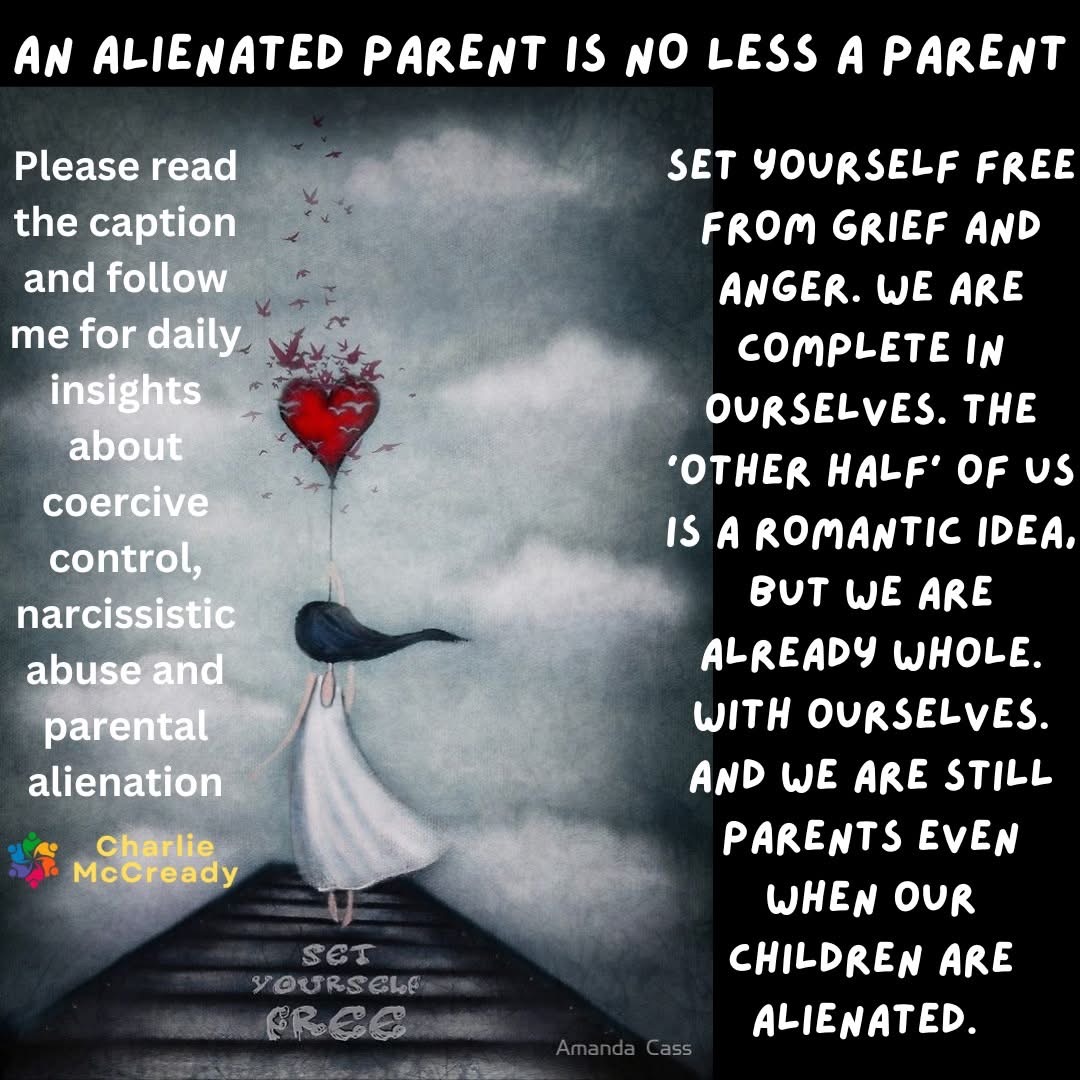
One particular Valentine’s Day quote caught my eye: “I am not searching for my other half because I am not half.” I like that it rebels against the idea that anyone could be incomplete without a romantic partner. This notion of finding our ‘other half’ implies a sense of lack, incompleteness in ourselves, or dependency on external relationships. It is the same for alienated parent. You are still wholly a mother or father, even when the other parent is engaged in harmful, selfish, alienating behaviours. You are not a half-person romantically or a half-person as a parent (this isn’t about those who parent half-heartedly). Have you seen the film Jerry McGuire? I love it, but when I hear the apparently romantic line, ‘You complete me,’ I feel nauseous. I would have run a mile if anyone ever said that to me. I don’t believe love involves any ownership, neediness or giving away our power.
Of course, there’s a beautiful kind of ecstasy when we meet someone; it can feel like an end to any confusion, loneliness, and sense of not being loved. And we can somehow ‘find ourselves’ and equally, we do ‘lose’ ourselves and our identity in certain roles – like when we become parents. Regarding attachment, we can fear losing what we identify with – I am a mother. I am a father. I am a teacher. I am a doctor … Secure attachments contribute to a sense of safety, trust, and self-worth, extending from childhood into adulthood. But being complete in ourselves, autonomous and practising self-love is vital for our children and us too.
Recognise that you are whole, strong, loved, and loving. Despite the anguish of ‘parental alienation,’ practise self-love today and every day. True love, often commercialised with red roses and chocolates, fully transcends manipulation, possessiveness and control.
#charliemccready
#parentalalienationcoach
#traumabonding
#parentalalienation
#parentalalienationawareness
#love
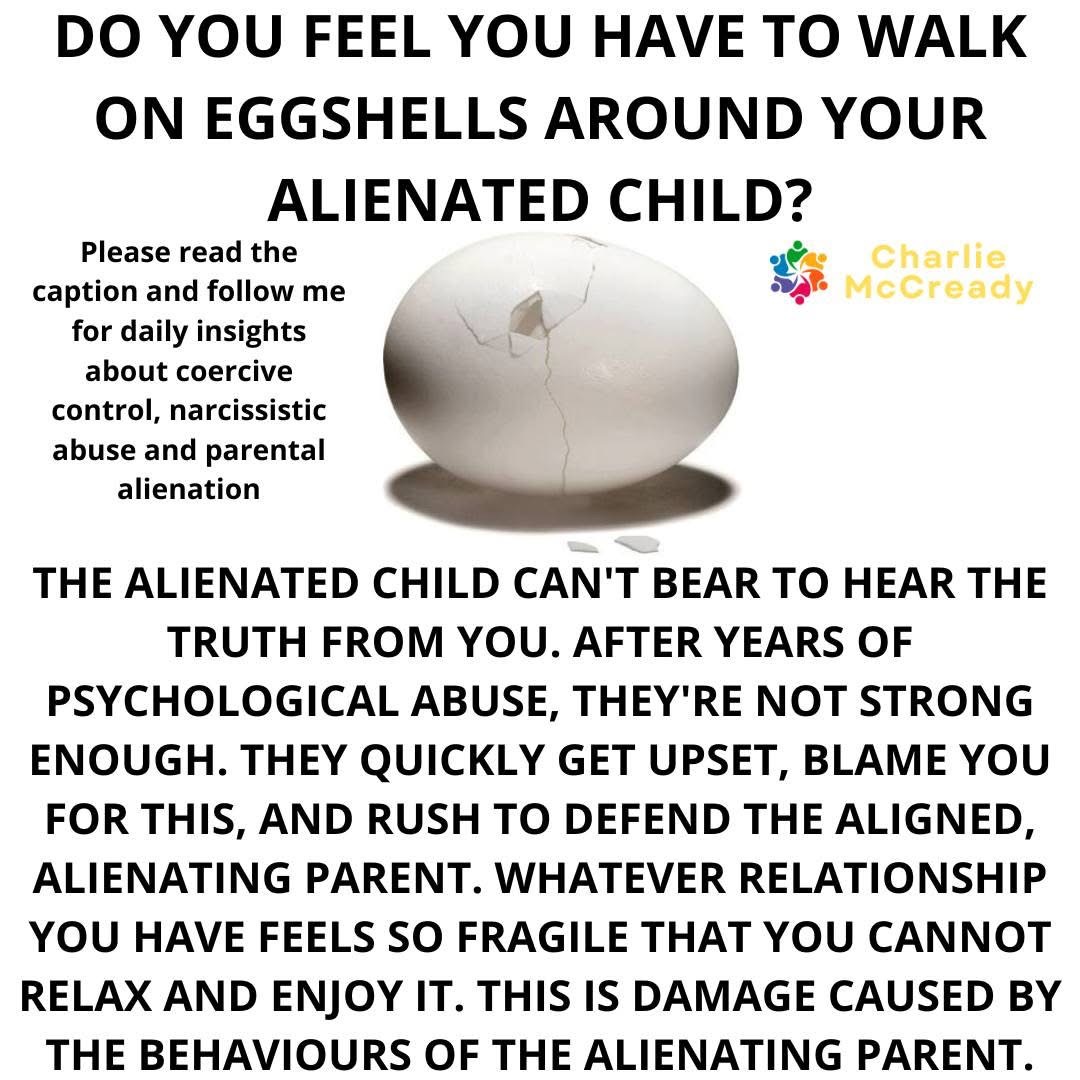
Walking on EggShells with alienated child(ren)
When our relationship with our child has been damaged because of the alienating behaviours of our ex, it becomes very challenging to establish boundaries and normal parental authority because we fear inadvertently worsening an already strained and limited relationship. It’s common for alienated parents to feel like they’re walking on eggshells around their child. There are truths we’d like to tell them, but an alienated child often fiercely resists hearing the truth about their situation and reacts with anger and denial due to their psychological defence mechanism against confronting uncomfortable realities. The alienating parent has empowered the child to pass judgment, criticise, and emotionally disconnect, so of course, there’s a genuine worry that asserting parental authority might create even more physical and/or emotional distance between us and our child.
Equally, it’s always a good idea to do what we can to avoid being walked over! And if it’s not us saying to our child, ‘That’s not a kind way to treat somebody’ or ‘Those are the rules in my house’, it’s not going to be anyone else. It’s about boundaries and teaching our children respectful behaviour. This is challenging during those teenage years when they’re more predisposed to rebellion anyway; they don’t need a lot of encouragement. It is fairly easy for an alienating parent to take full advantage of this.
Our relationship with our children, being so wilfully harmed and unstable, prevents us from fully relaxing and enjoying the time together. This certainly doesn’t help. Challenging and unnecessary as it is, we just have to keep being patient, empathetic and understand this is not their authentic behaviour. We have been thrown into a warzone together, one we’re trying to survive, and it’s not one we chose to participate in. Focus on building a peaceful, safe and supportive space for your child, even if they cannot fully grasp the truth of their situation at the moment. Over time, with consistent love and care, there’s a chance that they might be able to see through the manipulation, hear the truth, and heal.
If you are going through parental alienation, know you’re not alone. I’ve been through it myself. Personally and professionally, I have over 20 years of experience. I am reunited with my children and here to offer support with daily posts on social media and also with the coaching I offer. Feel free to reach out to me anytime.
#charliemccready
#parentalalienationcoach
#narcissisticabuseawareness
#CoerciveControl
#
Alienator Traits
People who alienate their child from a loving parent often exhibit identifiable personality disorders, such as borderline and narcissistic personality disorders. While labelling these individuals as having personality disorders may seem like an attack, it is essential to recognise that they need help rather than pity. Behind their harmful behaviours, such as emotional abuse and coercive control, is an inner core of fear, inadequacy, vulnerability, and worthlessness that drives their actions. Understanding the mental health issues and personality disorders behind parental alienation can guide interventions and support systems to address these issues effectively.
Statistics on the prevalence of personality disorders among alienating parents can be challenging to obtain, as diagnosing personality disorders often requires in-depth psychological assessments and evaluations. Studies and expert observations indicate a higher prevalence of individuals with borderline and narcissistic personality traits among alienating parents.
Borderline personality disorder (BPD) is characterised by difficulties managing emotions, unstable relationships, impulsive behaviour, and a fear of abandonment. These traits can manifest in intense and unstable relationships, including the parent-child relationship, contributing to alienation.
Narcissistic personality disorder (NPD) involves a grandiose sense of self-importance, a lack of empathy, and a constant need for admiration and validation. Alienating parents with NPD may manipulate and control their children to maintain a sense of power and control over them, leading to the alienation of the other parent While it is essential to recognise the internal struggles of people with personality disorders, addressing the root causes of their behaviour and the impact it has on the targeted parent and child is equally crucial. Unfortunately, many alienating parents blame the targeted parent, make false allegations, and subject them to psychological abuse, which can be emotionally devastating. Alienating parents typically struggle with self-reflection and are often resistant to seeking help to address their behaviour. As a result, the cycle of harmful and abusive actions towards the targeted parent and the child continues.
Convincing them to seek help can be challenging even though if they could break free from harmful patterns, it would create healthier environments for their children. Simultaneously, interventions should prioritise the well-being of the child and the targeted parent, recognising the pain and distress they experience due to the alienation. Acknowledging the complexities of parental alienation, particularly when personality disorders are involved, is crucial in developing more effective strategies to address this damaging phenomenon and promote healthier family dynamics.
#charliemccready
#parentalalienationcoach
#narcissisticabuseawareness
#mentalhealth
#healing
#parentalalienation
Psychological Splitting – Charlie McCarthy
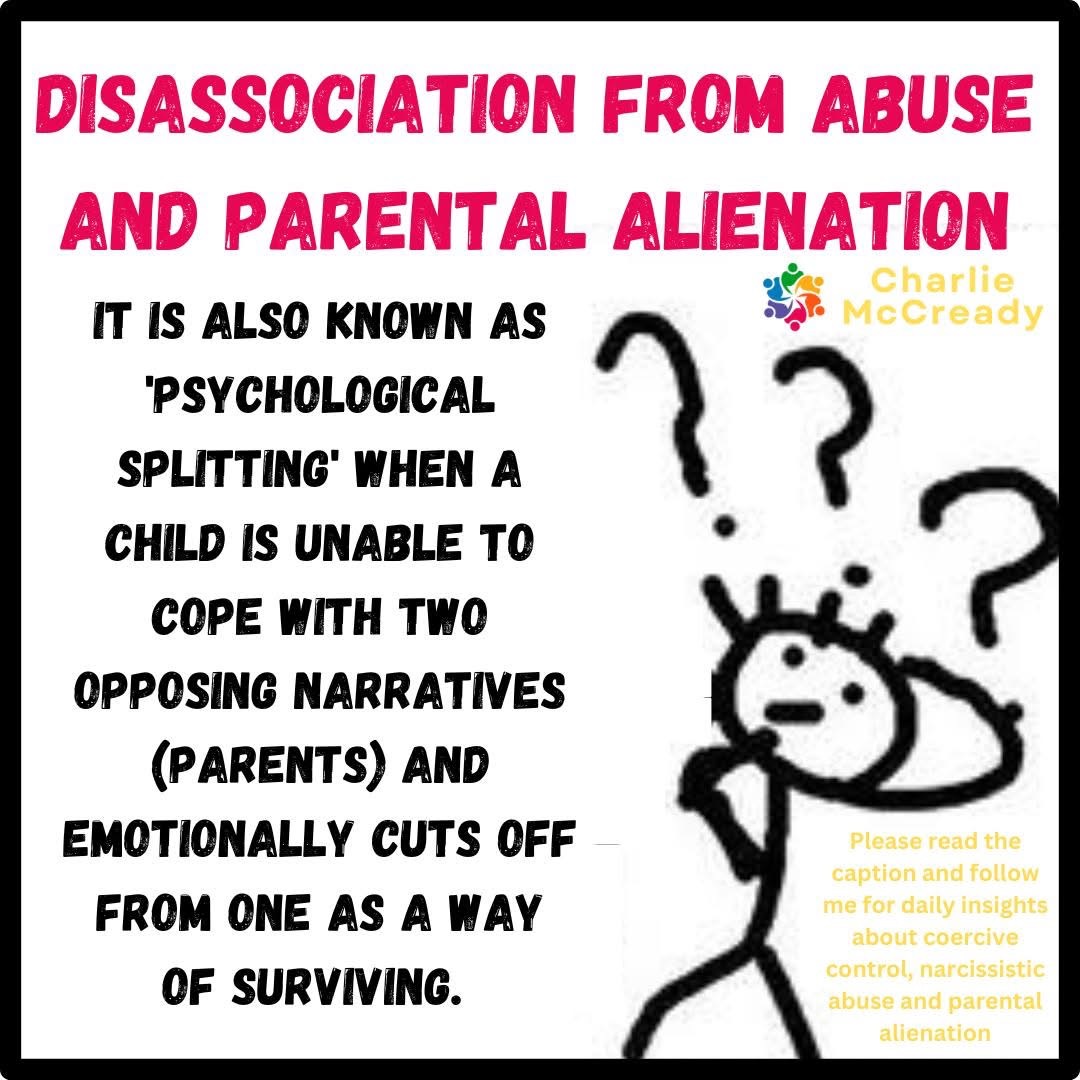
Psychological splitting, also known as “splitting,” is a defence mechanism employed by an alienated child to cope with the trauma of parental alienation. This occurs when the child is coerced and subjected to unbearable pressure, similar to psychological terrorism, into believing that a previously loved parent is bad and must be rejected. The child feels torn between two opposing realities: the love they once had for the rejected parent and the need to please and pacify the aligned, ‘favoured’ alienating parent.
Despite the alienation, the child may know deep down that their rejected parent loves them and is there for them. They may have fond memories of the loving relationship they once shared, and on a subconscious level, they may retain a sense of the parent’s care and support. However, the overwhelming influence of the controlling, alienating parent causes them to suppress these feelings, creating confusion and doubt.
On a deeper level, splitting reflects the child’s alienation from their authentic self, as they are compelled to live someone else’s beliefs and thoughts to survive. The child becomes enmeshed in the parent’s trauma story, losing their sense of self.
As the healthy-minded, alienated parent, it is essential to understand that the child’s splitting is a manifestation of their coping strategy and not a true reflection of their feelings towards you. Although you may feel confused, angry, and grief-stricken, it’s crucial not to let these emotions hinder your recovery. It is challenging for the child to “de-programme” once they’ve split, and pushing them to accept your defence or truth may further distance them. They are already grappling with shame, guilt, and confusion, so it may be best not to mention parental alienation directly.
Understanding the phenomenon of psychological splitting can help recognise parental alienation’s impact on the child and how they may still harbour love and attachment to the rejected parent beneath the surface.
#charliemccready
#parentalalienationcoach
#alienatedchild
#narcissisticabuseawareness
#traumabonding
#narcissisticparent
#splitting
#psychologicalabuse

Psychological Splitting from Abuse /Parental Alienation – Charlie McCarthy
The emotional strain and confusion resulting from parental conflict can be overwhelming. The child may feel powerless, torn between loyalty to both parents or fearful of displeasing the ‘favoured’ alienating parent. Fear of displeasing the alienating parent, coupled with emotional manipulation and coercion, may prompt the child to distance themselves emotionally from the targeted parent, resorting to disassociation as a protective measure or psychologically ‘split’. This is because the child’s mind instinctively resorts to disassociation to protect itself from intense emotional distress.
Disassociation offers the child a psychological escape from the distress caused by parental alienation. By emotionally detaching from the alienated parent, the child shields themselves from the pain and confusion of their situation, essentially numbing themselves to cope with the overwhelming emotional turmoil.
However, despite the challenges posed by this emotional cut-off/disassociation, there is hope for children affected by parental alienation. Children can overcome this defence mechanism and reconnect with the alienated parent. Even from afar, the alienated parent can be a beacon of stability and love, providing a role model for their child. With time, understanding, and intervention, reconnection is possible, offering healing and restoration to families affected by parental alienation.
#charliemccready
#parentalalienationcoach
#narcissisticabuseawareness
#coercivecontrol
#parentalalienation
Alienating Parents believe their own lies /💯🙌
The motivations and psychological processes of alienating parents can vary, making it challenging to generalise their behaviour. In some cases, alienating parents may genuinely believe their lies, deluding themselves into thinking they are protecting their children or acting in their best interest. These individuals might have convinced themselves that the target, alienated parent is a danger or unworthy of the child’s love, and they may genuinely believe the false narrative they have constructed. Their actions may be driven by cognitive dissonance, where they unconsciously justify their behaviour to align with their self-image as a “good” parent, even as their actions cause harm.
On the other hand, some alienating parents may knowingly lie and manipulate the situation to further their agenda and “win” at all costs, even if it means hurting their children in the process. This behaviour can stem from deep-seated resentment, anger, or a desire for revenge against the target parent. These individuals may display narcissistic or sociopathic traits, seeking to control and dominate others, and believe that alienating the child is a way to achieve this control. They may even derive pleasure from causing pain to the target parent and feel powerful when manipulating the child’s
Sometimes, the alienating parent’s behaviour may be a combination of self-delusion and calculated manipulation. They might have started with negative emotions towards the target parent but then become consumed by those feelings, weaving a web of lies and distortions to reinforce their beliefs and justify their actions. This complex mix of cognitive dissonance, narcissism, and calculated manipulation can create a toxic environment for the child, where they are caught in a battle between their parents.
The consequences of parental alienation on the children and the target parent can be severe and have long-lasting emotional and psychological effects. Understanding the dynamics of parental alienation and its impact on all parties involved helps develop effective interventions to address this form of emotional abuse.
#charliemccready
#parentalalienationcoach
#coercivecontrol
#ParentalAlienationSyndrome
White Hats – Parental Alienation/ Charlie McCarthy
Amid gross injustice, misunderstanding, lack of support, enormous grief, and obstructed contact and communication because of a vengeful, selfish, alienating ex (and/or others), the ‘target’ rejected parent still strives towards an end to the conflict even though they’re often left with no option but to ‘fight’ in court, while valiantly trying to rebuild their connection to their much loved and missed children. These are the ones who demonstrate a genuine concern for their child’s well-being and do what they can to maintain a loving and supportive relationship, despite every effort of the alienating parent to sabotage things.’Target’ parents act with integrity and prioritise their child’s emotional needs over personal grievances, representing the epitome of selflessness and unconditional love.
We are talking about heroes.
‘White hats’ typically refers to high-level government officials or insiders who, it’s believed, are working to expose corruption in the deep state, to dismantle a global conspiracy of corruption on every level, and disordered state control and crimes against humanity. Whatever your take on this, I’m likening alienating parents to white hats here for the sake of an analogy which you know I’m partial to when writing these posts. When will people see the blatant lies and false narratives of the alienating parent? When will people know it is the target, rejected parent who stands for truth, authenticity, and love? And that the apparently loving, protective one who has positioned themselves as all powerful and the only parent needed is actually doing so much more harm than good, despite appearances.
It could be seen as a battle between good and evil, ‘white hats’ and ‘villains’ on the world stage and at home, the ‘target’ parents and alienators.
I believe love is mightier than hate. I believe ‘parental alienation’ – despite being called a pseudo-science by some, and despite us having to use terms such as ‘target’ and even ‘parental alienation’ – will one day (soon let’s hope) be widely recognised as psychological abuse, with informed and trained legal and mental health professionals donning ‘white hats’ and stepping into their role as heroes supporting and taking action to combat abuse alongside the parent heroes, like you.
#charliemccready
#parentalalienationcoach
#narcissisticabuseawareness
#coercivecontrol
#parentalalienation
#ParentalAlienationSyndrome
#parentalalienationawareness
#Custody
#ChildCustody
#divorced
#FamilyCourt
#mothersmatter
#FathersMatter
#mothersrights
#fathersrights
#CustodyBattle
 GreatCosmicMothersUnite