Craig Childress, PsyD – Family Courts lacking diagnosis info & legit parents

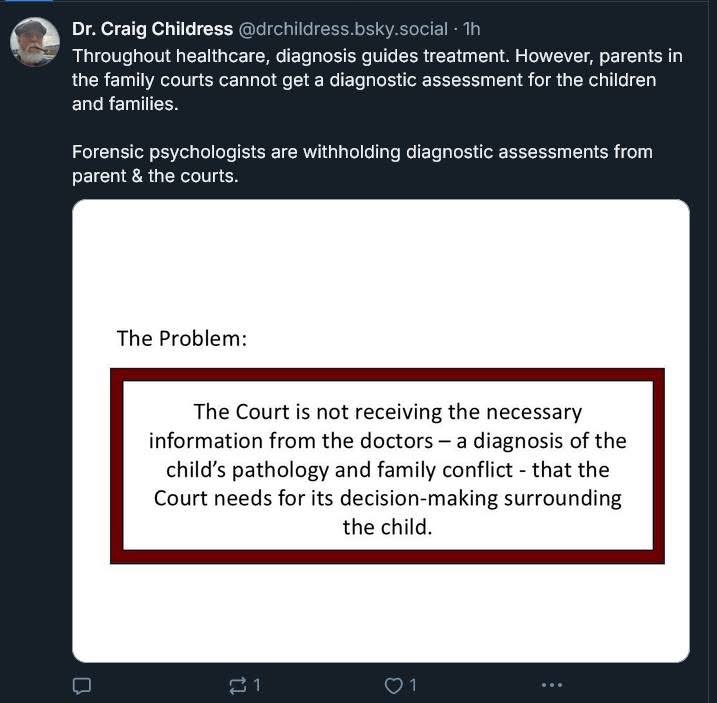
The forensic psychologists are withholding a diagnosis from the courts and from the litigant parents.

As a result, the courts don’t have the necessary information for decision-making surrounding the child, and one of the litigants (the targeted parent) does not have the necessary information to fully make their case to the court for a child protection response.

Court-involved psychologists should NOT be withholding highly relevant diagnostic information from the courts and the litigant parents.

The doctors need to be doctors, they need to formally diagnose the problem (pathology) using the DSM-5 & ICD-11 diagnostic systems, and then tell the court and the litigant parents what that diagnosis is.

This allows each litigant to present their case to the court and to challenge a clearly made diagnosis if they choose. The appellate system for a disputed diagnosis is second opinion.

I recommend that we get that second (and third) opinion throuigh telehealth right at the initial assessment point, thereby giving the court clear mental health information on which to base its decisions – and for a treatment plan to fix the diagnosed problem.

The legal system lands on the wrong end-point, the custody decision of the court. Healthcare lands on the proper end-point, treatment, we need to fix the problem.

Throughout healthcare, diagnosis guides treatment. What is the DSM-5/ICD-11 diagnosis for the pathology (problem)?

They won’t tell you. The forensic psychologists in the family courts won’t tell you what the DSM-5 diagnosis is. They refuse. They are intentionally withholding relevant evidence – the DSM-5 diagnosis – from the court and from the litigant parents.

That’s exactly the problem. The forensic psychologists are breaking the system… for their own financial and career status gain.

The moment the psychologists start returning DSM-5 diagnoses of Child Psychological Abuse (a shared persecutory delusion & FDIA), that will indicate the previous failure of the forensic psychologists to protect the child and targeted parent.

The forensic psychologists are highly motivated now to NOT diagnose the Child Psychological Abuse (DSM-5 V995.51), Delusional Disorder (shared/induced); persecutory type (DSM-5 297.1), and FDIA (DSM-5 300.19) because it will expose their prior failure – throughout their career.

The forensic psychologists in the family courts are intentionally – intentionally – disabling the mental health system’s response to child psychological abuse (DSM-5 V995.51) in the family courts for their personal financial and career-status gain.

Debate: Are Forensic Psychologists Intentionally Disabling the Mental Health System Response to Child Abuse?

Yes: Dr. Childress

No: Pick one. Anyone. How about Dr. Saini, he’s President of the AFCC. How about him? Or anyone. Surly there’s a forensic psychologist who will argue that they are NOT intentionally disabling the mental health system response to child abuse?

Crickets. Watch.

I’m encountering them. They’re encountering me. Howdy, I’m Dr. Childress, pleased to meet you. Are you aware of Standard 2.04 of the APA ethics code?

Are you aware that the DSM-5 & ICD-11 diagnostic systems are among the “established scientific and professional knowledge of the discipline” required – mandatory – for application as the bases for professional judgments?

So? What’s your DSM-5 diagnosis for the child and family problem?

You’re a doctor. That’s your job. Tell the court and the parents what your DSM-5 diagnosis is… and why. Cite to the symptoms, cite to the diagnostic criteria.

Does the child have a fixed and false belief maintained despite contrary evidence (i.e., a delusion) that the child is being malevolently treated in some way by the normal-range parenting of the targeted parent (i.e., a persecutory delusion)?

A litigant parent – the targeted parent – needs an answer to that question for their arguments made to the court. You’re the court-involved psychologist, that’s your “field” of practice – so – answer the diagnostic question for the litigant parent and court.

They won’t answer the question. They are intentionally withholding the diagnostic information – they’re covering up their prior failure. Oh my.

We’re in the active cover-up phase now – which will expand into a larger conflict of interest.

To fix the broken mental health system response to the pathology in the family courts, we need to acknowledge that the experimental quasi-judicial role of forensic custody evaluators failed, and that we need to return to established healthcare of diagnosis and treatment.

But the moment we eliminate forensic custody evaluations and return to clinical diagnostic assessments… they lose their jobs. They are a failed model. Bye-bye, no one needs a “forensic custody evaluation” anymore.

There is currently a tremendous conflict of interest with forensic psychologist in positions of authority and influence. To change means to acknowledge their failure – and they will need to exit the family courts.

They misdiagnosed child abuse their entire careers and were responsible for disabling the mental health system response to child abuse that irrevocably destroyed the lives of thousands of children and their parent.

They experimented on human subjects, the parents and children in the family courts, with their made-up “quasi-judicial” role for doctors. Their experiment on children and parents was a complete and total failure.

They need to go away. They don’t want to go away because this is their career. We’re in the cover-up phase now – entering the conflict of interest phase.

It will get worse for them, and worse, and worse. Reality is what reality is. The DSM-5 diagnosis is V995.51 Child Psychological Abuse (DSM-5 297.1 Delusional Disorder; DSM-5 300.19 FDIA).

Howdy. I’ve been retained in this matter to review your work. It’s a pleasure to meet you.

Craig Childress, Psy.D.

Clinical Psychologist

WA 61538481

OR 3942 – CA 18857
Indoctrination/Parental Alienation- Charlie McCready

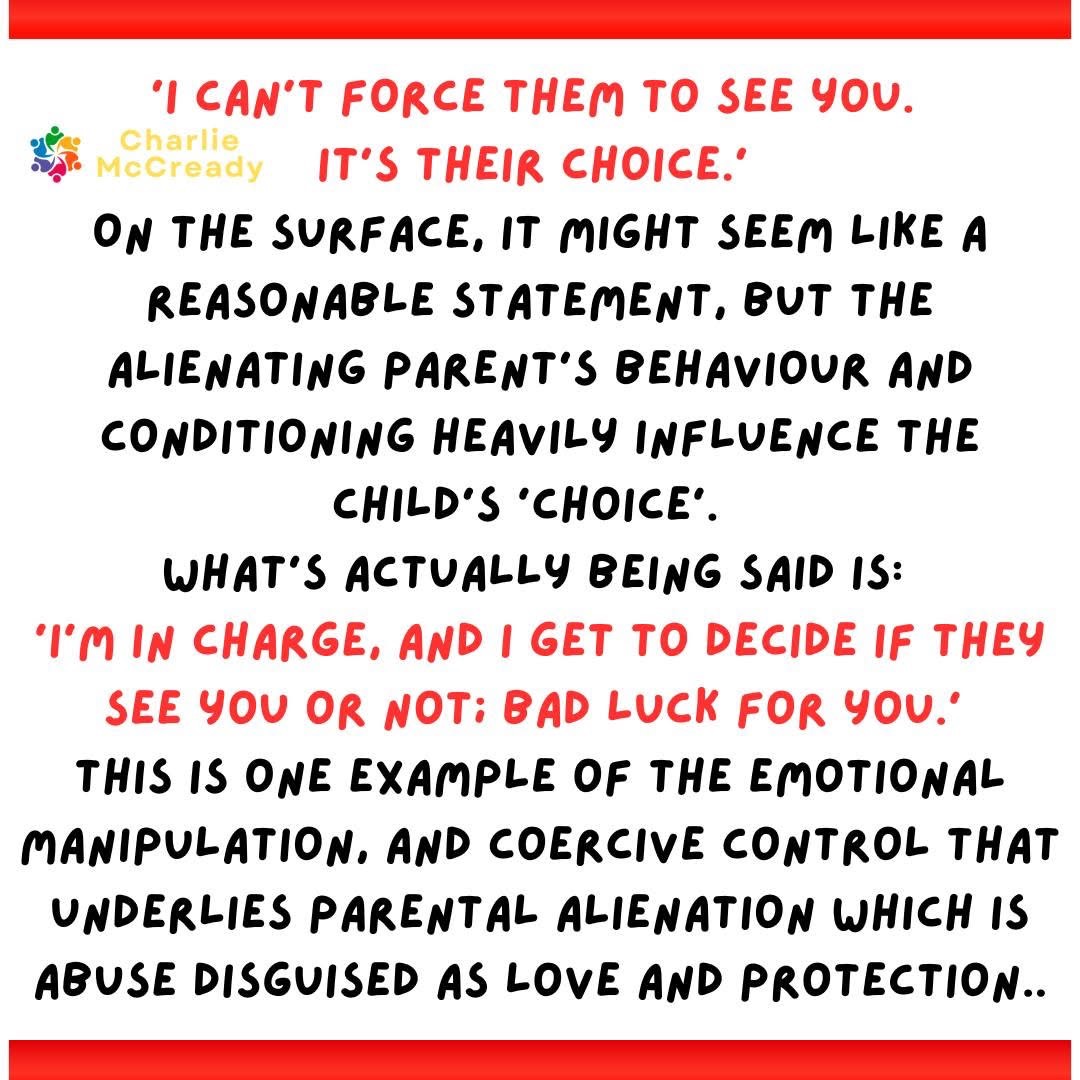
The idea that the alienating parent is not standing in the way of your relationship with your child is pure theatre. It’s an act. Behind the scenes, they’ve already given the child their lines and coached them into believing the character they’re supposed to play. Indoctrination, such as when a child is alienated and without justification for their rejection of you, is what’s happening. The child isn’t being given choices. They’ve already been coercively controlled and enmeshed into an alignment with the alienating parent.⁠

A child’s expression of wishes holds such power and is often a deciding factor in proceedings concerning them, but it should be acknowledged as a voice, not a choice. Placing the child in a position where they must select one parent over the other goes beyond being inappropriate. Children often desire things at age 8 or 9 that they’d go nowhere near ten years later. I’ll give you an example. I thought it would be incredibly cool to be a lion tamer. Thankfully my parents didn’t think to put me in a lion’s den with a whip and a whistle, thinking that my needs must be met because this is what I believed was right for me. I also wanted to be able to fly, and they didn’t send me off to be operated on with wings attached to me surgically. Of course, children need to be heard, but they also have to be guided, nurtured, given boundaries while not being totally indoctrinated. Children might not know better than to wish for something detrimental to them, as in the case of being allowed to choose to reject a loved, loving parent, having been encouraged by the alienating parent to do so.⁠

Research shows that many adults who, in their youth, rejected a parent, having been given a lot of pressure to do so by the other parent, later came to regret it and wished somebody would have had the sense to help them realise this was not a good idea – friends, family, legal or mental health professionals, anybody. ⁠

Taking, ‘it’s their choice’ at face value fails to recognise the extent of coercive control, psychological abuse, and manipulation at play, which can have profound negative effects on the child’s emotional development and well-being.⁠

#charliemccready

#parentalalienationcoach

#adversechildhoodexperiences

#CoerciveControl

#custodybattle

#parentalalienation

#narcissisticparent

#mothersmatter

#FathersMatterToo

#FathersMatter

#FamilyCourt

#coercivecontrolawareness

#parentalalienationawareness

#mothersrights

#FathersRights

#ChildCustody

#traumabonding

#familycourts

High Conflict – Charlie McCready

A wise and wonderful parent I’ve worked with made a very good point about the term ‘high conflict’, typically used to define divorces between a warring couple. In other words, we all get thrown in together, even though our character and behaviour might be polar opposites. One parent might be actively working towards a peaceful resolution, genuinely seeking an amicable resolution for the well-being of the children, and understanding the importance of maintaining a healthy relationship between both parents. The other is engaging in alienating behaviours, including provocation, false allegations, lies, withholding information, and limiting or blocking contact. ⁠

Labelling both parents as ‘high conflict’ without discerning the underlying dynamics can be detrimental. It might unintentionally equate the legitimate concerns and actions of one parent with the manipulative behaviours of the other. It’s important for all involved who seek to be able to differentiate between legitimate conflict resolution efforts and manipulative tactics. It’s unhelpful to call both parents ‘high conflict’, and it is particularly lenient towards the alienating parent and less kind to the parent seeking a peaceful way forward. This labelling can create a false equivalency, perpetuating an environment where the true victim of alienation is treated as if they are equally responsible for the conflict. ⁠

A more psychologically informed approach, understanding the underlying dynamics of parental alienation, and acknowledging the intricate emotional interplay between the child, alienating parent and targeted parent, could lead to a fairer assessment of the situation, potentially protecting the child from the harmful effects of alienation. This approach requires mental health professionals, legal experts, and all involved parties to recognise that alienation often stems from a complex web of psychological factors, including unresolved conflicts, emotional manipulation, and distorted perceptions. ⁠

#charliemccready

#parentalalienationcoach

#highconflictcoparenting

#highconflictdivorce

#narcissisticparent

PA is a Sinister Form of Domestic Abuse

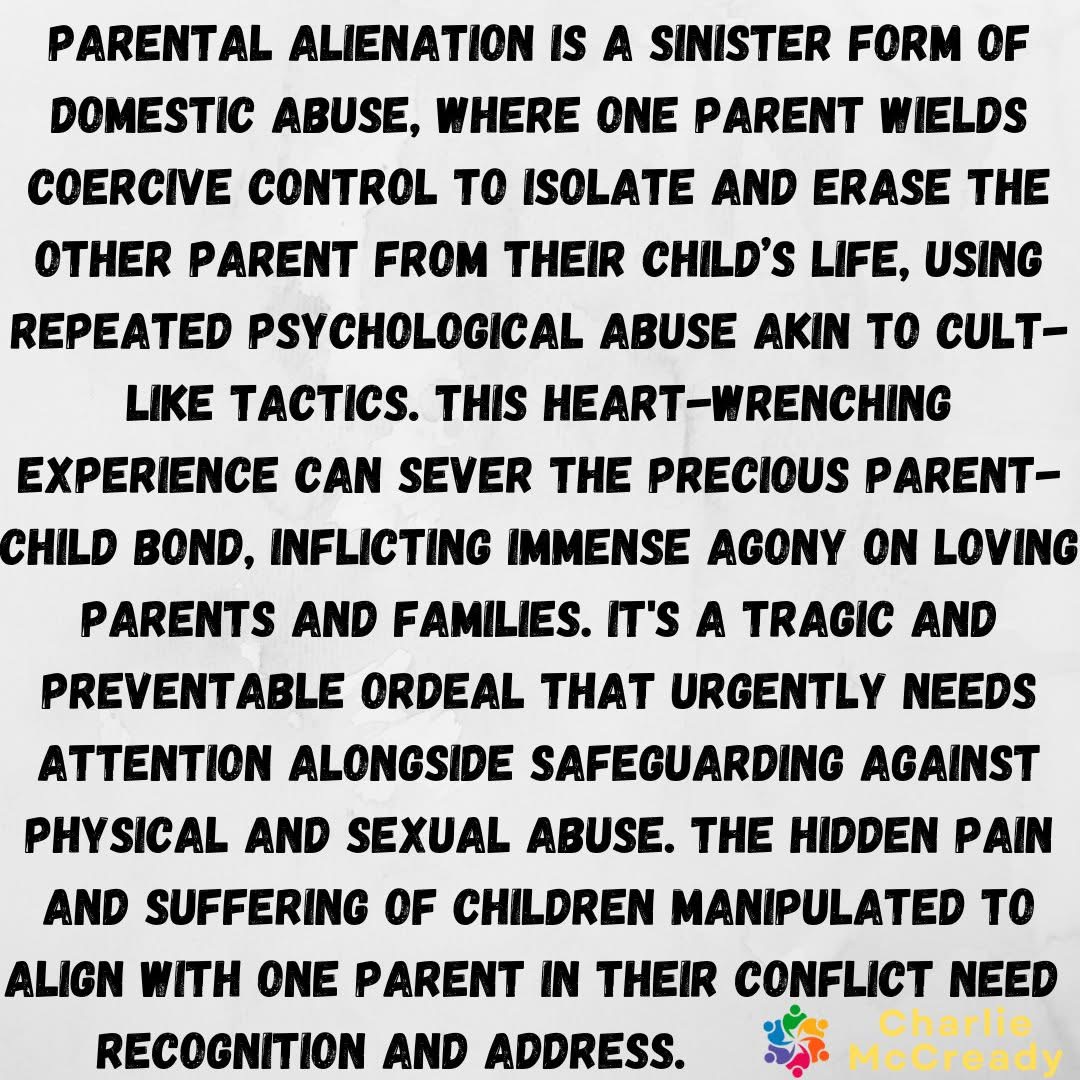
Parental alienation is a complex attachment disorder in which one parent psychologically, wilfully, and covertly conditions a child to fear and despise the other parent—whether mother or father. This results in the child’s unjustified rejection of a loving parent and anyone associated with them. Through a relentless campaign of lies, coercion, and manipulation, the alienating parent enforces their control, exploiting the child’s vulnerability. These destructive behaviours often surface after a high-conflict separation or divorce, stemming from a need for vengeance. While it’s non-gendered, it’s frequently associated with a cluster B personality disorder, such as narcissism. Parental alienation is not a custody issue—it’s a profound issue of child protection, a mental health crisis, and a form of psychological abuse that demands urgent recognition and action.

It goes by many names—‘the excluded parent’ phenomenon, pathogenic parenting, hostile aggressive parenting, child alienation, intractable contact, psychological manipulation, chronic litigation, spousal abuse, family bond obstruction… but by any name, it is abuse. And it is woefully misunderstood, maligned, and mistreated.

We are here to spread awareness, inform, and uplift. Millions are suffering in this pandemic of grief and injustice. This is a crisis that demands our attention.

Please follow me for daily insights, and visit my website to learn more about the coaching I offer—whether group sessions or 1:1 support.

#charliemccready

#parentalalienationcoach

#parentalalienation

#parentalalienationawareness

Parental Alienation- Charlie McCready

“The only thing necessary for the triumph of evil is for good men to do nothing.” – Edmund Burke⁠

The problem with good people doing nothing, often due to constraints like job remits or instructions not to step in and take action, is that it sometimes allows harmful situations or injustices to persist unchecked. Their inaction enables the continuation of wrongdoing, And so it is with parental alienation. ⁠

There’s a story about a teacher with a fishbowl on his desk. Before leaving the room, he gave strict instructions to his class not to touch the fish. He took a fish from its bowl and placed it on his desk. When the teacher had gone, the school kids stared at each other, shrugging their shoulders, confused and unsure what to do. They sat there. They stared at the fish, flapping desperately. Dying before their very eyes. One girl couldn’t bear it anymore. She rushed to the desk and put the fish back in the bowl. The teacher returned to the class. She expected to be reprimanded, but she didn’t care. Nor did he. Instead, he congratulated her and proceeded to give a lesson on how it’s sometimes best to break the rules, especially in a life-and-death situation. ⁠

The problem with legal and mental health experts is that they tend to go by the book, but as parental alienation is yet to be recognised officially, there is no standardised method of identifying it, taking action, or supporting the true victims of this psychologically abusive family violence – the children and ‘target’ parents. Too often, they do nothing. And this is worse. It’s harmful to do nothing. ⁠

However, I do believe this will change. Just as we now know, cigarettes are not healthy. We have safeguarding measures for domestic abuse (especially women). In time, parental alienation will be recognised as abuse.

#charliemccready

#parentalalienationcoach

#alienatedchild

#childpsychologicalabuse

#familycourts

#parentalalienationawareness

#custody

#FamilyCourt

#parentalalienation

#healing

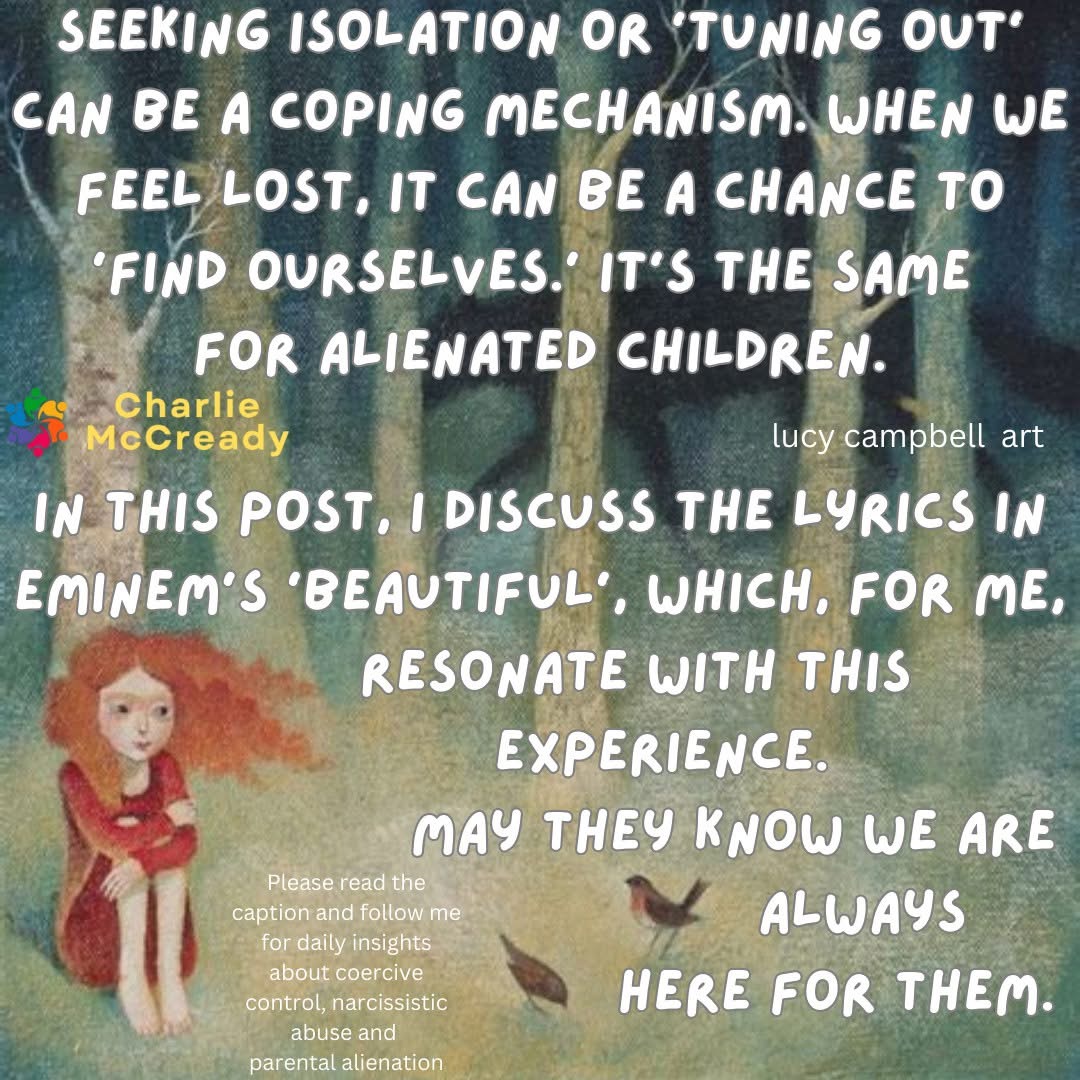
Isolating ; Tuning Out in Parental Alienation

I noticed the distancing – preempting what I later became ‘parental alienation’ – happen sometime before my children left. When it was particularly unpleasant and upsetting in those weeks and months before they moved to the other side of the world, I tried to remind myself that this was how they were bracing themselves to cope with such a monumentally life-changing, scary/exciting/brave/unknown decision. I didn’t always deal with it well, either. I’d been through parental alienation before, as a step-parent in 2001, but this took me to another level of grief long before the alienation kicked in.

It was 2009, and in the time before they left, Eminem’s’ Beautiful’ was played a lot in my children’s bedrooms. It’s a song that expresses a struggle with depression, self-doubt and a yearning for understanding, acceptance, and a desire for a better life. After they’d gone and I heard the song, I grieved. I convinced myself that the lyrics were a child’s hope for a bridge between worlds, and that mine could come back anytime. The time with their other parent became permanent, and then I was cut off, no longer necessary, and even deemed unsafe. It’s the 180 turnaround from good parent with happy, healthy children to monster that’s nonsensical and horrifying.

But they don’t lose us – we’re still here.

The song ‘Beautiful’, to me, is about alienation. It’s about longing for connection after being rejected, building ourselves up no matter how many times we’re set back or fall. We and our children are disconnected by enforcement and manipulation. We cope with it the best we can. The ‘distancing’ or ‘emotional cutoff’ is also known as disassociation. This is something in our children that the alienating parent can exacerbate, too.

There are times we have to let things run their course. We need the time and space to figure things out, and so do they. We’re still here. Mine did figure things out, reach out, and they came back. It is my heartfelt wish that yours do, too.

#charliemccready

#parentalalienationcoach

#alienatedchild

#parentalalienation

#familycourts

#childpsychologicalabuse

#parentalalienationawareness

#adversechildhoodexperiences

#FamilyCourt

#custody

#custodybattle

#ChildCustody

Weaponized Alienated Children

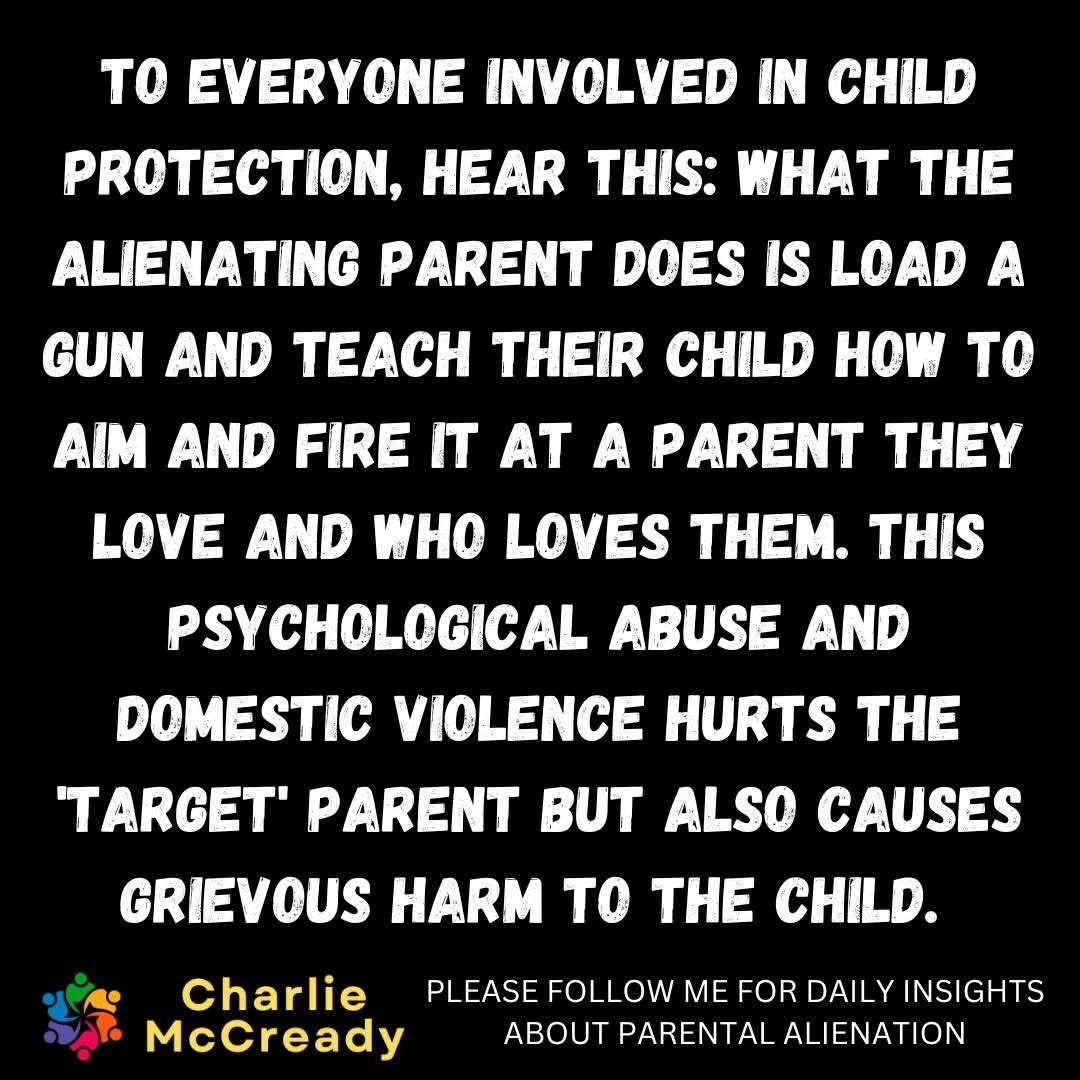
To all those engaged in safeguarding the well-being of children, it is crucial to recognise and address the deeply troubling phenomenon of weaponised, alienated children. This behaviour is far from natural; it results from a manufactured conflict that transforms innocent children into emotional weapons aimed at a parent they have loved and would still love. Family courts and mental health professionals must grasp the gravity of this situation.⁠

Imagine a scenario where an alienating parent loads a figurative gun and instructs their child on how to aim and pull the trigger against the other parent, a parent who loves them deeply. This shocking analogy draws attention to the psychological abuse and domestic violence within the dynamics of parental alienation. Just as a loaded gun can inflict physical harm, an alienated child, driven by coercive control, fear and confusion, can cause immense emotional and psychological damage to the targeted parent.⁠

This situation is akin to a psychological war waged against a loving parent. The tactics employed by the alienating parent distort the child’s perceptions, turning them into unwitting participants in this emotional conflict. The consequences are profound and far-reaching. The targeted parent is hurt by the betrayal, the severed bond, and the false accusations, but the child also suffers grievously.⁠

Family courts and mental health professionals must be equipped to recognise the signs of this weaponised behaviour. A child who acts like a loaded gun demonstrates the results of insidious manipulation. This destructive behaviour should not be trivialised or ignored. Instead, it requires urgent intervention to dismantle the psychological weaponry and to restore the child’s emotional well-being.⁠

By acknowledging and addressing the gravity of weaponised alienation, we can work toward protecting the targeted parent’s and child’s mental and emotional health. We need to look at who is loading the gun and teaching their child to fire it, as well as educate them so they know the harm they are causing. We can then hope to rebuild healthy relationships and create an environment where the child can flourish without being caught in the crossfire of adult conflicts.

#charliemccready

#parentalalienationcoach

#alienatedchild

#childpsychologicalabuse

#CoerciveControl

#parentalalienation

#FamilyCourt

#custody

#mothersmatter

#FathersMatterToo

#FathersMatter

#ChildCustody

#narcissisticabuseawareness

#traumabond

#parentalalienationawareness

#mothersrights

#FathersRights

#narcissisticparent

#FamilyCourtReform

#attachmenttheory

#custodybattle

Alienated Children – Cognitive Dissonance

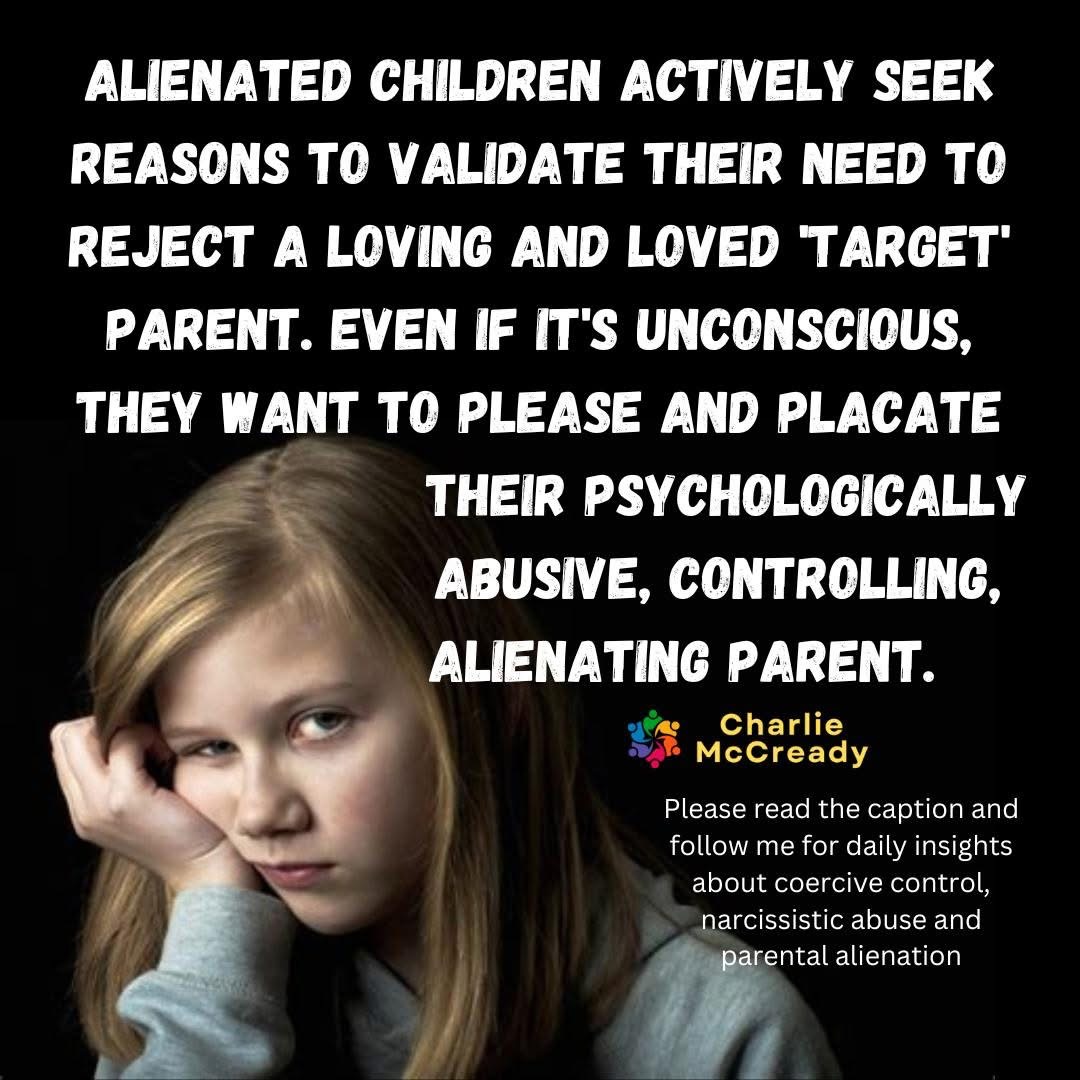
Alienated children often suffer from cognitive dissonance as they struggle to reconcile the negative narrative imposed on them by the alienating parent and their own genuine feelings and memories of the ‘target’ parent. This can lead them to seek reasons to justify their rejection of a loved, loving, available and non-abusive parent. It’s also a means to align with the alienating parent who presents as stronger and apparently safer. This is what the child wants – safety, security, love. Initially, they may subconsciously prioritise pleasing the controlling alienating parent to avoid conflict or further manipulation. ⁠

The alienated child consciously or unconsciously seeks evidence, often exaggerated or distorted, that supports the negative image the alienating parent has portrayed of the ‘target’ parent. Information can be twisted out of all recognition. There are many examples of this. A phone call can be called harassment. Gifts can be bribery. Virtually everything can seem wrong as the alienating parent repositions it, and unfortunately, the child learns this behaviour and starts to put it into practise themselves. This can involve past and present events. Happy memories can be erased and reprogrammed in a negative light. ⁠

But it has to be remembered that when the child does this, it is a way of surviving a dreadful ordeal and somehow trying to justify and validate the behaviours they’ve been coerced into. I’ve heard it so many times from adults who were alienated children that it really helped them to know their rejected parent was always there for them, waiting, in the background, with love, giving them hope that one day everything would be okay.⁠

#charliemccready

#parentalalienationcoach

#alienatedchild

#parentalalienationawareness

#CoerciveControl

#FamilyCourt

#childpsychologicalabuse

#attachmenttheory

#parentalalienation

#custody

#ChildCustody

Parental Alienation is Not Gender Specific – Charlie Mc Cready

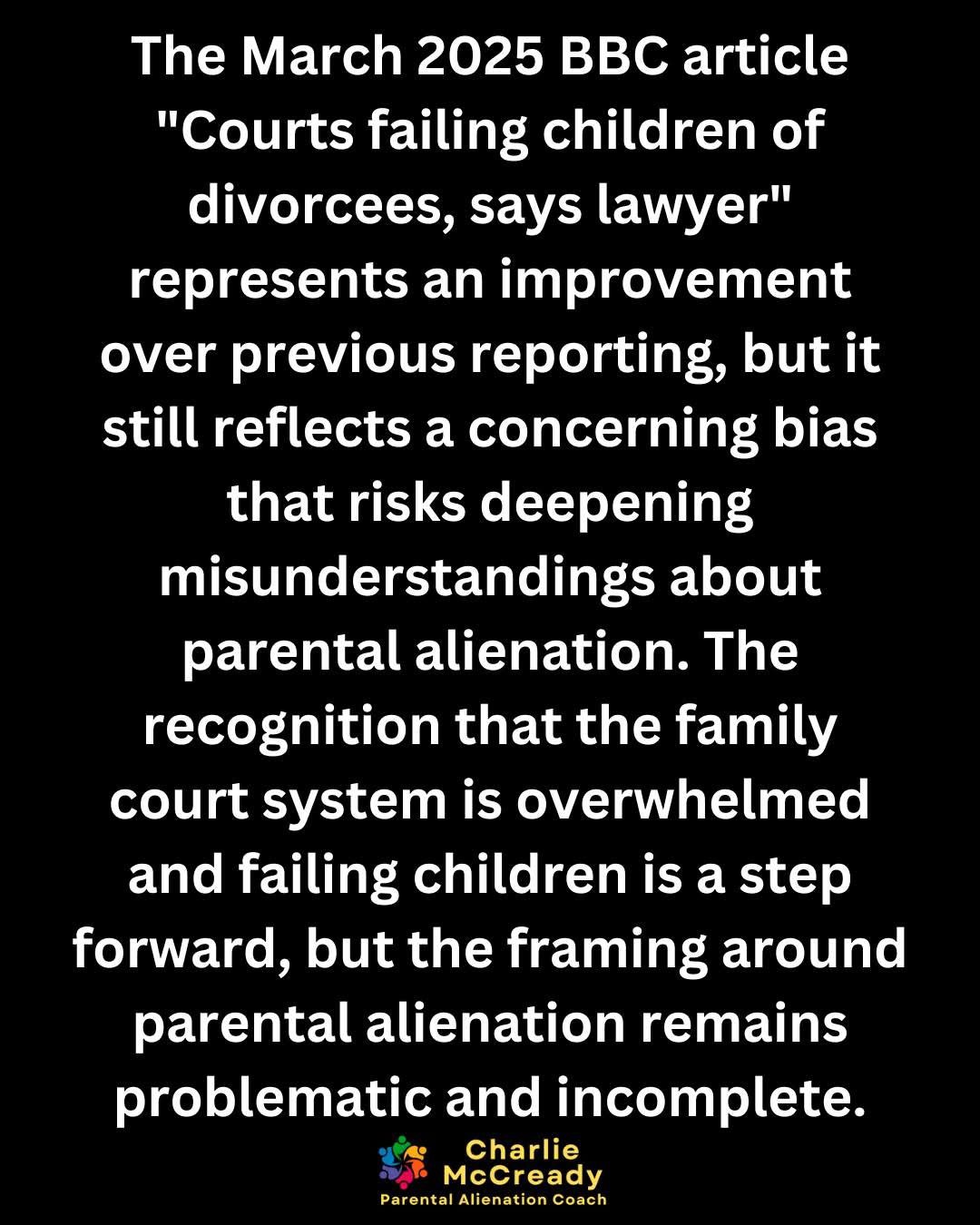
The latest BBC (14 March 2025) article says that parental alienation claims are sometimes used strategically in family court cases and, in doing so, is downplaying the reality that alienation itself is a well-documented form of psychological abuse rooted in coercive control and attachment disruption. Emphasising alienation as a manipulative tactic without properly recognising its legitimate existence harms alienated parents and their children. Alienating behaviours—whether intentional or unconscious—are extensively supported by clinical and legal research. Labelling it as a “pseudoscience” because of its historical association with the outdated “Parental Alienation Syndrome” is both misleading and harmful.⁠

The article repeats the troubling narrative that allegations of domestic abuse should automatically take precedence over claims of alienation. This was the crux of a BBC report in December, and thank you to all of you who wrote in to complain (this is acknowledged in the article). I strongly believe this continuing binary framing creates a false hierarchy of harm. In reality, both domestic abuse and parental alienation can coexist. An abusive parent might falsely claim alienation to deflect from their behaviour, while an alienating parent might fabricate domestic abuse claims to justify cutting off contact. Courts must investigate ALL allegations thoroughly rather than setting up a default presumption that one form of harm outweighs the other. Protecting children requires understanding the complexity of these cases—not reducing them to a simplistic “abuse versus alienation” framework.⁠

I also believe a critical flaw in the Family Justice Council’s recommendations is the suggestion that judges—not psychologists—should determine whether parental alienation has occurred. Judges may lack the specialised training needed to recognise the subtle patterns of psychological manipulation that define alienation. Excluding mental health professionals from these assessments risks leaving children exposed to emotional abuse that may not be immediately visible to a legal professional.

The gendered framing in the article is also concerning. The implication that fathers are more likely to use parental alienation as a weapon and mothers are more often victims of domestic abuse

reflects outdated stereotypes. In reality, I can say my partner and I both suffered, the parents I work with – mothers and fathers – suffer the same. I’d say the differences are in presumed familial relationships and stereotypes, which again are unhelpful. Both mothers and fathers can be victims or perpetrators of alienation and abuse. Alienation is not a gendered issue—it is a psychological and relational one. A gender-neutral, child-centred perspective is essential for understanding the true dynamics of alienation and abuse.

Alienated parents already face immense psychological and emotional strain navigating a system that often fails to recognise the coercive control and emotional abuse they—and their children—are enduring. Until parental alienation is treated with the same seriousness as other forms of abuse, many children will remain trapped in harmful family dynamics, cut off from a loving parent. A balanced and evidence-based approach—grounded in the realities of both domestic abuse and alienation—is essential to ensuring that children’s welfare remains the central focus of family court decisions.

This is not just a legal issue—it’s a safeguarding issue. The failure to adequately address parental alienation means failing the very children the system is supposed to protect.

#charliemccready

#parentalalienationcoach

#highconflictcoparenting

#FamilyCourt

#FamilyCourtReform

#FamilyCourtCorruption

#custodybattle

Craig Childress, PsyD – Child Attachment Pathology & Child Abuse

I think I’m going to Coffee talk you twice tomorrow.

In the first one I’ll answer a question. In the second I’m going to talk to teachers – and the principal. For schools, it’s mostly the principal who’s involved, but the teacher should know what’s up.

Mostly teachers need to keep their heads down and remain non-involved… mostly it’s navigating the parent conferences. It’s the principal and the front office where most of the inter-parental action happens.

Sometimes it’s the records thing. Sometimes it’s a child tantrum in the office at exchange. Sometimes it’s a missed pick-up because the allied parent already picked the child up.

Triangulation is a hallmark of manipulative pathology. General public bystanders need to de-triangulate. It’s the psychologists who should be handling it. But they’re not.

Everything is a problem because the doctor psychologists in the family courts aren’t doing their job of fixing the problem. That’s their profession, that’s their job – to fix the mental health problem.

In this case, child attachment pathology and child abuse.

This isn’t a custody issue. Its a treatment issue. We need to fix the problem. To fix the problem we first have to identify what the problem is – i.e., which parent is abusing the child?

Diagnosis guides treatment. If we try to treat cancer with insulin, the patient dies from the misdiagnosed cancer. What is the diagnosis?

Start there. Once we have an accurate diagnosis for what the problem is, then we can develop an effective treatment plan to fix the problem… whatever the problem is.

That’s what we do in healthcare. You go to the doctor when you’re sick and the doctor diagnoses what’s causing your problem and then gives you a treatment plan to fix the problem.

Diagnosis first, then treatment. The treatment depends on the diagnosis, are we treating cancer or diabetes – which parent is abusing the child?

If a child is rejecting a parent, one parent or the other is abusing the child because abusive parenting is the ONLY thing that causes a symptom of a child rejecting a parent.

The ONLY diagnostic question is which parent is abusing the child?

Once the doctors start doing their job… everything will be fixed because they’ll fix the problem.

I should tell you how to fix problems. Maybe I should start with the basics of behavior change. Do you want to change any aspect of your life? I should tell you how to do that.

It’s relatively easy. The problem is you won’t do it. It’s called “resistance” and it arrived with Freud and has been the obstacle forever after.

I should tell you about Alfred Adler and why people want their problems. I should tell you about depression and anxiety too – just kind of orientations.

Should I tell you about Sapolsky and how it doesn’t matter what you do because it’s all Determined? Probably not.

I should talk to the teachers and principals to give them suggestions for navigating their child end of inter-parental custody conflict. We’ll see how the spirit moves me.

Craig Childress, Psy.D.
Clinical Psychologist
WA 61538481
OR 3942 – CA 18857