Africa

O- said to originate in East Africa – Cro Magnum , hunters and gatherers .

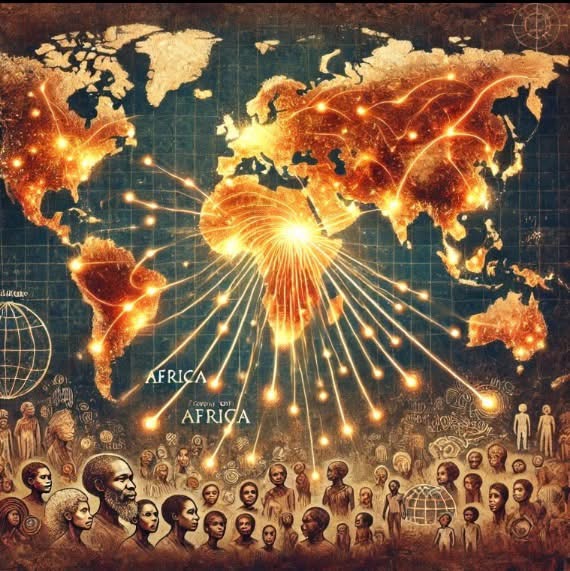
All modern humans come from Africa – this is a scientifically confirmed fact. Our shared history begins around 200,000 years ago, when the first Homo sapiens emerged on the African continent. Around 60,000 to 70,000 years ago, our ancestors embarked on a great journey, leaving Africa and settling other parts of the world.

This migration, known as the “Out of Africa Theory,” was a pivotal moment in human history. Genetic research clearly shows that all modern humans, regardless of skin color, language or culture, share common ancestry from Africa. Fossil and archaeological finds further support this fascinating story of our origins.

What makes us special is not only our diversity, but also the fact that we all share the same story of survival, adaptation and migration. Whether in Asia, Europe, America or Australia – we all carry a part of this history in our genetic code.

This realization reminds us that the boundaries we often draw between ourselves are artificial, because deep within us we all share the same roots. It is a lesson about connection and community that reminds us of our true oneness.

Jupiter Retrograde Ends

Jupiter’s retrograde has ended, and with it comes a powerful shift in energy. The delays, confusion, and emotional heaviness you may have felt are clearing, making space for soul growth, fresh opportunities, and a renewed sense of hope.

Challenges that felt overwhelming will start to fade. Problems that seemed complicated will suddenly have simple solutions. Opportunities you thought were out of reach will reappear, and doors that once felt firmly closed will swing open with ease.

Your relationships will also benefit from this shift. If there’s been tension, distance, or unresolved issues, now is the time for healing. Jupiter’s energy encourages forgiveness, understanding, and emotional growth. Old wounds will feel less painful, and you’ll find it easier to let go of grudges and open your heart. You might receive unexpected messages from people you haven’t heard from in a while, heartfelt apologies, or have meaningful conversations that help rebuild connections and bring clarity. This is a time for strengthening bonds, whether it’s with family, friends, or romantic partners.

Jupiter’s influence also makes it easier to attract the things you’ve been dreaming about. Whether it’s love, success, financial abundance, or personal growth, you’ll notice that things start falling into place more easily. You’ll see signs and lucky coincidences—like meeting the right person at the right time, receiving unexpected good news, or having opportunities show up out of nowhere. It will feel like the Universe is guiding you, helping you manifest your desires with ease.

You’ll also feel more confident and inspired to take action. Dreams that once felt too big or out of reach will now seem possible. Whether you’re starting a new project, going after your dream job, launching a business, or opening your heart to love again, you’ll feel ready to take bold steps. Jupiter’s energy gives you the belief that you can achieve anything you set your mind to, and that belief is the key to making it happen.

This is a time to say yes to new opportunities, even if they feel a little scary. Yes to healing, even if it means facing old wounds. Yes to abundance, even if receiving feels unfamiliar. The Universe is ready to deliver, but it’s up to you to be open to receiving.

This is your time. Trust in the process, believe in your dreams, and know that the Universe is supporting you every step of the way. Jupiter’s energy is clearing the path, opening doors, and bringing opportunities you never thought possible.

~ Alex Myles ❤️

Dan Nelson – Psychiatry , Capitalism & the Industrial Machine / Mad in America

Psychiatry, Capitalism, and the Industrial Machine

by Dan Nelson

The birth of psychiatry coincided with the rise of industrial capitalism, and the two have been intertwined ever since. Our systems have been so consistently damaging that a branch of “medicine” has developed to treat those afflicted by what might be termed “industrial sickness.” Psychiatry, under the guise of science, developed frameworks to identify and manage individuals who deviated from the norms established by industrial society.

By labeling these deviations as mental illnesses, psychiatry helped to neutralize threats to the system. The individual was no longer a person with legitimate grievances but a patient requiring treatment. In that way, psychiatry sides with the oppressors while helping the oppressed better endure their oppression.

https://buff.ly/4aMKjFt

Alienator Traits

People who alienate their child from a loving parent often exhibit identifiable personality disorders, such as borderline and narcissistic personality disorders. While labelling these individuals as having personality disorders may seem like an attack, it is essential to recognise that they need help rather than pity. Behind their harmful behaviours, such as emotional abuse and coercive control, is an inner core of fear, inadequacy, vulnerability, and worthlessness that drives their actions. Understanding the mental health issues and personality disorders behind parental alienation can guide interventions and support systems to address these issues effectively.⁠

Statistics on the prevalence of personality disorders among alienating parents can be challenging to obtain, as diagnosing personality disorders often requires in-depth psychological assessments and evaluations. Studies and expert observations indicate a higher prevalence of individuals with borderline and narcissistic personality traits among alienating parents.⁠

Borderline personality disorder (BPD) is characterised by difficulties managing emotions, unstable relationships, impulsive behaviour, and a fear of abandonment. These traits can manifest in intense and unstable relationships, including the parent-child relationship, contributing to alienation.⁠

Narcissistic personality disorder (NPD) involves a grandiose sense of self-importance, a lack of empathy, and a constant need for admiration and validation. Alienating parents with NPD may manipulate and control their children to maintain a sense of power and control over them, leading to the alienation of the other parent While it is essential to recognise the internal struggles of people with personality disorders, addressing the root causes of their behaviour and the impact it has on the targeted parent and child is equally crucial. Unfortunately, many alienating parents blame the targeted parent, make false allegations, and subject them to psychological abuse, which can be emotionally devastating. Alienating parents typically struggle with self-reflection and are often resistant to seeking help to address their behaviour. As a result, the cycle of harmful and abusive actions towards the targeted parent and the child continues.

Convincing them to seek help can be challenging even though if they could break free from harmful patterns, it would create healthier environments for their children. Simultaneously, interventions should prioritise the well-being of the child and the targeted parent, recognising the pain and distress they experience due to the alienation. Acknowledging the complexities of parental alienation, particularly when personality disorders are involved, is crucial in developing more effective strategies to address this damaging phenomenon and promote healthier family dynamics.

#charliemccready

#parentalalienationcoach

#narcissisticabuseawareness

#mentalhealth

#healing

#parentalalienation

Distributive Bargaining – Prez Trump’s Art of the Deal

The best, most cogent and elegantly simple explanation into the inexplicably destructive negotiating processes of the president,by Prof. David Honig of Indiana University.

Everybody I know should read this accurate and enlightening piece…

“I’m going to get a little wonky and write about Donald Trump and negotiations. For those who don’t know, I’m an adjunct professor at Indiana University – Robert H. McKinney School of Law and I teach negotiations. Okay, here goes.

Trump, as most of us know, is the credited author of “The Art of the Deal,” a book that was actually ghost written by a man named Tony Schwartz, who was given access to Trump and wrote based upon his observations. If you’ve read The Art of the Deal, or if you’ve followed Trump lately, you’ll know, even if you didn’t know the label, that he sees all dealmaking as what we call “distributive bargaining.”

Distributive bargaining always has a winner and a loser. It happens when there is a fixed quantity of something and two sides are fighting over how it gets distributed. Think of it as a pie and you’re fighting over who gets how many pieces. In Trump’s world, the bargaining was for a building, or for construction work, or subcontractors. He perceives a successful bargain as one in which there is a winner and a loser, so if he pays less than the seller wants, he wins. The more he saves the more he wins.

The other type of bargaining is called integrative bargaining. In integrative bargaining the two sides don’t have a complete conflict of interest, and it is possible to reach mutually beneficial agreements. Think of it, not a single pie to be divided by two hungry people, but as a baker and a caterer negotiating over how many pies will be baked at what prices, and the nature of their ongoing relationship after this one gig is over.

The problem with Trump is that he sees only distributive bargaining in an international world that requires integrative bargaining. He can raise tariffs, but so can other countries. He can’t demand they not respond. There is no defined end to the negotiation and there is no simple winner and loser. There are always more pies to be baked. Further, negotiations aren’t binary. China’s choices aren’t (a) buy soybeans from US farmers, or (b) don’t buy soybeans. They can also (c) buy soybeans from Russia, or Argentina, or Brazil, or Canada, etc. That completely strips the distributive bargainer of his power to win or lose, to control the negotiation.

One of the risks of distributive bargaining is bad will. In a one-time distributive bargain, e.g. negotiating with the cabinet maker in your casino about whether you’re going to pay his whole bill or demand a discount, you don’t have to worry about your ongoing credibility or the next deal. If you do that to the cabinet maker, you can bet he won’t agree to do the cabinets in your next casino, and you’re going to have to find another cabinet maker.

There isn’t another Canada.

So when you approach international negotiation, in a world as complex as ours, with integrated economies and multiple buyers and sellers, you simply must approach them through integrative bargaining. If you attempt distributive bargaining, success is impossible. And we see that already.

Trump has raised tariffs on China. China responded, in addition to raising tariffs on US goods, by dropping all its soybean orders from the US and buying them from Russia. The effect is not only to cause tremendous harm to US farmers, but also to increase Russian revenue, making Russia less susceptible to sanctions and boycotts, increasing its economic and political power in the world, and reducing ours. Trump saw steel and aluminum and thought it would be an easy win, BECAUSE HE SAW ONLY STEEL AND ALUMINUM – HE SEES EVERY NEGOTIATION AS DISTRIBUTIVE. China saw it as integrative, and integrated Russia and its soybean purchase orders into a far more complex negotiation ecosystem.

Trump has the same weakness politically. For every winner there must be a loser. And that’s just not how politics works, not over the long run.

For people who study negotiations, this is incredibly basic stuff, negotiations 101, definitions you learn before you even start talking about styles and tactics. And here’s another huge problem for us.

Trump is utterly convinced that his experience in a closely held real estate company has prepared him to run a nation, and therefore he rejects the advice of people who spent entire careers studying the nuances of international negotiations and diplomacy. But the leaders on the other side of the table have not eschewed expertise, they have embraced it. And that means they look at Trump and, given his very limited tool chest and his blindly distributive understanding of negotiation, they know exactly what he is going to do and exactly how to respond to it.

From a professional negotiation point of view, Trump isn’t even bringing checkers to a chess match. He’s bringing a quarter that he insists of flipping for heads or tails, while everybody else is studying the chess board to decide whether its better to open with Najdorf or Grünfeld.”

— David Honig