

Yes 💯🙌🙏❤️
Tag: child Psychological abuse
Charlie McCarthy- Bereavement
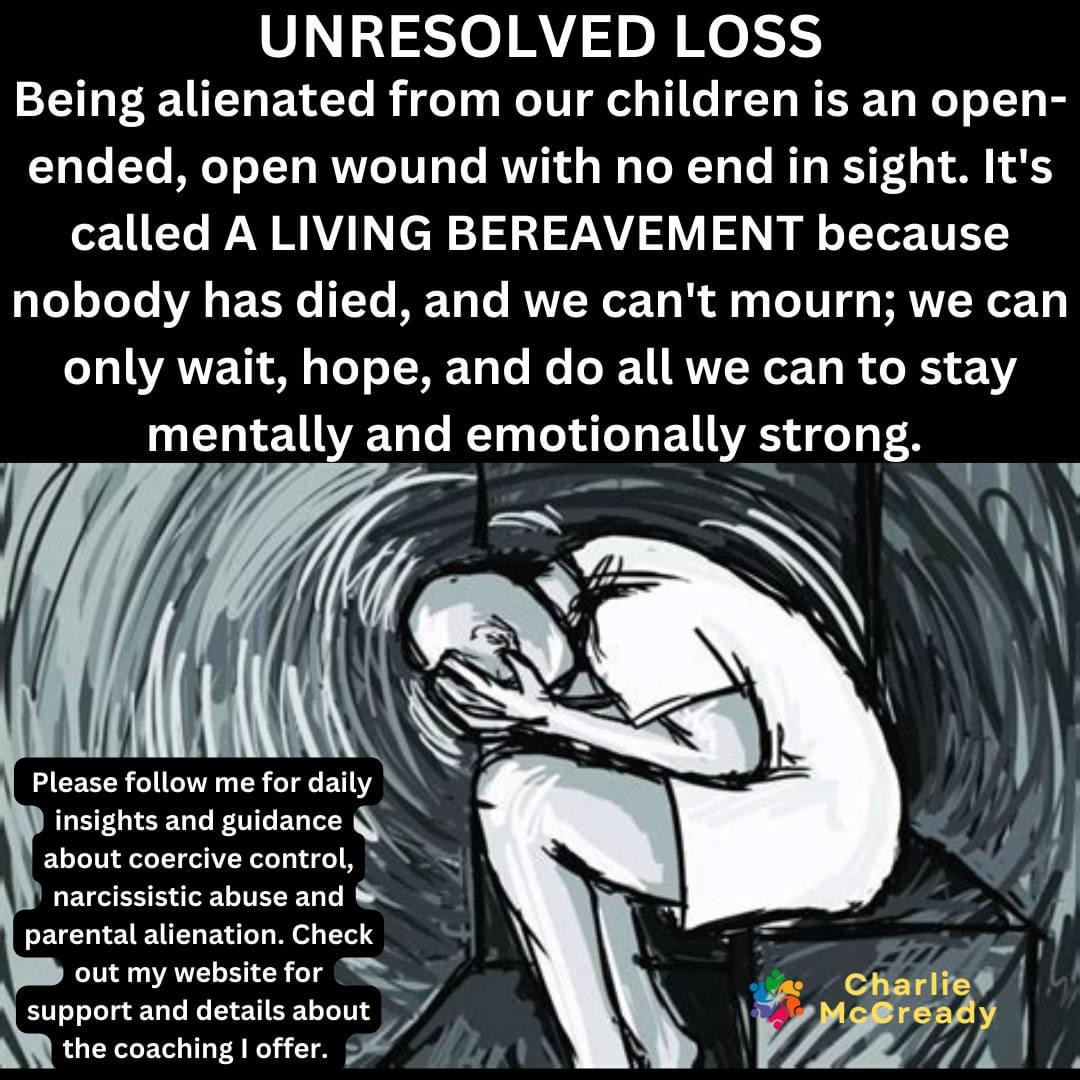
Our child is alive, but the other parent has severed, damaged, and wilfully blocked the emotional bond and connection that once existed. This loss is unjustified, ongoing and unresolved, leading to intense grief and mourning. It is isolating, too, especially as so many deny, minimise or misunderstand what we’re going through.
The unresolved loss stems from our longing for our previous relationship with our child, shared experiences, and love. I cannot tell you how many people say, ‘We used to be so close’ or ‘I did all I could to keep them close to their other parent’, and I have been in this situation myself. This unresolved loss also involves the dimming of hopes, dreams, and expectations of a nurturing and loving parent-child relationship. We grieve the loss of daily interactions, milestones, and the ability to be a meaningful presence in our child’s life.
Like bereavement, the grieving process for rejected and alienated parents may involve a range of emotions, such as sadness, anger, guilt, and confusion. However, unlike traditional bereavement, where closure can be reached through acceptance and adjustment to the loss, the unresolved loss experienced by alienated parents can persist indefinitely as we continue to hope for reconciliation and the restoration of our relationship with our child.
Acknowledging and addressing this unresolved loss is crucial for healing and finding some sense of peace. Finding a way to stay strong and find joy in our lives is so important too.
#charliemccready
#parentalalienationcoach
Alienated child & rejection
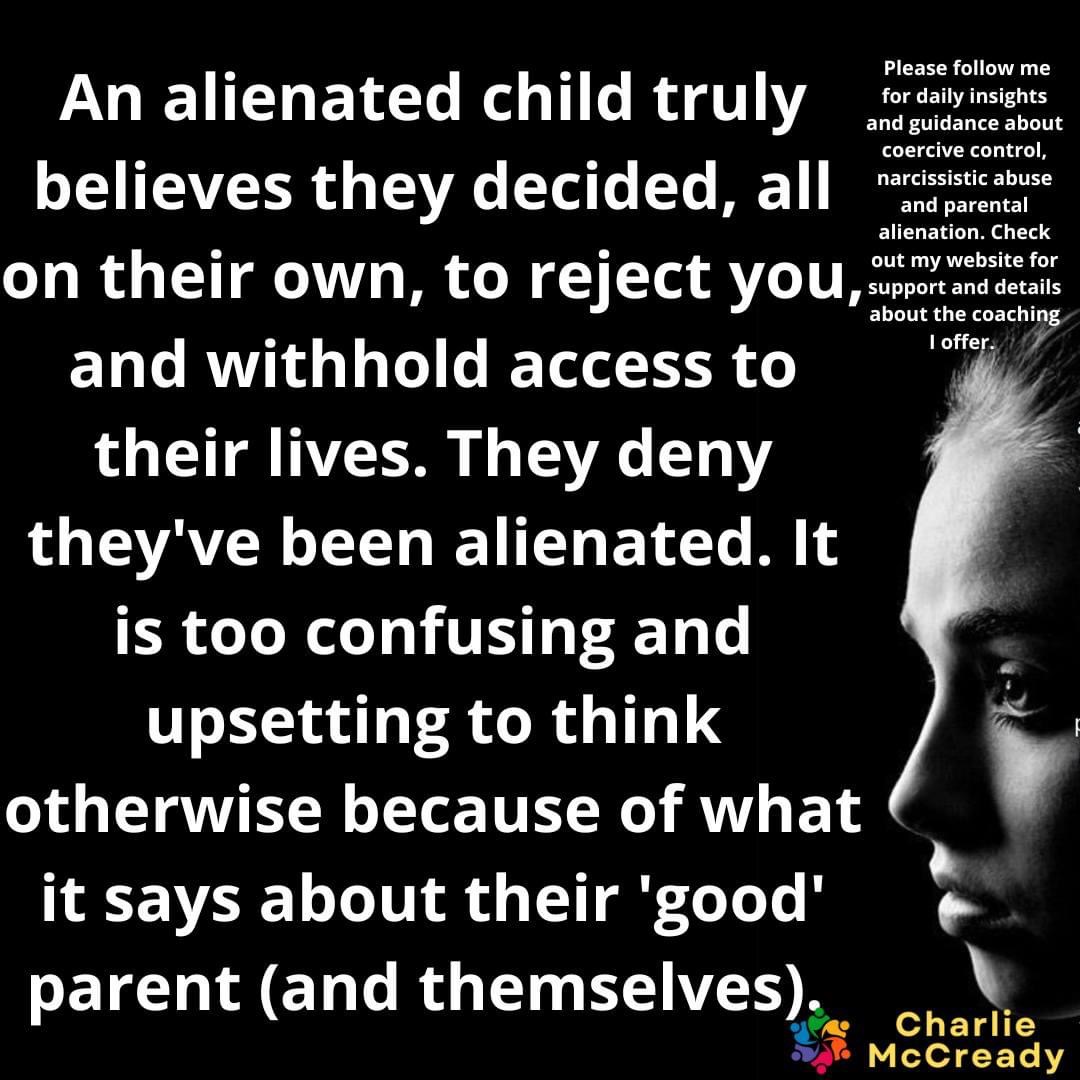
An alienated child feels autonomous because their aligned parent’s psychological tactics are often subtle. The alienating parent may use ‘leading questions’ such as ‘Are you sure you want to be with them for such a long time away from home?’ They can use passive-aggressive language such as, ‘It’s a shame they make you feel so angry when they behave as they do, and you’re so good about it.’ It can seem caring and concerned rather than coercive and controlling. The child also develops a strong sense of loyalty and alignment with the alienating parent due to the fear of losing their love, approval, or the stability of the family unit. They can become ‘trauma bonded’ in an emotionally abusive relationship, often due to intermittent reinforcement, manipulation and a cycle of reward and punishment. They may feel autonomous because they’ve internalised the beliefs and narratives of the alienating parent. Often they justify their actions and maintain a positive self-image by convincing themselves that their rejection of the targeted parent is valid. Accepting the reality that the alienating parent acted out of selfish motives and not in the child’s best interests can be extremely distressing and conflicting. It may require them to confront the fact that they were manipulated and used as a pawn in the alienating parent’s agenda. This can be psychologically overwhelming. They can feel incredibly betrayed, sad, guilty, and ashamed, but they can overcome this. They can break free and truly become autonomous when they accept that they were not previously. It is hard to accept, but the key to their liberation and healing.
#charliemccready
#parentalalienationcoach
#parentalalienation
#alienatedparent
#alienatedchild
#childcustody
#FamilyCourt
Narcissist & Parental Alienators : facts
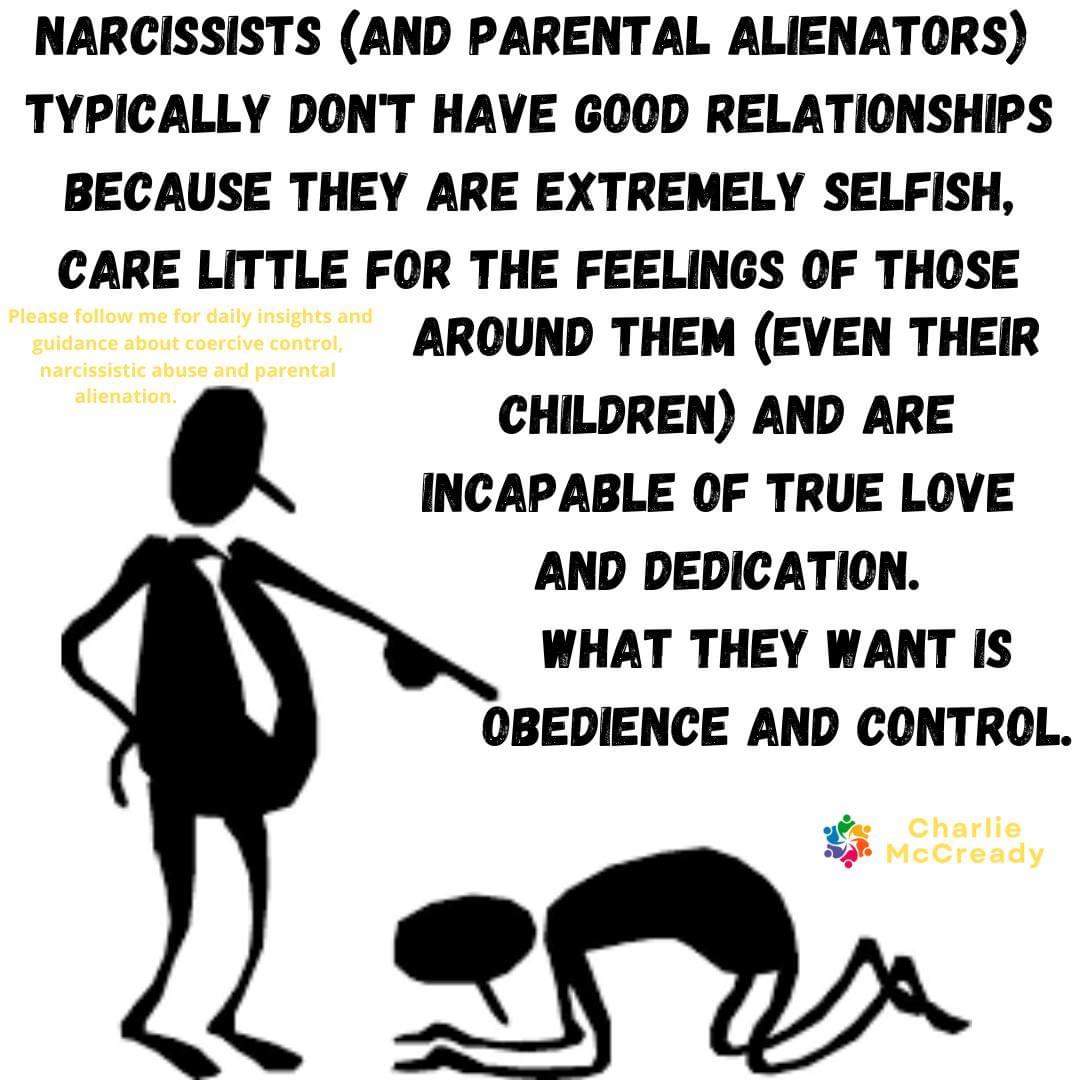
Narcissistic alienating parents are characterised by a self-centred, manipulative, and exploitative nature. They prioritise their own needs, desires, and self-image above the well-being of others, including their children. Here are some key points:
Lack of empathy: Narcissistic individuals often struggle with empathy, which is the ability to understand and share the feelings of others. They have difficulty recognising and validating the emotional experiences of their children or anyone else in their lives. Their focus is primarily on themselves and their own needs.
Manipulative and controlling behaviour: Narcissistic parents tend to manipulate and control those around them to maintain a sense of power and superiority. They may use tactics such as gaslighting, guilt-tripping, emotional manipulation, and coercive control to assert dominance and maintain control over their children.
Exploitation of relationships: They view relationships as opportunities for personal gain rather than genuine connections based on mutual care and support. They may exploit their partner’s and their children’s love and loyalty to serve their own agenda, using them as extensions of themselves rather than recognising their autonomy and individual needs. This also goes for other family members and work associates, in fact, anyone in their lives.
Lack of genuine love and care: Narcissistic individuals struggle to experience and express genuine love and care for others. Their primary focus is obtaining admiration, attention, and validation. As a result, their relationships, including those with their children, lack the depth, emotional connection, and authentic care that healthy relationships require.
Superficial charm and manipulation: They often appear charming, charismatic, and even loving in the early stages of a relationship. However, their behaviour tends to be manipulative, self-serving, and inconsistent over time. Their actions are primarily driven by a need for control, admiration, and validation rather than genuine care and concern.
They lose interest when someone no longer ‘serves’ them. When someone calls out their behaviour, they’ll go on the attack to protect their interests/lies. It’s important to recognise that not all alienating parents are narcissistic, and not all narcissistic parents engage in parental alienation. But when these two dynamics intersect, the results can harm and damage the child’s well-being and the parent-child relationship.
#charliemccready
#parentalalienationcoach
#parentalalienation
#narcissisticparent
#FamilyCourt
#custody
#childcustody
#FathersMatter
#mothersmatter
Can children of CPA develop phobias about their targeted parent ?
Yes 🙌
Connection & Support – Charlie McCready
We’re a community of people who have the most unfortunate shared experience. There can’t be many experiences worse than having our loved, loving children turned against us and coerced into rejecting us by a vengeful ex. Parental alienation is often called a living bereavement for good reason. I post daily to spread awareness, inform and uplift. But your comments are integral and so valued. Thank you for contributing when you feel moved to do so. Sharing your opinions and experiences helps others. We have a connection and a common struggle. We can gain insights from each other. When we’ve received kindness and support from others, we know what a difference it makes. Personal suffering can lead to personal growth, resilience and a heightened sense of love and compassion. Connection and support is a wonderful thing. Thanks for being here.
#charliemccready
#parentalalienationcoach
#alienatedparent
#parentalalienation
#selfcare
#FamilyCourt
#custody

Narcissist persecutory delusions – Charlie McCarthy
When a parent with a dark, narcissistic personality falls into persecutory delusions, they try to rewrite reality. Their fear of being seen as unworthy drives them to alienate the child from you. They lie, manipulate, and seek control—not out of love, but out of deep-seated insecurity and fear that your child might see you as the better parent.
But remember, love is stronger than lies. One day, your child will begin to see through the false narratives. When that time comes, they will need a safe, loving space to turn to—a parent who is calm, mentally strong, and emotionally healthy. Be that parent. Show them that true love is unwavering and unconditional.
Stay resilient. Stay grounded. Continue to be the parent your child can rely on, even when it’s difficult. Do this for yourself, and most importantly, do this for your child.
#charliemccready
#parentalalienationcoach
#parentalalienation
#FamilyCourt
#narcissisticparent
#childcustody
Craig Childress PsyD ParentChild Contact Problems
If a psychologist uses the terms – “parental alienation” – “resist-refuse dynamic” – “Parent-Child Contact Problems” – they are ignorant – they lack knowledge or information.
Google ignorant: lack of knowledge or information
The reason they have to use made-up pathology labels is because they are ignorant about real things – they are awful psychologists – ignorant like a rock.
It’s the trans-generational transmission of trauma. It’s child psychological abuse (DSM-5 V995.51). It’s attachment pathology, a problem in love-and-bonding. It’s spousal abuse using the child as the weapon (DSM-5 V995.82). It’s a cross-generational coalition and emotional cutoff (Minuchin, Bowen, Haley, Madanes; family systems). It’s a shared (induced) persecutory delusion (DSM-5 297.1). It’s a false (factitious) attachment pathology imposed on the child for secondary gain to the allied parent (FDIA: DSM-5 300.19).
There’s a lot of things it is – real things – diagnosable and treatable things.
Unless… you don’t know what those things are. If you lack knowledge and information about real things, you have to hide your ignorance behind things you simply make-up – like “parental alienation” – “resist-refuse dynamic” – “Parent-Child Conflict Problems.”
Here’s a tip… if a pathology exists ONLY in the family courts, it’s not a real pathology. Use the DSM-5 to identify (diagnose) pathology. Start there.
DSM-5 297.1 Delusional Disorder (shared); persecutory type.
DSM-5 300.19 Factitious Disorder Imposed on Another
DSM-5 V995.51 Child Psychological Abuse
DSM-5 V995.82 Spouse or Partner Abuse, Psychological
Start with applying the established knowledge of the DSM-5 diagnostic system to identify (diagnose) what the problem (pathology) is.
If you still need new forms of pathology to explain what the pathology is – then – and only then – propose your new “resist-refuse dynamic” as a new pathology unique in all of mental health.
After applying the DSM-5. Not before. Not instead of. After applying established knowledge. Start with the DSM-5.
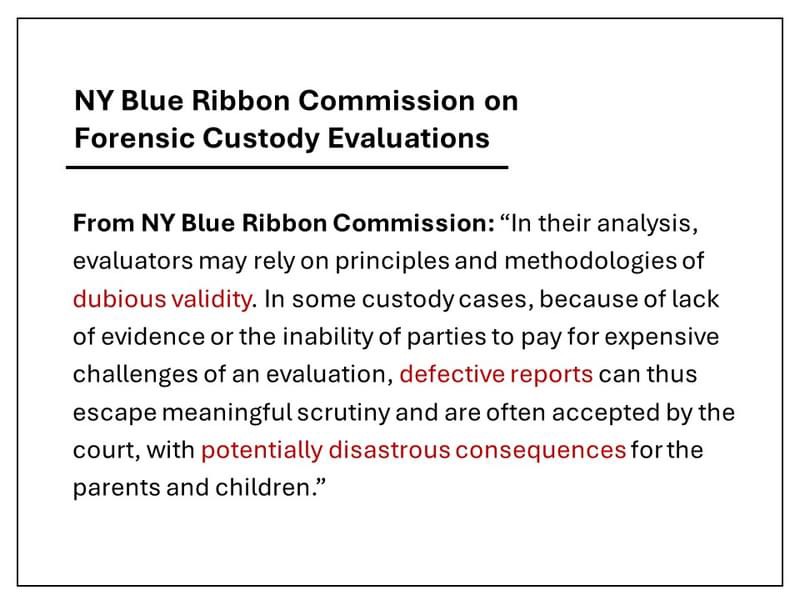
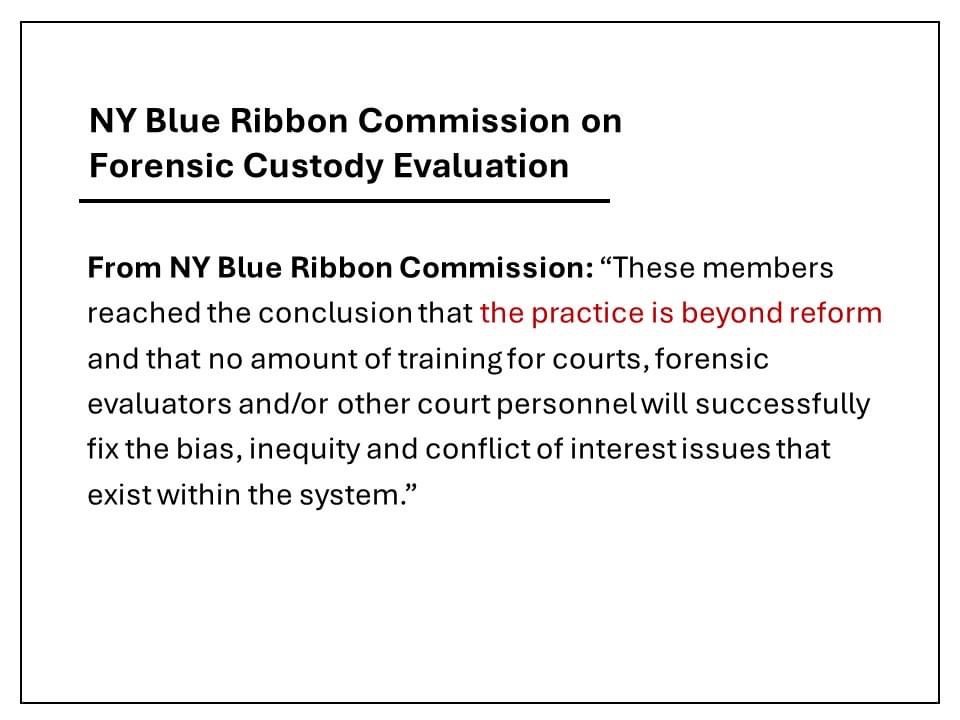
We need standards – forensic custody evaluators are the worst psychologists imaginable – ignorant like a rock.
It’s a “tell” on professional ignorance. If the professional has to use made-up pathology labels… they lack knowledge or information… they are ignorant by definition of the English language.
If you, the patient, have to explain the pathology to the doctor, the doctor lacks knowledge or information… they are ignorant by definition of the English language.
How did you wind up with so many ignorant and incompetent doctors in the family courts? Just lucky?
Luck had nothing to do with it. They were allowed to experiment on you and your children with a new assessment approach they call a “forensic custody evaluation” – it was a complete failure.
Their experiment failed. They left the practice of healthcare to enter a quasi-judicial role. That was a wrong thing for doctors to do.
The gave themselves permission to make up an entirely new type of assessment – not a diagnostic assessment as is done in all the rest of healthcare – the forensic psychologists decided to do something… different.
Clinical psychologists identify (diagnose) what the problem is and then they fix the problem (treatment).
Forensic custody evaluators do something different. They DON’T identify (diagnose) what the problem is and they DON’T fix it (treatment).
That is different – NOT to identify the problem and NOT to fix the problem IS different than what other doctors do, that’s for sure. It’s also entirely worthless.
Clinical psychologists diagnose child abuse when it is present, and clinical psychologists protect the child.
Forensic custody evaluators do something different. They DON’T diagnose child abuse when it is present (they don’t diagnose anything) and they DON’T protect the child from child abuse.
That too, is different – and dangerous to children.
They experimented on you and your children with a new approach to assessment and service delivery… for you alone. Their experiment failed – miserably failed – completely failed.
As a result of their failed experiment, the lives of thousands and thousands of children and parents were irrevocably destroyed.
While the forensic custody evaluations made money – lots of money – from their failed experiment on you and your children.
Did they tell you it was an experimental approach? Did they tell you that you had an alternative, a clinical diagnostic assessment of the problem? Or did they ONLY offer you ONE choice, their experimental approach to assessment that they simply made-up?
The forensic custody evaluators withheld clinical diagnostic assessments from the courts and parents – giving courts and parents ONLY one choice – their experimental approach to assessment… that they simply made-up.
It failed.
Lives – children’s lives – were irrevocably destroyed as a result.
Why were they allowed to experiment on children and parents?
Why are they allowed to continue?
They are ignorant, incompetent, and unethical. They are the worst psychologists imaginable… and they are all you have. How did you get so lucky?
Why are you the only parents for any pathology who must educate your doctors about what the pathology is?
Craig Childress, Psy.D.
Clinical Psychologists, CA PSY 18857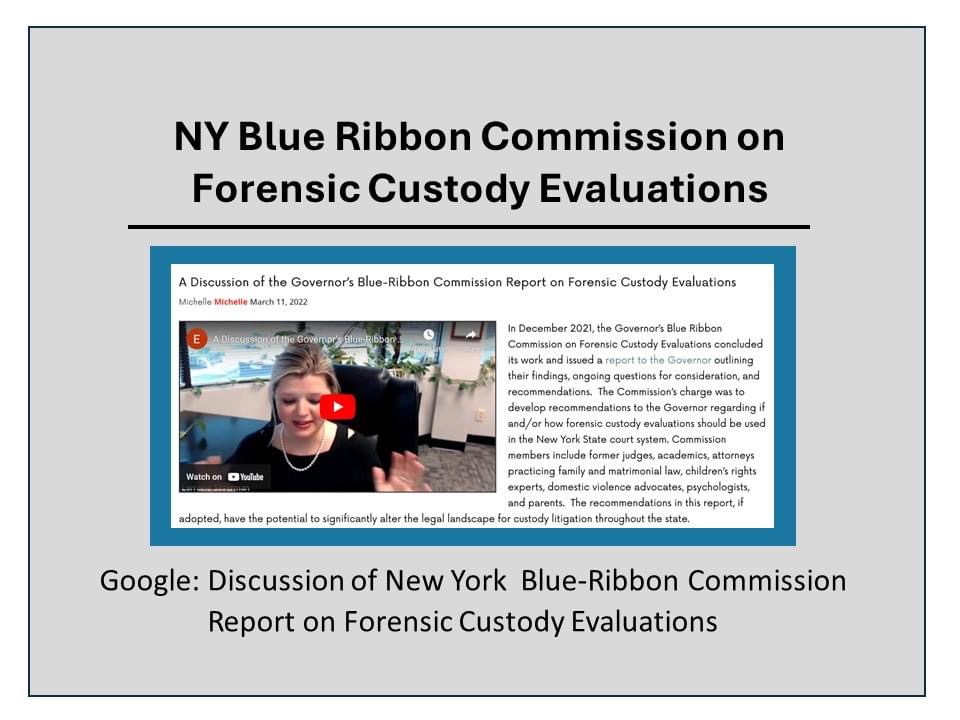


Craig Childress PsyD – Do over
I’m too anxious to get any work done, and I’m too anxious because of all the work I’m doing. So I can’t do the work I’m doing. That’s annoying.
I get excited as the information coalesces, too excited. I have to get up and do something and I start to wander around… thinking and wandering aimlessly to release the energy of anxiety excitement.
I don’t know which it is – it’s just restless from the ideas, I gotta get up but when I get up I’m not getting anything done.
So I’ll talk to you to release the energy at the same time I’m sitting… so maybe I can get back to work.
I know what I want to talk about this Sunday over Coffee – the Conflict of Interest. Oh, and the under-line that’s emerging from that. We are headed for a point of collision between a thought disorder and reality.
This should be interesting. The pathogen hides – and – it seeks allies. The trick is to expose the pathogen in the allies
Exposing the pathogen in the parent is easy – its exposing the pathogen’s allies that’s the tricky part. We’re there now.
I wanna talk about that. In fact, I want to release and have some fun. I don’t need to be “productive” all the time now, I can indulge myself now.
And I’m going to, I’m going to allow myself some throw-off Sunday Coffees just for me.
I’ve hired an intern from UW who’s getting course credit for helping me out – and money – a paid internship, she lucked out.
She’s produced a list of all my YouTube “titles” – with her next instructions to retrieve the transcripts from the ones I select. Then we’re going to reverse-engineer them into books and booklets of various sorts.
I should say more about secret decoder rings stuff – the red pill of understanding. I should start ‘writing’ an audio-visual book about The Pathogen’s Source Code.
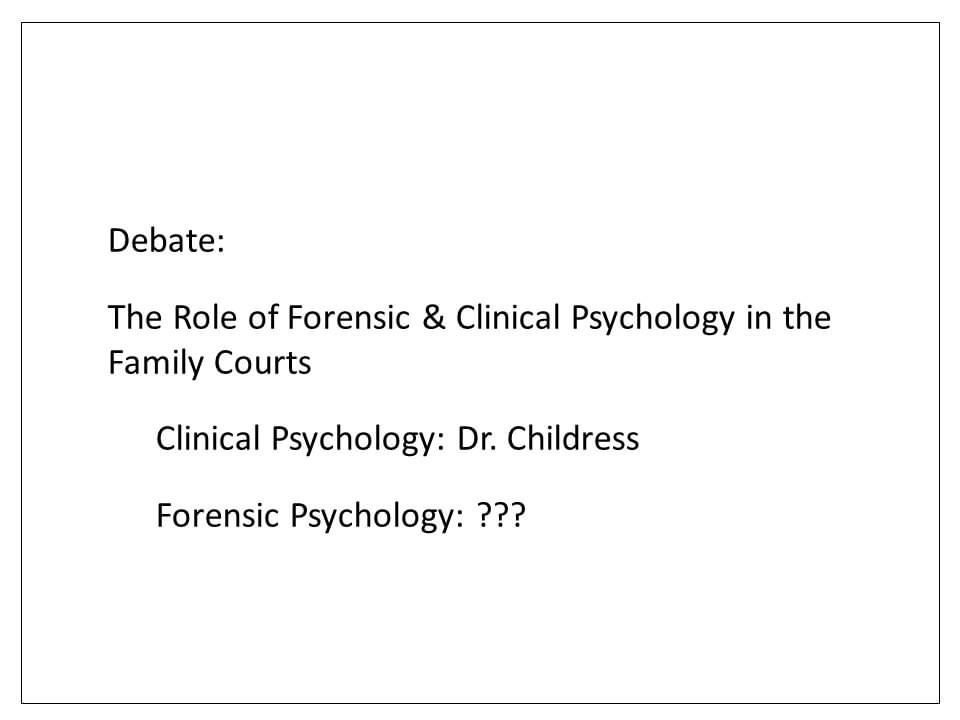
Debate. That will be one of the lines I’ll be developing: The Role of Forensic & Clinical Psychology in the Family Courts. I’ll represent for Clinical Psychology… now all we need is someone to represent for Forensic Psychology.
Dr. Saini? He’s President of the AFCC. How about him?
Or Dr. Pickar, he’s on the Board of Directors for the AFCC and he’s on the Editorial Board for their journal, the Family Court Review, how about him?
Or how about either Dr. Simon or Dr. Stahl, either one, they literally wrote the book (two Editions) on how to conduct a forensic custody evaluation, how about one of them to represent for Forensic Psychology’s role in the family courts?
How about Dr. Deutsch or Dr. Sullivan, they’re both prominent long-time forensic custody evaluators?
That’s six options. You should be able to find ONE of those forensic psychologists who is willing to defend what they do – hosted by the AFCC.
You know I’m a member now, right? I wasn’t a member before for… well… reasons. I didn’t want to trigger things too early. I want to trigger them now.
They’ve wanted to avoid me… which suited me just fine. The lion is a stalking hunter. When you see the lion, the hunt is already over. Howdy, I’m Dr. Childress, pleased to meet you.
I’ve got some things to do first. I need to get back to work.
This Sunday I’m going to indulge myself in reflective insights, it’s the Mirror after all. We have reached the Conflict of Interest stage, that’s the final one before the fall.
Forensic custody evaluations are ending. That… is simply a fact. Clinical diagnostic assessments are coming. That too is a fact.
When the forensic custody evaluations go away – and they will – all, all, all, of the forensic custody evaluators go with them because that’s all they know how to do.
It’s an evolutionary thing of specialized niches – they can be productive until… something changes, then they completely collapse because they’re too specialized to their niche.
Demand for forensic custody evaluations will disappear – and – they will face increasing scrutiny which will expose that which is hidden. Oh my, what’s hidden is a nightmare of bad.
Are you ready for a nightmare of bad before Christmas? Okay, I can do that if you want. Or how about sometime in 2025? Debate: The Role of Forensic & Clinical Psychology in the Family Courts hosted by the AFCC.
I’ll represent for Clinical Psychology, and Saini, Pickar, Stahl, Simon, Deutsch, Sullivan, or someone else can represent for Forensic Psychology.
I think a Debate on that topic would be great, don’t you? So… let’s do that. Saini’s President of the AFCC and Pickar’s on the Board of Directors, if they want the AFCC to sponsor a Debate – it’s sponsored.
Look, if I’m wrong, they get to humiliate me with their superior knowledge and understanding – and – if I’m right, I get to humiliate then with their ignorance and failure. It should be fun.
A 90-minute online moderated Debate – they can go first – they can describe the Role of Forensic Psychology in the family courts for ten minutes, then I can do the same for the Role of Clinical Psychology in the family courts – that’s the opening 20 minutes.
Then the moderator goes through a set of predetermined topic areas giving each side ten minutes to present on that topic from their point of view:
Opening Statement – Forensic – Clinical
Determining Best Interests of the Child – Forensic – Clincal
Risk Assessments & Duty to Protect – Forensic – Clinical
Ethical Standards 2.01 & 2.04 – Forensic – Clinical
That’s 80 minutes, now each side gets a 5 minute Closing Statement and we have a 90-minute Debate: The Role of Forensic and Clinical Psychology in the Family Courts.
Then a 30-minute moderated Q&A with submitted questions from the audience presented by the moderator.
Online so everyone can see and know the issues involved. I think that’s a good idea, don’t you?
I do. Let’s do that. I’m in.
Craig Childress, Psy.D.
Clinical Psychologist, CA PSY 18857
Trauma Bonds – Charlie McCready
How can the child still suffer from trauma bonds and loyalties towards the abusive alienating parent even when the truth about their behaviour comes to light? How can the child come over to see me but not take off their coat as if they won’t settle in or stay long? How can we have plans for them to spend the first Christmas with me in a decade, but then, at the last minute, they cancel because they say nobody should be alone at Christmas and they need to be with their other parent forgetting or ignoring the fact I’ve spent many Christmases without them? Why don’t they tell me about important events in their life? Is it a habit to keep me at a ‘safe’ distance after all these years? Why do they mostly call when they want a favour? Why do they still believe I abandoned them? These have been some of my questions.
Reconciliation between an alienated child and a rejected parent can be a complex and challenging process, and it is not uncommon for the effects of parental alienation to persist even after the truth comes to light. The alienating parent employed various emotional manipulation tactics to create trauma bonds with the child and instil fear, guilt, or loyalty. Breaking these bonds can be difficult, as the child may have internalised these messages and developed a distorted perception of the rejected parent. The child may have experienced emotional abuse, coercion, or threats from the alienating parent, leading to deep-seated fear and trust issues. Rebuilding trust and feeling safe with the rejected parent can take time and require ongoing support. The child may struggle with conflicting emotions and beliefs. They may have been taught to see the rejected parent as the enemy or as someone unworthy of love, and reconciling this narrative with the new information can be psychologically challenging. The child may feel strongly loyal to the alienating parent, even if they were abusive or manipulative. This loyalty can stem from a fear of abandonment, a desire for approval, or a need to protect the alienating parent’s feelings.
Healing takes time. The child – or young adult – needs to process their emotions, develop healthy coping mechanisms, and rebuild their relationship with the rejected parent. What’s vital is that you do your healing first so you can welcome them with open arms, having let go of your anger and grief, and just give them love.
#charliemccready
#parentalalienationcoach
#alienatedparent
#ParentalAlienationSyndrome
#parentalalienation
#custodybattle
#childcustody
#mothersmatter
#FathersMatter
#FamilyCourt
 GreatCosmicMothersUnite